

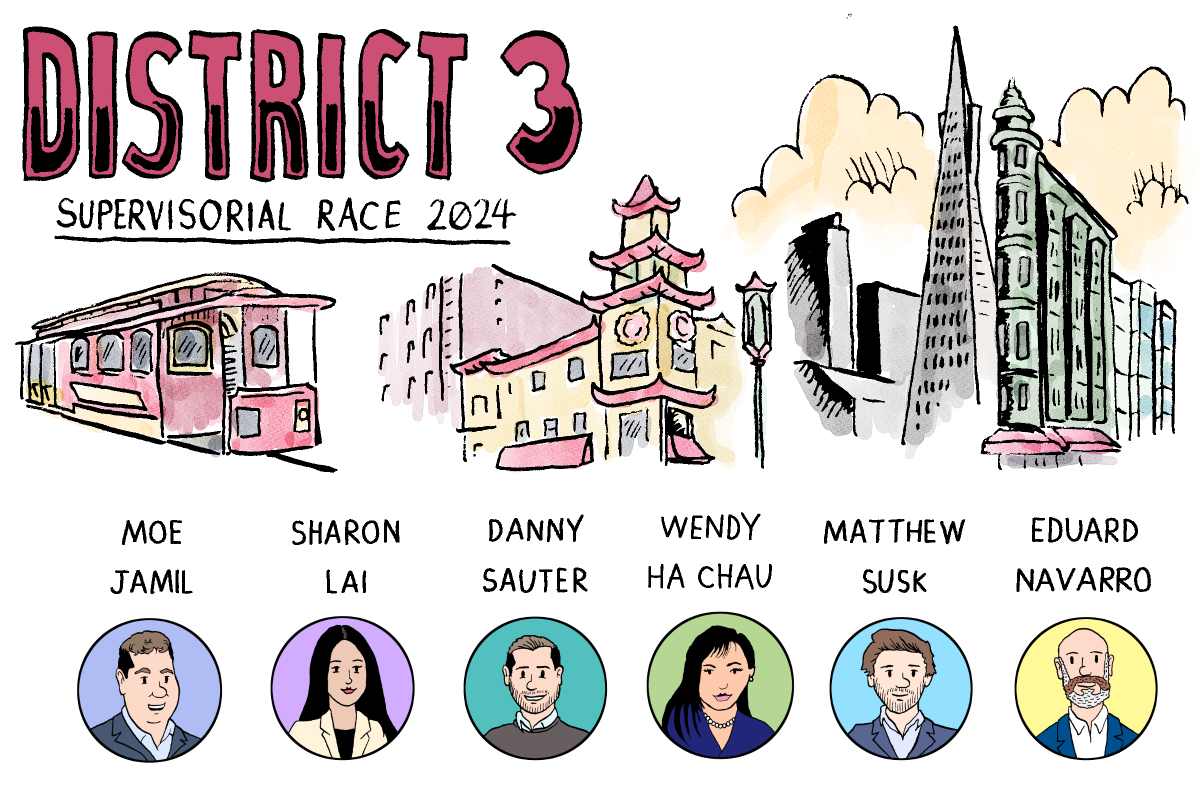

In our “Meet the Candidates” series, we are asking every supervisorial hopeful in the November 2024 election one question each week. Candidates are asked to answer questions on policy, ideology, and more in 100 words or less.
Answers are being published individually each week, but we are also archiving each answer on separate pages for each district, to make it easier for voters to browse. Click the questions below to see all the District 3 candidates’ responses.
Week 35: Do you support the list of potential school closures/mergers?

Danny Sauter
- Job: Executive Director, Neighborhood Centers Together
- Age: 36
- Residency: Tenant in District 3 since 2014
- Transportation: Public transportation
- Education: Bachelor’s degree from Miami University
- Languages: English, Cantonese
Of the 13 impacted schools, 4 are in District 3. This process has unfairly targeted District 3 and has caused families to further lose trust in the school system. It must be reconsidered.
I do not support the preliminary list. I am deeply concerned by the process and how it has been fraught with delays, errors, and poor communication. In the past week, I have continually met with parents and am committed to being a partner to make sure these decisions are reconsidered. I stand with parents in demanding better for Yick Wo, Spring Valley, Jean Parker, and Redding.
Endorsed by: San Francisco Democratic Party, California Democratic Renters Council, Sierra Club, Alice B. Toklas LGBTQ Democratic Club … read more here

Matthew Susk
- Job: Former lead with Divvy Homes
- Age: 32
- Residency: TIC owner, first moved to District 3 in 2007. 2007-2009 while in high school, 2014-2016 after college, 2023-present with his wife.
- Transportation: Walking
- Education: Bachelor’s degree from St. Lawrence University, master’s in business from Georgetown University
- Languages: English
I strongly oppose the suggested school closings. With a daughter on the way, this is deeply personal to me.
We need true transparency and accountability—why are some of District 3’s highest-achieving schools impacted? These closures will disrupt communities and take away the quality education our kids deserve.
Clear communication is essential to ensure closures actually benefit students and lead to real improvements. World-class public schools are vital to our city’s success, and supporting them must always be a top priority.

Wendy Ha Chau
- Job: Attorney
- Age: 44
- Residency: Tenant in District 3 since 2009
- Transportation: Walking
- Education: J.D. from John F. Kennedy University
- Languages: English
Before I answer the question, I believe the public must be informed on why the schools are closing.
Schools are closing because enrollment is down. Families are moving out of San Francisco and the people staying in SF are not having enough children to fill the vacancies.
Why are families moving out? Why aren’t San Franciscans having more children? Answer: It is way too expensive to raise a family in San Francisco, and the homeless situation is out of control.
My child goes to 95% Asian enrolled public school and it’s a great school but my child has to see … read more here

Moe Jamil
- Job: Deputy city attorney, San Francisco City Attorney’s Office
- Age: 46
- Residency: Owner-occupied condo owner, living in District 3 since May 2014
- Transportation: Walking
- Education: University of California, Berkeley, and law school at Santa Clara University, K-12 public school
- Languages: English, Cantonese
I oppose simultaneously closing Yick Wo, Spring Valley and Jean Parker all located within close proximity to each other. These closures disproportionately harm the Chinese American community and will result in more families moving out of D3. Any decisions regarding closures should be deferred until the new school board is in place next year and a better plan can be formulated that is geographically equitable and that will not displace families.
Endorsed by: San Francisco Tenants Union, San Francisco police Officers Association, San Francisco Building and Construction Trades Council, Board President Aaron Peskin … read more here

Sharon Lai
- Job: Economic recovery leader at the World Economic Forum, former board member at the San Francisco Municipal Transportation Agency
- Age: 41
- Residency: Tenant and owner, living in District 3 since 2023, first moved to SF in 2005
- Transportation: Walk and Muni when solo, drive when with kids
- Education: Bachelor’s degree from University of California, Berkeley, development studies and city and regional planning; master’s degree in public administration, Harvard Kennedy School
- Languages: English, Mandarin, Cantonese
No. The Superintendent’s management, approach to balancing the budget, and nontransparent flawed process in establishing the potential closure list has left our community feeling shutout of the process and unable to trust the evaluation.
The list disproportionately impacts District 3 and the city’s AAPI population. Families from these backgrounds already face numerous challenges, and this threat of school closures adds an additional unfair burden.
As a mother of two school-aged children, and a family rights advocate having fought against the likes of big tobacco, I stand with families to demand a fairer, more open process that centers on students.
Endorsed by: Community Tenants Association, Teamsters Joint Council 7, 7 of the current Board of Supervisors … read more here

Eduard Navarro
- Job: Tech startup founder
- Age: 44
- Residency: Tenant in District 3 since December 2021
- Transportation: Walking, public transportation
- Education: CFA Institute: Chartered Financial Analyst, passed level 1. Master’s degree from Columbia University, architecture, concentration in urban design. Master’s degree from Columbia University, real estate development, concentrating in finance. Ecole d’Architecture de La Villette. Bachelor’s degree in architecture from Georgia Institute of Technology.
- Languages: Spanish, French, German, English, Valèncian (Catalan)
I do not support the closure of any school. Schools are vital to the fabric of our communities, and even the mention of closing them is already having long-term negative effects.
Instead of shutting schools down, we should explore more innovative ways to utilize our real estate and improve education delivery.
My experience with the small schools movement shows that there are creative alternatives to closures, and I believe SFUSD can and must do better.
We are San Francisco! We should be focused on making our school system the best in the country and the world, not reducing its capacity.
Week 34: Do you support Prop. 33?
Eduard Navarro
No. Prop. 33 sends the wrong signal right now for California and San Francisco. While the repeal of Costa-Hawkins is idealized as a solution to ensure affordability and greater tenant rights, rent control has very real pitfalls and can’t be a stand-alone fix. If we want true affordability, we need a holistic approach: streamline permitting, attract development and investment, establish urban design frameworks that preserve and beautify our built environment, create paths to homeownership, review property taxes to keep homes affordable, and ensure California is open for business. This comprehensive strategy will keep the California dream alive and make housing … read more here
Danny Sauter
As a 10+ year renter in District 3, I know how important protecting our existing rent control is. I also know that we need to build more new homes and reduce the burdensome permitting and financing that stands in the way.
Unfortunately Prop 33 does nothing to make it easier to build new affordable homes, and most economists agree it would in fact freeze new construction across California. I do not support Prop 33 because I believe we should expand rent control in combination with making it easier to build new homes, something this flawed ballot measure fails to do.
Matthew Susk
I oppose Prop 33 because it will worsen San Francisco’s housing crisis, reduce public safety, and hurt our public schools.
Prop 33 will reduce the availability of rental housing, drive up housing costs for everyone, and reduce property tax revenue for the City (by far our largest source of tax revenue). This means budget cuts for essential services like schools and public safety.
We need balanced solutions that protect renters and increase housing supply – not policies that make housing more expensive, hurt our schools and reduce public safety.
Wendy Ha Chau
I am against Prop 33.
Rent will be lowered if I become elected if we follow my plan I already addressed here at https://missionlocal.org/2024/09/meet-the-district-3-candidates-do-you-support-these-4-sansome-st-towers/
Moe Jamil
Yes on Prop 33. One size does not fit all. Cities should once again have the right to decide on their own, free from state interference, what if any types of rent stabilization programs best fit their needs.
Sharon Lai
I support local jurisdictions having the ability to determine the appropriate rent control regulation for their own communities.
Keeping existing tenants housed is a priority for San Francisco as we work towards expanding housing and housing security at all income levels. Rent control is one of the best tools we have to ensure that San Franciscans can stay in San Francisco.
As Supervisor, I intend to ensure that our housing policies are based on evidence to keep as many people housed as possible, while weighing impacts on housing development and housing market stability as a whole.
Week 33: What are your thoughts on the SFUSD ‘Resource Alignment Initiative’? (school closures)
Sharon Lai
SFUSD needs to balance their budget, but we cannot move forward without more clarity on how this process will impact and serve our students.
Unfortunately, the information is being delayed. Families need and deserve transparency and predictability ASAP. As a parent myself, I know how important it is to plan for change in our kids’ education. School closures can disrupt our students, impact logistics for families, cause blight in our neighborhoods, and result in additional financial impacts.
As Supervisor, I will fight to ensure any resource alignment does not negatively impact our communities, particularly for immigrants and historically underserved.
Eduard Navarro
I am firmly against closing schools in San Francisco. Schools are cornerstones of our communities, and we should instead leverage creativity in managing the real estate portfolio and rethink how we deliver education. We must aim higher—not just to keep schools open but to make SFUSD the best in the country. I attended ENDC’s “SFUSD Forum Accountability in Education” in March and saw firsthand the distress in the Bayview community and the weak responses from SFUSD leadership. My work on school design at Columbia University, focusing on the small schools movement, showed me that there are better ways forward.
Danny Sauter
I am watching the SFUSD’s actions and announcements closely. I was disappointed to see the recent delays which have thrown parents into more confusion as they seek to make plans for next year’s school year with uncertainty around if their preferred schools will be open.
SFUSD must regain trust by focusing on student outcomes, reducing costs, and increasing enrollment. Though a distinct body, I’m ready to do everything possible as the next District 3 Supervisor to make sure that our amazing schools, from Yick Wo to Garfield and Spring Valley to Gordon J. Lau, better serve our District 3 families.
Matthew Susk
By focusing on redirecting resources to classrooms and reducing administrative bloat, we can ensure that education remains a priority.
Investing in our public schools supports student success, strengthens the future workforce, and makes the city more attractive to families. My first daughter is arriving later this year, I’m deeply committed to creating a future where families can thrive in San Francisco.
I want to make San Francisco a destination for families, where strong schools and vibrant communities create a welcoming environment. We can build a thriving, resilient city for families to live, grow, and succeed.
Wendy Ha Chau
It should be held off until 6 months after the election. With many new BOS members coming in next year, it might be premature to act before policies and budgets have been implemented.
If I am elected, my plans will greatly increase the number of students attending SFUSD (especially when you consider the possibility of all SF employees paying on average $1K a month on rent. Making SF a perfect place to start and raise a family).
Moe Jamil
As Supervisor, I will amplify the voices of parents to preserve and protect the schools in our neighborhoods and the education of our children. Supporting our children’s education means advocating for STEM programming, language immersion courses, access to special education and support programs for newcomers. I will be a champion for before and after school programs and look forward to partnering with the YMCA, CYC, Tel-Hi, and Salesians, all who have been important community partners, to continue to support our working families.
Week 32: Do you support these 4 Sansome St. towers? 530, 875, 955, 1088 Sansome St.
Moe Jamil
I oppose these out-of-scale luxury towers on our beautiful waterfront. As a neighborhood leader, I supported hundreds of units of new sensible housing along Polk Street and Van Ness Avenue. As Supervisor, I will give great weight to the voices of long established neighborhood, community and merchant organizations in shaping my views on individual projects. We should welcome new housing, office, and hotel development downtown with appropriate community benefits and commitments to pay prevailing wages to a skilled and trained workforce.
Sharon Lai
As a trained professional urban planner, I believe that local zoning is the right level of government to manage growth. The three (955, 1088, and 875) Sansome towers are out of scale with the surrounding neighborhood and are effectively spot upzoning that does not adequately consider impacts.
I support the project at 530 Sansome, which is exactly where this type of height and density belong and are planned for. The proposed height is still much shorter than the adjacent Transamerica pyramid. Also worth noting that the project’s impact fees are planned to fund a 100% affordable senior housing project.
Eduard Navarro
No, I do not support 955, 1088, and 875, but I do support development and developers, and a yes with comments on 530.
The process is broken and pits San Franciscans against each other. The density bonus strips SF of home rule, and the city’s reliance on capricious zoning fails to design spaces for light, air, and beauty. Conditional-use permit appeals and CEQA lawsuits create a toxic environment for investment, unfairly impacting small local developers.
If today’s rules existed when our city was built, we wouldn’t get to build the San Francisco we know and love. There’s a better way … read more here
Danny Sauter
District 3’s Northern Waterfront needs more housing and activity to be a more complete neighborhood. We can achieve this by turning parking lots and empty buildings into new homes, and I believe we can find a way to do so by embracing mid-rise density that already works across our district.
I support the hotel and office space at 530 Sansome which is distinctly downtown while I believe the other projects should better fit their context in height and form. As Supervisor, I’ll work to make mid-rise density projects the most attractive option to quickly turn empty buildings into new homes.
Matthew Susk
As the next D3 Supervisor, I will bring builders and neighbors together for projects like 955 Sansome, 1088 Sansome, and 875 Sansome. We must find a sensible path forward.
530 Sansome is a great project that combines hotel, office, and amenities that will create substantial economic benefits and revitalize the surrounding area. Large scale developments are crucial for attracting new businesses, visitors, and services, which will stimulate our local economy. I believe the project will blend well with the neighborhood and contribute positively to San Francisco’s future.
Note: Susk asked to add the following sentence to clarify his stance after the publication of this post. “As the next District 3 Supervisor, I will bring builders and neighbors together for projects like 955 Sansome, 1088 Sansome, and 875 Sansome. I do not support the current plans. We must find a sensible path forward.”
Wendy Ha Chau
I am opposed to any housing projects that will include “affordable” housing mandated by the government.
All affordable housing in San Francisco will be built, owned and operated by San Francisco.
San Francisco will build 100,000 units of affordable housing immediately (thus all proposed private projects will be delayed).
SF owns $19 billion in land and assets. We have a 34,500 unionized labor workforce.
SF employs, architechs, welders, pavers, plumbers, sewage specialists, civil engineers and a host of other employees capable of building luxury 55+ story highrise apartments.
The financial district and downtown areas are where these highrises … read more here
Week 31: Do you support Sen. Scott Wiener’s AI safety bill? Why or why not?
Wendy Ha Chau
- Job: Attorney
- Age: 44
- Residency: Tenant in District 3 since 2009
- Transportation: Walking
- Education: J.D. from John F. Kennedy University
- Languages: English
I do not support Weiner’s bill.
It is complete garbage in an attempt to hide the real motives of the potential shake down a government entity can pull on any AI company who lacks legal representation to fight this unconstitutional bill.
The same way, Aaron Peskin (who endorsed some of my challengers) controls the water rights (hurting the Native American peoples) on the Truckee River, Pyramid Lake and Summit Lake, Weiner wants to hold AI companies hostage by potentially making claims the energy usage is somehow a WMD or will create mass amounts of deaths…when it is all fake … read more here
Moe Jamil
- Job: Deputy city attorney, San Francisco City Attorney’s Office
- Age: 46
- Residency: Owner-occupied condo owner, living in District 3 since May 2014
- Transportation: Walking
- Education: University of California, Berkeley, and law school at Santa Clara University, K-12 public school
- Languages: English, Cantonese
San Francisco and the Bay Area are the epicenters of the AI revolution. This new technology crosses state and international borders. This will require federal and international regulation rather than a state-by-state patchwork approach. California should be a major stakeholder in that national and global conversation.
Endorsed by: San Francisco Tenants Union, San Francisco police Officers Association, San Francisco Building and Construction Trades Council, Board President Aaron Peskin … read more here
Sharon Lai
- Job: Economic recovery leader at the World Economic Forum, former board member at the San Francisco Municipal Transportation Agency
- Age: 41
- Residency: Tenant and owner, living in District 3 since 2023, first moved to SF in 2005
- Transportation: Walk and Muni when solo, drive when with kids
- Education: Bachelor’s degree from University of California, Berkeley, development studies and city and regional planning; master’s degree in public administration, Harvard Kennedy School
- Languages: English, Mandarin, Cantonese
[No response submitted.]
Endorsed by: Community Tenants Association, Teamsters Joint Council 7, 7 of the current Board of Supervisors … read more here
Eduard Navarro
- Job: Tech startup founder
- Age: 44
- Residency: Tenant in District 3 since December 2021
- Transportation: Walking, public transportation
- Education: CFA Institute: Chartered Financial Analyst, passed level 1. Master’s degree from Columbia University, architecture, concentration in urban design. Master’s degree from Columbia University, real estate development, concentrating in finance. Ecole d’Architecture de La Villette. Bachelor’s degree in architecture from Georgia Institute of Technology.
- Languages: Spanish, French, German, English, Valèncian (Catalan)
No. We must not govern from fear. It’s too early to regulate AI when harms are hypothetical and the industry is still nascent.
Instead, the state should invest resources in developing the science of “AI Safety and Security” to prevent catastrophes—much like the CDC in Atlanta—rather than imposing bureaucratic hurdles on private companies through committees and task forces that may lack industry expertise.
In this new world, we must unite as a species, not assign blame or stifle exploration and enterprise. Like fire in human development, both terrifying and transformative, if catastrophe strikes, blame will not undo the damage.
Danny Sauter
- Job: Executive Director, Neighborhood Centers Together
- Age: 36
- Residency: Tenant in District 3 since 2014
- Transportation: Public transportation
- Education: Bachelor’s degree from Miami University
- Languages: English, Cantonese
AI presents incredible opportunities for growth and innovation, but it also poses risks and unintended consequences. Lawmakers are right to be taking this seriously and working to find a way to support innovation while placing reasonable safeguards alongside new technology. I support SB 1047 because I believe it balances these needs well. It only affects the largest AI companies and is narrowly scoped to avoid critical harm that could be caused by AI models.
Endorsed by: Nor Cal Carpenters Union, Senator Scott Wiener, Sheriff Paul Miyamoto, Operating Engineers Local 3 … read more here
Matthew Susk
- Job: Former lead with Divvy Homes
- Age: 32
- Residency: TIC owner, first moved to District 3 in 2007. 2007-2009 while in high school, 2014-2016 after college, 2023-present with his wife.
- Transportation: Walking
- Education: Bachelor’s degree from St. Lawrence University, master’s in business from Georgetown University
- Languages: English
I support efforts to ensure AI safety, but state-level AI policy should target risks California is uniquely positioned to manage, rather than those needing nationwide solutions. While I’m open to reasonable AI regulation, I’m concerned Sen. Wiener’s bill could stifle innovation in San Francisco’s AI industry and push companies to relocate. AI is advancing rapidly, and we need policies that address risks without hindering innovation or responsible risk-taking, ensuring continued growth in this critical field.
Week 30: Tell me about your thoughts on police redistricting.
Matthew Susk
I am endorsed by the SF Police Officers Association and I will work with the SFPD to ensure that any police redistricting improves public safety citywide.
We must prioritize neighborhoods like Lower Nob Hill to ensure they aren’t overlooked. Redistricting should reduce response times, strengthen officer-community relationships, and prevent simply shifting problems elsewhere.
Together, we can create a balanced approach that addresses both high-traffic areas and neighborhoods facing ongoing challenges, making San Francisco safer for all.
Wendy Ha Chau
Redistricting is a horrific idea. The redistricting idea is an example of how resources are mismanaged in San Francisco. Redistricting will not address any issue on crime except to continue the ineptitude of the current situation that allows for organized retail theft, homeless crisis and night markets selling ghost guns and fentanyl laced crack.
We need to fully fund the SFPD to allow training of all officers to follow the SFDPH’s manual on how to place people on a 5150 hold without violating anyone’s civil rights.
We also need to create a new special operations unit of 200 sworn police … read more here
Moe Jamil
We cannot have three police stations sharing responsibility for the Lower Polk/Lower Nob Hill neighborhood. We should aim to keep neighborhoods together under one district to best direct resources. Boundary changes this fall must consider and prioritize the input of residents, small businesses, station captains, and importantly rank-and-file officers.
Sharon Lai
Ensuring police resources lineup with neighborhood needs is critical for equity, responsiveness and safety. I support the current conversations to align our police district lines with our District lines, such as revisiting lower Polk to be incorporated into Central Station’s jurisdiction.
Any changes to police district boundaries would require an increase in staffing and resources to ensure effective coverage. Importantly, Central Station’s facilities have not been updated and long term facilities planning is also needed.
A robust and transparent process is needed to ensure that our neighborhoods have agency in determining how Police resources are distributed.
Eduard Navarro
Redrawing police districts to align with neighborhood boundaries can create synergies and improve community policing by helping officers better identify the areas they serve.
An additional step could be creating subdistricts that match specific neighborhoods, assigning officers to patrol these areas while understanding the unique needs of each neighborhood. Ensuring officers have the opportunity to live in the areas they serve would foster deeper connections and accountability.
This familiarity builds trust and strengthens relationships between law enforcement and residents. Redistricting should consider the city’s geography, respect neighborhood character, and prioritize community involvement to create a safer, more cohesive San Francisco.
Danny Sauter
This year’s police redistricting gives us an opportunity to reallocate resources to better serve District 3 residents and small businesses. I’ve been vocal in recommending that the District and Police boundaries are brought in line with one another.
Today, the confusing lines mean important areas like Polk Street, stretching from Russian HIll to Lower Nob Hill, are served by Northern Station instead of Central Station. This causes confusion and hurts coordination of resources between SFPD and the Supervisor’s office. District 3 will be safer if our offices are working together and all neighborhoods are united.
Week 29: Have your politics or your approach to a local issue changed significantly at any point in your life? What caused the shift?
Danny Sauter
My core principles of a commitment to public service and seeing government as a way to empower communities and pursue ambitious projects have remained consistent.
Over my 10+ years living in District 3 I have become more committed to protecting rent control and tenant rights. I know thousands of my neighbors would not be in San Francisco were it not for rent control and strong tenant protections. As someone who would be one of the only renters on the Board of Supervisors, I take this commitment seriously to protecting tenants and building more housing to make our city more affordable.
Matthew Susk
My national politics have remained consistent since I first voted for Obama in 2012, always supporting Democratic candidates.
My interest and approach to local issues has evolved. Working for Pete Buttigieg in 2020 was a turning point; his pragmatic and innovative approach to problem-solving inspired me. I understand the importance of addressing local challenges with creative, practical solutions tailored to the community’s needs.
That experience deepened my commitment to finding effective, community-focused solutions, and reinforced my belief in the power of local government to make meaningful, positive changes.
Wendy Ha Chau
[No response submitted.]
Moe Jamil
I have been unwavering in my politics and my views are a product of my organic life experience. Over my ten years as a resident of D3, I have consistently said our tenants, homeowners, families, small businesses and neighborhoods must always come first and their voices must never be shut out from our democratic process. My trust and faith in government has waned over the years in light of the growing number of corruption revelations. I hope a new generation of leadership will restore greater accountability and transparency at City Hall.
Sharon Lai
I’m running for office because I believe we need well-trained, experienced leadership to tackle our most difficult issues.
I did experience a major shift in approach early in my career. As a young planner, I came to realize how limited I was in my ability to affect change. I left that job to pursue hard skills in finance and construction to make the change necessary to make San Francisco a place where families can stay.
This is why I’m running for office, to continue to scale my impact towards advancing inclusive prosperity and housing opportunities for all in our City.
Eduard Navarro
My views have remained consistent, while time and experience have made my approach more seasoned and effective. I believe in protecting the environment, promoting walkability for its numerous benefits, and treating public space as our collective living room. Inclusivity, support, and social freedom are paths to happiness. Government should be simple and accessible, justice should be blind, and leadership requires self-awareness and leading by example. Above all, we must be stewards of our time, striving to leave the world better than we found it, listening and meeting others where they are. Love is the way.
Week 28: Do you support changing the zoning in Chinatown to allow for more buildings? If yes, how high would it be and who would the new buildings be for?
Eduard Navarro
Zoning alone is not useful in creating human-scaled, community-responsive urban space. I believe in curating a master plan for Chinatown that enhances its existing architecture and community while identifying or creating opportunities for additional construction. Zoning would then adapt and conform to that master plan. Any proposed height that exceeds the current ceiling must achieve master-plan objectives of community-enhancement and beautification, and thus be carefully evaluated within the broader context of the surrounding neighborhoods and the city. Housing is the cornerstone of a vibrant urban fabric. Providing more housing in Chinatown is positive to consolidate and enrich the community.
Danny Sauter
Chinatown is a vibrant, incredible neighborhood. Any changes within this community must be well thought-out and led by community voices. The current “Chinatown Area Plan” has largely worked to keep Financial District style office towers out of Chinatown and to prioritize open space and support tourism and small businesses while also respecting residential areas.
I am encouraged by the community’s calls for more housing in Chinatown, particularly for Seniors and Families. In particular, I support the plans for 175 new homes and a new banquet hall on Pacific Avenue at the New Asia site.
Matthew Susk
Chinatown’s unique character and historical significance are irreplaceable. As the oldest Chinatown in America, it’s essential to preserve its cultural heritage. Rather than changing the zoning to allow for more buildings, I believe the focus should be on working with residents to enhance the community in ways that respect its history. Any development must be thoughtfully considered to ensure it aligns with the values and needs of those who live there, safeguarding Chinatown’s legacy for future generations.
Wendy Ha Chau
[No response submitted.]
Moe Jamil
The Chinatown Plan was a historic community driven effort to protect and preserve Chinatown. It should not be disturbed unless there is strong demonstrated support from Chinatown residents, small businesses and family associations. Change is not impossible. The history of the I-Hotel is a useful recent example of how height limits can be narrowly modified to build affordable housing with strong stakeholder support.
Sharon Lai
The existing Chinatown Area Plan’s zoning restrictions were adopted after a community process that was intended to protect Chinatown as a dense residential village, cultural site and tourist destination. These key elements are still relevant today. I support this plan and in general there are other mechanisms to allow for unique project proposals such as a Special Use District for the proposed New Asia site redevelopment efforts for an 100% Affordable Senior Housing project.
I would not support making drastic changes to this plan, however I would be open to considering well thought out adjustments in consultation with the community.
Week 27: What do you think about last week’s homeless sweeps? Do you want to see more of these in San Francisco and D3?
Danny Sauter
- Job: Executive Director, Neighborhood Centers Together
- Age: 36
- Residency: Tenant in District 3 since 2014
- Transportation: Public transportation
- Education: Bachelor’s degree from Miami University
- Languages: English, Cantonese
It is not compassionate to let people suffer and deteriorate on our streets. We should enforce laws to keep sidewalks clean and clear, especially from encampments. We need to make sure these interactions lead to solutions and are not just moving people from one block to another.
Our resources should be directed towards programs and services that we know best move people out of homelessness: shelter and permanent supportive housing, drug treatment programs, and preventative work like rental vouchers and tenant assistance.
Endorsed by: Nor Cal Carpenters Union, Senator Scott Wiener, Sheriff Paul Miyamoto, Operating Engineers Local 3 … read more here
Matthew Susk
- Job: Former lead with Divvy Homes
- Age: 32
- Residency: TIC owner, first moved to District 3 in 2007. 2007-2009 while in high school, 2014-2016 after college, 2023-present with his wife.
- Transportation: Walking
- Education: Bachelor’s degree from St. Lawrence University, master’s in business from Georgetown University
- Languages: English
I support the recent homeless sweeps as a necessary step to address safety and cleanliness concerns. Additionally, I advocate for sustainable, compassionate solutions like the Homeward Bound program to bring those in need to a loving community and opening the Log Cabin Ranch as a treatment facility outside city limits. These initiatives can help address the root causes of homelessness.
Wendy Ha Chau
- Job: Attorney
- Age: 44
- Residency: Tenant in District 3 since 2009
- Transportation: Walking
- Education: J.D. from John F. Kennedy University
- Languages: English
The recent sweeps done were examples of how not to do “homeless sweeps”.
There are videos showing evidence of excessive force and other 4th Amendment violations perpetrated by the police.
If I am elected, I will have the police properly trained, to 5150 all homeless people who break the law (and I mean any law).
Once the homeless are 5150, then DPW can clean up the garbage left behind.
For a complete answer, please follow me on X.
Moe Jamil
- Job: Deputy city attorney, San Francisco City Attorney’s Office
- Age: 46
- Residency: Owner-occupied condo owner, living in District 3 since May 2014
- Transportation: Walking
- Education: University of California, Berkeley, and law school at Santa Clara University, K-12 public school
- Languages: English, Cantonese
D3 should be tent free everyday – not just for APEC, Dreamforce and the 100 days before an election. Encampments have grown out of control because criminal and civil laws have not been enforced humanely despite the pleas of residents and small businesses. We need long-term solutions to prevent our residents from becoming unhoused by expanding emergency rental assistance for tenants, investing in treatment and recovery programs for those who are currently housed and accelerating programs to help the 37% of the unhoused who moved here in the last year return home to the care of family and friends.
Endorsed by: San Francisco Tenants Union, Teamsters Joint Council 7, Retired Assistant Police Chief Garrett Tom, Board President Aaron Peskin … read more here
Sharon Lai
- Job: Economic recovery leader at the World Economic Forum, former board member at the San Francisco Municipal Transportation Agency
- Age: 41
- Residency: Tenant and owner, living in District 3 since 2023, first moved to SF in 2005
- Transportation: Walk and Muni when solo, drive when with kids
- Education: Bachelor’s degree from University of California, Berkeley, development studies and city and regional planning; master’s degree in public administration, Harvard Kennedy School
- Languages: English, Mandarin, Cantonese
We need fiscally responsible and effective solutions to unsheltered homelessness. Homeless sweeps without increases in services shuffle people around and don’t address homelessness sustainably. Leaning on the jail and the ER is costly and not an appropriate intervention in many cases.
I support keeping our public spaces clear, and providing people with viable alternatives to living on the streets. That includes:
- Shelter opportunities including expanding the tiny homes I built for San Francisco as the ED of a homeless housing nonprofit
- Leveraging the 800 PSH vacancies to get people into existing housing units
- Expanding homeward bound and other reunification efforts
Endorsed by: Community Tenants Association, Teamsters Joint Council 7, 7 of the current Board of Supervisors … read more here
Eduard Navarro
- Job: Tech startup founder
- Age: 44
- Residency: Tenant in District 3 since December 2021
- Transportation: Walking, public transportation
- Education: CFA Institute: Chartered Financial Analyst, passed level 1. Master’s degree from Columbia University, architecture, concentration in urban design. Master’s degree from Columbia University, real estate development, concentrating in finance. Ecole d’Architecture de La Villette. Bachelor’s degree in architecture from Georgia Institute of Technology.
- Languages: Spanish, French, German, English, Valèncian (Catalan)
Watching videos and images of the sweeps this week is heartbreaking. However, the reality is that people do not belong on the street as a permanent settlement. Public space belongs to all of us; it is our collective living room, not a place to be occupied permanently by any neighbor. We must classify our homeless population into those facing temporary hardship and those with cognitive disabilities, such as mental illness or drug abuse. Clearing the streets and enforcing the law must go hand in hand with securing paths to homes or institutional care that promote rehabilitation and reintegration.
Week 26: Who do you support for DA?
Eduard Navarro
Supporting a DA who can collaborate with other city officials is crucial for effective governance. San Francisco’s law enforcement involves multiple independent roles, including the Chief of Police (appointed by an independent commission selected by the Mayor and Board of Supervisors and independent of the DA’s election). When these officials clash or hold differing ideologies, it leads to inefficiencies, public confusion, stalled reforms, reduced accountability, and resource wastage. A DA who fosters open dialogue, seeks common ground, and prioritizes the city’s well-being over personal ideology can bridge these divides. Let’s prioritize candidates committed to cooperation and justice for an effective … read more here
Danny Sauter
I am supporting Brooke Jenkins for San Francisco District Attorney. Under her leadership, San Francisco is improving. Crime has dropped, and people are beginning to see and feel a difference in their neighborhoods. Still, we have a long way to go which is why I want to see our District Attorney build on her early success in improving public safety.
Matthew Susk
Brooke Jenkins. She is a great leader and I will continue to promote her across D3. San Francisco is safer with Brooke Jenkins.
Wendy Ha Chau
I support the candidate who will support my ideas on public safety. No candidate has reached out to speak with me regarding my approach to public safety.
If I am elected, there will be a new approach (an old school approach) on public safety. The DA must be willing to work with the B.O.S. (Board of Supervisors) on this direction of ZERO TOLERANCE for crime.
That said, the DA should expect the police to follow every law on the books which will make the DA’s office extremely busy prosecuting.
Moe Jamil
Brooke Jenkins. Partnerships and collaboration are key — not politics. As Supervisor, I will work collaboratively with the DA’s office, SFPD, victim advocates, the Public Defender, Probation, the City Attorney’s Office and the Courts to ensure the concerns of residents and merchants are addressed and adjudicated by either the criminal justice system, the civil enforcement system or other innovative forums depending on the issue. Your safety is always my number one priority.
Sharon Lai
I have not made a decision. Shared values and priorities I’m looking for:
- Strong prosecution of race, sexual orientation, religion-based hate crimes
- Prioritize resources towards violent crimes
- Protect women who are victims of sexual and domestic violence
- Collaborate with PD to end illegal fencing and drug dealing
- Support effective solutions to homelessness instead of using justice system as a revolving door
- Promotes public safety while finding alternatives to jail where possible
- Reduce recidivism rates
- Not trying youth as adults
- Increase victims services
- Ensure diverse representation in staffing
- Meet drug users with effective services and treatment
Week 25: What do you think about the Biking and Rolling Plan and the District 3 portion of the three proposed scenarios?
Sharon Lai
People should be able to get to their destination along a network of safe and reliable routes and lanes. As a mom in a multimodal family, my vision includes a network that resolves existing conflicts and supports all people on their daily needs to work, shop, play and make family trips, no matter their mode of choice.
However, we need a holistic approach to mobility planning that engages all users. Meetings should be held with all impacted parties, and SFMTA should be responsible for outreach, not outsource it to a neighborhood group, so that there can be trust and transparency.
Eduard Navarro
Biking and rolling are good things.
The Biking and Rolling Plan, however, must be reviewed in conjunction with all other modes of transportation and streetscaping to ensure a holistic approach. Biking should not be presented or implemented in a vacuum or piecemeal.
Second, outreach must be simpler and more effective; the recent North Beach meeting evidenced that residents feel overrun by the current methods, a missed opportunity to garner support and participation for what should be joyful city improvement.
Third, a simultaneous awareness campaign is essential to educate and inform cyclists about the rules of the road, ensuring everyone’s safety … read more here
Danny Sauter
Getting around District 3 by foot, bike, or public transit needs to be safer, faster, and more reliable. As Supervisor, I’ll partner with SFMTA to make sure that we bring pedestrian safety and protected bicycle infrastructure to the parts of District 3 that need them most.
We need to slow down dangerous traffic in Lower Nob Hill, protect seniors in Chinatown as they walk, and support families as they travel to school. District 3 is full of what makes San Francisco special: vibrant and walkable neighborhoods full of creative people. As Supervisor, I’ll strengthen this, not roll it back.
Matthew Susk
It is important to offer safe bike paths, but we must also ensure that young families, seniors, and small businesses feel supported.
Seniors require open roads and parking spaces to access medical care and social connections. Young families need more roads, not fewer, to take their children to school and sports practice. Small businesses in Chinatown were irreversibly impacted by the SFMTA’s mismanagement of the Central Subway construction, and we cannot allow that to happen again.
I will always prioritize D3 neighbors over special interests.
Wendy Ha Chau
NO ADDED BIKE LANES IN CHINATOWN.
This plan does not serve the people of color in District 3.
What needs to happen is the people of the SFMTA need to tell the police to start giving speeding tickets and enforce all traffic laws.
In the Tender Nob, the posted speed limit is 20 MPH (same in the TenderLoin). No one goes 20. The bicyclists all go over 20, the cars go over 20 … no one uses their signals (which is especially dangerous if you are on a bike and not using hand signals)
There is not a single law … read more here
Moe Jamil
The perspectives and interests of all D3 stakeholders must be considered before decisions are made for our streets. MTA does thorough outreach to bicycle riders but neglects feedback from residents, small businesses, transit riders and drivers. By the time plans are presented to the greater community, like the Biking and Rolling Plan, they’re often skewed, and soliciting input seems to be a formality rather than a genuine interest by the SFMTA to incorporate the needs of all street and sidewalk users. That must change. Proper community outreach and including neighborhood voices in policy-making is the City’s responsibility.
Week 24: Do you support building a park in Lower Nob Hill? Why or why not? As a supervisor, how would you create a park space in the Lower Nob Hill area?
Moe Jamil
I support Lower Nob Hill and Lower Polk’s efforts to acquire, build and maintain a new park in the neighborhood. For years, efforts fell on deaf ears at the Recreation and Parks department but, thanks to the hard work of President Peskin listening to community organizations like the Lower Polk Community Benefit District, Lower Nob Hill Neighborhood Alliance, and the Lower Polk Neighbors, the department is now committed to making this happen and a site has been identified. As Supervisor, I will continue these efforts to bring this project across the finish line.
Sharon Lai
Yes, I support building a park in Lower Nob Hill. The neighborhood is one of the densest and currently has very little, if any, open recreational space.
As Supervisor, I would work with the neighborhood community and our City departments including Recreation and Parks, Real Estate, and the Mayor’s Office to identify sites and conduct a community planning process. I would create and lead the funding path to ensure that the capital as well as operations are funded.
The above is likely to be a lengthy process. Short-term, I would identify vacant and underutilized lots to be activated near-term.
Eduard Navarro
I fully support building a central public space/park in Lower Nob Hill. As Supervisor, I would engage the community through public meetings and surveys. As an urban designer, I can already identify and envision various exciting options. As an entrepreneur and financier, I know how to cobble together funding from various sources. Plus, learning from my neighbors, expert area residents, I would ensure the space is planted fully with native species, especially those that can feed animals or people. Together we can create a vibrant, sustainable park that enhances the quality of life and encapsulates the identity of Lower … read more here
Danny Sauter
Yes, I have been advocating for a new park in the Lower Nob Hill neighborhood for the past 4 years. Lower Nob Hill is one of the densest parts of San Francisco and it deserves open space like every other neighborhood.
As Supervisor, I will bring together the city’s Real Estate Division, Rec & Park Department, and other partners including neighbors and prospective donors to identify, acquire, and open a new park for the Lower Nob Hill neighborhood. Neighbors deserve this, and it’s my commitment to deliver it.
Matthew Susk
As the next D3 supervisor, I will create spaces that address residents’ needs and foster community. We will build modular parklets in parking spaces, sacrificing a few parking spots to provide much-needed green areas for recreation and relaxation. This will benefit the entire community and increase police presence, fulfilling a long-standing neighborhood request.
I will collaborate with local businesses and organizations to secure funding and support. Integrating community policing within the park will enhance safety and strengthen neighborhood ties, ensuring a secure and welcoming environment for all.
Wendy Ha Chau
No. The Tender Nob has plenty of parks in the Tenderloin, with Urban Alchemy staff providing security. We love our neighbors.
The focus of the Tender Nob should be to build up the small businesses. These small businesses should be world famous tourist attractions like any other neighborhood in D3. By giving $800K to each small business or to start new businesses, we’ll have the opportunity to have more Michelin star restaurants like Liholiho Yacht Club, the Hawaiian restaurant on Sutter.
We can work with the Academy of Arts and SF Art Institute to provide spaces for the students to … read more here
Week 23: For 10 years, the building at Polk and Jackson, formerly home of Lombardi Sports, has not found a tenant. One issue that came up is the neighborhood’s restrictions on formula retail. Would you support loosening the retail restrictions in your district?
Wendy Ha Chau
Yes, I would support loosening the retail restrictions in D3.
For the past 10 years, the BOS has been violating the constitutional rights of retailers and workers alike.
The vacant Lombardi store is a perfect example of the unconstitutional nature of the BOS actions.
The BOS deliberately makes starting a business and building housing costly. There is no legal justification for these costs that the BOS has imposed on building owners and workers alike.
If the BOS continues their unconstitutional behavior, I will advise my constituents on how to take proper legal action.
Moe Jamil
With businesses like the CINCH, Cheese Plus, the Jug Shop, the Bell Tower, Bob’s Donuts, Bow Wow Meow and more, Polk Street is not Anytown USA. Beloved local grocer BiRite will open its doors this year. I, through my work with Russian Hill Neighbors, courted BiRite to come to Polk Street for years – a testament to the role neighborhood organizations play to effectuate change.
Lombardi’s is a perfect site for affordable or workforce housing for families complemented by neighborhood serving retail on the ground floor.
Sharon Lai
District 3’s vibrancy comes from our small local business community, which I would protect. As a start, we need to create the conditions to make opening a small business easier, and promote an environment where our existing local businesses can thrive.
Filling retail vacancies and economic resilience are priorities to me. However, any discussions of changing retail restrictions would need to center around complementary uses to the existing neighborhoods and where there is community support.
We need to have guard rails in place so that there is a balance and the existing vitality of small businesses are not undermined.
Eduard Navarro
Retail restrictions function similarly to tariffs, often making commodity prices more expensive for residents. The prolonged vacancy at Polk and Jackson illustrates these unintended consequences.
Our small businesses should be encouraged to further specialize, continue offering unique products that enrich city living by only being available here. A larger grocery store, however, is a commodity, often an extension of the home, a necessity that is not competitive but complementary to our local boutique groceries offering uncommon specialty products.
By thoughtfully adjusting these restrictions, we can effectively harbor neighborhood character while also affording consumer choice, affordability, and dynamic commercial corridors that … read more here
Danny Sauter
District 3 is currently the hardest place to open a small business due to onerous restrictions. This system favors those who are wealthy or win political favors. Consider that it’s currently illegal to open “Flexible Retail” anywhere in D3 meaning a cafe and bookstore under one roof, for example, is not allowed. These outdated rules don’t work, as we can all see with empty storefronts lining Polk, Sutter, and Union Square.
As Supervisor, I’ll use my experience of starting two small businesses, including the North Beach Farmers Market, to make it easier to open and run small businesses in D3.
Matthew Susk
I support loosening formula retail restrictions in our district. The Lombardi Sports building has been vacant for a decade due to these restrictions, limiting potential tenants like Whole Foods, which the neighborhood overwhelmingly supported (80%+), and contributing to neighborhood blight.
With sales tax revenue in District 3 down over 20% since 2019, attracting new businesses is essential for revitalizing our community and boosting our local economy. Easing these restrictions will help fill the 40+ vacant spaces on Polk St, improve neighborhood safety, and increase foot traffic, benefiting residents and our local businesses.
Week 22: Given the context of Lower Nob Hill residents feeling like they get short shrift, what would you do to integrate Lower Nob Hill better into District 3?
Matthew Susk
I grew up in Nob Hill and walked my dog on these streets as a kid. To better integrate Lower Nob Hill into District 3, I will push for more resources and attention to this often overlooked neighborhood facing homelessness and drug issues. District borders frequently get underrepresented, but I’ve built strong relationships with the District 5 candidates, so we can work collaboratively on supporting Lower Nob Hill. By enhancing support services, safety protocols, and community engagement, we can revitalize Lower Nob Hill and ensure it receives the focus it deserves.
Wendy Ha Chau
No time for platitudes!
1. We need to integrate police training with the infrastructure I am building in D3.
2. We need to build safe spaces that include restrooms for the trans sex workers (who were ignored during the pandemic as they were forced to work).
3. Convert all shelters into Intermediate Care Facilities (operated by SF with MDs and licensed nurses (RNs and Psych Techs).
4. Give actual money/capitol ($800K+) to 300 small businesses a year with no interest using existing laws and admin processes. Not a grant or a loan.
5. Vote for me to find out … read more here
Moe Jamil
I know residents and business owners in Lower Nob Hill are frustrated that their neighborhood must bear the brunt of these services. I won’t support any additional shelter or supportive housing in this neighborhood unless supported by the residents and merchants and will partner with the mayor, SFPD and the DA to prioritize and redirect resources to programs that show actual results.
I support creating a Lower Nob Hill Community Benefit District to complement these efforts. Preservation is also essential. Lower Nob Hill is home to a special collection of in-tact historic buildings, but protecting residents and merchants matters most!
Sharon Lai
Lower Nob Hill has carried a huge amount of supportive housing and shelter for the district. As this neighborhood has disproportionately taken on the impacts and solutions for homelessness, we need to match with neighborhood facing services.
We need to ensure that Lower Nob Hill has the resources it needs to mitigate impacts of city programs. As supervisor, I would:
- Ensure accountability and enforcement of existing good neighbor policies
- Convene city departments to coordinate cleaning, police and ambassadors
- Adjust police precinct boundaries so that resources are aligned
- Work with OEWD to help struggling small businesses
- Enable and empower neighborhood self-determination
Eduard Navarro
Unlike other D3 neighborhoods, which are defined by their geography, architecture, or anchoring public space, Lower Nob Hill suffers from not having a clear border or identifying characteristic that embodies its idiosyncrasy. To consolidate and share this identity, the first step is to create a central public space, like a town square. This is where creativity and urban design intersect. I envision many possibilities for this space. Once that identity is confirmed and shared, Lower Nob Hill will become unforgettable not only to its residents but also to visitors, government agencies, and elected leaders.
Danny Sauter
Lower Nob Hill deserves more resources and attention from City Hall. As District 3 supervisor, I will be a partner to make improvements, block-by-block. Together, we will:
- Hold regular town halls and community meetings to give Lower Nob Hill neighbors a voice
- Commit to regular foot beat patrols in partnership with SFPD
- Require “good neighbor” commitments from nearby shelters and services
- Expand street cleaning services, add more trash cans, and plant new sidewalk gardens and trees
- Create new open space by establishing a new mini-park in the neighborhood
- Lower barriers for small businesses to open and succeed
Week 21: Can you explain to voters why they should care about the District 3 race? Why does it matter to their lives? Please be specific.
Danny Sauter
As District 3 goes, so will San Francisco. District 3 plays an outsized role in our city’s budget because we are the hub for tourism, hospitality, and business. District 3 contains parts of our city that are in most need of reimagination, from a slow-to-recover Financial District to a Union Square lined with empty storefronts.
This is a rare opportunity for new leadership in District 3. Not since 2008 has there been an election without an incumbent. As someone who is not backed by city hall, I’m proud to represent the new leadership we badly need in this district.
Matthew Susk
The District 3 Supervisor race is vital for all San Franciscans. Supervisors author legislation from zoning to business regulation. Legislation passed by the board of supervisors impacts the entire city. The board of supervisors also appoints commissioners to all essential departments, like police and fire, impacting community safety across the city. Engaging in all supervisor races ensures that city leadership reflects the public interest and helps shape San Francisco’s future.
Wendy Ha Chau
I don’t blame them for not caring. Once the supervisor gets elected, they will deny access to the voters. The voters will not get access to anything, and transparency is nonexistent. Even lawsuits won’t get you complete transparency.
That all said, all voters in District 3 should care if I win.
I will be the only person attempting for a 100% transparent San Francisco. I will get all government employees to wear body cams while at work.
Imagine a government workplace with zero harassment, no workplace violence while all the corruption, nepotism and favoritism ends. Body cameras are some sort … read more here
Moe Jamil
President Obama said “Don’t Boo, Vote!”
Elections matter, and have consequences. Our next supervisor will vote to decide whether we appoint and confirm police commissioners that have our officers’ backs and improve the morale of the department, or whether we will be blinded by ideology when it comes to policing and public safety. This supervisor will decide whether we allow 25-story Fontana Towers on the waterfront or whether we build sensibly and fight to preserve and protect rent controlled housing.
As District 3’s supervisor, I understand that every decision made at city hall will affect the daily lives of residents … read more here
Sharon Lai
I’m running for District 3 Supervisor because I have the ability to deliver change on the local issues that matter most: Public safety, homelessness, economic recovery and housing.
Your supervisor has the power to set laws that affect day to day life from whether plastic straws are permitted to hours of your local bar, and can coordinate resources to address issues on your block. Supervisors also set citywide priorities like funding for affordable housing, public safety, and homelessness spending.
With my public, private and nonprofit track record, I’ll be balanced, accessible and effective as supervisor on day 1.
Eduard Navarro
Supervisors make and approve the laws of SF, directly shaping our community. Poor leadership can result in disastrous policies, increased crime, and the neglect of small businesses, undermining District 3’s unique character. Even lackluster leadership means missed opportunities to advance affordable housing, improve public safety, and support vibrant local economies. In contrast, with the right supervisor, we can lead on these issues, making D3 a beacon of progress and innovation that reinvigorates San Francisco and resonates nationally and internationally. Your vote is essential not only to prevent decline but to empower and push our community and city to achieve new breakthroughs.
Week 20: As a supervisor, what sort of legislation could you imagine that could better integrate the existing shelters in D3?
Eduard Navarro
It’s crucial to distinguish between those needing institutional care for mental health, addiction, or other ailments, and those facing circumstantial hardship or reintegrating into the community.
For the latter, rather than more legislation for existing shelters, we need robust programs focusing on community engagement, support services, and partnerships with local organizations. Offering job training and creating community advisory boards can foster a supportive environment for shelter residents. These initiatives will bridge the gap between shelters and the community, promoting collaboration to help individuals get back on their feet and become active participants.
Danny Sauter
As supervisor, I will make sure that resources, from shelters to supportive housing, are well-run and are resulting in long-term recovery and stable housing outcomes. I will champion legislation and oversight to prioritize:
Transparency and communication: There must be a commitment to open communication between any service providers and surrounding neighbors. This should involve regular updates, and easy ways for neighbors to share concerns.
Safety & drug-free spaces: There should be zero tolerance for weapons in or around shelters or city-run facilities. Drug-free common-area guidelines must be enforced, and I support state legislation to allow funding of more drug-free facilities.
Matthew Susk
Legislation should integrate supportive services like mental health counseling, job training, addiction treatment and abstinence-based solutions within shelter programs. This can be achieved through partnerships with healthcare providers, educational institutions, and businesses.
Additionally, legislation must require measuring success and investing in top performers, instead of continuing to fund low performers. We must make tough decisions if we want better results. By implementing these changes, the most vulnerable San Franciscans will receive the help they need, restoring efficiency and compassion to our shelter system.
Wendy Ha Chau
There are many types of shelters in District 3, and each shelter requires different solutions. BUT the shelter called the Tay Navigation Center impacts D3 in such a negative way that it needs immediate change.
I would integrate existing laws that regulate Intermediate Care Facilities (ICF), and turn that place into an actual SUD treatment center AND job-education center.
SUD Staff would be licensed nurses (PTs, LVS and CNAs), while job-training staff would come from the California Conservation Corps (which will start the SF Conservation Corps). The ages of the people served will be 18 to 29.
Moe Jamil
As supervisor, I will work with the mayor to ensure all city departments maintain proper oversight of any shelter or supportive housing in our district and across the city. This includes mitigating potential impacts these facilities may have on local residents and small businesses by enforcing community-negotiated Good Neighbor policies.
Just as I have done over the last decade as a District 3 community leader, as supervisor I will bring together coalitions of neighbors, merchant groups, community benefit districts and other stakeholders to ensure these facilities are a net positive program for our neighborhoods.
Sharon Lai
District 3 has taken on new shelters at 711 Post St. and in Lower Polk. These additions have not been without issue. Clean, safe streets around new projects need to be a given for shelters in District 3.
Currently, our contracts for shelters in San Francisco include good-neighbor policies that lay out expectations. These often fall short, however, and are not always enforced.
Any new shelter needs to start with a community-developed good neighbor policy that incorporates resident feedback. Legislation could do this, but reforming existing contracting policies and engaging with the community would be my first step as supervisor.
Week 19: Would you be willing to take more homeless housing in District 3?
Sharon Lai
Yes
Eduard Navarro
The better question is, how should we think about homelessness?
Public space belongs to all of us and should not be occupied permanently; it should be clean and safe.
Simultaneously, but separately, we must address homelessness with a sophisticated approach. For those financially challenged, most neighbors are happy to help. However, for those dealing with or recovering from substance abuse, mental health, or other issues, it’s the government’s role to provide proper institutions. We need institutions in District 3 that are responsible, professional, and supportive. Such facilities could become points of pride, enhancing our community and setting a model for … read more here
Danny Sauter
Yes. Every district needs to do its part to offer recovery and shelter to meet our homelessness crisis.
The vast majority of D3 residents support homeless housing, but they also want — and deserve — assurance that these services will be well-run and will be effective in leading to stable-long term housing outcomes. Today, we’re short on results even as spending on homelessness has surged.
I’ll work to ensure any proposals are done in partnership with organizations with stellar records, clear guidelines are set to ensure a “good neighbor” policy, and that every dollar spent is put towards solving this crisis.
Matthew Susk
I support more homeless housing in San Francisco if it includes strict performance monitoring and enforced abstinence. We need to promote accountability and offer customized treatment plans for those committed to recovery. This balanced approach addresses the challenges of homelessness, mental health, and addiction while ensuring community safety. By integrating these measures, we can foster a supportive environment that encourages recovery and stability for the homeless population and safety for the neighborhoods.
Moe Jamil
D3 has taken on its fair share of supportive housing for the unhoused and I have not heard a desire for more from our district residents or local businesses. We must call on our state representatives and agencies to use the new Prop 1 funding to build substance abuse treatment facilities throughout California. Together, with more robust conservatorships, we can break the cycle of substance abuse, frequent flier visits to the ER, drug overdoses and the tragic deaths of our unhoused neighbors.
Week 18: What do you think about the situation at the Granada Hotel homeless housing?
Moe Jamil
The city’s acquisition of the Granada Hotel has been a challenge for the existing senior citizen population and those awaiting placement into the project’s new supportive housing.
The city has disproportionately concentrated shelters and supportive housing in Lower Nob Hill. One neighborhood and its residents cannot continue to bear the responsibility of these facilities – especially without proper planning and oversight by city departments.
While PG&E is responsible for a majority of the delays in opening the facility, this serves as another reminder that the city should make every effort to support Clean Power SF and the public power movement.
Sharon Lai
The state’s time-bound Homekey funding allowed for the acquisition and conversion of the Granada, but it was rushed and didn’t adequately consider the risks of integrating formerly homeless populations with legacy tenants.
Formerly homeless populations require significant support to stabilize and adjust to formal housing. The impacts to the existing tenants were unacceptable. As a former homeless housing executive, I don’t think this integration and transition should have occurred.
The city should have conducted proper assessment of building’s conditions, provided adequate resources to ensure legacy tenants’ safety, involved them in the conversion process, and provided relocation options as needed.
Eduard Navarro
I canvassed at the Granada Hotel on March 2nd for a friend running for DCCC. I saw firsthand the building’s deplorable condition. The environment was unsettling. Coleen, the wonderful onsite manager, provided a personal connection to each resident that made the visit possible. It’s heartbreaking to read about the ongoing issues. SROs are not hospitals or treatment centers and must not be treated as warehouses for people in need. We must do better, ensuring housing solutions are humane and effective. This requires a nuanced understanding of sociology, architecture, and a clear administrative structure providing not only accountability, but also authority … read more here
JConr B. Ortega
“A lack of oversight created an unbearable and dangerous environment for existing tenants, Supervisor Peskin who championed the deal after residents reached out to him for help, declined to comment”, says the Standard.
City Hall has gotten too comfortable with nonprofits doing City Hall’s job and avoiding the responsibility after a scandal erupts.
Time and time again, nonprofits prove their inability to solve the problem, so it’s time we defund the nonprofits and require the city to once again do their job in providing a livable environment for residents.
It’s unacceptable that reports like these happen even to this day!
Danny Sauter
The Granada Hotel and its years of well-documented building neglect, rash of public safety challenges, and difficult working conditions are alarming and are indicative of larger challenges around supportive housing in San Francisco.
I would work with all stakeholders to ensure zero-tolerance policies for drug use in common areas, essential building and worker safety projects are fast tracked, and that neighbors have their concerns addressed.
Everyone at the Granada deserves better: workers deserve protections and better wages, residents deserve safety and comfort, and neighbors deserve to have their support of the project rewarded with a safe, well-run supportive housing site.
Matthew Susk
The situation at the Granada Hotel is alarming. The hasty acquisition caused significant declines in safety and living conditions for tenants. Allegations of elder abuse, forced evictions, and inadequate oversight underscore a severe lack of accountability.
This troubling scenario highlights the urgent need for more accountability with quantifiable metrics. We must hold all city departments and nonprofits to the highest standards with clear success metrics. The situation at the Granada Hotel is a stark reminder of the consequences of poor management.
Week 17: What’s your plan to make it easier to open a small business in District 3?
Matthew Susk
I founded a small business right here in San Francisco, giving me first-hand experience with the red tape, bureaucracy, and unnecessary fees. I will be the foremost advocate for small businesses.
I engage with small business owners every week and I hear their consistent calls for safe streets, clean streets, and clear regulations. To enhance the quality of life for business owners and residents alike, we must: (1) fully staff the SFPD to ensure our streets are safe and clean, and (2) streamline the permitting process to support the entrepreneurs who want to open new businesses in our neighborhoods.
Moe Jamil
Small businesses are the lifeblood for our neighborhoods and their continued success is one of my top priorities.
– We need to give prospective new businesses a single point of contact at City Hall to assist them through the process from start to finish. The Office of Economic and Workforce Development has the acumen to get this done with appropriate funding.
– Develop a program for ownership succession for legacy and neighborhood-anchoring businesses so a new generation of owners can receive training, financial assistance and support to take over our most beloved local institutions.
– Maintain and evolve our tradition of neighborhood local … read more here
Sharon Lai
Vibrant small business communities are the backbone of our economy and neighborhood vibrancy, especially in District 3. I’ve heard from prospective and existing small business owners about many barriers they face with the city.
I would champion the following to make it easier to open and sustain a small business:
- One-stop-shop permitting for small businesses with clear predictable requirements and timelines
- Audit, assess, and reform administrative fees and HR burdens
- Increase and fund backend small business support on complex requirements such as healthcare, liability and retirement benefits
- Support tax relief, and access to state and federal resources
- Expand incentive programs
Eduard Navarro
Small businesses are the backbone of our community. Having started businesses myself, I know the many challenges involved. Our city’s bureaucracy shouldn’t be one of them. That’s why we need to further streamline the permit process and reduce fees, eliminating subjectivity in decision-making. Improving the Office of Small Businesses to guide entrepreneurs and building on Proposition H’s foundation will help. By “holding the hand” of new businesses through city hall, we can transform the city from an obstacle course into a welcoming partner.
Additionally, for further support, I recommend creating or improving these city programs:
1. Business Incubator Program
2. … read more here
JConr B. Ortega
As a business manager, there are two battles we must fight for our small businesses and that is bringing them in and keeping them.
To bring in our businesses, I will do three things:
1. Remove fees from existing business properties to invite new business in.
2. Slash any unnecessary fees and paperwork, including timetables to open a business.
3. Be the first business representative at City Hall and help navigate our businesses through the paperwork from the city.
To keep our businesses here, I will do three things:
1. Make thieves and vandal pay for the damages done to … read more here
Danny Sauter
As Supervisor, I will make District 3 the best place to open and run a small business.
We will achieve this by reforming our broken planning code, limiting abuse of discretionary review that hurts small businesses, and holding the city accountable to do their job of providing clean and safe streets and straight-forward business permits and rules.
I’ve opened two small businesses in D3, including the North Beach Farmers Market, haveadvocated to change the bureaucracy that blocks small businesses, and started a free restaurant delivery service during the pandemic that supported more than 40 District 3 small businesses.
Week 16: Should the Central Subway be extended to Fisherman’s Wharf? What about North Beach? Why or why not?

Danny Sauter
Yes, the Central Subway should be extended to include a North Beach and Fisherman’s Wharf station.
Our next District 3 Supervisor needs to be a public transit champion, and there’s no more important project to the northeast corner of San Francisco than the completion of the Central Subway to North Beach and Fisherman’s Wharf.
I’ve been vocal about my plan for the city to acquire a vacant property near Washington Square Park for housing and a station, and for a Fisherman’s Wharf station to be a part of the Wharf’s much-needed revitalization plan.
Matthew Susk
The Central Subway should not be extended right now. We should continue to invest in public transportation but modular options, like buses, are a superior choice.
First and foremost, the capital expenditure is not affordable right now. The budget deficit will already significantly strain our city resources.
Second, construction will cause a massive disruption to local businesses and residents. Buses can be operational within weeks, whereas subway extensions take decades to build.
Finally, current ridership data does not justify the extension. Buses offer a variable cost structure that can flex up and down as demand dictates.
Moe Jamil
President Peskin understands how the city works better than anyone else I know and even he couldn’t get SFMTA to do its job right on the Central Subway. $400 million over budget and 4 years late – and now the tunnel is leaking! That’s unacceptable.
Even so, I support extending the subway to Fisherman’s Wharf under strict guidelines:
- No new taxes on City residents and businesses
- Strict financial oversight and project management to ensure the expansion is within budget and on time.
- Require the City to collaborate with residents and merchants when choosing station locations, minimizing impacts on residents and businesses
Sharon Lai
As a former SFMTA Commissioner, I am 100% pro-transit. I’m open to SFMTA’s plan to study the Central Subway extension, but financial feasibility, small business and neighborhood impacts are critical considerations.
Current SFMTA budget outlook, and state and federal funding availability cannot accommodate capital expansions. SFMTA should prioritize serving the most residents possible and those dependent on the system during uncertain budget times.
As part of any public infrastructure project, we must ensure robust community input and disruption planning. The extremely disruptive impacts from Central Subway construction in Chinatown and Van Ness BRT are not something we want repeated.
Eduard Navarro
Yes, the Central Subway should be extended. This would improve transit access, ease congestion, and reduce reliance on cars. Fisherman’s Wharf and North Beach are major cultural and economic hubs, and better connectivity would boost local businesses and tourism.
To make this extension viable, we must be creative and appropriate in its financing. Having previously acquired a significant tunnel in Europe equips me to lead this effort, ensuring we secure necessary funding while minimizing the financial burden on our community.
Additionally, we should study broader, comprehensive transit investments in SF and the Bay Area to provide competitive alternatives to cars.
JConr B. Ortega
Yes, I’d love for us to have a fully connected transit system, but it’s not going to happen with the huge deficit and the need to climb out of the financial hole we are in.
An analysis of the first 15 weeks: Every District 3 supe candidate is cautious on new housing
Mission Local’s Q&A series with District 3 candidates is entering its 15th week, so we are taking a break to sum up what has been said over the past three months. At present, they diverge very little on the most contentious issues citywide.
All six candidates want more police and a slight increase in housing.
By 2031, San Francisco is required by the state to plan for 82,000 homes, of which 46,000 would be affordable. That plan for more housing has met resistance in District 3, and appears likely to meet more, no matter who wins this race.
The northeast corner of San Francisco, Districts 3 and 6, are already considered the densest part of the city. Or, as the District 3 supervisor and Board of Supervisors President Aaron Peskin put it earlier this month, “We have a lot less opportunity sites than there are in other parts of the city.”
Similarly, all six candidates oppose major housing projects in District 3, or at least a large portion of it.
Candidates Moe Jamil and Sharon Lai, both endorsed by Peskin, each said during a May 8 debate that the 82,000 units goal “was set up to fail,” or “should be pushed back on.”
Jamil’s stance on housing is more about protecting and preserving existing housing. If District 3 does need to contribute to meet the city’s housing goal, he said, it needs to be done while incorporating community input and within the existing height limits, he said.
In a recent opinion piece, Jamil coined a new label that is different from NIMBY or YIMBY: SHIMBY, or Sensible Housing in My Backyard. “YIMBYs are demonizing San Francisco residents and small businesses with labels like NIMBY,” he wrote.
Similarly, Lai argued in the May 8 debate that the California Department of Housing and Community Development, in setting the goal of 82,000 housing units, didn’t give sufficient credit to all the housing projects already in the pipeline in San Francisco. “I don’t know that we should be relaxing our pursuit to try to get to a more reasonable number,” she said. “Frankly, that’s a position that the Planning Department even held, and I believe the mayor also held.”
Lai believes San Francisco needs more housing, particularly affordable housing. Growth, however, needs to be thoughtfully managed without damaging neighborhood vibrancy and causing gentrification, she said.
Among other candidates, JConr B. Ortega and Eduard Navarro suggested both building housing and protecting current residents. Navarro claimed that his background in architecture could enable him to “integrate 82,000 homes into our city without them even being noticeable.”
Danny Sauter and Matthew Susk are the two District 3 candidates most in favor of new development. But, even for them, building housing comes with a caveat: Prioritizing downtown or the Fisherman’s Wharf area. “We’ve got to reshape downtown. It’s not going to look the same. It’s got to have more housing. Absolutely,” Sauter said during the May 8 debate.
Susk suggested “strategically increasing housing units,” while Sauter wanted to make it easier to quickly build all types of housing, and advocated for a “special-use district” that would be restricted from zoning regulation for senior and familyhousing.
Despite his advocacy for housing at all income levels, Sauter, who’s backed by moderate-leaning politicos such as pro-housing devotee Sen. Scott Wiener, didn’t omit the needs of existing District 3 residents. “I’m dedicated to building more housing and strengthening protections for tenants and existing residents,” he said. He stands somewhat apart from the YIMBY pack in his caution around mass development in that regard.
In March, Peskin, who is running for mayor in November, sponsored housing legislation that would limit the development in some historic District 3 areas. The bill was later vetoed by Mayor London Breed, who’s seeking re-election, but her veto was overturned by a supermajority of the Board of Supervisors, led by Peskin.
Public safety, drug use, street safety and more
In March, 58 percent of District 3 voters voted in favor of Proposition E, which would loosen police rules, and 63 percent voted yes on welfare drug-screening bill Proposition F. Those were wider margins than the citywide numbers of 54 percent in favor of Prop. E and 58 percent in favor of Prop. F.
That is also reflected in the candidates, or at least in their messages to voters.
Three of the six candidates, Lai, Sauter and Susk, listed public safety as their No. 1 issue in this election.
Lai, however, appears interested in a different approach than Propositions E and F promised.
She was the sole no vote on Prop. E among the contenders, and said that she was concerned that passing the reforms as a ballot measure could have “unintended consequences,” and make it “extremely difficult” to change later, as it may require a decision by voters again.
The other five candidates voted to support Prop. E, seeing it “as another pathway to strengthening our public safety departments.” Moreover, Ortega said that the Police Commission, which oversees the department and is expected to lead the city’s police reform, “prevents the San Francisco Police Department from doing its job to keep our community safe.”
Lai, along with Sauter, also voted against Prop. F. The ballot measure might “displace more people from their stability and housing,” said Lai, and it might add another burden for people “busy trying to get better” by creating more bureaucracy. Similarly, Sauter said he feared Prop. F “might actually result in more people pushed onto the streets,” because “details of how the program will work are scarce.”
Nonetheless, the other four candidates voted to support Prop. F in March, generally seeing it as “a small step in the right direction.”
Once again, Sauter’s position on Prop. F differed from many in San Francisco’s moderate camp, who were wildly in favor of it.
All candidates opposed the controversial sober-living facility in District 3, on the edge of Chinatown and North Beach, which Breed proposed and shelved in February. They said it was an example of failed community engagement.
Five candidates support the concept of sober living facilities, with Susk being an exception. “The city has not proved it’s capable of operating these facilities effectively,” said Susk, who argued that the city should hold nonprofits accountable for effectiveness.
District 3 has a large concentration of high-injury streets. While most candidates envision a future where streets are safer for all, Navarro explicitly called for “a pedestrian-firsturban landscape” by broadening pedestrian areas, improving sidewalks and enhancing crossings. “We must keep car accessibility throughout our city, but together, let’s make our streets a testament to our priority: people,” he said.
Week 14: Identify one missed opportunity in the past four years, when current Supervisor Aaron Peskin could have taken action to benefit District 3.

JConr B. Ortega
Supervisor Peskin has failed in many areas, but one area specific he has failed at is public safety. Supervisor Peskin was an original ‘defund the police’ supervisor who passed the budget that removed $120 million from the San Francisco Police Department. To this date, Supervisor Peskin has supported those who advocate for police abolishment. Under his leadership, we have seen an increase of Anti-Asian hate crimes and an ever-dwindling police force. In the March election, he had the chance to repair his anti-SFPD position, but chose not to. As the next Supervisor, I won’t make the same mistake.
Danny Sauter
The pandemic sent shockwaves through District 3’s downtown and tourism-heavy neighborhoods. The response has been too little, too late. Specifically, I would have acted earlier and with more urgency to:
Diversify downtown: Downtown needs more housing, dozens of new pedestrian plazas and open spaces, and flexible use that weaves together retail, entertainment, offices and housing.
Reimagine Union Square and Fisherman’s Wharf: There has been no robust planning taken to make these neighborhoods full, fun, and vibrant once again. We need to make these neighborhoods shine and amaze to keep tourism, our city’s economic engine, running.
Matthew Susk
A missed opportunity for District 3’s benefit was neglecting the decade-long vacancy of Lombardi Sports on Polk Street. There was, and still is, overwhelming community support for an affordable grocery store in that location. While drug grocery stores thrive, there’s been no proactive effort to bring affordable grocery stores to everyday San Franciscans. Collaboratively working to fill this vacancy could’ve met a vital community need and ensured residents had access to essential and affordable food.
Moe Jamil
Rather than nitpicking the past, I plan to move District 3 forward.
I will not look to the political winds, camps, or ideologies when making decisions. I am rooted in organic life experience, including my deep roots working on the ground in every neighborhood of District 3 with tenants, homeowners and local businesses, fighting for the City we love.
As Supervisor, I will insist that residents and local businesses are empowered to participate in land-use decisions. I vehemently oppose efforts to systematically remove public input from these decisions, as we saw in 2022’s Proposition D and many laws removing … read more here
Sharon Lai
District 3 has one of the highest percentage of renters, and Supervisor Peskin has been one of the best advocates for renters, including the long-overdue restriction on the tax pass-through law last month.
These are not “lost” opportunities, but opportunities to go further:
- Keep rents affordable by further limiting optional capital-improvement pass-throughs, such as project management and soft-cost expenses.
- Keep displaced tenants informed about their rights, such as requiring landlords to fund a third-party tenants’ rights outreach program for every month rent-controlled tenants can’t return to their home due to unforeseen damage to their unit.
Eduard Navarro
In SF, discretionary components like California Environmental Quality Act lawsuits and conditional-use-permit appeals introduce significant risks in urban development. CEQA, which evaluates environmental impacts, frequently results in legal disputes that halt projects, while conditional permit appeals add further uncertainty. Additionally, zoning regulations, intended to control growth and protect the environment, often prove blunt and ineffective. These issues complicate compliance, increase costs, and hinder efficient resolution of housing and infrastructure challenges. There’s potential for reform to facilitate smoother quality-development, reviving the civic enthusiasm and hope for urban progress seen in the late 19th century. SF has the opportunity to reform and lead.
Week 13: How can District 3 help the city hit its housing goals?
Eduard Navarro
I know how to integrate 82,000 homes into our city without them even being noticeable. This ranges from planning street layouts to optimizing IRR to make market rate and affordable housing attractive for investment.
In District 3, we can deliver our share based on either our population (9%) or our land area (4%), which may be more equitable.
Paris, not known for tall buildings but denser and with less land than SF, remains vibrant and livable for all income levels. We can enhance our city’s density, charm, affordability, and economic returns without building blunders. I am uniquely qualified and … read more here
JConr B. Ortega
District 3 currently has so many commercial units that are for sale and risk becoming another District 6, where we have more units that are available. What we can do as a District is to work with our fellow districts to ensure we spread out housing availability equally. For too long, District 6 and my District 3 have been the only ones building while others have not. We need to get housing built, but not in an already tightly packed neighborhood that will only be dangerous for the residents in the future to come.
Danny Sauter
I’m committed to building more homes in District 3 by:
- Creating a Special Use District for Family & Senior Housing – This will create badly needed senior or family housing units in return for additional density. This program can also fund the critical Senior Operating Subsidy to place seniors on social security in deeply affordable housing.
- Prioritizing Housing in Vacant Retail & Offices – District 3’s downtown and Fisherman’s Wharf areas have enormous empty spaces that need to be reimagined with more housing.
As a 10-year renter in North Beach, I’m dedicated to building more housing and strengthening protections for tenants and existing residents.
Matthew Susk
District 3 can support the city’s housing goals by strategically increasing housing units without overwhelming residential neighborhoods with new skyscrapers. By developing underutilized spaces around Fisherman’s Wharf and converting some offices to residential units downtown, D3 can add much needed housing.
This approach will help revitalize Fisherman’s Wharf which has seen a 25% reduction in sales tax revenue since pre covid and breathe life into Downtown which has seen foot traffic decline over 50% since 2019. This balanced development approach will enhance our communities while also contributing to the housing goals.
Moe Jamil
Each district has a responsibility to contribute to meeting the City’s housing goals while incorporating community input. As District 3 Supervisor, I’ll prioritize protection and preservation of existing housing for tenants and homeowners while ensuring the City stays on track with production by:
1. Partnering with the SF Building Trades to prioritize financial incentives to unstick projects committed to skilled & trained and prevailing wage requirements
2. Utilize financing and tax incentives to bring more housing to downtown and Central SOMA
3. Develop an aggressive affordable housing land banking program
4. Invest in the acquisition and rehabilitation of existing multi-unit buildings … read more here
Sharon Lai
District 3 and the east side of the city have the majority of the housing density. We need to accommodate more housing, particularly affordable housing. Growth needs to be thoughtfully managed without damaging neighborhood vibrancy and causing gentrification.
D3 should:
- Support thoughtful projects reflecting community needs, like the proposed 100% affordable senior housing project in chinatown
- Leverage public land for affordable housing
- Preserve affordable and rent controlled housing through rehabs and acquisitions, including 659 Union St
- Expand support for co-ops, community land trusts, small-site acquisitions
- Ensure funding by supporting measures like Prop A and the regional housing bond
Week 12: Which mayoral candidate do you support? How did you vote on the March 5 propositions (A, B, C, D, E, F, G)?

Sharon Lai
I have not made an official endorsement yet. However, I will prioritize a candidate who will deliver the most for District 3’s interests, including safety, homelessness, affordable housing and economic recovery. I look forward to working collaboratively with the Mayor’s office.
My primary focus was on passing Prop A in the March election. Thanks to citywide support, an important funding mechanism to deliver affordable housing was passed.
The main measure I opposed was Proposition F. I voted yes on A, B, C, D, and G. I support the concept of E, but it should have been legislated.
Eduard Navarro
As an independent candidate for District 3, my platform emphasizes law and order, reversing the exodus, and ensuring San Francisco remains a beacon of hope and global leadership. I expect the same conviction from our next mayor. In a city where we share common values, however, it’s crucial to contrast our leaders based on their technical knowledge and real ability to turn visions into actionable and measurable outcomes—a standard I apply to both myself and other candidates. With abundant rhetoric, true capability is often elusive. Demand excellence!
Yes on A, C, D, E, F & G.
No on B.
JConr B. Ortega
I am staying out of the mayoral race as I run for supervisor. I look forward to work with anyone who becomes our next mayor. The propositions I supported and campaigned for are Propositions E & F. The remaining proposals, I rejected. (Yes on G)
Danny Sauter
I have not yet made an endorsement in the Mayor’s race, but am committed to working collaboratively with the Mayor’s office, no matter who may occupy it.
A: Yes, because we badly need more affordable housing.
B: No, because the ballot was poorly designed and wouldn’t have hired a single additional first responder.
C: Yes, to encourage office-to-housing conversions.
D: Yes, to strengthen ethics rules.
E: Yes, to improve public safety.
F: No, because there are better ways for us to add accountability to our drug-treatment policies.
G – Yes to restore confidence in our schools
Matthew Susk
I have great respect for all of the mayoral candidates, but I am currently concentrating on my own campaign. Regardless of the outcome, I am committed to collaborating with the next mayor to ensure safe streets, thriving businesses and more housing.
Propositions:
A: Yes
B: No
C: Yes
D: Yes
E: Yes
F: Yes
G: Yes
Moe Jamil
Aaron Peskin.
A: Yes
B: No
C: No
D: Yes
E: Yes
F: Yes
G: Yes
Week 11: Tell us about your campaign finance — where did you raise the money and how have you been spending it?

Moe Jamil
My campaign has received generous contributions from Teamsters 350 and individual contributors. This grassroots support comes from individuals who resonate with my vision for the future of District 3 and want to help my team spread that vision to fellow San Franciscans. My campaign’s priority is to facilitate meaningful connections with District 3 residents and create opportunities for me to listen to their ideas for our community’s future while also creating platforms for me to articulate my priorities as their potential next Supervisor.
Sharon Lai
We are proud to run a grassroots campaign focused on people and will not accept donations from corporate PACs. Over 20% of the funds raised are from every corner of District 3, over 70% of donors are San Franciscans, and we are applying for public finance. We are careful stewards of donations and are powered by volunteers. We have only spent approximately 15% of the funds raised, primarily on bilingual campaign literature and accounting fees. We will be using these funds to power a grassroots campaign focusing resources on bilingual field operations.
Eduard Navarro
We host small community gatherings, 30-40 people, where we cook authentic Paella together. This Valencian staple is celebrated for how each ingredient supports the others to create a delicious, cohesive dish and for its ability to unite people—a perfect metaphor for our campaign. Here, we discuss issues important to our neighbors and district. All are welcome to come by obtaining tickets at Navarro.vote; once a quorum is reached, we provide dates, usually on a weekend, to celebrate the paella. The response has been great; it has aided in recruiting volunteers, raising funds, and fostering community as a grassroots campaign.
JConr B. Ortega
Ortega declined to respond.
Danny Sauter
I am proud that we were the first candidate to qualify for public financing, a testament to our diverse coalition of everyday supporters. We have received donations from more than 500 individuals, 85% of whom are San Francisco residents.
Based on the latest filing data, our campaign has:
- The most San Francisco donors of any candidate
- The most District 3 donors of any candidate
- The most small-dollar donations of any candidate
We will put these funds to work to go out and talk to District 3 voters and share our message of safer neighborhoods, economic recovery, and more housing.
Matthew Susk
Our funds have come from a wide array of supporters, united by their belief in our vision for San Francisco.
Professional colleagues, from my decade in the private sector, family and friends who trust my deep love for the city will guide us to better days, and new friends and neighbors made at house parties and during neighborhood canvassing, have generously supported our campaign.
Week 10: What makes you love D3? And when you began living in D3?

Matthew Susk
District 3 represents urban living at its best. It’s where the pulse of the city beats the strongest. From the bustling markets of Chinatown to the cozy cafes of North Beach, every street and alleyway has a story to tell.
D3 is a slice of San Francisco where world famous innovation meets world class tradition. We are proud to be home to not only San Francisco’s oldest bar but also the newest startups. The vibrancy, the people, and the sense of belonging make District 3 the best place to live and work.
Moe Jamil
(1) Diverse Historic Neighborhoods
District 3 has the oldest and most vibrant Chinatown in the country, the vitality found in North Beach and Polk Street, vistas from Nob, Russian and Telegraph Hills, our amazing waterfront from the Barbary Coast to Fisherman’s Wharf and the beautiful architecture of Lower Nob Hill and Downtown. That’s why I’ve volunteered for numerous neighborhood organizations to help renters and homeowners protect these treasures.
(2) Amazing Small and Legacy Businesses
Walk any part of D3 and you’ll find amazing cafes, bars, restaurants and our critically important neighborhood-serving businesses that represent the true lifeblood of the City.
Sharon Lai
I love the intertwined histories between D3 and my Chinese ancestry. I feel close to my heritage. Like early immigrants, I have made a life here. It’s dense and convenient, much like Hong Kong where I’m from. I live next to my kids’ favorite dog park and school. We ride the cable car for groceries, take the bus for appointments, and walk to family dinners in our neighborhood.
It’s a slice of history, the city’s front door, and cultural epicenter. I’m humbled by its beauty and proud to be running to honor its history and shape its inclusive resilient future.
Eduard Navarro
- Diverse Neighborhoods: From North Beach’s flavors to Chinatown’s vibrancy.
- Living history: Stories embedded into landmarks and the imperial grid.
- Local Commerce: Cafés, markets, and eateries enriching the local scene.
- Scenic Beauty: Captivating views and hills that inspire.
- Unique sloping streets: Defying engineering and parking.
- Unique ever-changing weather: Dress like an onion for wonderfully cold summers.
- Strong Sense of Identity: The unique San Franciscan character that binds all of us residents together and makes D3 home.
- And Opportunity: I see so much more possible; from street beautification to rekindled fraternity, brightening our city´s ❤️ as beacon & safe-harbor to the world.
JConr B. Ortega
What I love about D3 is we boast the best of what SF has to offer. Most specifically, our district is evenly divided by neighborhood cultures. I love the sharp contrast between the cultural neighborhoods. Walk along Broadway and see the two distinctive Chinese and Italian cultures. Walk down Montgomery and see the two distinctive shopping and financial cultures. Walk Columbus to Fisherman’s Wharf and the Embarcadero and see the Golden Gate Bridge and Sea Lions in the Bay. Walk up and down Hyde (or ride the Cable Car) to see the neighborhoods of Russian/Nob Hill. We are iconic.
Danny Sauter
I love District 3 because of the people and the neighborhoods which show the magic that can occur when people live in a walkable, urban setting with schools, parks, small businesses, and dense housing right outside their door. District 3 is where people want to live, want to visit, and want to shop, precisely because of this setting. Our neighborhoods, from Chinatown to North Beach, have a storied history and represent the best of San Francisco and the incredible diversity of people who make it the world’s greatest city.
Week 9: What’s your plan to improve road safety in D3?
Danny Sauter
My plan focuses on:
- Infrastructure: We need to make it drastically harder for cars to speed with better street design and we need to deliver these projects quickly.
- Enforcement: SFPD traffic enforcement has dropped by 97%. This is unacceptable. We must restart enforcement immediately — both by traffic officers and new automated speed enforcement — to save lives.
Better Transit: We need to make public transit faster, more frequent, and enjoyable so that it can be a more attractive choice. It’s why I’ve advocated for a Central Subway extension, protected bike lanes, and transit lanes to speed up buses.
Matthew Susk
I’m dedicated to making San Francisco’s streets safer with measures such as daylighting and speed bumps. They will enhance visibility and reduce speed at crosswalks. Additionally, I believe the SFPD must use technology to increase enforcement of traffic violations and serve as a deterrent. These simple solutions will drastically improve safety in our community.
My vision encompasses a balanced strategy that ensures all streets remain open to cars while integrating protected bike lanes for safer cycling and upgrading pedestrian infrastructure. We must always strive to enhance our community’s safety, accessibility, and economy.
Moe Jamil
1. Invest in Technology
Empower PD to crack down on sideshows & street racing by investing in cameras/license plate readers in historic neighborhoods & tourist areas.
2. Community-Centered Policymaking
City Departments should initiate projects in response to needs of residents & small businesses — like the Lower Polk Alley plan — empowering community voices without performative “outreach” & no real intention of modification based on feedback.
3. Mandated Vetting of Street Closures/Parking Changes
Street regulations should consider families with children & workers across the City. Chinatown merchants were shocked when MTA, without notice, erected weekend “no parking” restrictions on Grant Ave. — hurting the City economically.
Sharon Lai
District 3 has a concentrated number of High-Injury-Network streets. I will increase investments in safer physical designs, speed management, and changing behavioral norms through enforcement and education. I will use funds like Prop. L for District 3 to conduct a comprehensive safety study, network planning, and invest in:
• Self-enforcing infrastructure by implementing road designs to slow drivers down.
• Reduce modal conflicts, including daylighting crossings and expanding “No Turn on Red.”
• Technology beyond the three proposed speed safety cameras and red light cameras as enforcement and educational tools, if proven effective.
• Enhance “Safe Routes” to schools and for seniors.
Eduard Navarro
I’m calling for a decisive pivot towards a pedestrian-first urban landscape. Relying on signs and surveillance to govern driver behavior falls short. So too does SF´s Vision Zero implementation. Our plan? Broaden pedestrian areas, improve sidewalks, and enhance crossings, but do so physically. We will slow traffic naturally with curb extensions, and beautify with green spaces and street furniture. This initiative is more than a safety measure; it’s a step towards a stronger community. We must keep car accessibility throughout our city, but together, let’s make our streets a testament to our priority: people.
JConr B. Ortega
What Supervisor Ortega will do to improve road safety through my R,R&R plan is three simple things: 1. Keep them physically clean and free from debris that we find all around our city streets. 2. Repair all our roads and streets that are damaged from cracks, holes and more, to make them safer to drive on. 3. Remove and place bike lanes where bikers will be safe from traffic throughout our city. It is possible to keep everyone safe by ensuring we get street basics right.
Week 8: What do you think about the housing density bill Peskin and Breed are battling over?
JConr B. Ortega
I am truly disappointed that the housing debate has turned into an all or nothing fight. We all agree, we must build housing and make it affordable, but at the same time, we must also protect current residents. I stand with every other common sense resident who chooses not to get sucked into the YIMBY-NIMBY debate and say: I disagree with the veto and I disagree with the veto override. What I support is a compromise that both sides can agree on and, unfortunately, we are not close to that.
Danny Sauter
San Francisco is decades into a severe housing crisis that has pushed tens of thousands of low and middle-income residents out and hurt our neighborhoods. We need to respond to this crisis by making it easier to quickly build all types of housing.
As Supervisor, I would bring forward a plan to add more housing in District 3, including areas in the northern waterfront from Fisherman’s Wharf to the Financial District. We can provide incentives, such as adding a few additional stories, for projects that provide additional benefits or greater affordability while including robust tenant and historic protections.
Matthew Susk
I am a 3rd generation San Franciscan and a homeowner, who first moved to D3 in middle school. I love San Francisco’s unique character, and I believe District 3 is a shining example of how a dense district can maintain many distinct neighborhoods.
We must build more housing so (1) our firefighters don’t have to commute 1.5 hours each way to work, (2) our teachers don’t have to sleep on their friends’ couches while they teach our children, and (3) our elders can age in place and enjoy the communities they helped create.
Moe Jamil
I oppose the veto. Mayor Breed’s housing policies have become entirely radical, including her proposition to erect 25+ story ultra-luxury towers, three times the height limit along the waterfront. It’s unacceptable to impose top down, one-size-fits-all upzoning and shut neighborhoods out of the planning process.
I support neighborhood self-determination to build housing within our existing height limits and as a long-time neighborhood leader in District 3, I have a pragmatic track record of fighting for neighborhood voices. We must protect and preserve our existing affordable housing and not allow the Mayor and her allies to demolish rent control buildings.
Sharon Lai
San Francisco needs more housing, but we need to manage density thoughtfully and equitably. We can do that without damaging the integrity of our historic neighborhoods like NE Waterfront, which is only 1% of the city. Growth that is multiple times the expected density in a sensitive area that bypasses impact assessments like demand on infrastructure was not the intent, so I supported the legislation. The Mayor’s Planning Department and Commission, and the BOS all approved this zoning correction.
Something can and should be developed, but extreme density at all cost without a process of evaluation is going too far.
Eduard Navarro
This is a trick question. I’ll explain why:
– Down-zoning does not achieve Board President Peskin’s objectives of limiting change in our district.
– Up-zoning does not guarantee fulfilling our state’s mandate to create housing.
Zoning is an imperfect and blunt instrument. As a result, the tug of war is pointless and gets no one what they want. As supervisor, I will use my expertise in the subject to lead with alternative but time-tested city-design and development tools; to simultaneously meet our quota of new housing and to protect & preserve our historic architecture, neighborhoods, and views. We can and should have both.
Week 7: Do you support the sober living facility that Mayor Breed proposed and shelved? Why or why not?
Eduard Navarro
No, I don’t support a sober living facility in Hotel North Beach. Here’s why:
– Our community was not adequately consulted, a key driver for success.
– The location, within one of our city’s most vibrant nightlife areas, could be counterproductive for individuals in recovery.
– The use does not enhance the strong character of the neighborhood, vital for tourism and greater spend in local shops and restaurants.
While the intent to aid those in recovery is commendable, we must find a more suitable site that balances support for individuals in recovery with the interests of our vibrant community and its economic drivers.
JConr B. Ortega
The sober hotel project was doomed from the start since the community was not involved, nor is there a plan for treatment itself. In terms of the specific North Beach/Chinatown location, I do not support it. It was poorly designed, planned and executed. We need leadership that will do a better job at involving the community and to have a plan before seizing properties and forcing a community to accept something. I support sober hotels, but not this one specifically.
Danny Sauter
The recent proposal for a site on the edge of Chinatown and North Beach was poorly coordinated and left more questions than answers. In the days following the announcement, I had countless phone calls and meetings to learn more and try to produce answers for the community. The plan never gained my support and it was quickly canceled.
I believe a sober living environment is an important model for our city to establish to combat our crises of homelessness and substance abuse. I hope we can find an alternative site and learn from the mistakes made in this particular plan.
Matthew Susk
No, for two reasons.
First, there was no effort to engage the Chinatown community. When I spoke with small business owners and families living near the proposed location, they were shocked to learn of the plan. The Chinatown community deserves to be treated with respect.
Second, the city has not proven it’s capable of operating these facilities effectively. Average success rates are in the 5%-10% range. The city must hold nonprofits accountable for their effectiveness. That will happen under my leadership.
Moe Jamil
The mayor’s proposed sober living facility was yet another example of failed community engagement and outreach to our historic neighborhoods of Chinatown and North Beach. Rather than engage in a true dialogue with residents and merchants regarding the proposal, the mayor attempted to claim victory by holding a press conference to celebrate the announcement of the sober living facility, leaving local merchants and residents feeling blindsided. As supervisor, I will demand meaningful community engagement and outreach to merchants and residents for any development, shelter, or transit projects prior to holding a press conference. It’s what the community expects and deserves.
Sharon Lai
I support the concept of sober living facilities as a housing option but in this case, the city failed to conduct community outreach prior to publicly announcing their plans, which made it virtually impossible to address concerns from the Chinatown, Jackson Square and North Beach communities I heard from regarding impacts on their small businesses. We need innovative housing solutions, but that should come with engagement and support from community members. Conducting community outreach prior to announcing a new sober living facility is crucial to build trust, and to ensure transparency and that all voices are heard.
Week 6: What have you done to support District 3 so far?
Sharon Lai
As SFMTA commissioner, I tripled the public safety budget, helping District 3 transit riders stay safe. I helped redesign Broadway for pedestrian safety, and advocated for lower speed limits. I reintroduced bus line 8-Bayshore, oversaw the completion of Van Ness BRT and the Central Subway, and advocated for free Muni and parking for Chinese New Year.
As DignityMoves’ founding ED, I opened a tiny homes village, expanding housing for the homeless citywide.
Most recently, I took a leading role in passing Prop. A, which will provide affordable homes for 4,500 working San Franciscans and fund D3 affordable housing projects.
Eduard Navarro
I have presented my candidacy to supervisor of District 3. This role demands leadership and specialized knowledge, and cannot be a reward for past service nor a step in a political career. My diverse experiences and achievements position me to serve our district with dedication and insight. Choosing this path means setting aside other opportunities, a true testament to my dedication to our community. In these uncertain times, District 3, the heart of our city, needs a voice that can unite and take us forward. I am committed to being that unifying leader. Join our movement at Navarro.vote.
JConr B. Ortega
What I have done for the district is to stand up to represent the neighborhood. When the board of supervisors pushed for legislation that will harm our community, I stood up to put a stop to it. When the police commission proposed new orders that hampered the SFPD, I stood up to kill the orders. When the SFPD needed someone to defend them, I stood up for our officers. Those who threatened our Jewish community, I stood against thousands so say “Never again.” Our district needs someone who will stand up for them no matter who they’re up against.
Danny Sauter
I’m proud of my record supporting District 3 over the last 10 years:
- Support thousands of low-income youth and seniors in District 3 through my work with Cameron House in Chinatown and TEL HI Neighborhood Center in North Beach
- Started the North Beach Farmers Market
- Organized donors to fund and open a new computer labin Chinatown
- Supported 40+ District 3 restaurants with a free delivery service during the pandemic
Led efforts to make it easier and more flexible to open small businesses in District 3.
Matthew Susk
Safety is my No. 1 priority, so I am very invested in supporting my community. I am extremely proud of my experience in the SFPD Community Police Academy and my position as Safety Chair for my neighborhood association, Russian Hill Neighbors.
The SFPD Community Police Academy was an amazing opportunity for me to deeply understand the police department. I learned directly from officers about emergency communications, vehicle operations, bias training and crisis intervention.
While I think that safety starts with the police, it doesn’t end there. As Safety Chair, I am also responsible for emergency preparedness and street infrastructure safety.
Moe Jamil
I’ve spent over a decade championing issues facing District 3. In that time, I have:
- Organized Polk Street neighbors and property owners to create the Discover Polk Community Benefit District with permanent funding for clean and safe streets, business development, & special events
- Recruited Bi-Rite market, Russian Hill’s newest grocery store
- Secured a permanent home for The Jug Shop, a 50+ year Polk Street Legacy Business
- Championed opposition of an X-Ray center in North Beach, leading to the creation of Luke’s Local Market
- As Deputy City Attorney*, fought to ensure corporations with large commercial properties pay their fair share of taxes
(* Identification purposes only. All posts and comments are Moe Jamil’s own and do not represent his work in an official capacity.)
Week 5: What’s your plan to revive shopping districts like Union Square, as a lot of shopping has moved online?
Moe Jamil
The closure of the Union Square Macy’s location left residents concerned about the future of the historic shopping district. However, this moment presents an opportunity to rethink, redevelop and revive Union Square. As supervisor, and through collaboration with the Union Square Alliance, I will:
- Explore federal, state and local tax incentives for adaptive use of historic buildings.
- Support conversion of buildings to mixed-use, residential, food and beverage, and event space for businesses and activities that attract residents and visitors.
- Promote development incentives offered through the city’s Downtown Adaptive Reuse legislation.
- Support the redesign of Powell Street, the gateway boulevard to Union Square.
Sharon Lai
We must cultivate a welcoming environment to mitigate retail decline. My work on downtown revitalization prioritizes diversifying the economy, growing green jobs that won’t be exported, and supporting small businesses to improve resilience.
Leveraging my two decades of public, private, nonprofit and people-partnership experience, I will align resources to:
- Provide clean and safe streets.
- Improve foot traffic via event activations and incentives.
- Prioritize the retail experience with tenants that relies on in-person shopping business models.
- Relax regulations, reduce the burden on businesses and create a one-stop shop for approvals.
- Expand support to small businesses and connect neighborhoods.
JConr B. Ortega
At jconr.com, I outline my plan to not only bring back our businesses, but to save San Francisco! What we need to do to revive Union Square and our businesses is, we need to shut down retail theft, clean up the streets from tents, and arrest drug dealers. We must allow SFPD and protect security guards that chase down those who steal from our stores. Now Prop. 47 prevents us from jailing thieves, but what we can do is to fine thieves the equal amount of property stolen, same with thieves who are minors.
Danny Sauter
I will prioritize the following to support retail and small businesses:
- Provide clean and safe streets — We need to drastically improve our street conditions for shoppers to feel welcome and merchants to feel safe as they run their businesses.
- Streamline permitting — We need to make most permits over-the-counter so that they are processed more quickly, and we also need to limit the instances where competitors and neighbors can block small businesses from opening.
- Attract businesses — We need to proactively recruit businesses, large and small, to our city and roll out the red carpet to those who want to operate here.
Matthew Susk
Reviving Union Square will require filling vacant retail space and incentivizing shopping in the area. There is ample affordable retail space, but potential vendors and visitors don’t want to enter the market because Union Square is no longer safe.
To address this, we must enhance the local police presence, and then provide complimentary parking and activation events to draw visitors back.
Bolstering the SFPD will minimize theft, and help retailers and shoppers feel safe. Activation events like music series, ballet previews, and movie nights will attract people again. Free parking in Union Square garages will encourage longer shopping visits.
Week 4: Do you support Proposition F? Why or why not?
Moe Jamil
Due to a lack of strong leadership, our city departments have sat idly by while the city’s drug crisis has grown out of control. There’s no denying that something needs to change. Proposition F presents an opportunity to identify individuals who are struggling with substance abuse and addiction and connect them to treatment. While I see this as a supportive approach to achieving our goal of a safer and healthier future, as District 3 supervisor, I will demand accountability from our Mayor and city department heads without wasting time and putting the responsibility on voters’ shoulders.
Sharon Lai
Continued smart investments in treatment capacity and long-term recovery are necessary; evidence shows programs like Care Not Cash have led to better outcomes. Although Proposition F attempts to improve the return on homelessness investments, it’s at risk to have the opposite effect, and instead displace more people from their stability and housing. This measure creates more reporting and bureaucracy for people who are busy trying to get better; if we make things harder, we will see more people back on the streets.
As supervisor, I will improve department coordination and efficiency to get us out of this public health crisis.
JConr B. Ortega
Team JConr endorses Proposition F as a much necessary step in ensuring the city funds and resources are not used to increase drug use and further one’s addiction. Our streets have been turned into a drug den, where drug use and overdoses run rampant. As a result, all the money that the city takes from taxpayers, pays it out to users, which is then used on the same drugs that cause the overdose numbers to climb year after year. This is another much needed step to incentivize users to get clean. We can no longer pay for someone’s drug use.
Danny Sauter
I believe we need to expand access to substance use disorder treatment and, in certain circumstances, mandate these services. However, I am not convinced that Proposition F, as designed, will be effective in reducing drug overdoses and increasing pathways to recovery. Details of how the program will work are scarce, and I fear this may actually result in more people pushed onto the streets and exacerbate food security and homelessness.
Matthew Susk
I support Proposition F.
It is inhumane to watch two people die, per day, from drug overdoses in San Francisco. San Francisans are the most compassionate people in the world, but we have lost sight of the ball. Compassion is not letting our brothers and sisters, mothers and fathers and sons and daughters, die on the street.
The current strategy is not working. Proposition F is a small step in the right direction. We must utilize all available resources to help treat, but not perpetuate, addiction. We must have accountability.
Week 3: Do you support Proposition E? Why or why not?
Moe Jamil
Yes, I support Prop. E. Public safety is the #1 concern of residents and businesses in San Francisco, and protecting our communities is just common sense. In my years of experience working with community organizations, I’ve heard the frustrations of my neighbors and local businesses as our police department struggles to recruit and retain officers to protect our communities. While strong leadership should achieve these goals, I support Prop. E as another pathway to strengthening our public safety departments and putting San Francisco back on track.
Sharon Lai
I’m a strong proponent of giving our police officers the tools and technology they need to keep us safe. However, I’m concerned that passing these reforms as a ballot measure could have unintended consequences and make it extremely difficult to make even small changes at a later date, as it may require a vote by voters again. If Prop. E doesn’t pass, I will make passing a similar enhancement of the availability of sensible technology at the board an urgent priority, instead of legislating through the ballot box.
JConr B. Ortega
We at team JConr endorse Prop. E. As someone who regularly attends the San Francisco Police Commission, I am very aware how the commission itself prevents the San Francisco Police Department from doing its job to keep our community safe. I warned the police commission that if they did cease their uncooperative behavior with SFPD, we would see a ballot measure that will circumvent the commission and give SFPD the tools they need in order to go after criminals. Unequivocally, I stand in support of Prop. E and stand with our men and women of the San Francisco Police Department.
Danny Sauter
Yes, I am supporting Proposition E. I believe it is a step forward to improve our city’s public safety.
Prop. E will result in less time spent for officers filling out paperwork at the station and more time spent out in the community, something that makes us all safer. It also allows the police department to use the latest technology to solve and prevent crimes. Finally, it includes new options for community feedback so all future SFPD changes are vetted by community members to ensure they serve our city’s safety.
Matthew Susk
I support Prop. E. I’ll explain the key elements below.
(1) Increased community meetings and (2) eliminating redundant paperwork when body camera footage exists are smart policy updates. They will build trust and save the city millions.
(3) Vehicle pursuits only when a suspect committed a felony or violent crime and (4) surveillance cameras only after holding a community meeting are more nuanced, but I believe that equipping officers with these tools for deterrence will prevent crime before it happens.
I agree with what Mayor Feinstein once said: “Safety is the first thing you need to guarantee.”
Week 2: Tell us a little bit about your background and what makes you qualified to lead this district?
Moe Jamil
My father immigrated to the city from Jordan with a dream for a better life. He and my mother, both lifelong tenants and small-business owners, are the reason I’m here today. A father of two, I’ve served on the boards of Russian Hill Neighbors, San Francisco Heritage, Union Square Foundation, Middle Polk Neighborhood Association and co-founded the Van Ness Corridor Neighborhoods Council. As Deputy City Attorney, I’ve seen how the city works, and know how to get things done. I have the institutional knowledge and community understanding necessary to hit the ground running and make real change for San Francisco.
Sharon Lai
As an important cultural and financial hub, we need leadership that can deliver.
- Leading outreach, small business and housing development as city staff and in the private sector
- On SFMTA Board, tripled public-safety budget and brought back service like 8AX/BX
- On TIDA Board, shepherded 8,000 housing units and public infrastructure
- Homeless housing non-profit ED, delivering units in record low cost and speed
- Currently, working on downtown’s recovery by diversifying the economic base
My track record across sectors, and as the sole Asian-American and female candidate, uniquely positions me to serve and fight for our district’s diverse needs.
JConr B. Ortega
I carry experience from the same lives led by those we need to fix. I’ve been homeless. I understand the struggling and the fear calling the streets home. Through hard work, I now live in a home and run a business. I understand the fear business owners feel when it comes to trying to keep employees safe [and] trying to keep one’s livelihood thriving. The experience I shared gives me a clear understanding on how policy is supposed to be made, not crafted by politicians.
Danny Sauter
District 3 is a collection of incredible neighborhoods with unique challenges, and residents deserve someone who has a deep record of serving and delivering for this community.
From my time as president of my neighborhood association, to starting two small businesses in District 3, to serving low-income youths and seniors at our community centers in North Beach and Chinatown, I’m proud of my work to improve District 3.
I’ve rented an apartment in North Beach for 10 years, and would be a voice for tenants as one of the only renters on the Board.
Matthew Susk
My background and previous experiences distinguish me as a candidate. I am a third generation San Franciscan, I started a small laundry business in San Francisco, and I’ve helped thousands of families achieve their dream of home ownership.
My firsthand experience as a small business owner, success turning thousands of renters into owners, and generational roots in San Francisco equip me to engage with the community and write effective legislation. I would be honored to represent District 3 and shake up the institutional thinking at City Hall.
Week 1: What is your number-one issue in this election and what do you plan to do about it?
Moe Jamil
As District 3 Supervisor, I’ll hold our City government accountable for standing with our communities and ensuring our neighborhoods are clean and safe. I know City Hall inside and out from years of experience in the City Attorney’s Office and as a community leader. I’ll bring strong leadership to City Hall to re-establish trust, make sure District 3 residents are heard, and address everyone’s frustrations with the state of the City. I will remain open and accessible, actively meeting with — and listening to — voters’ concerns. By doing so, I’ll demonstrate that I’m committed to transparency and responsiveness as District 3’s next Supervisor.
Sharon Lai
Public safety: After being attacked on MUNI and rising anti-Asian hate, I tripled the public safety budget for SFMTA to increase ambassadors, visibility staffing, outreach staff, as well as increased data transparency with SFPD.
As District 3 Supervisor, I will:
- Build interdepartmental relationships, reduce inefficiencies, use appropriate technology to address hate crimes, theft and personal attacks.
- Hire, train, retain police officers: Tackle the 600 vacant police positions and streamline the job they should do. Expand alternatives like community policing and focus the officers’ time on violent crimes, instead of paperwork.
- Increase pedestrian safety to stop senseless fatalities and injuries now!
JConr B. Ortega
Sustainability is the biggest issue we face. What’s happening now, in both our district and the city, cannot be sustained any longer. Crime, homelessness, loss of businesses and the City at risk of bankruptcy; our city is on the verge of collapse. My RR&R plan is to remove drugs dealers (include deportation) and get addicts into treatment. While Prop 47 supports thieves, alternative ways of accountability can be developed to ensure thieves learn their lesson. Rebuild our community’s infrastructure and reinvest by making it easier and faster to start a business, encourage innovation and support our youth!
Danny Sauter
My top priority is ensuring that everyone feels safe in San Francisco. This starts with a fully-staffed first responder network, from police officers to street crisis teams and 911 dispatchers. I will increase hiring bonuses, especially for those who speak priority languages, like Cantonese to serve our Chinatown community.
We also need to do more with our existing resources. This means utilizing the latest technology to prevent and solve crimes and getting police officers out of the station and into the neighborhoods so that we have a community-oriented safety response.
Matthew Susk
When I was growing up in District 3, I was encouraged to explore San Francisco by walking around the community. I now speak with elders who are afraid to go out after dark, and young families who are worried about walking their children to school. That is unacceptable. As supervisor, ensuring the safety of our streets will be my number one priority. We will recruit the best law enforcement officers, fully staff the SFPD, arrest fentanyl dealers and compel all hospitals to treat those suffering from drug addiction and mental health issues.
See questions and answers from other districts
Answers may be lightly edited for formatting, spelling, and grammar. If you have questions for the candidates, please let us know at yujie@missionlocal.com.
You can register to vote via the sf.gov website. Illustrations for the series by Neil Ballard.
Having live in the City of San Francisco for more than 20 years. I would say two problems I can say as the major problem. Poverty and the lack of opportunity to thrive in the potential of city resources for ones growth and family uplliftment. This city has potential for creating massive numbers of middle class families if given the right kind of leadership. Social problem has become the escape goat for leaders from the starts the city was created. That without States and National budget contributions the city cannot perform for any form of self sufficiency program. We saw Hong Kong did it. So the imagination is simply not there to b e gin the begin. Navarro who is running for District 3 with noble and new idea has simply lack donors of that magnitude as we all know that Donations spell positioning and position for the coveted post. Political education and real education is what we need here in San Francisco as a whole not divisiveness in the ranks of our elected official. We need to look as San Francisco as unique that need unique mind and projects. Hong Kong has become a leading major city in the world with educated leaders and populace.