

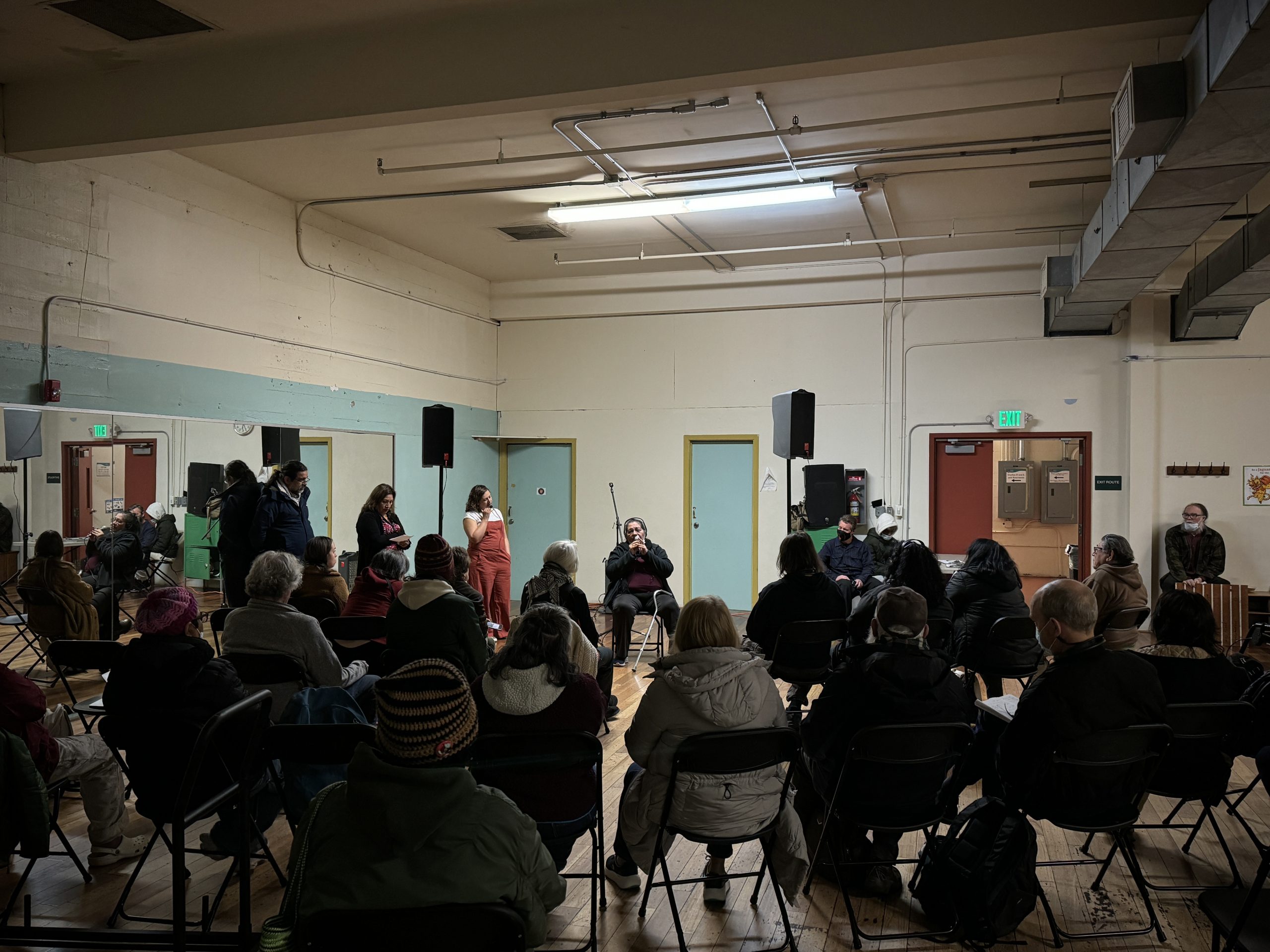

A group of some 35 commercial tenants of the historic Redstone Building and their supporters gathered Thursday evening to preserve access to free community meeting spaces, and to fight against a recent rent hike that may threaten displacement.
“We are getting together to create a place that artists can live, a space for the community and for different organizations,” said Susana Rojas, executive director of Calle 24, during the meeting at the Mission Cultural Center for Latino Arts.
Mission District groups, which often use the Redstone Building for community meetings, can no longer use the spaces for free, but can rent them for use, the landlord said.
That, alongside rent increases of up to 25 percent for some of the nonprofits and arts spaces in the building, has led tenants to call for increased communication with the building’s landlord.
James Kilpatrick, the president of Lakeside Investment Company, which took over the building in 2021, said in a phone call before the meeting that, while rents are being increased, they remain well below market rate.
“When the market rate is $2,000, raising rent from $500 or $600 to $700 or $800, I feel comfortable, ethically and on a business standpoint. It’s not gonna ruin someone’s life,” Kilpatrick said.
When a longer-term lease is reached, Kilpatrick said the lease would indicate how much rent would increase, and when. Specific increases differ from lease to lease, but he said the increase is generally less than 5 percent.
“No one’s been kicked out. No one will be. But raising rent is a different story,” he added.
Kilpatrick pointed to long-term leases that the company recently reached with the Lab and the Western Regional Advocacy Project, both existing tenants. But while those organizations may have signed new long-term leases, other nonprofits have only month-to-month contracts and fear they cannot pay more.
“This is terrifying for us,” said one participant. “We are immigrants without a lot of income … Who is not scared or worried they could be evicted? Even though they are just raising the rent, we need to stop this.”
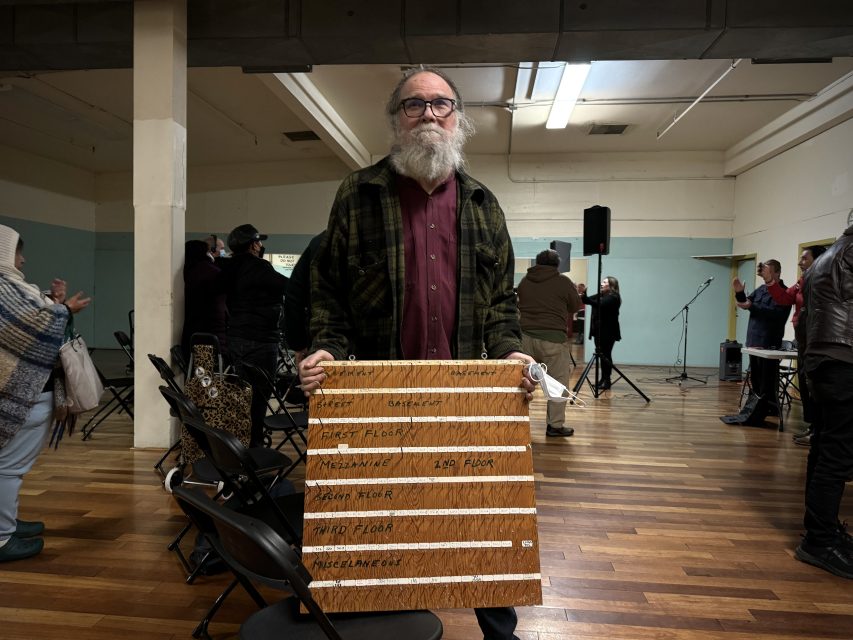
Karl Kramer from Alliance for Social and Economic Justice, who organized the meeting following a September rally by tenants to “defend community space,” said that his group, too, is facing rent increases — though it was unclear how large an increase, as neither Kramer or the landlord would share lease documents.
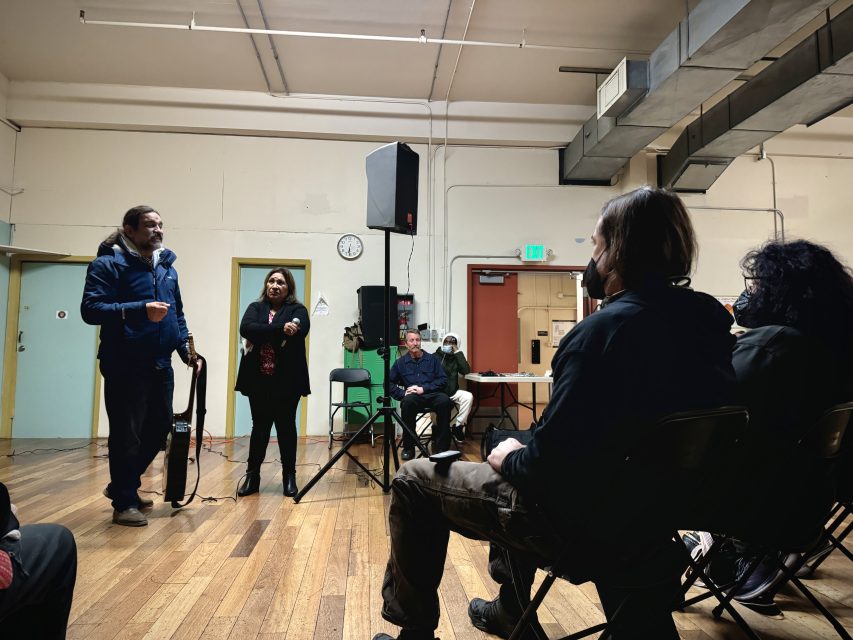
Chanting “Let’s save the Redstone Building” at one point, participants — many of them wearing headphones for a bilingual interpretation service — shared memories of the building and concerns about displacement. They gave speeches, played the guitar and read poetry.
Participants in the town hall meeting also sought continued access to three theater spaces that they have often used, freely, for events.
Those theaters — Teatro Esperanza, Lunasea and Rhinoceros — have been used by neighborhood nonprofits for years to hold events, workshops and fundraisers, said Savannah Landau, a staff organizer with the San Francisco chapter of the Committee in Solidarity with the People of El Salvador, which is also a tenant in the building.
“We always have this space. We really need it,” Landau said. All three spaces are now no longer accessible for the tenants. Instead, they’re locked up and ready for rent.
Kilpatrick said his company does not “have the budget or liberty” to provide the spaces for free, but would be happy to rent them out.
Meeting organizers also warned of “artificial intelligence startups moving into the Mission District” and causing displacement of arts spaces, nonprofits and small businesses.
The building landlord, however, denied the claim, saying it’s “super false.”
“There’s actually not a single engineering company, AI company or internet company that’s moving in,” said Kilpatrick. “We have no intention of having a tech tenant in the Redstone Building.”
Tenants also demanded clear and direct communication from the landlord, saying they have been given mixed information until now.
Kilpatrick said that the company has had “positive conversations with tenants,” and always responded to their concerns.
“Our goal is to keep everyone in the building,” he said.


Gee, these folks sound ungrateful. They have a below-market rent and the owner wants a below-market increase. The tenants no doubt want heat and a roof that doesn’t leak, and the landlord pays for that.
The cost of living has soared for everyone. Expecting that their group should be exempt because they are artists or illegally here (as one woman stated) is unreasonable. This is especially true when the groups are nonprofits and receive funding from the city or other sources.
just had to add a small hint of xenophobia to your comments, eh?
Not sure where you saw xenophobia there. I saw no mention of ethnicity.
Irish Scarlett made a fair point. The landlord made a number of concessions and wishes to continue this use of the building. Those tenants could have done a lot worse and should appreciate that.
Xenophobia is a dislike for people for other countries.
Also, SF values its art groups, activist groups, and nonprofits. This building is also known as the LaborTemple, which used to house Green Cab Co., a workers co-op. There are incredible labor murals in the lobby. During the wars of George W. Bush, the building hosted an underground radio station that was a major communications center for the massive street protests,
It’s a SF thing. Don’t blame those tenants—we cherish them.
thank you.
i appreciate the reporting. it helps me understand what is happening in the city beyond what the corporate media is willing to report.
what i don’t understand is why ML continually uses proper names for a building or location expecting the reader to know where it is.
perhaps it may be redundant but please stop forcing me to ask the stream for the address or location of the redstone or laku. it should be basic reporting.
Is your Google broken or something?