


The Ancona family was the last to leave Russell City, an unincorporated town outside of Hayward annexed to the city in 1963, after its 1,400 majority Black and Latinx residents were forced to leave the year earlier. But Lita Ancona didn’t plan to let the city’s bulldozers tear down her home. So, before she left, she burned it to the ground.
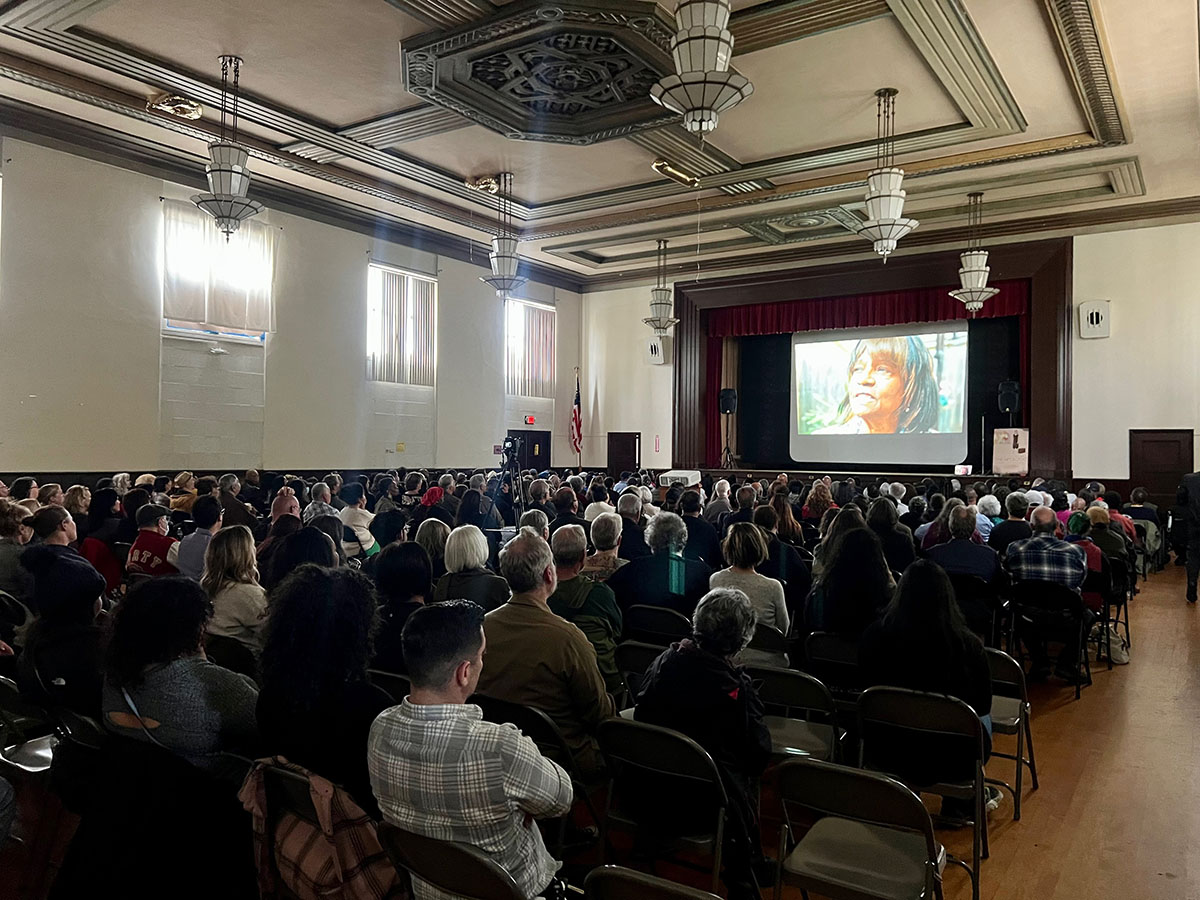
On Saturday, the same day that a California reparations task force voted to approve millions in potential payments to Black Californians, a documentary about the 1963 forced relocation, “The Apology,” got a community showing in Hayward, drawing an audience of several hundred, including former residents and their descendants seeing the film for the first time.
“Our history will be told,” said Zenobia Kimble, a former resident whose family was relocated when she was 14. “It was like we never existed. This shows that my parents existed and that they mattered.”
The documentary was screened in the Hayward Veterans’ Memorial Building where, 60 years earlier, the Alameda County Board of Supervisors held three public hearings about the redevelopment plan that would eventually force residents from their homes. It is the sixth feature-length documentary by Mimi Chakarova, who is also Mission Local’s pro bono multimedia advisor and a board member. “The Apology” started as a short documentary for a series she produces, but grew as she began to meet more residents and research displacement in the 1960s.
The film explores the forced displacement in Russell City, and comes at a time when California is advancing statewide reparations: The state panel approved possible payments totaling hundreds of thousands of dollars for Black Californians, depending on the specific discrimination they faced.
Hayward has been in the process of determining appropriate restitution and restorative justice for former Russell City residents and their descendants, which began with a formal apology to former residents in 2021. In March, the Alameda County Board of Supervisors approved the formation of a commission to explore reparations.
After the screening, former residents of Russell City processed resurfaced memories, new information from archival footage and transcripts, and hopes for restitution.
Sam Nava, a former resident, felt grateful to be in the company of others from Russell City and their descendants. He said that there are just 12 former residents still alive, all of whom are in their eighties.
“Every time one passes, it grieves us, because they’re not benefitting from this, they didn’t get to see this,” he said.
“I feel heartache, good memories, a lot of wishes, a lot of hope,” said Andy Serna, another former resident. “It’s very emotional for me. But I’m happy.”
“I think, in a way, it was healing,” said Kimble. “And I have to process it now.”
Several Russell City residents had previously testified before the California reparations task force, including Gloria Moore, whose family was given $2,200 for their home before it was bulldozed.
“I hope that, as a result of this film, we’ll see some kind of justice for pain and suffering,” she said.
Residents in attendance not only faced old memories, but also new facts.
“I had not seen the interview with Harold Davis,” said Moore, referring to the executive director of the redevelopment agency in charge of relocation, who showed no remorse in his interview for the film and said that Russell City “wasn’t a city, it was a dump.”
“I was fascinated by his state of mind and how he viewed the residents of Russell City and felt that he was doing the right thing by taking the land,” Moore added.
Serna was surprised by the transcripts of public hearings held by the Alameda County Board of Supervisors, in which one described the unincorporated Russell City as “conducive to ill health and juvenile delinquency.”
“That’s heavy, that’s heavy,” he said. “I didn’t know about the transcript.”
And former residents were well aware that injustices of this kind are not just a specter of the past.
“It wasn’t just Russell City,” said Serna. “There are many other cities that are experiencing this as we speak. Go to Oakland. There are certain areas that are just the same, just a different time.”
Monique Berlanga, the granddaughter of Sam Nava and a tenant rights lawyer in Oakland, said she saw similarities in the language used by the Alameda County supervisors in the film and what she hears from current supervisors when she defends residents of unincorporated areas.
“Seeing this makes me want to pull the transcripts from the last six months of meetings, where we’ve been saying these exact same things,” Berlanga said. “I come out energized to get back into this fight with more hope.”
The documentary will not be released until after it premieres at a film festival, in 2024.
Disclosure: Mission Local’s executive editor, Lydia Chávez, is a producer of “The Apology.“
I was born in 1963 -as Russell City was being pillaged and then stolen. I grew up in the Fillmore in San Francisco. In 1970’s, the same mass dislocation of people from their home and land happened to my family there.
We we’re relocated to the Western Edition, now a modern day community of projects and nominally valued townhouses. Our Victorian home in the Fillmore was then renovated and purchased by newly arrived whites, -along with all the other homes there-under the false pretense of urban renewal for the purposes of cleaning up blight. Meanwhile, the black, Chinese and Filipino neighbors who represented the racial makeup of those who resided there, were then pushed out forever as the area slowly and continuously gentrifies to this very day. San Francisco presently is completely unrecognizable from my childhood home. It breaks my heart every time I go see my old neighborhood, and how it is completely tech-driven and totally whitewashed, with all of these newbies arriving from other states and countries to buy up what is now considered prime real estate. How is that?!
In the 70’s, however, we we’re living in a thriving SF community of black doctors, entrepreneurs and other professionals. It’s really a shame that this was a well thought out plan of theft of the property and prosperity of people of color that continues unchecked all over the state and country. It’s well past time for reparations!
My mother lived in Russell City,we are the family Vazquez,I and 3 other sisters would like to file or be put on the list,how can we do this my sisters birth certificate have her being born zin Russell City my self I was born on Depo Rd where Doris car parts stands,
Dear Ms. Campogan,
Please feel free to send me your names and contact information here: mchakarova@stillirisefilms.org
I will make sure to pass it on to the group that’s keeping track of records and contact information for former Russell City residents.
My best,
Mimi Chakarova
There are a couple of USGS topographic maps depicting Russell City on them; the maps are of the 7.5′ series titled “San Leandro, CA”; the first one of this 7.5′ series was mapped in 1947, and shows every structure that existed in the community using square black dots. The next map (a revision) was surveyed in 1959, but on this map, the community is overlain with a red shading, indicating that addition structures had been built there in the intervening twelve years. These maps can be viewed online by GOOGLING :”Historic USGS Maps” and following the instructions therein.
One of the displaced young people, became Sunset High, Senior Student Body President 1963-64. Reginald Hughey.