


Slow week, eh? Slow month, eh? Deep, deep apologies to everyone who did the “Dry January” thing.
Pace yourselves.
L’affaire Mohammed Nuru, like an earthquake, was both destructive and predictable. It’s pretty much all that anyone at City Hall could think about last week (“Please talk into my lapel pin,” was a joke that induced nervous laughter when addressing public officials).
This is all understandable: Federal raids, an alleged John Deere tractor bribe, revelations of rampant, casual corruption — you know, a lotta ins, lotta outs, lotta what-have-yous.
So, a lot of folks in City Hall were blessedly unaware of a Public Employment Relations Board (PERB) ruling that began hitting local desks on Jan. 21 — the same day FBI agents arrested Nuru (for the first time).
A 66-page ruling blending the tedious chocolate of state employment law with the impenetrable peanut butter of parsing San Francisco’s voluminous City Charter does not make for straightforward reading. There’s a lot in here. But, in the briefest summation, a clear path has been established for this city’s unionized workforce to credibly threaten to strike, something we haven’t seen since the 1970s — and do it.
“Yes,” concurred a knowledgeable city source who did see the January ruling. “They could shut down the city.”

In these frenetic times, it’s easy to ignore the PERB ruling and its ramifications — which city sources tell me are “extremely significant.”
Workers are incensed by Mayor London Breed’s call for 3.5 percent budget cuts across the board for the next two years — but they won’t be walking out tomorrow. Yet, when the time comes, this ruling will allow them to channel that discontent into real leverage.
The balance of power in labor-management relations has shifted, and the theory of deterrence will soon be tested.
Here’s our best shot at gleaning the gold dust out of 66 pages of legal arcana. In this city, prior to this ruling, unions were required to finalize contract negotiations by May 15 — or their members were locked out of receiving any enhancements in wages or benefits for a year.
This was, in effect, a nigh-invulnerable barrier for any union that would hope to opt out of binding arbitration and take its chances with a strike; when losing out on wage and benefit increases for an entire year is the minimum buy-in before you’ve even started, a strike just ain’t worth it. Better to be steered toward arbitration.
But January’s ruling shifts this dynamic. Now, instead of having to have things done and done by May 15, a place-holding document can be submitted instead. A document that’s essentially as meaningful or meaningless as the unions want it to be.
And then money and whatnot can get argued over and allocated later.
That’s a big difference.
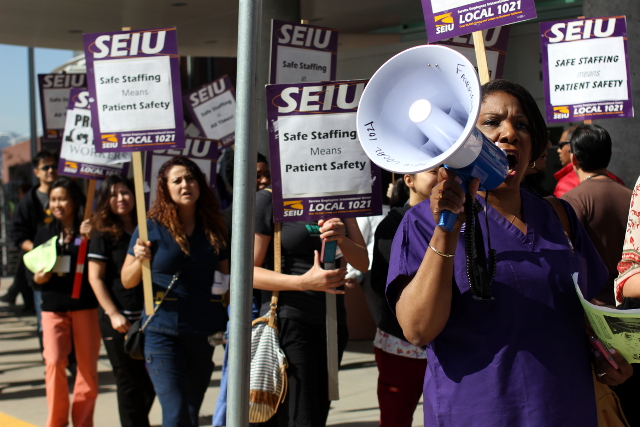
“In effect,” confirms John Stead-Mendez, the executive director of the Service Employees International Union Local 1021, “the May 15 deadline is now meaningless.”

Your humble narrator has written before about the unconscious decoupling of memories that must be undertaken to pine for San Francisco in the 1970s. There were tight-knit communities and affordable neighborhoods but there was also pollution and crime and violence and chaos on a level not conceivable in the present day.
Municipal workers going on strike — including public safety workers — were part of that chaos. For good or ill, much else that defined the ’70s — domestic terrorist cells blowing stuff up, polyester Giants uniforms, gunfire in City Hall — is a quickly receding memory. But we may have those walkouts again.
Union leaders are thrilled to have this weapon back in their arsenal. But it may not work entirely as intended.
Those detested deadlines forced everyone in this sclerotic city to get things done. Take that away and we may be faced with a litany of meaningless deadlines blown, expired contracts staying in place, and a perpetual state of bargaining. In such a scenario, the city might even come out ahead, as workers continue to toil under expired contracts for weeks or months.
Unless, of course, they go out on strike.
And since it seems this city’s wealth and its goodwill between labor and management are conversely related, that’s a healthy possibility.
While Breed is pushing for those 3.5 percent cuts, analysis by city unions indicates that this city has, for years, earned well more than it projected it would — and that city revenue is still outpacing expenditures, to the tune of billions. The city, in Stead-Mendez’s words, continues to “cry poor” while being stinking rich.
Padding the reserves is prudent, but so is addressing this city’s striking and overt poverty and street crises. It’d be useful to have a fully staffed General Hospital emergency room. It’d be useful to hire social workers or dispatchers.
“The revenue is coming in. But instead of dedicating revenue to deal with this, the mayor is sending out budget instructions to do the opposite,” Stead-Mendez complains. “At some point, this is immoral.”
In the coming months and years, Stead-Mendez plans to ask questions about all this during bargaining sessions.
If the answers are not to his liking, he now has options at his disposal that he did not have before.
This City, indeed every city and county in the state, needs every penny of reserves it can get during these boom years for stocks and real estate. If proper pension accounting were applied to the City, it would be insolvent. And of course, when a recession hits, which one will at some point, the holes in the City and State budgets will be gigantically epic. Given the history of terrible timing by the labor movement, tha is when they will choose to mount a public workers’ strike. Fun Times!
It’s high time to radically and dramatically reduce the City’s undeniably massively bloated public-sector workforce.
In 1960, SF had a population of 740K and less than 7,000 public employees.
(1 public employee per 106 residents.)
Today, we have a population of 889K and 40,951 public employees.
(1 public employee per 22 residents — far and away, the highest in the nation.)
A 20% increase in population relative to an absurd/out-of-control 485% increase in public sector employment — resulting in over $10 Billion* in unfunded pension liabilities and healthcare-for-life costs which the taxpayers are on the hook for.
*(and rapidly climbing; could be as high as $20B. Incredibly, nobody knows for sure!)
If we cut the City’s workforce deep enough, then luxury condo development projects would not get approved.
But I don’t think that’s what the boosters have in mind here.
(Let me guess, you’re employed in the public sector — or the publicly-subsidized “non-profit” sector — right?)
If we reduced the City’s workforce to a more reasonable number (say in alignment with averages nationwide), it would actually streamline and accelerate the absurd distended timeframes that one currently experiences in both the SF Planning and Building Depts. as we could then cost-effectively outsource these services — like other more sensibly managed cities do.
Outsource to where? AYKM?
Keep saying that, Karl, because it is a looming truth that so many want to ignore. If we think things are bad now, they are going to get way worse. I wonder what the force will be that will level the entire playing field for everyone….
The old rationale used to be “we’re employing our own citizens and residents”. Doubt if that’s the case today.
How would we know?
But the I think the public would have little support for striking city workers today. Funny how high wages, generous benefits, and low productivity will do that. Everyone has personal examples of shirking and incompetence on the part of regular city workers. I wouldn’t beat up on individuals over single incidents, but the collective waste is immense. And it holds the city, even with its $12 billion budget, back from accomplishing our stated goals.
Actually I work for the City and I see just the opposite. Dedicated workers expected to do more with an ever artificially bringing pie. Take the nurses for example. Chronic short staffing and mandatory overtime.
As a nurse at SF General, I can say even before a global pandemic hit, we were chronically understaffed and feeling the crunch. This city’s politicians received nominations and millions in campaign dollars with false promises of doing more for frontline staff. Increasing temp workers, union busting and lining the pockets of wealthy politicians on the back of nurses is absolutely disgusting! This city received $600M+ from the American Rescue Plan and not surprisingly, none of that has gone to frontline staff who has put their lives and their families’ lives at risk during the past 2 years of this pandemic.
I meant “shrinking” pie not “bringing”. Damn predictive text.
Get rid of Breed !!!