

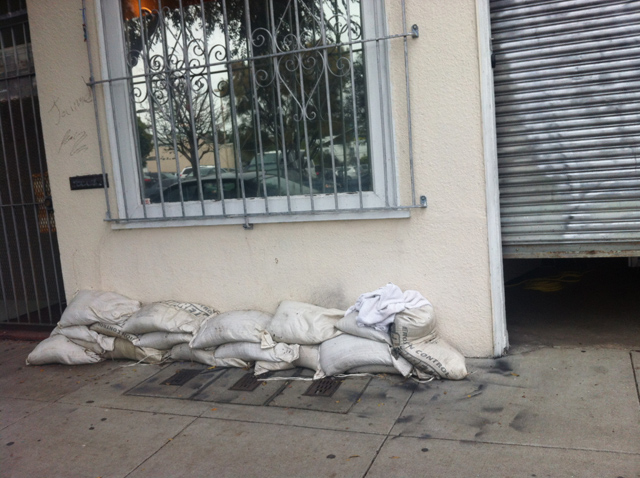

You could say that Chris Hickey’s 36,000 square foot building on Folsom was an experiment in flood control – one that offered a template for a change in a city ordinance that District Supervisor David Campos will introduce on Tuesday at the Board of Supervisors.
It is a change – a waving of fees – that will accompany some new grants for flood control. The two changes are particularly relevant in the northeastern Mission where flooding has been an on-going problem and where the city has paid out millions of dollars in damages to businesses impacted by the city’s sewers spilling over during winter rains.
The Stable Café on Folsom Street, for example, was closed for months after the rains on December 3, 2014 when its floor flooded and had to be replaced.
The ordinance to waive fees has to do with the slightly ominous sounding, but very expensive encroachment fees the city imposes when the owner of a building moves onto city property such as sidewalks – even when the owner is attempting to fix a problem.
Hickey did just that after six to eight inches of water flooded into the ground floor of his building at 2154 Folsom between 18th and 17th Streets after the heavy rains of 2012. It was clear from the water whooshing into his – and many of the businesses nearby – that the historical flooding problem had not been fixed.
“I had to protect my building,” said Hickey who also owns City Picture Frame, which he moved into 2140 Folsom Street after making the fixes.
It’s a problem that dates back to the mid-1880s when the city filled in marsh land to build. Older buildings – those built before 1930 – have sunk so much that one city official told Mission Local that the Stable’s Courtyard in 1890 would have been 24 inches higher.
Hickey moved into the neighborhood in 2012 just in time to experience the April rains that devastated the area.
To fix the problem after the flooding meant emptying out the 18,000 square feet of commercial space on the ground floor, digging it out, raising the slab and then having to raise the sidewalk. “All I had really done was to put it back where it was,” said Hickey.
Doing that, however, triggered a notice from the city for a $2,000 a year encroachment fee. He objected – he was after all fixing a problem the city had promised to fix – but only got the fees knocked down by half.

After the area flooded once again in December, Campos held a March hearing and a working group that included staff from the Public Utilities Commission and local residents came up with some ideas on how to solve a problem that the city estimates will cost millions of dollars to fix permanently.
Two recommendations came out of those meetings, according to Campos – to modify a grant program administered by the Public Utilities Commission to make it easier for local businesses to make changes and to waive the fees on flood prevention projects done with PUC grant money.
“This is really about helping small businesses and tenants deal with the situation to stay in the neighborhood,” said Campos.
If approved by the Public Utilities Commission, the $30,000 grants will allow more flexibility on the kinds of measures property owners will be able to take including using the money “ to install flood barriers and/or sewer backflow preventers.”
If the owner encroaches on city property using one of these grants, Campos’s proposal will waive those fees.
Although $2 million will be set aside for the grants – $250,000 this fiscal year – it is still far below the millions of dollars it will take to raise the buildings. Hickey estimates that his improvements cost upwards of $1 million. Still, it is says Hickey, “ a step in the right direction.”
The sewer failure extends past the Mission. The two sewer failures in December extended into the Excelsior and over 100 homes along Cayuga Ave were damaged. The PUC and the City Attorney have failed to address the causes of the problem: inadequate infrastructure and poor planning. Until they are willing to address the problem, the sewer flooding will continue.