
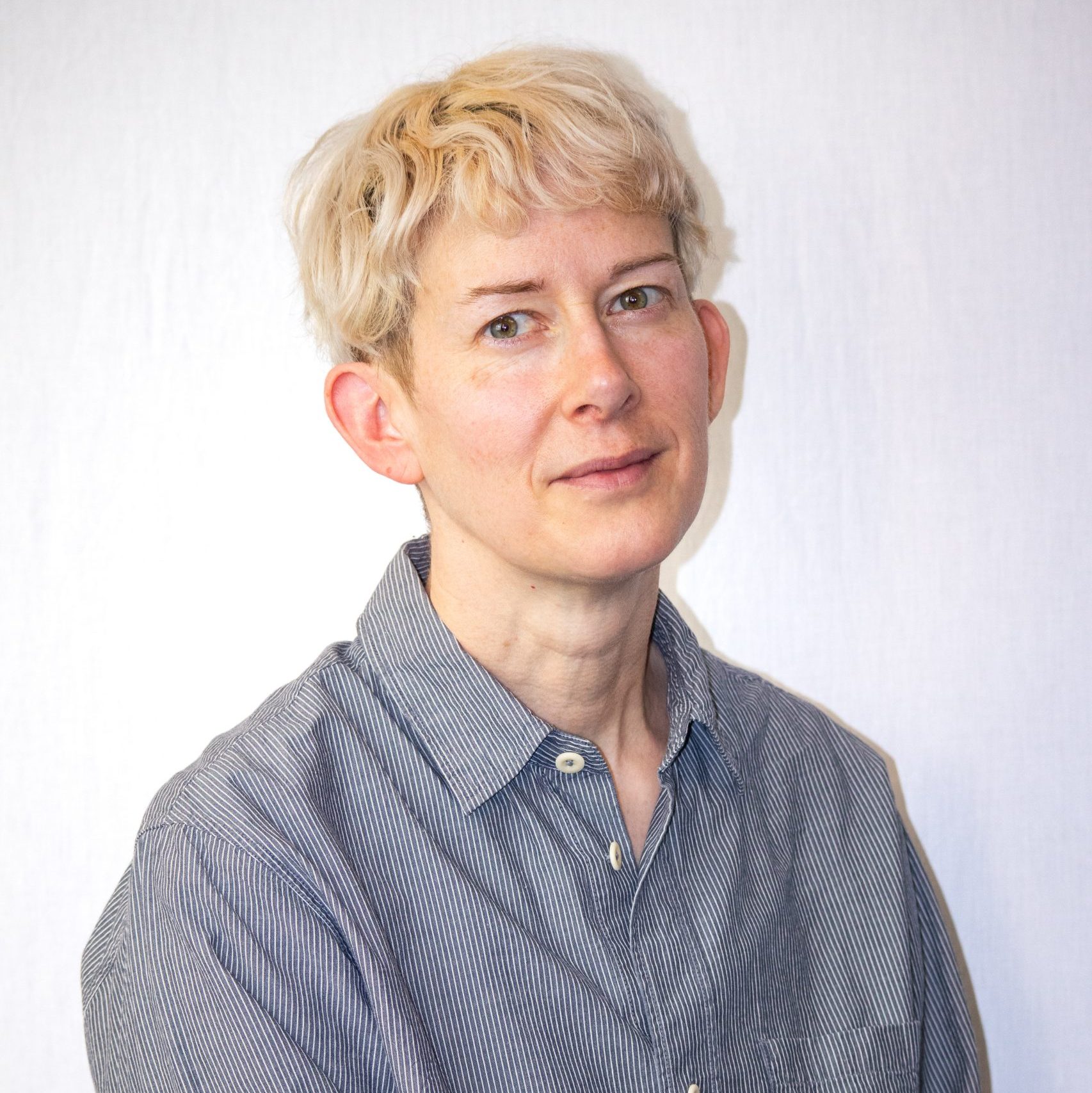


To get to Judy Rosenfeld’s office, you walk through the massive, dark-tiled lobby of Mission High (it feels less like a high school than Union Station in Los Angeles) and then down a stairwell, past murals of bird-headed gods and other figures from Mayan folklore, down another basement hallway, and into a small concrete room with about the same floorspace as a picnic blanket.
It’s quite nice. Experimental jazz is playing quietly. There are two large posters of (respectively) the male and female reproductive system on the wall. The posters are there less because they’re fun to look at all day than because they function as conversation starters. Mission High has a sex ed curriculum, but Rosenfeld, a small, gray-haired woman with an air of infinite calm, gets plenty of questions anyway. “Menstruation — what is it?” is one. “Is this normal?” is another. “Am I ready to have sex? Am I ready? Am I ready?” is also common — raised in this tiny office by both boys and girls.
“The perception is,” Rosenfeld says, “that everyone is having sex. But in San Francisco, only 17 percent of teenagers between the ages of 14 and 18 reported having sex. In the last 30 days, at least. And that is not everyone.”
Most of the room’s decoration serves double duty as a conversational lead-in: the racks of test tubes showing the relative amounts of sugar, fat and salt in things like jello and soda and so forth (the “What are you eating and is it good for you?” conversation starter). There is a heavy jar of black schmutz that can be shaken up like a snow globe, so that the mass inside oozes down the sides like an oil slick (the “Maybe you shouldn’t smoke” conversation starter). And there’s a Tupperware container stacked with different examples of birth control methods (self-explanatory, and one of the most popular items in the room.)
There is a knock at the door. It is a student, one hand wrapped in an elastic bandage.
“It really hurts” he says, by way of explanation.
“Oh, dear me,” says Rosenfeld. She unwraps the bandage and holds his hand in hers, touching it gently like a fortuneteller. The room is so small that their knees are almost touching. “That is really swollen.”
“I hit it on a helmet at football practice,” he says.
“Such a good team,” she says. “What’s your GPA?”
“3.88.”
“They really push the football team to get good grades,” Rosenfeld says proudly. “The coach canceled a winning varsity football team last year because they’re weren’t getting good enough grades.”
She looks back at the football player.“Did you go and get it x-rayed?”
“No,” he says. “I took some Advil.”
“Well,” she says. “I can’t tell if it’s broken. If there’s pinpoint pain, that’s a sign that it could be broken. And you have that. You probably made it worse wrapping your hand that way. It should be like this,” she says, holding her hand out straight, then curving it upward so that it looks like a rowboat. She looks around the office. “I wish I had…I wish…. We don’t have anything to bind it properly here. If it’s still hurting after school, you should probably go get an x-ray.”
“OK,” he says, but dubiously — as though an x-ray is going to be a far more complicated process than it seems. Later that afternoon, Rosenfeld will call his parents and personally ask them to get him an x-ray — one that will reveal that he has indeed been walking around with a bone fracture.
Rosenfeld works at Mission High full-time, an at times tenuous state of affairs currently supported by federal grants, the Department of Public Health, the mayor’s office and Mission High itself. Mission High and its students are in many ways equally sensitive to the ups and downs of the economy. She can feel the shifts, Rosenfeld says, by how many students appear in her office with untreated dental problems. To some of the kids here, Rosenfeld is the only health care professional they see.
Rosenfeld sees students who are homeless, students who are undergoing chemotherapy, students with chronic illnesses, students who’ve just arrived in America and don’t speak any English. She’s learned over time to keep a close eye on the high schoolers that teachers send to her with a note to help them get glasses. If no one up until this point has noticed that a kid needs glasses, they’re more likely to have other as-yet-undiagnosed health problems.
Rosenfeld slowly rewraps the football player’s injured hand. As the bandage loops over, he reaches out with his good hand and cracks the knuckles of the injured one.
“No,” says Rosenfeld, taking his hand and cradling it between hers. “No no no no no. Treat this like a newborn baby. Is this the hand you write with?”
“Yeah. I can’t write. It sucks.”
“Get someone to take notes for you. Come down here and Xerox them.”
The last health conversation starter is one of those ornate, jointed spheres of the sort that is commonly found in the gift shops of science museums. Rosenfeld bought it at Thrift Town, on impulse. The most common ailment she sees is what she refers to as “headache/stomach ache/headache/stomach ache.” Kids come in with vague complaints, start playing with the sphere, space out and start talking. “Down here, they’re totally polite,” she says. “Upstairs, they may act differently — participants in the theater of high school.”
“We have the luxury — I shouldn’t say luxury, but it is — of referring kids to mental health,” says Rosenfeld. “Most kids take it quite seriously. They make plans. How to get through school. How to get through the next month. How to get through the next week. It’s a great chance to teach kids how to take control of their lives. They can’t control their home and they can’t control their parents, but they can control what they do in school.”
Once upon a time Rosenfeld was a nurse working with outpatients with AIDS at San Francisco General. That job paid more, but she likes this job better. Here she’s outside of a hospital hierarchy. She sees the same patients for four years, gets to know their families, watches them grow up.
When Mission High is written about, it is often in the context of the school’s challenges. To Rosenfeld, the situation is more nuanced and has more room for hope. “Working here makes me incredibly optimistic for the future,” she says, her expression intent and serious. “I ask these kids what they want to do with their lives. Most of them will say that what they want to do, more than anything, is to be helpful.”
Such a well written, thoughtful piece, thanks.
So good!
What a great read!
Brilliant. Notes from the Underground for the 21st century? With an attitude and a practice like that, small wonder the City Fathers want to keep her hidden away while they chop, dice and pillage public education and health funds.