

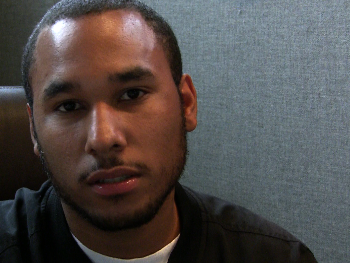
Arsenio Ogilvie, a 21-year-old dressed in baggy shorts, walks into a stuffy basement filled with Apple computers, synthesizers, and nine teenagers. Some wear headphones and edit audio tracks, while others sit on couches watching their friends work on songs. Although he’s the teacher, Ogilvie could be mistaken for a student. Four years ago, he was.
Then 17, depressed and a dropout, a former counselor encouraged him to join The DJ Project, a 10-week course that teaches teenagers entrepreneurial skills through hip-hop. It was the medication he needed.
“I thought, this is all I need to hear, these two sounds together,” Ogilvie says of that first experience. “I need to do this every day of my life. That’s what I try to duplicate for each person that goes through the program, that feeling I had that first week.”
In class, he’s doing just that. He walks over to one of the students and plays notes on a keyboard reminding him what an octave is.
The class of six has less than a week before students showcase their music on Oct. 3 at 440 Potrero Ave.

People who come through the program are very different, Ogilvie says, but the common ground is music. Some, he says, have a hard time at school, but do well in his class. “I had a student who was in a special ed class, “ Ogilvie says. “He was able to learn like the others here, the teacher to student ratio is 1:8, in a public school it’s 1:30.”
The DJ Project is part of Horizons Unlimited, a nonprofit that also runs substance abuse and violence prevention programs.
Olgilvie’s class has a casual air. Students surrounded by sound equipment look like teenagers hanging out, but boards listing rules of conduct, including the importance of regular attendance, remind visitors that this is a class.
A group of teenagers walk in. One of the teenagers is Ogilvie’s student; others are friends who have come to check out the class. Ogilvie shakes each newcomer’s hand. He didn’t want friends along today because one of his students was supposed to record a song, he says, but he forgot to remind everyone and the student in question hasn’t shown up.
Raised in San Francisco, Ogilvie started cutting class in the 10th grade when his family’s landlord wanted to sell their rental and they were forced to move to Pittsburgh in the East Bay. Unhappy about being pushed out of the home where he had grown up, he had a hard time fitting in.
“The counselors there were telling me, ‘Why don’t you be a doctor or a lawyer?’” he says. Neither of those were careers Ogilvie had envisioned for himself. “It felt very limited.”
Ogilvie started feeling depressed. “I was debating suicide,” he says.
The police picked him up and took him back to school several times.
A few months short of graduation, Ogilvie dropped out.
He came to San Francisco one day to see his former school counselor who told him about The DJ Project. It wasn’t long before he was suggesting ideas to its director, Jeff Feinman. In addition to starting mixers for student DJs to meet industry people and an advanced class, Feinman recognized Ogilvie’s ability to find new students and hired him.
Even then, Ogilvie says, Feinman told him, you need to go back to school and get your diploma.
“He knew he couldn’t force me,” Ogilvie says, “but he kept telling me not graduating high school would come to bite me in the butt. It did.”
His request in 2006 for a raise was turned down because he had no diploma. So in January 2007, Ogilvie quit and went to an adult education center in Pittsburgh, where he and his family still live. Nine months later, he was back at the DJ project with a raise and a new title as instructor.
A student walks out of the studio looking for candy. Ogilvie tells him there’s a bowl on a desk and walks over and hands it to him.
“For some, he says, “this is a home away from home.”
He tries to bring more than music to the classes, he says.
“I want them to engage in topics they wouldn’t otherwise. We talk about race, religion, politics, anything that’s of relevance,” Ogilvie says.
Once students have two songs ready, Ogilvie chooses one and presents it to possible funders. Knowing that people outside the project are going to listen encourages students to do their best.
Outside of class, Ogilvie is a hip-hop artist. In 2007, Ogilvie, known as Sin, and Critical Akklaim, produced and performed on the album “The Souls of Rap Folks.”
“I don’t strive to be a role model but if you’re in a position to lead, you’re automatically going to be looked at as a role model. I accept that role 100 percent,” he says.
A student asks Ogilvie to listen to some songs. Ogilvie turns up the volume and moves to the beat. The student picks one and adds his rap to it laughing nervously as other students take off their headphones to listen. Ogilvie too listens–carefully.