


A new independent poll of the race to succeed Speaker Emerita Nancy Pelosi in Congress finds that state Sen. Scott Wiener leads Supervisor Connie Chan by six percentage points, at 47 percent to 41 percent.
When undecided respondents were pushed to choose, Wiener’s support rose to 51 percent and Chan’s to 44 percent.
While Wiener holds a lead, it’s within the margin of error, and monolingual Chinese voters could give Chan an edge.
The District 1 supervisor tends to outperform her poll numbers at the ballot box because her monolingual Chinese-speaking supporters rarely respond to polls.
Chan was neck and neck with then-candidate Saikat Chakrabarti, with both at around 20 percent, in three polls conducted in the month before the June primary. That included an independent poll sponsored by the San Francisco Chronicle, which found 36 percent of Chinese respondents favored Wiener and 19 percent Chan, who would become the first Chinese-American member of Congress to represent San Francisco.
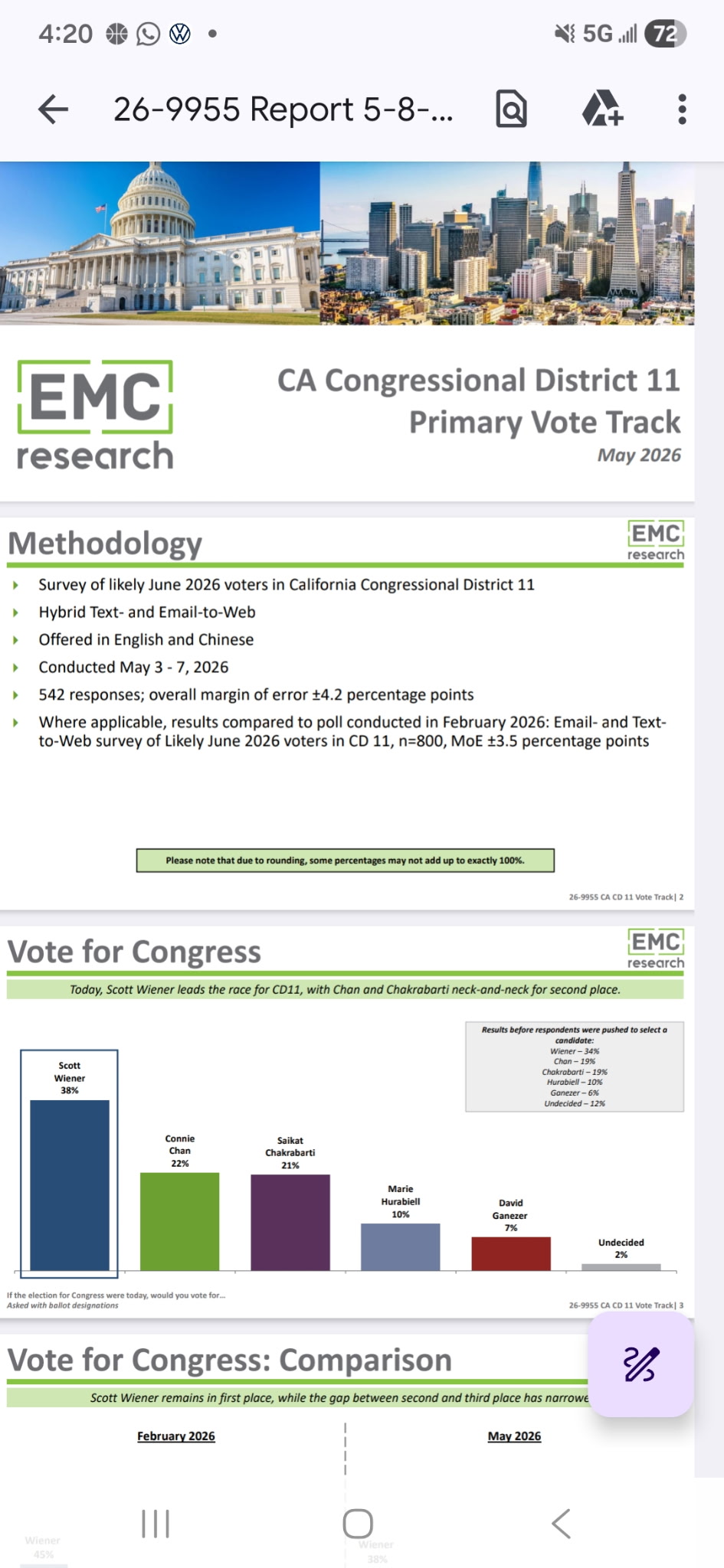
In the actual June election, however, Chan came in second with 29.7 percent of the votes, while Chakrabarti finished third with 17.9 percent. And in precincts with more than 30 percent Chinese American registered voters, Chan led with 35 percent to Wiener’s 31 percent, according to a San Francisco Standard analysis.
The latest poll, from the University of Southern California, however, finds 31 percent of Asian and Pacific Islander respondents favor Chan while 59 percent prefer Wiener. The polling team emailed non-English surveys to respondents based on surname matching and also included options to take the survey in other languages in English emails, according to Christian Grose, lead pollster of the independent poll and a professor of political science and public policy at the University of Southern California.
Still, “it’s harder to survey monolingual non-English speakers,” he said.
Grose also noticed a split within Asian voters in the results (the team didn’t include it in the published results because the sample sizes were small). “Chinese voters are more likely to support Chan. But then there’s some evidence of other Asian voters who are maybe more with Wiener,” he said.
The poll also suggests Chan is getting support from both ends of San Francisco’s political spectrum, the Democratic Socialists of America and the Republicans, while people who approve of the Democratic Party are more likely to support Wiener.
“In any Democrat versus Democrat election, the Republican voters and the Republican leaners may actually decide a very close election,” said Grose.
In general, higher-income voters are with Wiener while lower-income voters and people who identify themselves as working class are with Chan. “The recent changes in San Francisco with more higher income residents, more upper class residents, probably does help Wiener a little bit here and could hurt Chan a little,” Grose said.
Pelosi’s strong endorsement of Chan may have helped her build a wider coalition to counter Wiener. The polling results show slightly more strong supporters of Pelosi favoring Wiener than Chan, at 54 percent to 46 percent.
“I would have guessed maybe in the absence of Pelosi endorsing, Wiener might do even better among Pelosi supporters,” said Grose.
Both campaigns appear to have been effective at attacking each other. In an optional question that asks respondents to describe both candidates in their own words, the top two categories for Wiener were “corporate/donor-backed” and “effective/accomplished.” The top two for Chan were “progressive/liberal” and “NIMBY/anti-housing.”
Notably, even though 87 percent of respondents have an unfavorable opinion of the Israeli government, Israel-related issues appear to have minimal importance in this congressional race. “Isreal/AIPAC” comes very low on the list of words people associate with Wiener, with only three percent respondents mentioning it in their responses.
Mayor Daniel Lurie’s supporters overlap significantly with Wiener’s, with 75 percent of those who strongly approve of Lurie supporting Wiener and 88 percent of those who strongly disapprove of Lurie supporting Chan.
The poll was conducted via email, which, while imperfect, has in the last several years become “more of the gold standard” as people increasingly ignore phone calls and text messages from strangers, said Grose, who’s also director of the USC Democracy and Fair Elections Lab.