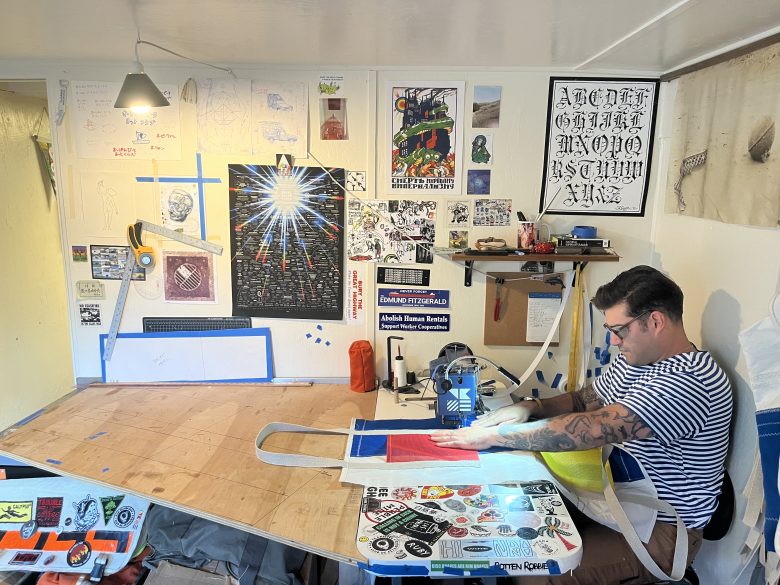

Outer Sunset resident Stephen Amato-Salvatierra remembers the first sail that he rescued from oblivion.
He was in his early 20s, recently moved from San Jose, California, to attend San Francisco State and, wanting to be in the water, found work on a sailboat in the Marina. When one of the boat’s sails ripped, he couldn’t bring himself to drop it in the dumpster. So he brought it home and stashed it under his bed.
A couple of years and one small Singer sewing machine later, that first sail became practice material for tote bags that Amato-Salvatierra would go on to sell under the brand name Ocean Beach Yacht Club, or OBYC. Each bag is cut and sewn from repurposed sails in Amato-Salvatierra’s garage studio, and no two are exactly alike. He’s been making them for more than ten years.
The totes come in two sizes: Smaller “day” totes are roughly the size of a grocery bag, and larger “cargo” bags more than double the day totes in volume. They run $140 and $180, respectively, and their triple-digit price tags come with something of a lifetime guarantee.
“I want stuff to be pretty bomb-proof,” Amato-Salvatierra said over the jazz music playing in his studio. “If ever there was an issue where someone needed a new one because something got messed up, A, I would be really embarrassed and B, I would totally fix it, or just give them a bag.”
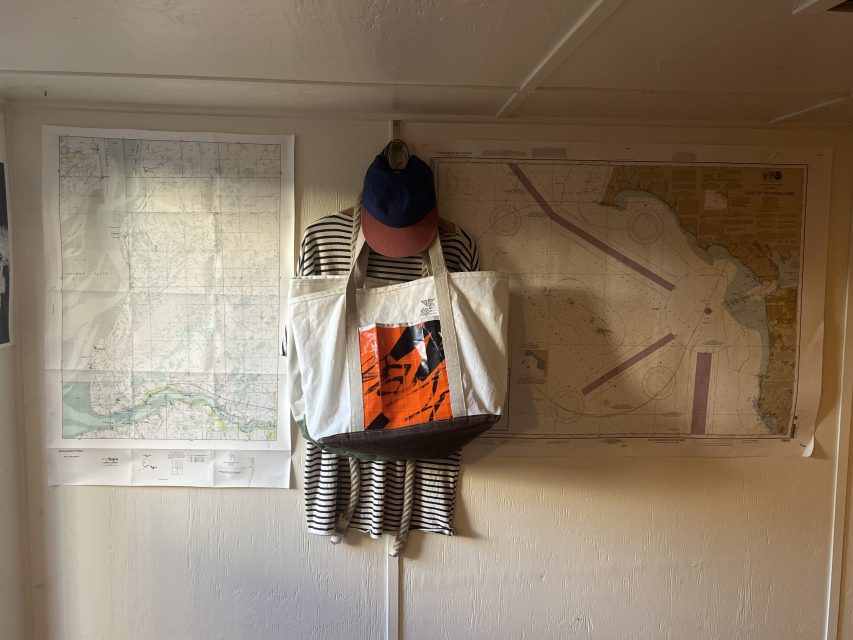
The tongue-in-cheek name underscores OBYC’s aesthetic. Amato-Salvatierra sees the peninsular urbanism of San Francisco as a “constant source of inspiration.”
“We’re three sides surrounded by water, and this really unique interface of a very diverse and dense urban area, butted right up against the raw Pacific wilderness,” he mused from behind his sewing machine as it whirred.
“There’s $20 million mansions in Seacliff, right above the water with a view of the Golden Gate Bridge, and then you’ve got these rusty container ships coming in, and the sea walls beneath them are covered in graffiti.”
But there’s nothing ironic about the “club” in Ocean Beach Yacht Club. Though Amato-Salvatierra makes the bags by himself and runs the Instagram account, he says it’s an artistic passion project among a group of friends who are similarly inspired by the water.
“I was making the bags separately as its own kind of spontaneous thing, and eventually I was like, these two creative endeavors can just mold into one thing,” he said. He and the OBYC crew bike or “cruise around town” to swim, sail, surf and take photos. And they sell other merchandise, including stickers of a political slant.
“I can’t take credit for its genesis,” Amato-Salvatierra said, though “I’m at the helm of it.” It’s an apt metaphor, he agreed.
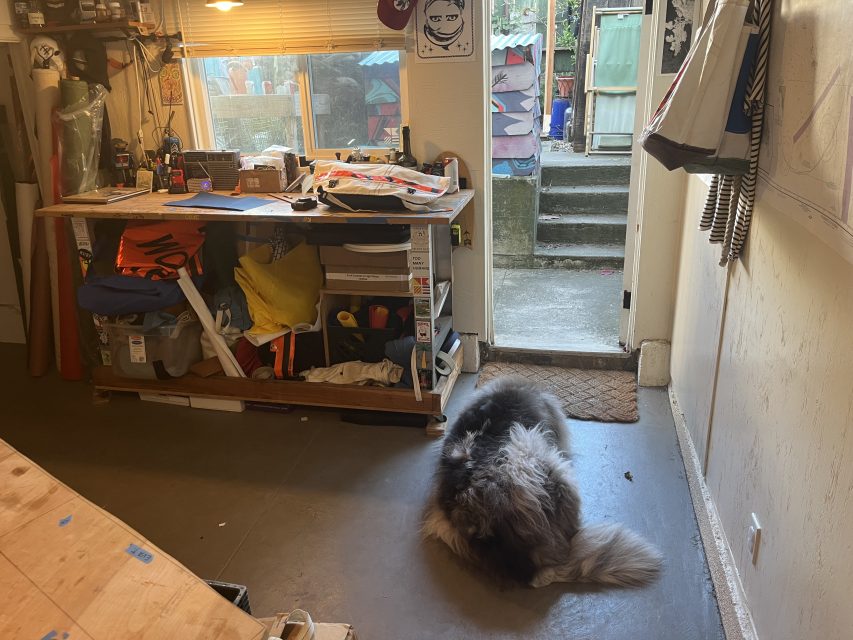
These days, Amato-Salvatierra has upgraded to a more industrial sewing machine, has a few City College of San Francisco sewing classes under his belt, and sources discarded sails from all over town. He’ll often make bags for fellow Bay Area sailors in exchange for the material.
“It kind of works out. Some of these sails can be really big, so it saves them a trip to the dump,” he said. “They get a nice little memento out of it, and then I get this really cool fabric that I can turn into lots of bags and give a whole new life.”
The bags are a small operation, and Amato-Salvatierra would like to keep it that way. He says he sells between three and ten bags a month, working on the bags between his full-time job at Ruby Wine Cooperative and a handful of other endeavors, including seasonal commercial salmon fishing in Alaska.
In the coming months, though, he plans to expand his offerings to include other designs, like messengers and smaller bags at a “chiller price point.”
In addition to the main component of sail canvas, Amato-Salvatierra meticulously sources other materials, always with an eye for the nautical.
His bags’ straps come from an ethically-grown organic hemp farm (“hemp has a really long history as a material used in the maritime world”), and their mesh lining from the same kind of commercial fishing bags he’s used in Alaska to hold hundreds of pounds of salmon. These sturdy materials protect the bags far beyond normal wear and tear.
“It’s overkill,” Amato-Salvatierra admitted as he made stitches with marine-grade UV-resistant thread. “But I’ve never had any of these seams rip, so, it seems to be working.”