

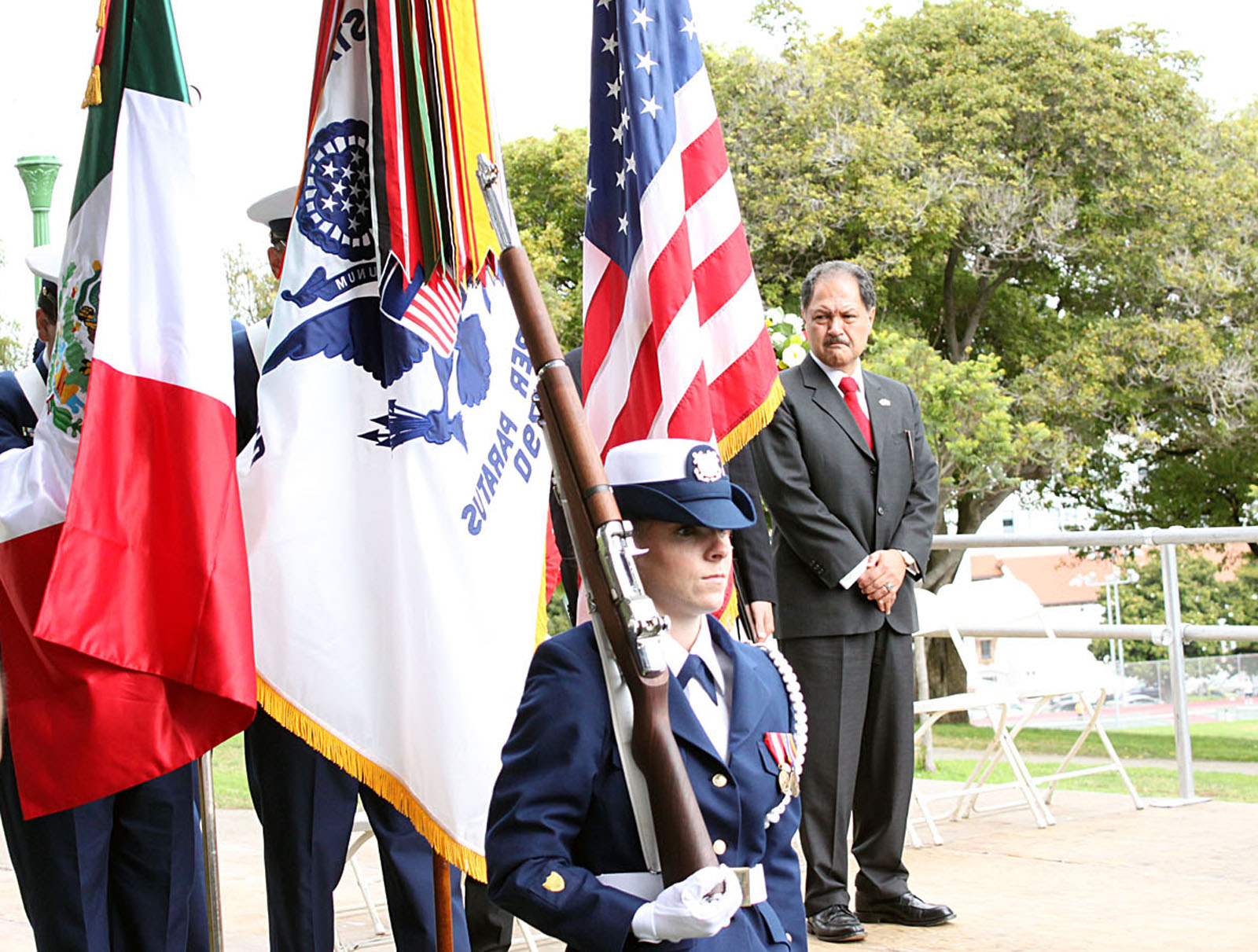
The newly polished statue of Miguel Hidalgo, the father of the Mexican independence movement, looked on as a small group of locals gathered last Thursday in Dolores Park to celebrate Mexico’s bicentennial.
When Hidalgo rang the town bell and issued his “grito” for Mexico’s independence from Spain on September 15, 1810, the Spanish settlers who had founded Mission Dolores in 1776 were likely unaware, said Professor Abdiel Oñate, who specializes in Mexican history at San Francisco State University.
After Mexico emerged victorious in 1821, the country made several attempts to settle the area around San Francisco with generous land grants to Mexican citizens and Anglos alike.

“It was very difficult to lure people from Mexico proper to migrate to this borderland. It seemed almost at the end of Mexican civilization,” said Professor Chris O’Sullivan, who studies early California history at the University of San Francisco.
The fledgling government broke up the mission’s lands, hoping to integrate the natives who remained. But, said Oñate, “Those territories were never quite clear in the minds of politicians and Mexicans in central Mexico.”
The land grants and disbanding of the mission’s control led prominent ranchers to take hold of the local economy. “It was an agricultural society of ranches and great estates,” said Oñate. “It was not a democratic system, it was a system of strong men where landlords dominated.”
Those ranchers — Noe, Bernal, Valencia, De Haro, Guerrero — have lent their names to the Mission District streets and subdistricts they once inhabited.
Though these settlers benefited from the territorial aims of Mexican leaders, they were ambivalent about maintaining political ties to the new government, said Oñate. “In those years, there was civil war and instability in Mexico. No president lasted more than a few months.”
When the Mexican-American war broke out in 1846, Californios fought the occasional battle that ran up into the hinterland territory, but many settlers were increasingly attracted to the idea of an independent California Republic — in effect, their own country. Soon, none of that mattered.
The war ended in February 1848, just days after gold was discovered at Sutter’s Fort. California was put on the fast-track to statehood, and entry into the union became inevitable.
Not all Californios returned to Mexico. Those who stayed became the founding fathers of California as a state, said O’Sullivan, including Mexican Colonel Mariano Vallejo, who helped draft the first constitution and was elected to the first state senate in 1850.
Both Oñate and O’Sullivan called the loss of California one of the greatest tragedies of Mexican history.
“It boggles the mind what the consequences might have been if gold had been found while Mexico still ruled California,” said O’Sullivan.
But last week’s speeches focused on the rosier side of California and Mexico’s shared past.

“We are here in the heart of the Mexican presence, Dolores Park, home to the Dolores Mission, the statue of Miguel Hidalgo and the reproduction of the bell of the town of Dolores, birthplace of Mexican independence,” said Consul General Felix Corona, referring to the statues gifted by the Mexican government in 1962.
Javier Villagomez, 85, was stoic as he watched the festivities in silent content. Born in Mexico, Villagomez came to the city when he was just 19. When asked why he was compelled to attend, he said simply, “Because I’m Mexican.” He raised four children in San Francisco, and beamed as he said that they went to schools like Stanford and Harvard. “San Francisco has been very good to me, but I can go anywhere in the world and my roots are really deep being a Mexican.”
“It’s a very special moment for many people in our district who are of Mexican descent,” said San Francisco Supervisor David Campos, “and we want to celebrate with them.” Blanca Cordoba, a real estate agent who works in the Mission and is originally from Nicaragua, agreed. “We speak the same language, you know, we are the same. We are all in this country, and this country was made for immigrants.”
Thank you for your comments, Robert. It was fascinating to learn some of the detailed history behind the Mission.
Christine, this is a a fascinating telling of history and a compelling report on what sounded like a great civic event. We need solemn ceremonies like this, and great journalism, to remind us of where we came from and where we are headed.