

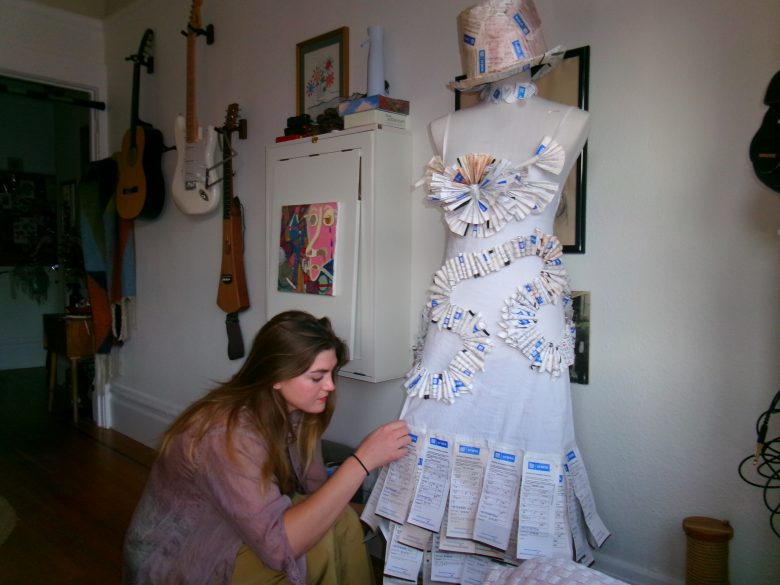

Have any parking tickets lying around? Musician Olive “Pants” Panthofer will take them off your hands — if they’ve been paid off, of course — for her latest project: Making a dress from these burdensome pieces of paper.
Her plan is to photograph the dress as Spotify cover art for an upcoming diss track about the San Francisco Municipal Transportation Agency, set for release in late December.
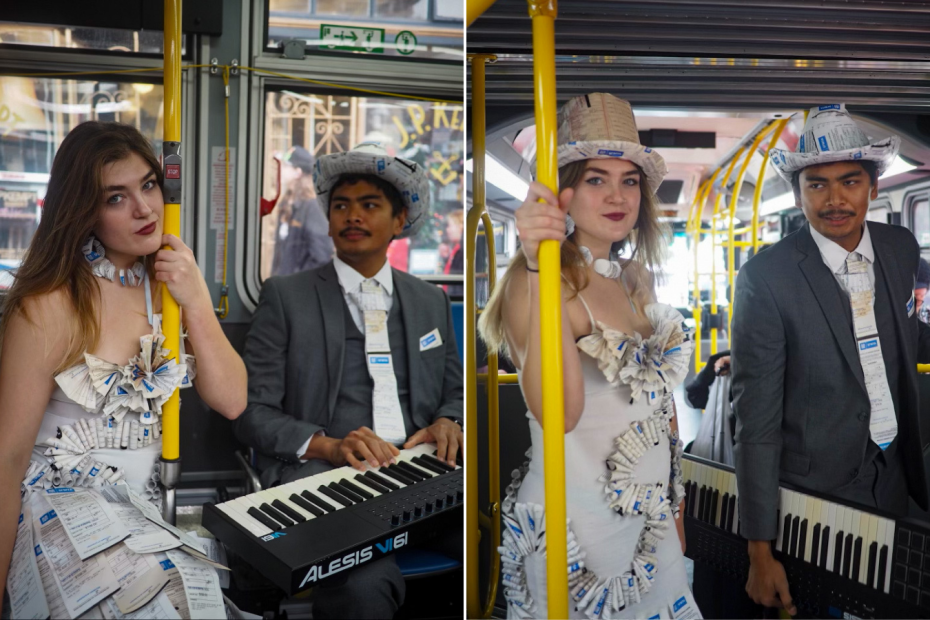
Until last March, Panthofer, 26, worked as a research associate at Vicinitas Therapeutics, a South San Francisco biotechnology startup.
When the company went under, she suddenly found herself with nowhere to drive to every morning, a nightmare for those who own a car in the city without a parking permit or designated spot.
“I’m out of a job. And now, because I can’t [re]park my car every two hours, and because I’m not leaving at 8 a.m. every day, I got $800 worth of parking tickets,” said Panthofer. It was about eight tickets in total.
To make matters worse, within days of losing her job, her landlord asked her to move out because he wanted to take over the unit himself.
To pay off her parking tickets, Panthofer signed up for an SFMTA program that lets volunteers work with different nonprofits in the city. But at least half the hours must go toward cleaning city buses.
She was appalled when she found out that SFMTA requires an enrollment fee between $29 to $84 to participate in the community-service program.
“The shifts start at 4 a.m., and every hour you work, you get $20 off your citation amount. So I ended up working 21 hours,” said Panthofer. “It really sucked, but I didn’t have a job.”
Frustrated beyond measure at the problems stacking up, she eventually turned to the one constant in her life: Music. One day she sat down at her piano and started composing:
SFMTA, I’ve got a strongly-worded letter with some things to say.
I’ll admit, you’ve really got a special talent for ruining my days.
What makes you think I’ve got 100 spare dollars I’m willing to pay?
“I’ve been taking piano lessons, so I had a fun chord progression in my head. I guess this song is going to be about how annoyed I am by how much money I owe this goddamn city,” said Panthofer.

Panthofer has been playing music for live audiences since she was 16. Even when she was working in biotechnology, she would have at least one musical gig every weekend. Panthofer and her friend Romzoni, who often produces her music, perform at art galleries and opening events.
They also try to make quirky cover art for streaming platforms like Spotify, said Panthofer. The initial vision for the SFMTA song was to fill a bathtub with parking tickets and photograph herself in it.
But one day, she saw a fashion mannequin for sale in Chinatown. She knew she had a white dress she never wore in her closet back home, and the idea of a “parking tickets dress” struck her.
Once she settled on her vision, she realized she would need far more parking tickets than she had managed to accrue herself. So she spent the last few months on a side quest soliciting paid parking tickets.
She got the word out, starting with her friends, and was pleasantly surprised by how easy it was to collect tickets.
“It’s become normal for me to go to a party and someone will greet me with a hug and then immediately slip me one or two parking tickets,” said Panthofer.
One friend donated a “collage of parking tickets” they had created to support Panthofer’s cause. Another friend collected parking tickets from her coworkers. Her clients at a yoga studio in Nob Hill where she teaches would bring her “stacks of 12, $100 tickets.” They often came with notes like “make them pretty!”
Other sources who knew about the project from social media surprised Panthofer.
After she posted on Nextdoor, the neighborhood app, a user reached out with a whole roll of parking tickets that he had seen a parking meter enforcement officer drop on the ground. Another Nextdoor user in Lower Haight regularly finds discarded parking tickets in his driveway and collects them for Panthofer.
“It randomly turned into a kind of community art project,” said Panthofer. She feels good knowing that, when some people get a parking ticket, she has contributed some “giggliness” to the situation because they think of her.
Before this dress, Panthofer had never sewn anything, calling it a “learning curve.”
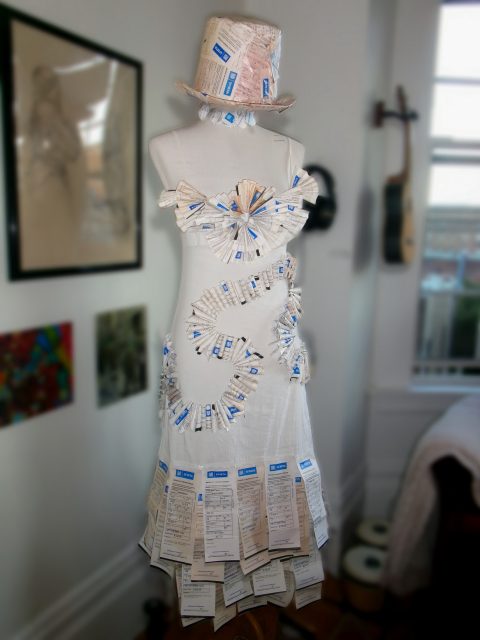
For each ticket, she sewed buttons onto the dress, then folded tickets into accordion-like shapes with electrical tape and glued them onto the buttons. The sweetheart neckline has tickets fanning out like starbursts, and tickets flare at the hemline, reminiscent of flapper-era style.
“Every time I sew one on, it will pinch a little bit of the fabric into the button. The dress has been getting tighter and tighter — I hope it still fits!” she said.
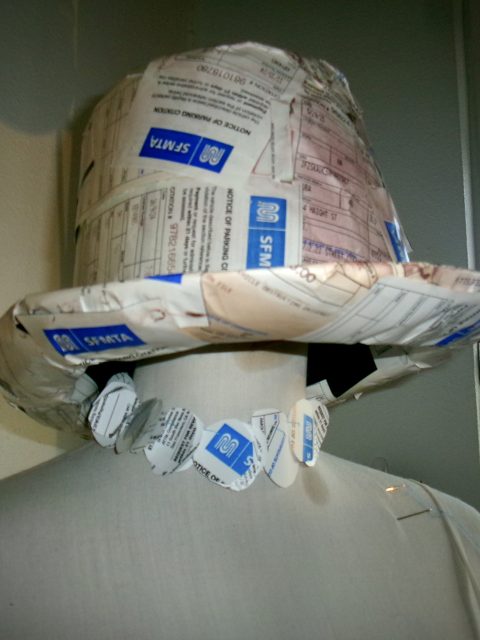
She now has more than 100 parking tickets on the dress. With the piece almost finished, she decided to make some accessories with the leftover tickets: A hat covered with overlapping tickets, and a small necklace.

The project has ignited conversation in the comments section of her TikTok videos documenting the dress about the perils of having a car in the city, said Panthofer.
Especially for musicians and artists who have equipment that has to be lugged from gig to gig, a car is imperative. But those are often the same occupations that can’t always afford the multiple parking tickets, she said.
“San Francisco has such high fines for parking citations, and they say it’s to promote this transit-first idea, but simultaneously, they are actively defunding Muni,” Panthofer said.
Panthofer is currently working multiple jobs as she settles into a new creative career. Along with her sessions at the yoga studio, she performs and teaches music to students of various ages.
Eventually, Panthofer hopes to sell this “collector’s item” parking-ticket dress to someone for the total cost of all the parking tickets sewn onto it. She is also working on getting a parking permit in the city.
She has no inclination ever to return to biotech.
“This used to be an artistic city. But now, with tech and everything, it felt like the stereotype was that there weren’t any living artists left here,” she said.
But, as she’s letting the “wind take her wherever,” she has met more creatives who love their work and have managed to stay.
Her parking ticket struggles, though, seem far from over. In the weeks since Mission Local spoke to her, she got two more. To pay them off, she’ll be cleaning buses again.
It’s so easy to get a RPP permit and it costs like 50 cents a day for a year. But you know, let’s blame someone else.
It depends on when you apply. SFMTA chooses to only offer 12 month or 6 month pricing, which makes it considerably higher than 50 cents a day depending on when you apply. They could easily offer pro-rata pricing instead.
OK, so worst case scenario it’s for 6 months for a permit and around $1 a day. Still better than collecting $100 tickets and complaining about it.
City residents can get parking permits. It’s unclear why she didn’t apply.
No, they can’t. I’m surrounded on three sides of my block by an RPP zone but because my specific building isn’t covered, I am ineligible for a permit. That means I have to find a parking space in 1/4 of the area available to others who live on my block.
Then rent a space for your car or, better yet, get rid of your car.
She’s not a resident. She’s another entitled transplant who doesn’t think the rules apply to herself. To make things worse, she’s trying to attract attention to herself instead of taking responsibility for her own actions (or lack thereof).
James,
If she lives in the City, she is a resident.
If she is a citizen or legal resident of the USA, she has as much right to live in SF as you.
You’re comment is nothing more than textbook jerk-wad “entitled” nativism.
I can appreciate the creativity, but I’d simply not rack up nearly $1000 in parking tickets if I didn’t want to owe $1000 in parking tickets.
At 92$ per it’s not a lot of tickets.
10 parking tickets is a ton (especially over less than a year!) You should have your license suspended at that point.
Duh, there is no cumulative punishment for accruing multiple parking tickets. You can collect hundreds of them and, as long as you pay them, nothing else happens.
In fact the City will love you, as everyone knows that the main purpose of parking tickets is revenue collection.
True. But the sort of person who messes up parking that badly likely isn’t a great driver as well. They typically go hand in hand.
You don’t think being caught and punished for breaking the law 10 times in a year is a lot?
She was unemployed and couldn’t find time in her day to obey the street parking rules? No wonder she didn’t promptly find a new job.
The dress is beautiful!
The parking in her area was moving the car every 2 hours as it says.
You’ve done that for a day even? SFMTA is a racket.
But she’s just completely in the wrong? Move your car for street cleaning! You have no right to keep your private vehicle on a public street 24/7.
So, this could have been avoided if she’d have been willing to get out of bed? Girl, please. If you were worried about $100/ticket you would’ve gotten your a** up.
Furthermore, an enrollment fee range of $29 to $84 doesn’t seem outrageous when you owe the City nearly $1,000. Again, because *you just didn’t feel like getting up to move your car.*
I can’t.
Why doesn’t she just get rid of the car? It’s clearly a luxury that she can’t afford.
She actually relied on it for her job, and hoped to get another.
Other than that sure, she should just sell pencils at the airport.
She relied on it for her job? What makes you think that? Their offices are right off of 101. It’s a 35-minute ride from Potrero on the 292 line.
This sounds like a skill issue
Get a resident permit? Then you can park for three days without moving your car.
Up to three days. Depending on street cleaning times, it can be considerably less (some residential parking zones have street cleaning 3+ times a week).
Not in all areas.
Yes, why should any of us have to follow ordinances? So dumb.
Points for the creativity though.
End the suffering! Just get rid of the car!
If you read, she works in SSF and there’s honestly no reliable public transportation option there in under 3 hours. Look into stuff then talk like a hippy.
And if you read, she USED to work there. She no longer does and no longer has that excuse.
BART, Caltrain, and samTrans all run through that area. Your Clipper Card works on all of them. Also, she worked in biotech. Take one of the tech buses.
Really? Have you looked? South SF is only 10 miles south of SF. It’s a 20 minute ride on Caltrain.
And the connecting bus can’t take more than a half an hour or so because she can’t possibly be living in the Outer Sunset or something, because only the inner neighborhoods do 2 hour parking.
And if she’s truly in a place where the bus to Caltrain takes too long, she can get a bike. Caltrain takes bikes. And anywhere in South SF is about 10 minutes by bike from the South SF Caltrain station.
You’re basically either ignorant, or you’re lying.
The Outer Richmond has 2 hour parking in an RPP zone.
You’re basically either ignorant, or you’re lying.
I mean when I lost income from not being able to work and moved to a place where I couldn’t park, I just sold my car. I actually ended up making money on my car because I got it used and cars have been going up in price with the pandemic.
You can get a residential permit for like $180/yr. Just google it and save yourself all these tickets & cleaning busses at 4am. If you have a lease and a utility bill you’ll be set. (Even if you need to move in afew weeks/months it’s still worth it).
I will say that even I got a ticket on 24th St last wk, and I was standing right next to my car, I’m not even sure how I got it. I had paid the meter, so maybe it was 1-2mins over. $100 poof!, so frustrating. I’m so careful not to get one.
Nice composition on the dress.
it’s $214 now..but still that’s less than three tickets
Boo hoo hoo.
“This used to be an artistic city. But now, with tech and everything, it felt like the stereotype was that there weren’t any living artists left here,” she said.
Olive,
If you truly want the make SF a city where artists and others of modest means can, once again, call home — become a pro-housing YIMBY advocate.
I hope she sees this experience as a learning opportunity. Being unemployed doesn’t give you the right to park your car on public streets for free.
Best of luck with the job search! I’m looking forward to cleaner in part because of her hard work!!
Love the creativity! This city needs more artists
This is amazing! Getting a ticket is always so annoying and to some, shameful. Thanks for making lemonade out of lemons and sharing the grievances of the people!
Also permits can be difficult to acquire if ur car isn’t registered in CA.
Thanks for sharing this lemons to lemonade story. Makes me want to transform two boxes of IEPS into an art project.
SFMTA/DPW is a racket.
Explain how? Do you think people should be able to store property on the street wherever they like, for free? Are you even dimly aware of what percentage of US population either has no license or limited to no access to a car? Thirty-six percent. That’s over **one third ** of the population. So yeah, I’m pretty ok with an agency that at least tries to make drivers pay for the privilege of having so much space to store their vehicles on public property.