
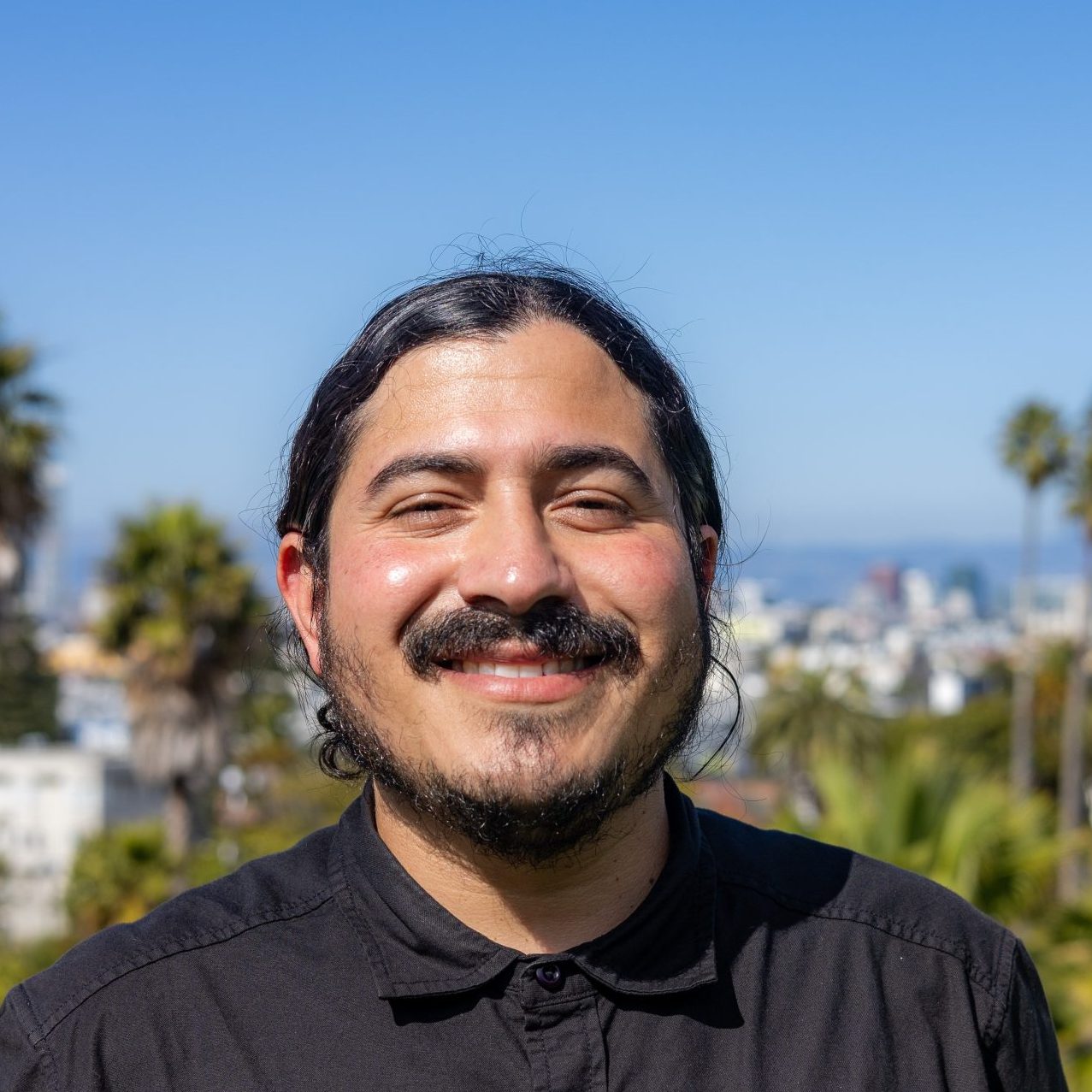

The Mission District is mourning the loss of one its cultural pillars and teachers. Ricardo “El Tigre” Peña died Monday morning from an apparent heart attack. He was 54.
“He was our guardian angel, an Aztec warrior of love,” said Roberto Hernandez, the chief executive officer of Cultura y Arte Nativa de las Americas, the non-profit overseeing Carnaval, an event in which Peña and his wife Connie Rivera have danced for decades.
“He was the heartbeat of our community with his danza. He brought medicine.”
Peña was a father, husband, artist, business owner, teacher, tío and a Nahuatl Indigenous danzante and drummer proud of his culture and roots. He was a friend to those who walked by Mixcoatl, the Mexican gift shop he ran with his wife and two children at 24th Street and South Van Ness Avenue for the last 21 years.
It was common to see him setting up sage, palo santo, traditional Mesoamerican arts and crafts and luchadores masks outside the store, and walking his daughter’s dog, Sleepy — or Oso, as he liked to call him — every morning and night.
But most people saw Peña, whether they knew it was him or not, as a friend and as an Aztec dancer. For more than 30 years, Peña, his family and their troupe, Danza Azteca, were ubiquitous Mission fixtures at community meetings and celebrations.

“This dance, this tradition has been passed down from oral tradition from generation to generation. We’ve respected it,” Peña said in a 2022 documentary about him and Danza Azteca. “For us, dancing is our way of praying. Our way of connecting to our elders.”
Peña moved to the United States when he was 17 from his native Toluca, a city just west of Mexico City. He had met Rivera in Mexico, and was following her north.
From the start, Peña and Rivera, who soon married, called the Mission District their new home. They carried their ancestral traditions, and the two kept practicing danza Azteca, passing the knowledge to generations of Mission kids, including two of their own, and blessing all kinds of ceremonies throughout the neighborhood.
“My mom says that I have been dancing since I was in the womb,” said Xochi Peña, Connie and Ricardo’s daughter, when asked about what it meant dancing alongside her family. “I’m very grateful that my parents continued the traditions from their ancestors.”
Xochi said there were not enough words or adjectives to describe who her dad was, but if one met him, then one would know.

“I learned a lot from his patience. He had so much love to give, whether he knew you on a deeper level or not. He never held any hate in his heart,” said Xochi. “He always had just some story to tell or something to teach you. People felt like they could open up to him. I wish I could have learned so much more from him. He was a great man.”
Friends and neighbors also described Peña as a man who was generous, wise, kind, humble, calm, peaceful, spiritual. A great listener who was always at the service of his community.
Every year, he’d volunteered with the Calle 24 Cultural District, hanging up papel cortado and small Latin American flags along the corridor during holidays like Día de Los Muertos and Fiesta de las Américas.
He and Connie also taught free danza Azteca classes at the Mission Cultural Center for the Latino Arts.

“He was our drumbeat. He was el latido de nuestro corazón,” our heartbeat, said Martina Ayala, the executive director of the Mission Cultural Center for the Latino Arts, where Peña and Connie taught danza Azteca for years.
“When you see Ricardo’s life, you see la Calle 24. You see the Mission, because he was always around, everywhere in our local businesses and our local organizations.”
Ayala said that, through his dancing, Peña shared his ancestral knowledge, spiritual grounding and a deep love for his traditions.
“His teachings shaped generations of dancers and families and community members who came to the Mission Cultural Center for Latino Arts seeking a connection, culture and healing,” Ayala said.
“Ricardo’s passing is a profound loss to the Mission District and for all of us who were touched by his gentle strength, his unwavering dedication.”
Some of the local businesses Peña liked were San Jalisco, La Taza, and Dianda’s bakery. He liked Sierra Nevada Pale Ale, an occasional whiskey, sweets, the Golden State Warriors (he designed a T-shirt once), the nopales his mom used to make in Mexico and Connie’s cooking: Enchiladas, moles and chiles rellenos.
He also liked heavy metal — Sepultura was one of his favorite bands — but he shared a bond with Xochi for Maná.
“With me and him, it was always Maná,” said Xochi, adding Mariposa Traicionera and Ángel de Amor as two of his favorite songs. She said her dad also liked his coffee and bread every morning.
Victor Nhul, 36, whose parents opened the Jelly Donut in 1987, diagonally across from Mixcoatl, has known Peña most of his life.
“He was the man of the Mission,” said Nhul. “The Mission District, he represented all of it, all the community aspects … he’ll say hi to you and everything if you knew him, or if you didn’t know him.”

Nhul remembers Peña as a good person and a hard-working man who always wanted to help people. Peña helped Nhul’s parents when they ran the shop and, more recently, was always a friend to Nhul, often offering to switch spots whenever Nhul needed a parking space.
On Tuesday afternoon, Nhul recalled Peña’s regular order: A sugar donut and a coffee — though, lately, he’d switched to tea as he tried to drink less coffee. One thing he admired, Nhul added, is how much Peña loved his wife and children.
Susana Rojas, executive director of Calle 24 Cultural District, knew and worked with Peña for the last five years. She said he leaves behind a legacy that will be cherished and honored, one they will continue to talk about to make sure future generations know who “El Tigre” was.
“He was a pillar of the community and definitely a staple of 24th Street. He was a keeper of culture,” Rojas said. “He shared the ancestral ways.”
Lydia Chávez, executive editor of Mission Local, met Peña 27 years ago when she was looking for a painter. They remained friends.
“He was remarkable; a man without artifice, someone you wanted to see and be around. He had an aura of calm, and a wonderful way of just being,” said Chávez. “And that smile. He was a very special person.”
Israel Rangel, an employee at 24th Street Auto Repair across the street from Mixcoatl, said he couldn’t believe his friend’s passing. He met Peña, who was a client of the shop, two years ago when he started working there.
He described Peña as a generous man who brought the employees sodas and tamales. He’d also share coffee and bread whenever they visited him at his shop.
Werner Delgado met Peña walking around in the neighborhood three years ago when he migrated from Peru.
Despite not being a close friend, he said that, on one occasion, Peña listened and gave him advice when he needed just that. He also vouched for him for a paint job, gave him a lift after his vehicle broke down, and even offered him a beer here and there.
When asked what she thought made her dad so special, Xochi said she believes it was the morals her grandma taught him: Always respect women, always put family first, help anybody in need. And, though gone physically, he’s not gone in spirit.
“Now that he’s gone,” she said, “I’m always going to carry him with me whenever I dance.”
Those interested in making a donation to the Peña family can do so here.

I’m so sad to hear this news, but also grateful for the reporting of Ricardo’s life and all that he gave to others. What an amazing person and example. I’ll miss you Ricardo!!
There was a vigil outside Mixcoatl for Ricardo on Tuesday evening.
I remember him always nodding his head and smiling or making a little comment about whatever metal T-shirt I happen to be wearing that day walking by his store. Mission legend! RIP Ricardo, that corner won’t be the same without you.
I would see him everywhere in the neighborhood. Walking his dog, putting up papel cortado and flags down 24th Street, but specially outside of his shop. This past dia de los muertos the dancers stopped on 24th and van ness but seemed to not have a drummer. Out of nowhere and saying excuse me through the crowd came Ricardo with with drum followed by who may be one of his children. He stood in the center and began playing his drum. He made that night so majestic for everyone in attendance. He will be missed and the Mission will not be the same without him. Rest in peace Ricardo.
Just a stroll down memory lane, but a Black woman,of Trinidadian decent created the first Carnival, and for decades, an African American gentle man, managed it. My condolences go out to Sr.Pena and his family and I’m sure he will be missed in the Mission.
During the Covid19 pandemic Ricardo and Connie volunteered at the Mission Food Hub. They were there constantly even though they still ran their own shop. Ricardo would be at the entrance when the doors would open. His strong presence made everything run smoothly. He was a gentleman to everyone that came to get food. A true leader of his community.
So devastating to hear. He was indeed a fixture. If you’ve been to the Mission, you have seen him or experienced the impacts from his generous heart. We have been so blessed to have been a part of his world. It is so tragic to lose such an important part of the community. Much too young; he will be missed.