

On a summer night in 2021, a fire broke out and burned down an art studio in Los Angeles’ Little Tokyo, where mixed-media artist Eunnuri Lee had collected her work for more than 10 years.
That included her art school thesis and the materials she used to make art. Calling herself “a sentimental hoarder,” Lee collects bits and pieces from her past, like pearls from her birth mother, or flowers she has meticulously accumulated over the years.
Lee has spent the three years since the fire recreating her lost work and making new ones. Now, she is showing her new pieces at the newly opened Strike-Slip Gallery at 14th and Guerrero streets.
Her solo exhibition, titled “Capitalist(ICK),” will be shown together with “Beyond Material,” a group exhibition featuring four other female Asian artists in the basement of the gallery. Opened earlier this month, the exhibitions will continue through June 1, with an Asian-American and Pacific Islander artists’ talk this Thursday, May 23, from 7 to 8:30 p.m.
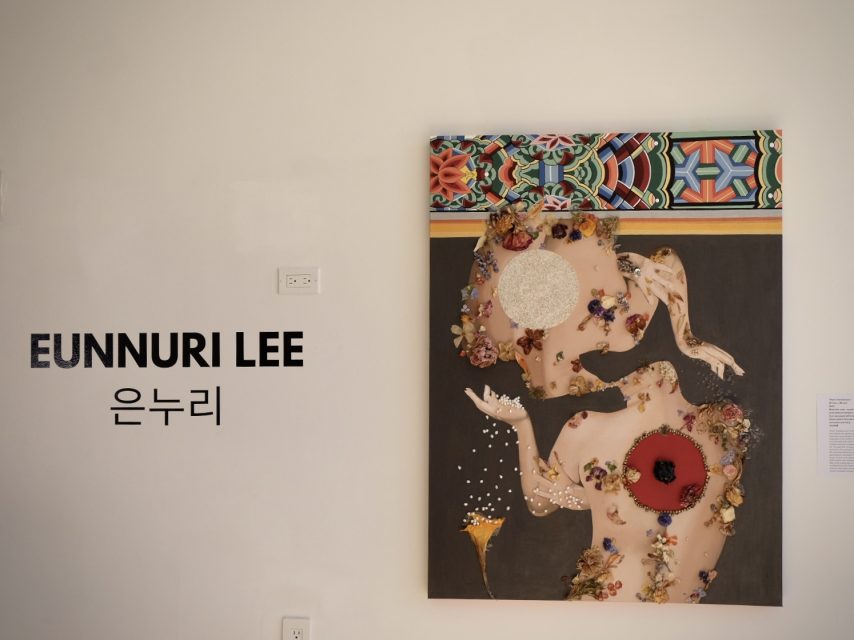
For Lee, the exhibition is a chance to showcase new iterations of her work, which she says, “look nothing like the original[s].” Her pieces still include self-portraits, but now they’re made from a wider variety of materials: A combination of acrylics on canvas, collages of social media posts and unusual materials, like repurposed make-up products.
What remains the same is Lee’s straightforward yet personal approach to work that explores her fractured identity. Born in South Korea, Lee, who is now 27, immigrated to the United States at the age of 1. That was soon after her birth parents died in the 1997 Korean Air flight 801 crash near Guam.
Early on, Lee indicated a predilection for art. During doljab, a ceremony in Korea in which a baby is placed in front of various objects and encouraged to grab one ( the choice predicts the child’s future), Lee picked the colored pencil. At four, she could be found falling asleep with pencils, markers and notebooks all around her.
Lee studied art at the California Institute of the Arts in Los Angeles. Now, she finds herself combining the surreal style of her youth with realism.
“I’m finding a middle ground,” she said. “I call it my left brain and my right brain, when I’m thinking too much or when I’m not thinking at all.”
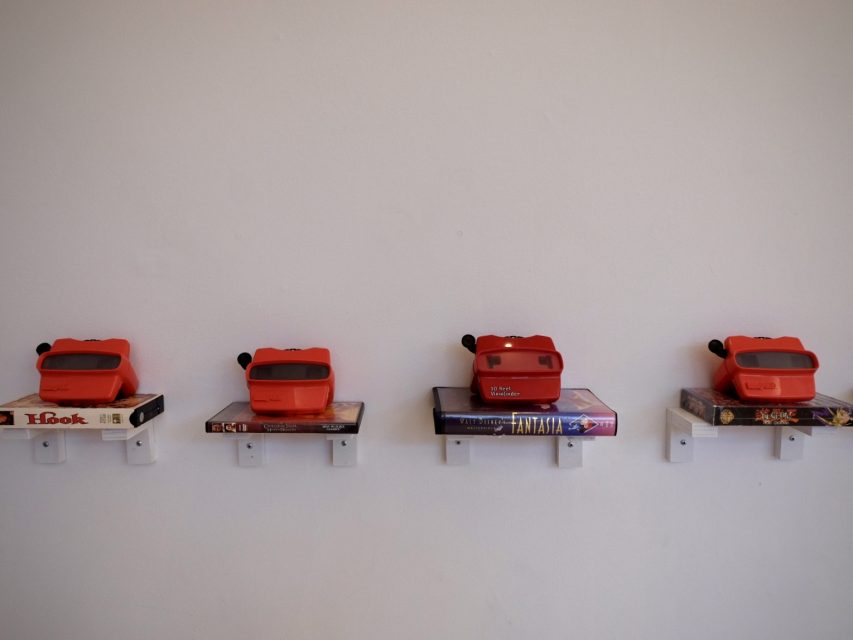
In “Looking at you as you look into me,” visitors peer through a viewfinder at Lee’s childhood photos, which lay above captions lifted from a letter by Lee’s grandfather. The letter, titled “my opinion on Eunneri’s future” and sent to Lee when she turned 18, explains why Lee’s grandparents decided to send Lee to America. “We want her to grow up without feeling of loneliness rooted from being an orphan,” one caption reads.
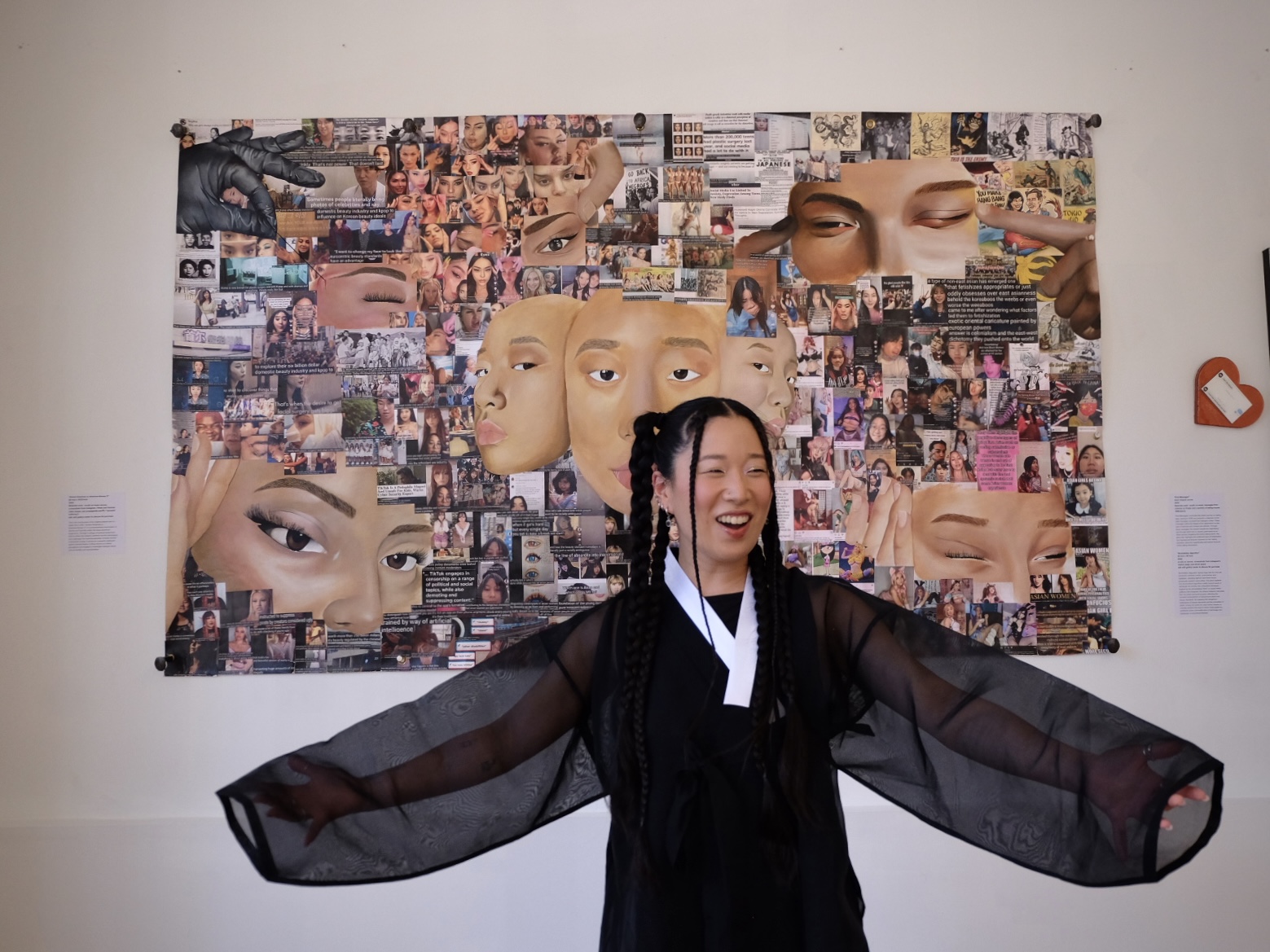
Physically, the largest work is “Korean-American or American-Korean 2” — Lee lost the first version in the fire. Through self-portraits and a collage of social-media screenshots, Lee details her experience of being an Asian woman in the United States: First she was feared and hated, then she was “sought after and fetishized” for her appearance.
In another piece, Lee depicts her face in the middle of the frame, with features that are considered beautiful in two cultures: Full lips in the United States, and flat eyebrows in Korea.
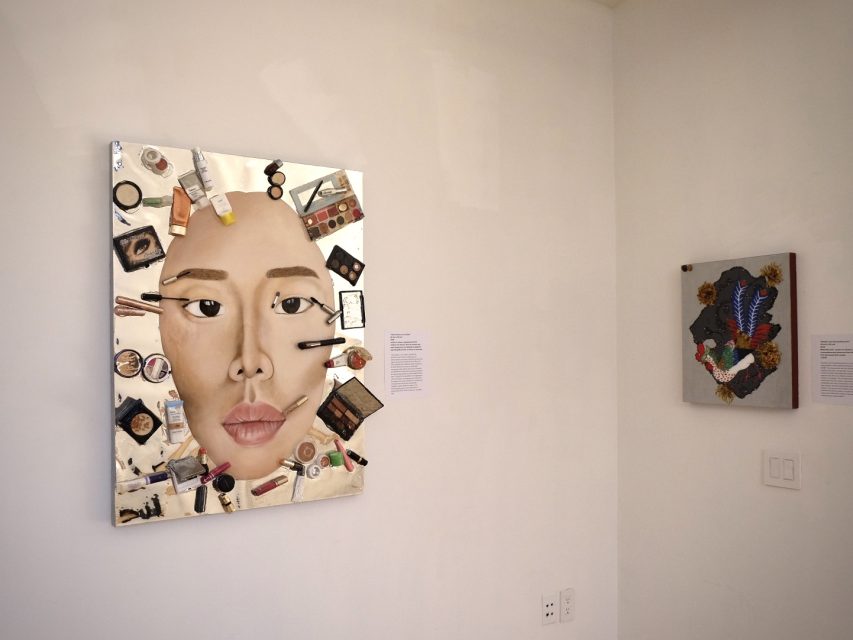
In “What am I supposed to look like?” Lee surrounded her self-portrait with a collage of Google search results for the query, “What are Asian women supposed to look like?” The results are plastic surgeries and Asian women described as “docile creatures.”
“It’s a mind-map exploration of the intersection of capitalism, consumerism and media,” Lee said. In both Asian and American cultures, women are bombarded with images that tell them how to change their appearance, and the products to buy to achieve conventional beauty.
Lee’s work leaves visitors reflecting on their own cultural identity and how that identity is perceived by the people around them. It’s exactly the kind of provocative work from emerging artists that Strike-Slip Gallery’s founders hope to highlight in the future.

Opened in February, the new gallery at 201 Guerrero St. was most recently occupied by the Misalignment Museum, spotlighting AI risks; the museum moved to a bigger space at the Chase Center last September.
The gallery was founded by James McCaffrey, a real-estate agent turned artist, and Soo Mee Yoon, a full-time Google employee and part-time gallery-events coordinator.

The Mission is a special place for the couple, who moved to the neighborhood four years ago. Last summer, at McCaffrey’s old studio between 18th and 19th streets, the co-owner hosted an open studio with 27 other Bay Area artists. More than 800 people showed up on the first night.
“Just seeing how much people in San Francisco were hungry for art, it was a sign that this is something that our community needs,” said Yoon. “We also just want to open up another retail business that could uplift this neighborhood and the city.”
In the basement of the gallery, the show features four other female artists: Momoko Schafer, a glass sculpture artist “in a male-dominated field” who Lee said “has an empathetic touch” in her work; Seesha Takagishi, who depicts nostalgic scenes like a spontaneous udon lunch with her family, with barley tea in styrofoam cups; Kristen Wong, who has four new pieces with layers of painting, photographs and hand-rendered marks; and Saint, a Filipinx American artist showing illuminated sculptures that emphasize light and space.
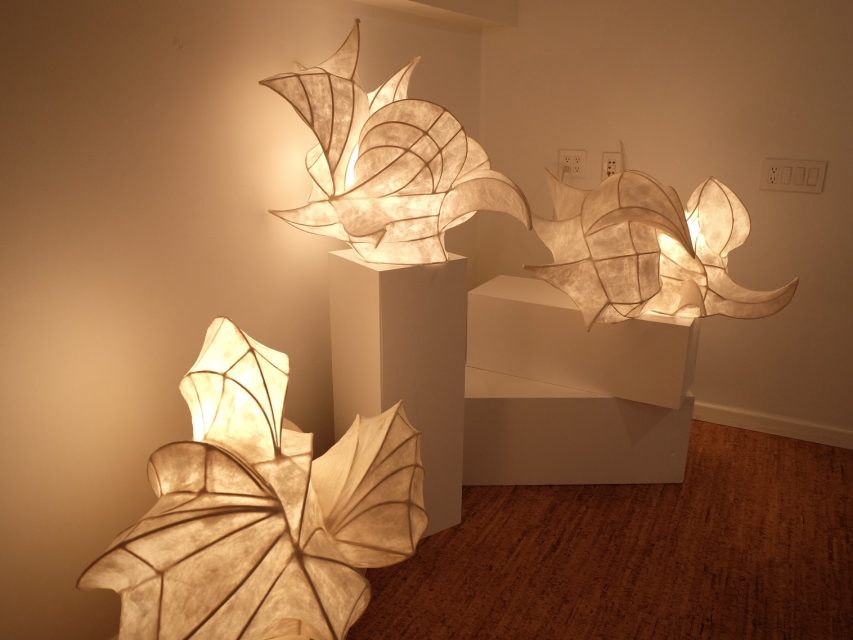
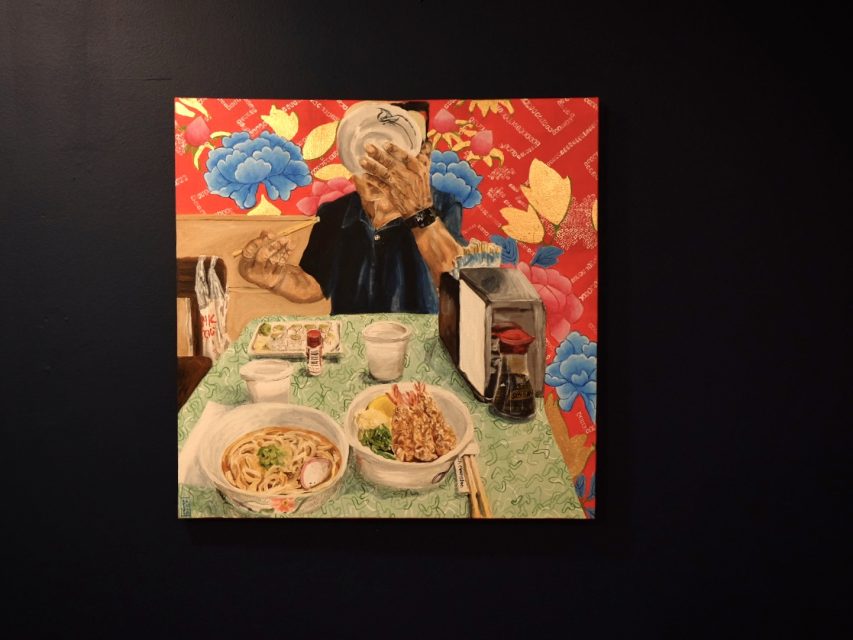
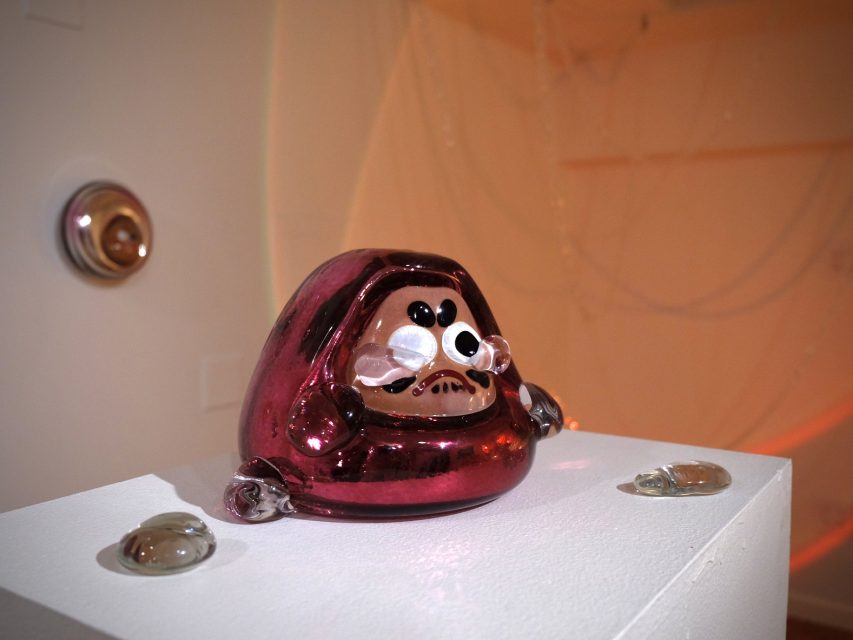
“The concept is a group of artists who dare to make work without the idea of making money in mind,” said Lee, co-curator of the group exhibition. She said she noticed how many artists compromise their practice to accommodate what is aesthetically pleasing and sells well. “But after aesthetics, what’s left?”
“You have a lot of privilege that comes with art making, and I believe that I should use that privilege for the social, political, cultural change that I seek,” she continued. “You can make a beautiful piece, but if it says nothing, then I don’t care about it.”
Strike-Slip Gallery is open on Tuesday to Friday from 3 p.m. to 7 p.m. and Saturday and Sunday from 11 a.m. to 7 p.m. Most artworks are available for purchase.