

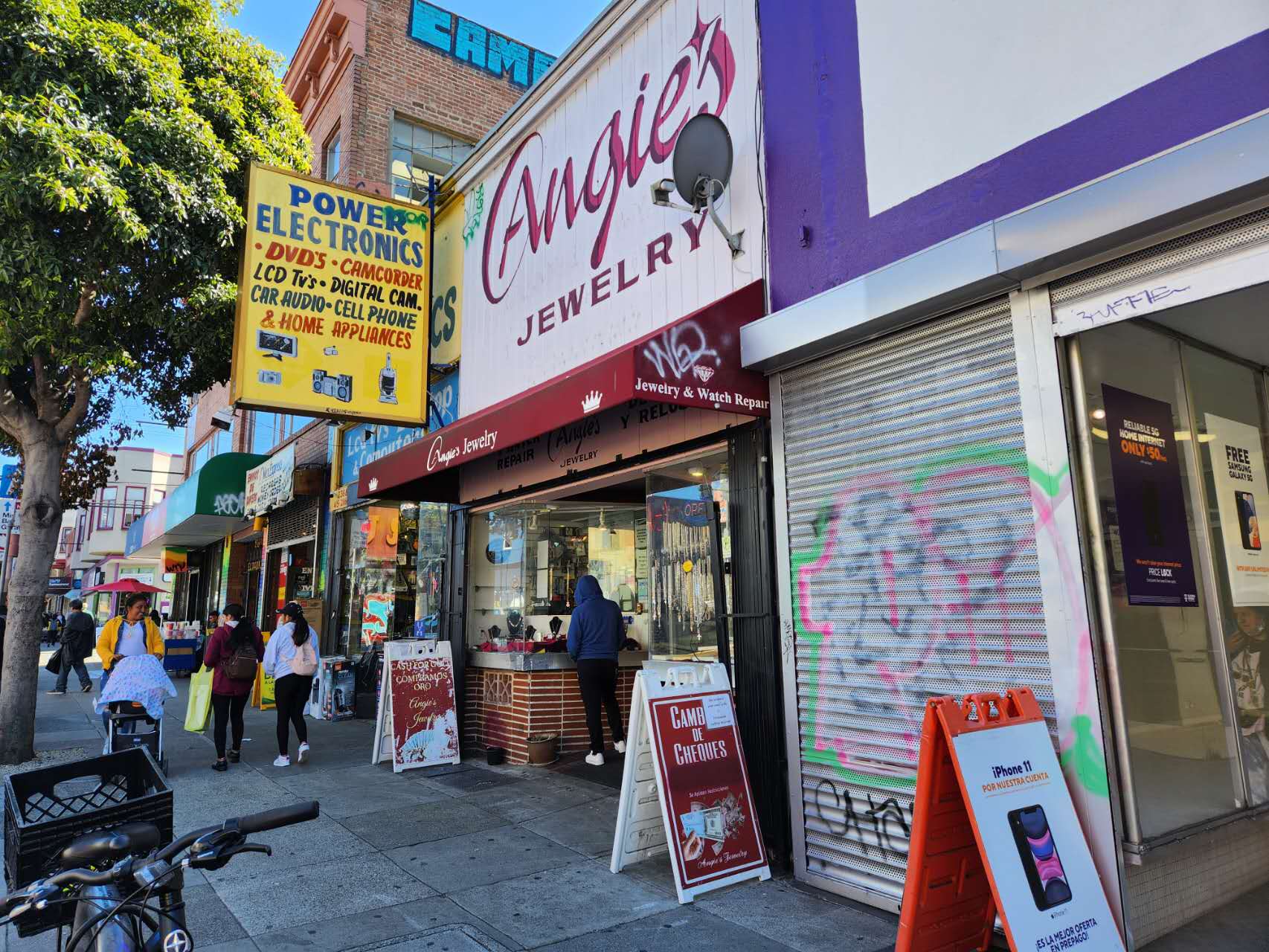
The sale and repair of jewelry and watches alone is no longer a lucrative enterprise for many Mission District jewelers, but a new lifeline has emerged for some: Providing financial services, like check cashing, for those without bank accounts.
Check cashing and boosting customer credit have saved two of the neighborhood’s jewelers in recent years. At these jewelers, customers can exchange their checks for instant cash in a store, for a fee, or finance their purchases, building their credit score while paying down gems and jewels.
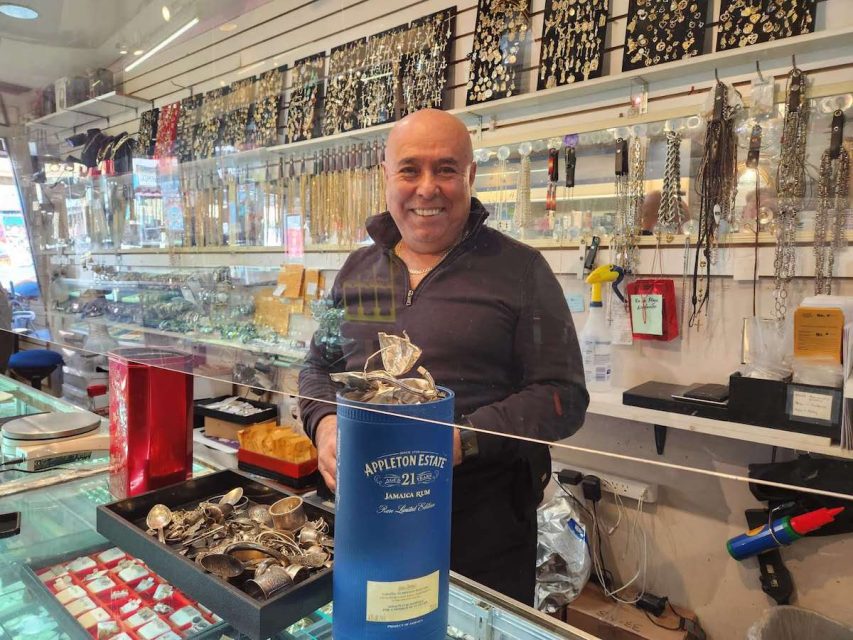
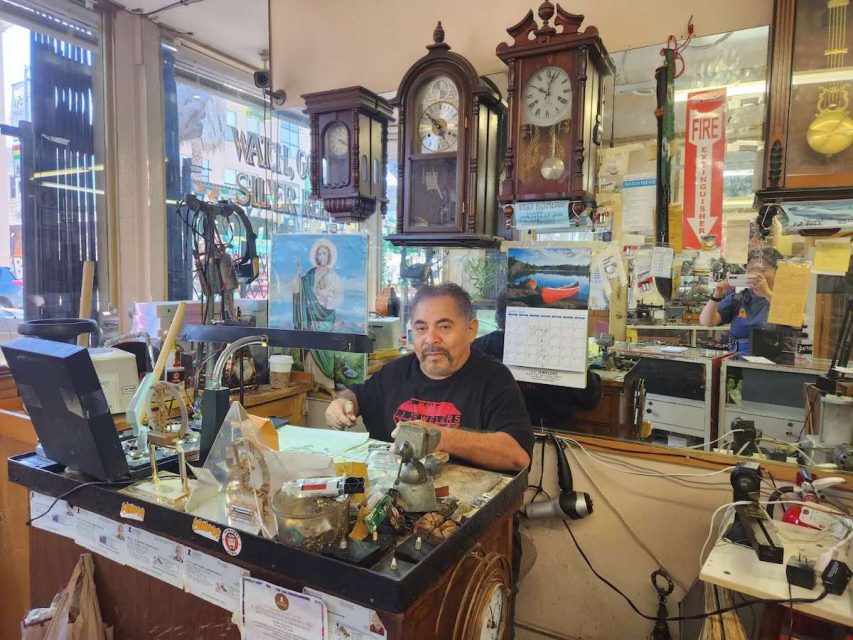
“We don’t sell much,” said Ramon Gonzalez, the owner of Angie’s Jewelry on Mission Street. “We cash a lot of checks.”
Neither gold nor watches are a cornerstone for Gonzalez: Check cashing alone now accounts for 60 percent of the total revenue at Angie’s Jewelry, with sales making up 30 percent and repair services the remaining 10 percent, he said. During the pandemic, check cashing not only kept Gonzalez’s business afloat, but vibrant.
Gonzalez said he charges one percent of the check’s face value for his regular customers. New customers or those presenting personal checks sometimes may be charged up to 3 percent. The higher rate helps cover the risk of a check bouncing. To provide the service, Gonzalez has to renew the store’s Check Casher Permit with the state’s Department of Justice annually.
That is in line with larger check cashing establishments: California Check Cashing Stores and Sigue Envios de Dinero, both in the Mission, charge between 1 and 3 percent for payroll checks, and up to 10 percent for personal checks.
California caps check-cashing fees at 3 percent of the check’s value for payroll or government-issued checks (or 3.5 percent if a customer has no ID). Personal-check-cashing fees are capped at 12 percent.
The store had to turn to checks for revenue when metal prices rose.
“You know what the gold price was 20 years ago?” asked Gonzalez, standing behind a long glass shelf of gleaming chains and rings.
“Two hundred dollars per ounce. And now how much?” Gonzalez asked. “Two thousand.”
As the metal becomes more expensive, fewer people buy gold jewelry, and profit margins shrink. Check cashing has made up the deficit.
Check cashing serves the unbanked
For many, cashing a check requires little more than a trip to the ATM or a photo uploaded to an app, but those without bank accounts must seek alternative channels that usually involve paying extra.
“Some people don’t have the papers to go to the bank and cash their checks,” said Gonzalez, referring to the undocumented immigrants who are unable to open a bank account, which often requires a Social Security Number and other identification documents.
Now, many banks have started to accept an Individual Taxpayer Identification Number in lieu of an SSN, which anyone can obtain, regardless of immigration status. Still, it doesn’t necessarily make a bank account more desirable for the unbanked.
Across the country, Black and Latinx households are more likely to be unbanked, as are foreign-born, non-citizen households. Most national banks also require initial deposits between $25 and $100 or have minimum balances, making the prospect unaffordable to many: “Not having enough money to meet minimum balance requirements” was the most cited reason for staying unbanked in a 2021 national survey.
“It’s not that they are unaware of the benefits of banking,” said Liliana Hernandez, a financial coach at the Mission Asset Fund. “It’s more that they are shut out of the system.”
Other frequently cited reasons include “avoiding a bank gives more privacy” and “don’t trust banks.”
The check cashing business, Gonzalez said, now makes up the bulk of the store’s clientele — and keeps him far busier than repairs did. “We are busy all the time.”

Jewelers make up for lost revenue in multiple ways
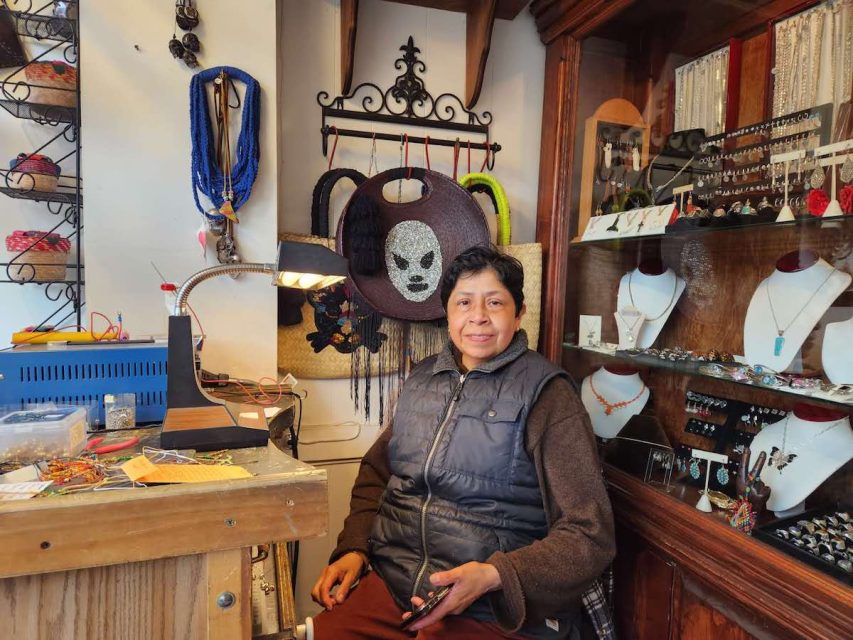
Diana Medina, of Diju Jewelry on 24th Street, has added blouses, hats and scarves to her racks, as selling jewelry alone would not suffice these days. Even so, sales barely cover the rent and bills, and sometimes not her salary. “It’s okay for the business,” said Medina, “not for me.”
Across the street is J.J. Jewelers, a three-decade-old jewelry store in the Mission. “You can see there’s only two customers in one day,” said the owner, Edgardo Campos, on a recent Wednesday. The shop was still suffering from a post-pandemic malaise, he said. “So it’s very, very slow.”
Jaime’s Jewelries on Mission Street experienced slow business even before the pandemic, according to the owner’s sister, Aracely Guevara, in the store. Having to pay the rising rent even during the pandemic closure just made it worse. Now, business has improved, but is not much better. All Guevara could say was, “everything is so expensive here” and “we are surviving.”
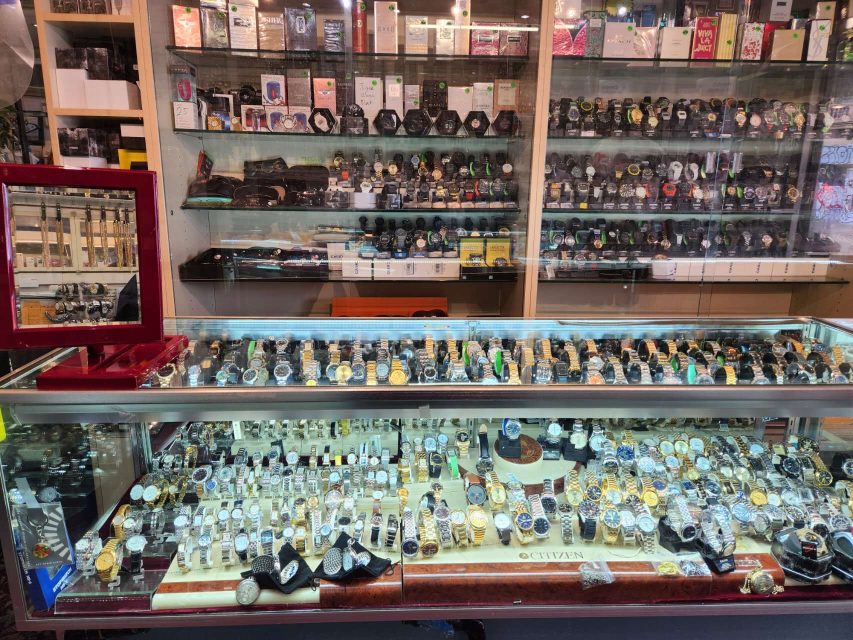
Just five years ago, Gonzalez of Angie’s Jewelry recalled, he would order watches four times a year to keep up with demand, holding up four fingers to illustrate. “Now, only once a year,” he said, dropping three fingers.
“People don’t buy watches anymore,” Gonzalez lamented, gesturing towards a glass shelf stocked with metal watches that sparkled in the light.
Meanwhile, a single basic fitness band with a little screen, packed in a plastic box labeled “$10” in hand-written script, hung forlornly in a corner on the wall on the other side of the store — a small reminder of the new era of smartwatches.
Building credit through jewelry
Cashing a check is not the only financial service for Mission jewelers.
“Bad credit, no credit, instant credit, OK,” reads a bold-font Spanish-and-English poster right outside Latin Jewelers, which sits at the same block as Angie’s Jewelry, between 19th and 20th streets.
Latin Jewelers allows customers to finance their jewelry purchases like financing a car — a down payment, followed by monthly installments — a rare service for neighborhood jewelry stores.
Irene Peña, the owner’s daughter who now runs the business with her brother, said that they report their customers’ payments to credit bureaus, meaning customers build credit while paying off jewelry, as they would when financing a car or home.
But customers do not need stellar credit to finance jewelry at Latin Jewelers, and they can walk out with their piece on monthly installments as long as they have put 50 percent down.
In fact, customers who finance jewelry get another perk: They can make monthly payments directly from their paychecks, and the remainder is given to them as cash, without any fees. “A lot of our customers here are unbanked,” Peña said, as the free check cashing was enough of an incentive to bring them in. However, they do not cash personal checks.
Peña said that this combination of financing, building credit and free check cashing kept many customers coming back, helping the business weather the pandemic years.
Hearing about Latin Jewelers, Nicole Agbayani, director of the city’s Office of Financial Empowerment, said the stores were filling a clear need. “They really tailored this model to the needs of the community to kind of fill these gaps where other institutions are not.”
“I feel like I want to put a flier there so that she can just point her customers towards a bank account,” Agbayani chuckled, referring to the city-run BankOn program, which accepts alternative forms of identification, like taxpayer numbers and foreign passports, and does not require a minimum balance.
Agbayani said the 19.2 percent annual rate Latin Jewelers charges for financing is similar to, or slightly less than, the rate for credit cards. She said 35 percent would be the threshold of being predatory.
For Hernandez of the Mission Asset Fund, the popularity of check cashing at Mission jewelers was no surprise: People need to access their funds immediately, she said. “I want the cash in hand now, and that convenience warrants that individual paying the fee.”

When Gavin Newsom was Mayor, he publicly aspired to drive check cashers out of business by providing an alternative with banks. Since then, half a dozen new check cashers have opened in The Mission. I worried that they were replacing shops that provided crucial services, but when I checked they were mostly flower shops and photo places.
Thanks for the article but I think you should do one about services that immigrants can use so that they do not fall for these outrageous fees of 12% for personal checks.
They might be nice people running these shops but let’s be clear… this is a predatory business (it makes more profits from the shortcomings of others).
It would be great if the community new more about alternative services that actually help people while not paying such high fees.
Right.Charging 12% to cash a personal check. These people are saints.
I thought the article states there’s a CA legal limit at 3% to cash checks..?
“California caps check-cashing fees at 3 percent of the check’s value for payroll or government-issued checks (or 3.5 percent if a customer has no ID). Personal-check-cashing fees are capped at 12 percent.”
The limit is much higher for personal checks as the risk of the check bouncing are higher.
Exactly. The entire check cashing industry is borderline predatory and causes way more debt and financial stress than any “privacy concerns” an actual bank could ever manifest.
The thing that really irks me is that all of these businesses suffering as a result of a shift in shopping habits and trends act dumbfounded; as though they can’t figure out why people aren’t interested in old/heirloom jewelry, etc. In fact, most of 24th street is emblematic of this issue.