
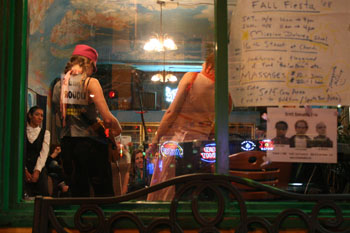
In the dark of the evening on a residential block of Folsom Street, a singular garage beamed like a backlit aquarium. Viewed up close, it had transformed into a small stage, occupied by a poet reading for a handful of people watching from the driveway.
A few blocks down, pedestrians streamed through a fence and into a backyard, where hundreds of hanging lanterns decorated a tree canopy above a pair of guitarists.
Over on 24th and Van Ness, drivers and pedestrians slowed to a standstill to watch a performance of Aztec dancers, the rapid beat of the log drum reverberating for blocks.
It was all part of the Mission Arts and Performance Project, or MAPP, a bimonthly event that takes art and its
makers from the rarefied realm of museums and into quotidian locales. Choreographer Theresa Dickinson danced in a garage, poet MamaCoAtl performed in a backyard, and Spanish heavy metal flooded 24th Street. For one afternoon and evening, ordinary Mission District hangouts turned remarkable, and art became everyday.
[kml_flashembed movie=”http://media.journalism.berkeley.edu/mission/MAPPsoundslide/soundslider.swf” height=”280″ width=”350″ /]
“You come into these intimate places and it’s kinda like walking into different worlds,” remarked Noemi Castro, holding a cup of wine and watching a jazz vocal and piano performance in a living room.
The audience on the second floor of the Harrison Street Victorian occupied every couch and chair, so Castro watched from halfway inside the home’s bathroom. A laid-back performance of local talents and friends, the show had the feel of a late night bohemian dinner party.

The living room, belonging to writer David Kubrin, was one of the sixteen venues participating in this month’s MAPP, all within a square kilometer between 20th and 25th Streets, and Bartlett and Bryant.
Across the neighborhood, performances on the sidewalk in front of the Mexican crafts store, Mixcoatl, evoked a different world completely. At dusk, a local Spanish rock band, Amnesia, assaulted the neighborhood with amplified covers of Jimi Hendrix and Metallica, drawing curious and appreciative crowds at the corner of 24th and Van Ness streets.
The low-key event was started five years ago by a collaboration of local artists and organizations. “The whole concept of the MAPP,” said singer and poet MamaCoAtl, who has performed at several of them and helped plan this month’s, “is to create a neighborhood celebration that is all about art, that is about transforming an ordinary place into an offering of art.”
Standing outside of the garage venue, called “Garage Azul” because it was flooded with blue light, MamaCoAtl said this was “the organic way to do things.”
“We don’t expect a festival or an institution to provide us with the space and the time for us to create and share our art.”
To thesbian Tony Bravo, MAPP strips away the modern trappings of performance art. “Performing in people’s houses and traveling from venue to venue,” said Bravo, following his set of musical comedy commenting on gay marriage at the garage, “brings performing back to its most root level. It brings it back to a place where it’s not about production, it’s not about money, it’s not about anything other than just art in its purist and simplest form.”
Aside from the rare donation box, no money was exchanged throughout the day. The venues, whether sidewalks, coffee shops, private homes or backyards, were open to anyone, and the performers earned nothing but applause, the chance to see other artists, and maybe a cup of wine.
“You know why we do it?” asked MamaCoAtl, a legendary veteran of the local arts community. “It feels good.”