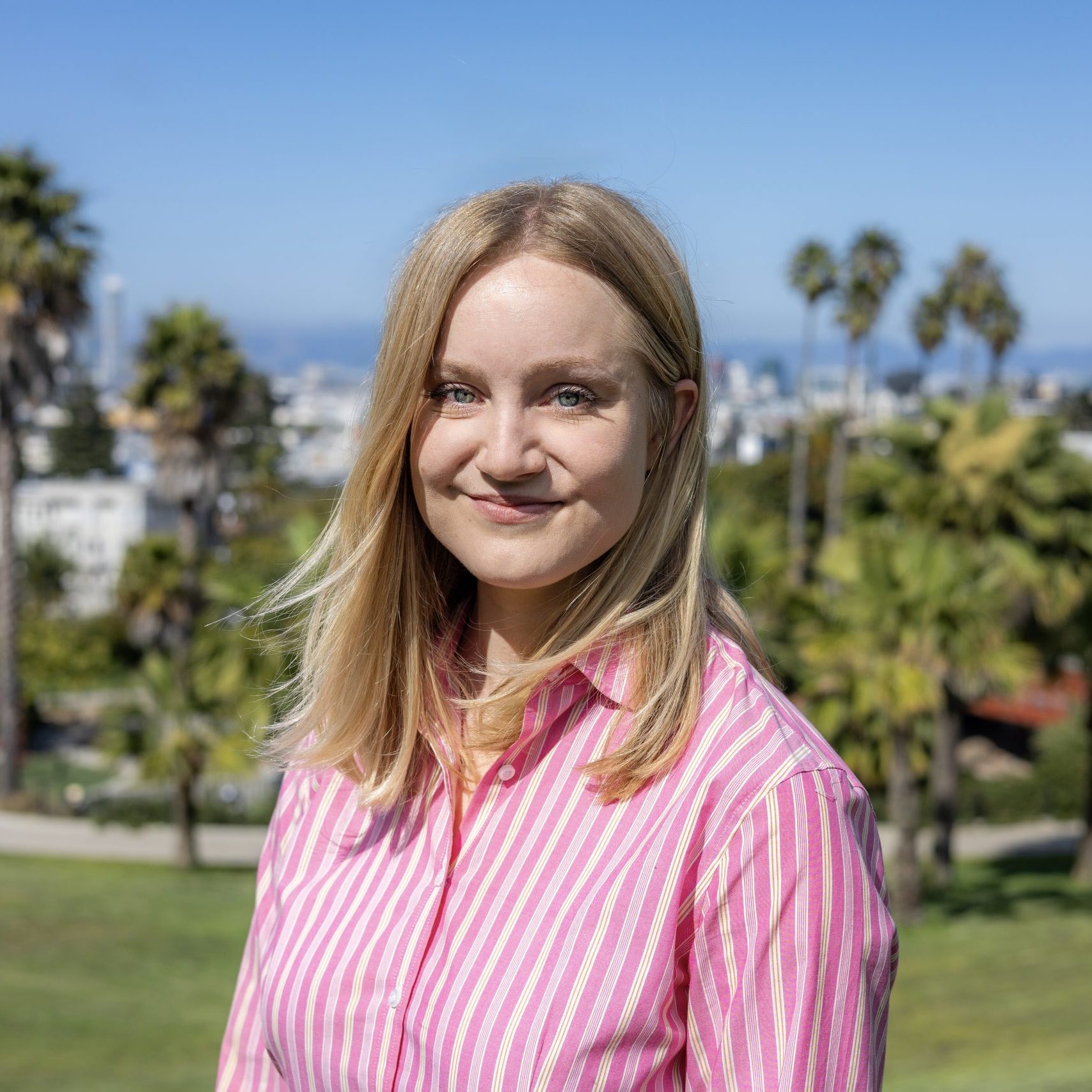

Debbie Walker, 69, has been homeless for nearly three years, cycling from living on the street to boarding in shelters in the city’s southeast.
But for the past year, she’s found a new home in an 80-square-foot double cabin she shares with her son.
Walker was one of the first residents at Jerrold Commons, a Bayview homeless village opened last April. She is living alongside 66 others in 60 cabins, tucked among the neighborhood’s many industrial warehouses.
“I’m like the mayor here,” said Walker on a recent afternoon.
Walker lived at the Bayshore Navigation Center for a year and a half before staff approached her to move nearby to Jerrold Commons.
The center’s staff has recruited its other residents in a similar fashion, searching the Bayview for residents like Walker: Older, disabled, and often chronically homeless adults who reside in the neighborhood.
It’s a good change, Walker said: a private room, case management, bingo nights, even art therapy — she pointed to a puffball glued onto a papier-mâché seashell, a recent creation.
Plus, Walker said, “I know just about everyone.”
But new neighbors may be in short supply. The expansion of the site, which Mayor Daniel Lurie championed last year, has been stalled indefinitely after the neighborhood’s supervisor, Shamann Walton, blasted Lurie’s plans.
Walton said that homeless people had been historically “warehoused” in the district, and that he was not consulted on the decision.

Today, half a dozen empty cabins remain in storage at the shelter, awaiting a decision on whether to use them at Jerrold Commons.
Even under Walton’s successor, who will be elected in November’s general election when Walton terms out, plans to expand the site may remain shelved. That would put a wrench in Lurie’s campaign promise to expand shelter capacity across the city.
Strolling through Jerrold Commons on a rainy weekday morning in March, Emily Cohen, a spokesperson for the Department of Homelessness and Supportive Housing, said the shelter has been a success.
Plans to expand the site are currently stalled, she said, but the department could replicate Jerrold Commons in other temporary shelters throughout the city.
Jerrold Commons was touted as the crown jewel of Mayor Lurie’s homelessness initiative, and has become a lifeline for older adults who reflect a growing and aging homeless population.
The city has taken a new approach to services at Jerrold Commons, in part because of the high needs of its residents.
Unlike other temporary shelters in San Francisco, which are often resource-constrained, staff at Jerrold Commons come from three city departments — the Department of Public Health, the Department of Homelessness and Supportive Housing, and the Department of Disability and Aging Services — as well as the nonprofit Homebridge.
Barnell Britton, 76, a disabled Bayview resident, was admitted to the hospital last year and had nowhere to go after his release. The transition from street homelessness to his own cabin at Jerrold Commons, where Britton with help from staff is now able to live independently, “changed his life,” he said.
Staff at Jerrold Commons distribute Britton’s medicine daily, and he has regular check-ups at the shelter’s health clinic. It’s unclear how long Britton will stay at Jerrold Commons. The shelter is meant to be temporary, but Britton will have difficulty living on his own.
Though the expansion of Jerrold Commons is paused for now, the shelter’s treatment-focused approach and involvement of multiple city agencies may be replicated elsewhere as Lurie works to meet his goal to provide more shelter beds.
The approach reflects Lurie’s initiative to treat homelessness as a behavioral health issue.
While hundreds of permanent supportive housing units and temporary shelters are slated to close, hundreds of “treatment” beds, which Lurie’s chief of Health and Human Services has said his administration will favor, have opened in their place.
But Jerrold Commons has continued to be viewed unfavorably by the neighborhood supervisor’s office and other stakeholders. It is an example of one more homeless service in a neighborhood they say has been overburdened by them.
Though District 10 contains approximately 18 percent of the city’s homeless population, many of whom live in their vehicles, it holds roughly 12 percent of the city’s shelters.
As of April of last year, the rest which are mostly distributed across the city’s eastern neighborhoods, including the Mission and the Tenderloin, according to a Mission Local analysis.
Neighborhoods on the Westside of the city, including the Sunset and the Marina, have few, if any, shelters. The Board of Supervisors voted in July to make it more difficult to open shelters in neighborhoods like the Tenderloin and SoMa.
Theo Ellington, who is running to replace Walton, says that the site’s location, mere feet away from another homeless shelter, is “not ideal.”
“We are overburdened with homeless services and so having geographical equity in our shelters is a must,” said Ellington. “But I also feel we have a lot of unhoused individuals moving into the neighborhood, and we have to come up with a plan to address that.”
Bayview has one of the largest populations of people living in RVs, which Lurie imposed a two-hour restriction on last year, essentially banning RVs from public streets. But despite the ban, in Bayview, many unpermitted vehicles remain.

The Jerrold Commons site, originally planned by former mayor London Breed in 2023 in collaboration with Walton, was slated to include 20 “safe parking” spaces for RVs and 60 tiny cabins. Those plans were scrapped once Lurie’s administration took charge.
Behind the tiny cabins, large parking spaces intended for the vehicles sit empty — too big to be used for parking, a staff member remarked.
Walton, who called Lurie’s expansion plans the move of an “oligarch” last year, now concedes that the shelter has “kept some folks from having to live off the streets.” But still, he says, the shelter is “the mayor’s project.”