


Some three dozen San Francisco nurses are planning to rally Monday for Ariel, a Filipina immigrant and surgical nurse at Kaiser Permanente San Francisco Medical Center on Geary Boulevard, who may soon be fired because the federal government has not renewed her temporary legal status and Kaiser Permanente has declined to extend her unpaid leave of absence.
Ariel, 34, has lived in the United States since she was 2 years old.
Her case reflects the fragile reality for recipients of DACA, or Deferred Action for Childhood Arrivals, a temporary legal status for children who arrived in the United States at a young age.
More than 11,000 DACA recipients live in the Bay Area, and their visas have to be renewed every two years. Nationwide, the American Medical Association estimates that around 27,000 health care workers and support staff depend on DACA for work authorization.
As she does every two years, Ariel — a pseudonym used to protect her from possible federal retaliation — filed her DACA renewal application on Dec. 1, 135 days before it was set to expire April 15. Usually, she gets a response fairly quickly.
But when she failed to hear back from the government by March, she contacted her union, the California Nurses Association and started reaching out to lawyers.
When her DACA status expired on April 15, Kaiser gave her 30 days of unpaid leave. Now, as the end of the unpaid leave approaches on May 15, it appears that she will lose her job and the promotion she had been training for.
In response to her inquiries, Kaiser wrote, “It is your responsibility to keep your work authorization current.”
The nurses union argues that she is not at fault. Under President Donald Trump, processing times for different kinds of legal status have increased significantly, and Ariel is caught in those crosscurrents, the union said.
Across the nation, over 500,000 immigrants hold DACA status and, like the Kaiser nurse, many have been caught up in delays, according to the Migration Policy Institute.
“This is the life I have known as a kid,” she said of her 32 years in the United States, a country she has never left. Still, she is now considering whether to move to another country, like Australia, where in a few years she could obtain legal status and continue working as a nurse.

Growing up undocumented
Ariel, like many DACA recipients, did not know she was undocumented until later in life. It was when a friend in high school told her they had gotten their green card that Ariel started to ask questions about her own legal status.
She remembers going home from school that day and asking her mother about it. Her mother told her she did not have a green card, but that it was something she should keep hidden.
“I didn’t know anything about immigration issues, I did not know I was considered undocumented and illegal,” she said. Her family came to the United States legally on an H-1B visa work program for physical therapy, but her mother ultimately failed to get her degree, and overstayed her visa.
Ariel knew she wanted to become a nurse but, after graduating nursing school, had no idea how she would be able to work legally.
Then in 2013, when she was 22, then-President Barack Obama created DACA, and she was able to get legal status in time to start working.
She is now up for a promotion in her surgery unit at Kaiser’s Geary Blvd location in San Francisco and has been training for more than six months to become a co-lead of her unit, which focuses on surgeries involving arteries and veins.
If she stays, she will replace a specialized nurse who is retiring after more than 30 years in the position, she said.
Sydney Simpson, another nurse at Kaiser and a union representative, said they are frustrated that Kaiser Permanente will not extend her unpaid leave. Not only will Ariel suffer, they said, “but that unit and patients are going to suffer.” Simpson called Kaiser “very robotic and very inhumane.”
Union pressure, political outreach, and Kaiser’s decision

Ariel and the California Nurses Association are asking Kaiser to extend her unpaid leave by 60 to 90 days to give Ariel time to receive work approval. The University of California hospital system has language in its contract that protects DACA nurses, but Kaiser does not.
Kaiser Permanente did not respond to Mission Local’s questions before the time of publication. After publication, it said it did not receive the initial query and that it is evaluating potential solutions.
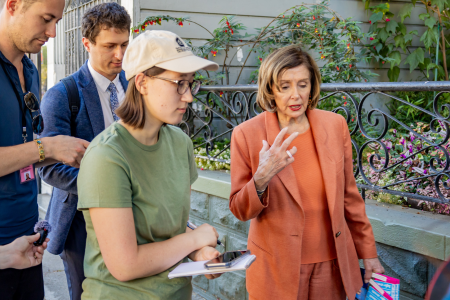
The union has submitted a congressional inquiry to former House Speaker Nancy Pelosi’s office. Alongside the inquiry, at least 11 letters of support from nurses and surgeons were submitted.
“Perioperative nursing shortages are already impacting access to care. The absence of this single, highly trained clinician has real consequences for surgical capacity and patient care continuity,” wrote Elizabeth Lancaster, a vascular surgeon at Kaiser, in a letter of support.
The nurses union is holding its Monday rally at Kaiser Permanente San Francisco Medical Center, 2238 Geary Blvd., at 12:40 p.m.
“I have always been a perfectionist. I have always had to prove myself to show I am good enough to be in this country,” Ariel said. “Through nursing school, even now being co-lead, I feel like it’s just never enough.”
Go go go nurses , surgeons, OR tech and other allied health professionals! Let’s support Ariel!
Please support this DACA recipient