
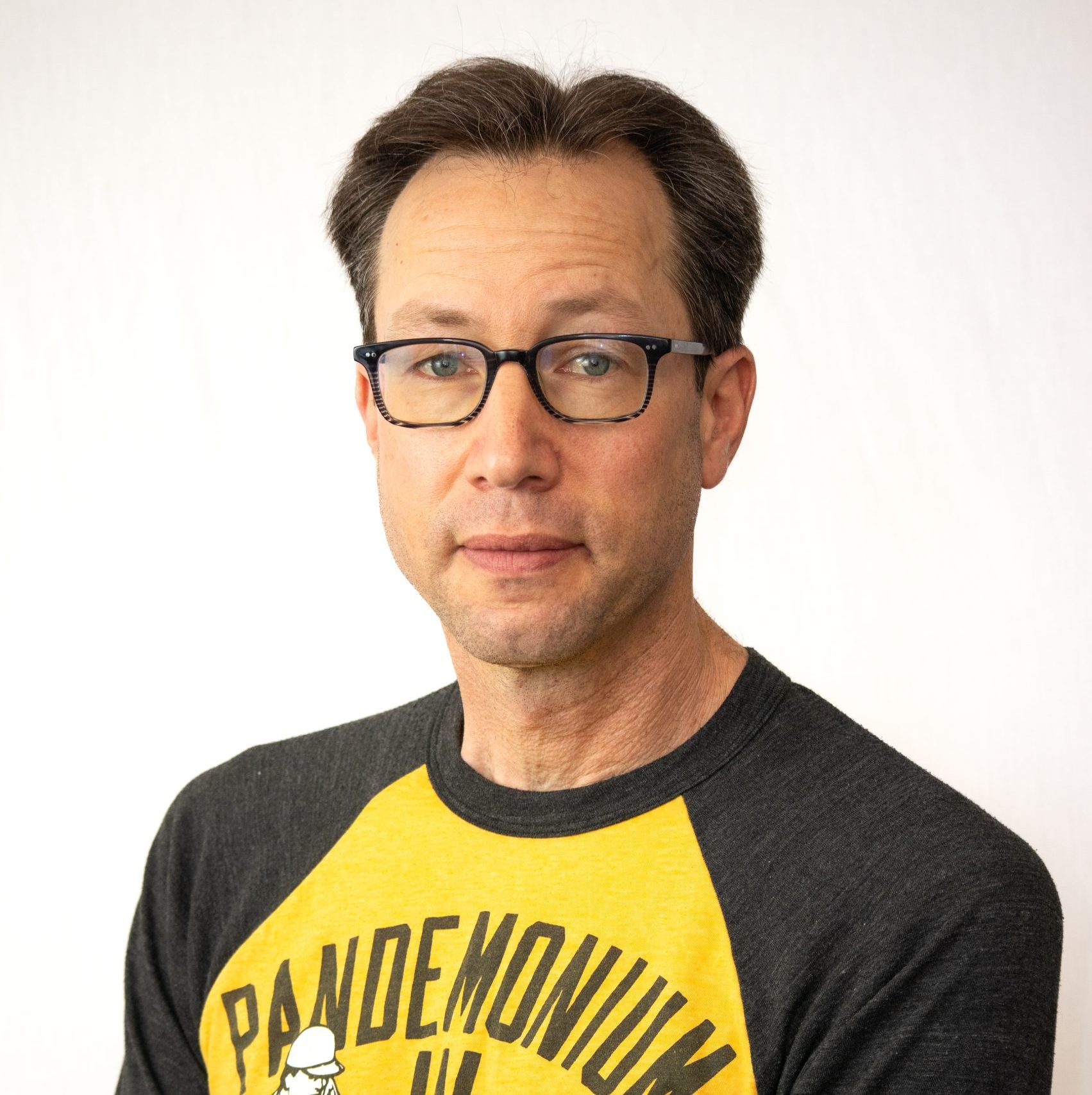

Jerry Brown was the youngest man to ever serve as governor of California in the modern era.
After leaving office, he embarked on a peripatetic career that included studying with Mother Teresa, hosting a radio show and lecturing a University of California, Berkeley class (Regarding the title of Hillary Clinton’s book, “It Takes a Village,” he deadpanned to the students: “Doesn’t it give you a warm fuzzy?”).
Brown then jumped back on the political hamster wheel, running successfully for mayor of Oakland and state attorney general and, finally, becoming the oldest man ever to serve as governor of California.
You’d think the notion of strict term limits would be an anathema to a four-time governor. You’d be right, but not for the reasons you’re expecting.
In June, San Franciscans will weigh in on Proposition B; voters began receiving their mail ballots last week. While city supervisors and mayors must, presently, sit out for four years before running for potential third and fourth terms, Prop. B would install a lifetime cap of two terms, full stop.
Since term limits were imposed on San Francisco supervisors nearly 36 years ago, only one has ever served more than two terms. And, if you can’t guess who it is, Gov. Brown will tell you.
“This is not complex,” he says. “This is all directed at one person in San Francisco: Aaron Peskin. People are giving hundreds of thousands of dollars because they’re worried he will support policies they don’t like.”
“You have a Trumpian move, almost something you might expect from Putin,” Brown continues. “One person is identified and barred from democratic participation. It’s a major abuse of the democratic process.”
“People say this is a solution looking for a problem. But it’s a solution looking for a problem that already happened: You’re a decade late, dude. I had my fun.”
Aaron Peskin on Prop. B
The present term-limit system was passed in June 1990, and was in effect for the election of November 1990. Political consultant Jim Stearns undertook an analysis of all the mayoral and supervisorial contests since that time.
Factoring out runoffs, which were in place until the adoption of ranked-choice voting in 2002, 109 candidates ran for mayor and 587 ran for the Board of Supervisors (120 citywide, 467 in the districts). So, that’s nearly 700 candidates in the course of not quite 36 years.
Of those, only four had served two or more terms in office before seeking an additional term: Peskin (he won) and John Avalos, Dick Hongisto and Carol Ruth Silver (they didn’t). Doing the math, Prop. B would’ve affected not quite six-tenths of one percent of the candidates running for office since November 1990.
Absent its function as the Aaron Peskin Privatization Act, it’s difficult to parse just what problem Prop. B is purporting to solve.

Prop. B is Supervisor Bilal Mahmood’s legislation. He insists that it has nothing to do with Aaron Peskin. He insists that it’s simply a “good government measure” to clarify “voter intent” and close a “loophole.”
Mahmood’s persistent repetition of the term “loophole” does not pass the Inigo Montoya test: You keep using that word. I do not think it means what you think it means.
He insists that, because in 1990 this was pitched as the “eight years is enough” measure and because some ballot arguments and media coverage simply stated it would impose a two-term limit, that voters made assumptions. This is the so-called loophole.
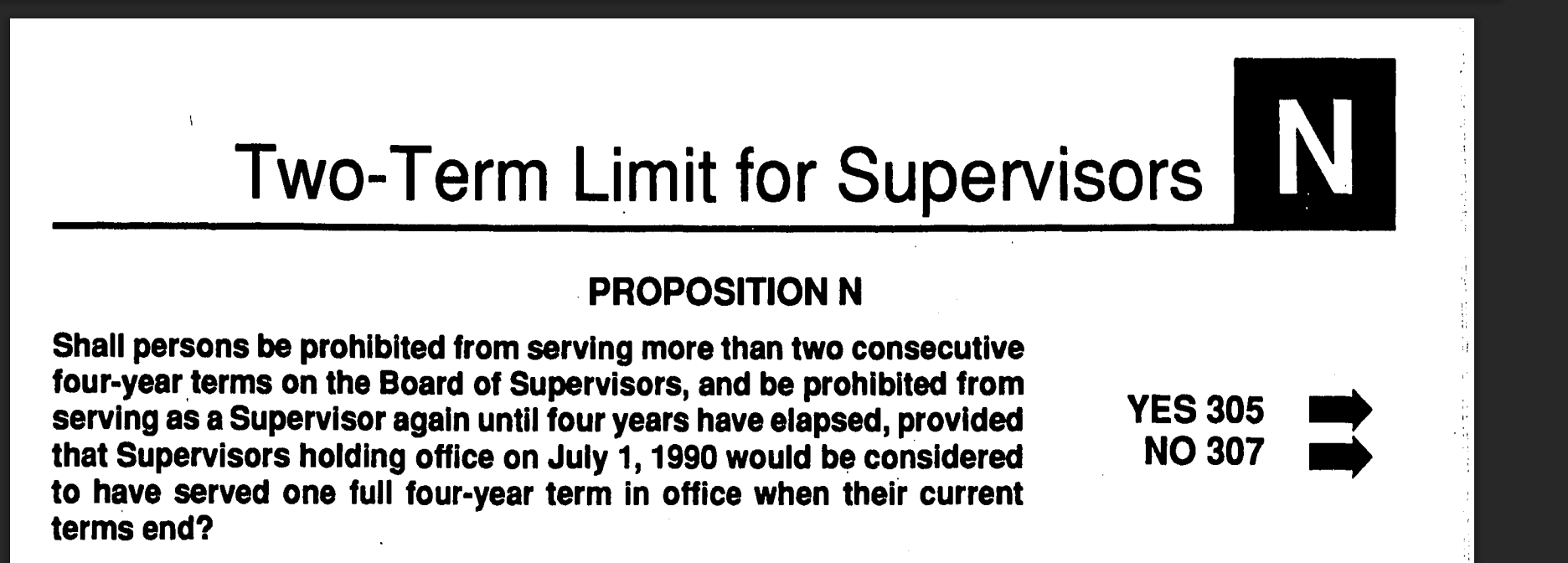
But any voter who actually looked at the brief description atop the June 1990 ballot would see that it clearly stated “Shall persons be prohibited from serving more than two consecutive four-year terms on the Board of Supervisors, and be prohibited from serving as a Supervisor again until four years have elapsed … ?”
Within the official argument for the 1990 measure was the following line: “Former supervisors may run for office again after 4 years.”
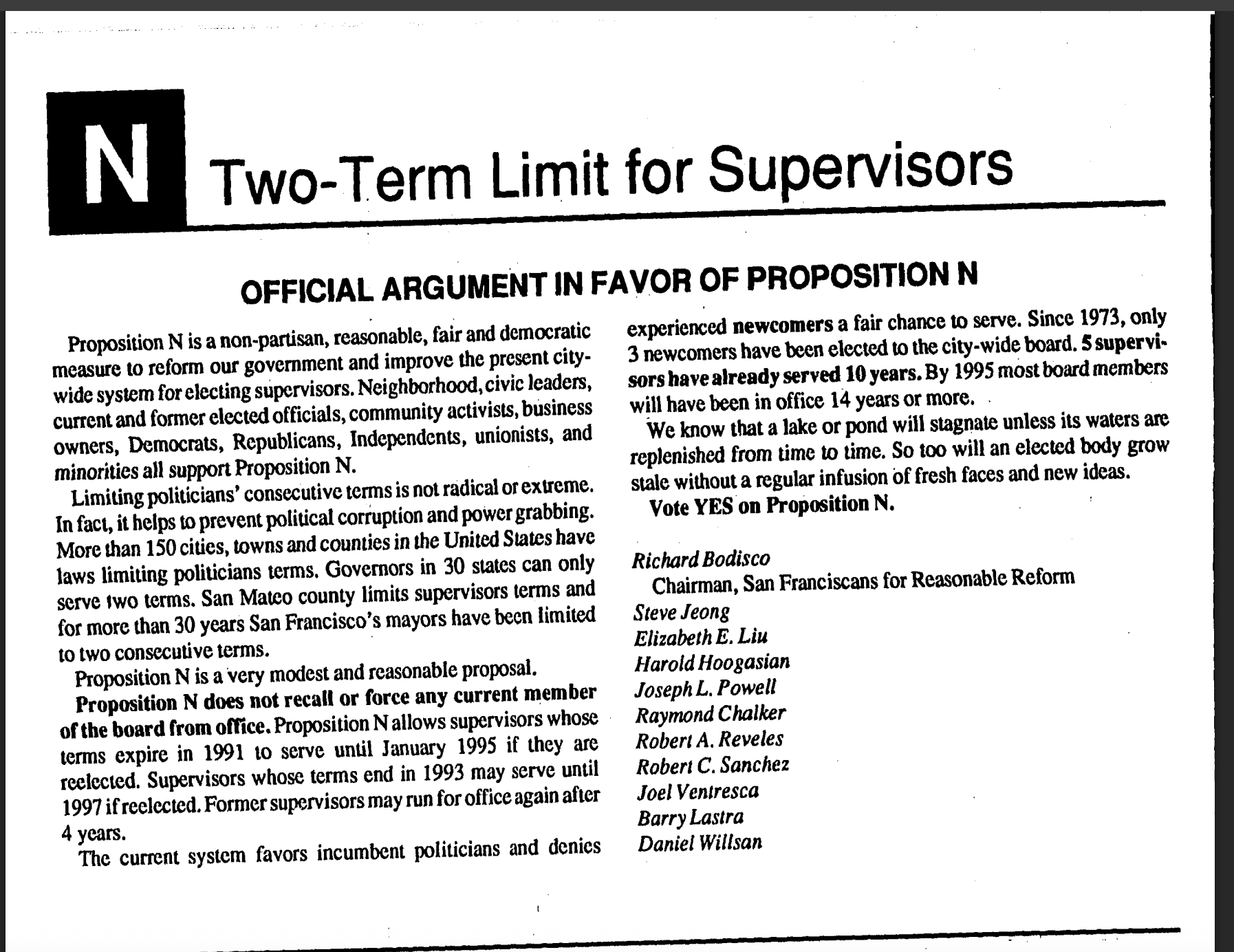
So there was no ambiguity here. And no loopholes.
Mahmood insists that Prop. B will create new opportunities for new leadership. That’s a hell of a claim for a measure that would’ve been irrelevant for 99.4 percent of the candidates who ran for the board or mayor over the past three-and-a-half decades.
It’s also an amazing thing to say when the mayor and four of the six supervisors elected in the latest cycle had never before held office.
Here’s a thought: If Mahmood and fellow Prop. B supporter Supervisor Matt Dorsey were truly committed to opening up the limited number of San Francisco elected positions to up-and-comers, perhaps they should resign the seats they simultaneously hold on the Democratic County Central Committee. You know, get some “new blood” in there.
Mahmood noted that in pushing Prop. B, he and his fellow supes were “holding ourselves accountable. … It limits my ability to serve a third term.”
Hold on there, champ; Mahmood hasn’t yet been elected to a second term. And his legislation would not keep, say, Dean Preston from giving him another run in 2028.
When told that only a minuscule number of politicians have attempted to run for additional terms out of nearly 700 candidates, Mahmood noted that former District 2 supe Michela Alioto-Pier is exploring her possibilities.
Stop the presses: Add her in, and the relevancy ratio grows from 0.57 percent to 0.72 percent.

Prop. B has, thus far, raised nearly $347,000. That includes $200,000 from cryptocurrency billionaire Chris Larsen and $50,000 from billionaire retired VC and San Francisco Standard founder Michael Moritz, who have become two of Mayor Daniel Lurie’s most ardent backers.
SF Believes, a PAC with Lurie ties, has also kicked in $20,000.
San Francisco’s tech barons and the political organizations they foster have no fondness for Peskin. Moritz in 2024 penned a New York Times op-ed laying the blame for decades of city mismanagement on him, labeling Peskin the chief zealot in a “coterie of longstanding political zealots.”
The billionaire wrote in his op-ed that “Democrats like me” were “fighting to take the city back.” That part of his jeremiad, at least, seems to be indisputable.
Our messages to both Larsen and Moritz querying why they donated to Prop. B were not answered. Surely it’s just a “good government measure” to clarify “voter intent” and close a “loophole.”
Unlike the Chronicle, which inveighed against Prop. B in a particularly sharply worded editorial, Mission Local does not do endorsements. You can vote however you wish for whatever reason you wish; you can, like my high school chemistry teacher used to say, make a pretty pattern with the bubbles you fill in on the sheet.
We would be surprised if fewer than 60 percent of voters went for Prop. B; voters like term limits. Regardless, Mission Local isn’t telling you what to do.
But we’re under no obligation to keep mum when city officials piss on your leg and tell you it’s raining.

Jerry Brown is 88, and he doesn’t have time for any of the arguments from Bilal Mahmood or other Prop. B supporters.
“Look, that’s just a cover story,” he says. “There is only one operative motive here: Keep Peskin out to please some very well-heeled contributors. I’m not even sure the supervisors are the leaders. They may be the pawns, too.”
Peskin, meanwhile, says he has no plans to run for office against Supervisor Danny Sauter in 2028. But, to be fair, Peskin had no plans to re-enter public life in 2015 either, and only did so after a concatenation of strange and terrible events.
“People say this is a solution looking for a problem,” he says of Prop. B. “But it’s a solution looking for a problem that already happened: You’re a decade late, dude. I had my fun.”
With 17 years, Peskin is the longest-serving district supervisor and, if Prop. B passes, that title likely becomes permanent. In the pre-term limits days a little-remembered at-large supervisor named Dewey Mead served from the mid-1930s to the mid-1950s. In the present day Mead doesn’t even merit a Wikipedia page.
“I spent 17 pretty intense years working 17 or 18 hours a day,” Peskin says. “It’s pretty nice living. I don’t want to say stress-free, but a vastly stress-reduced life.”
“It’s nice being able to walk down the street and not be barraged by 20 different people asking for 20 different things, 10 of which are intractable problems.”
Actually, that’s not entirely true. Even out of office, gobs of North Beach Frank Capra characters stop Peskin on his walks to and from Caffe Trieste; some even hand him sheaves of paper from the planning department or building department notices of violation and ask him how to extricate themselves from trouble.
Yes, Peskin admits, that’s still happening. “But now,” he says, “I just give them Danny Sauter’s number.”
This story has been altered to acknowledge Gov. J. Neely Johnson, Supervisor Carol Ruth Silver and Supervisor Dick Hongisto.
I’m a D3 resident. Aaron Peskin was a far more effective, knowledgeable, and productive representative than our current one. And the fact that he wasn’t so obviously beholden to big tech and real estate speculators was a great asset to us.
Sorry but Aaron is the problem, time for his leach on public funds to figure out what’s next
I wasn’t a huge fan of Peskin, but I’m also pretty disappointed in Danny Sauter. He’s been a consistent vote for a punishment-first approach to public safety/homelessness, including voting for the cruel RV ban and to remove Max Carter-Oberstone from the police commission. I’d hoped despite being part of the “moderate” faction, he might be a little more independent/thoughtful on these issues.
Even if Sauter were more aligned with me, I still think he should have to earn a second term by serving his district well and not get it by changing the rules to disqualify a potential opponent. It’s ironic that this term limit measure is actually designed to protect an incumbent (by making a second term more likely).
Well, that is it for me. As soon as billionaires attempt to pass something using their buckets of money, it no longer something I will vote for. Federal, state, local.
I actually support term limits, and maybe even age limits, but not if these propositions are funded by billionaires and their City Hall lackeys. They want nothing good for anyone but themselves. They fool way too many people who lack critical and analytical thinking skills, believe mailers and social media content as wholesale truth, and mistaken our country as a meritocracy.
J. Neely Johnson was the youngest man to ever serve as Governor at 29. Not Jerry Brown.
David —
I’ll be damned. You’re right. I’ll alter the story.
JE
It’s pretty clear that Lurie, Mahmood, Sauter, Sherrill and Alan Wong think a supervisor’s primary job is that of influencer as opposed to problem solver, legislator or policy wonk. They film themselves bestowing awards, honors and plaques while critical services for SF’s most vulnerable children, elders and moms are slashed. San Franciscans desperately need more reactionary ideologues making Instagram posts about music festivals, burritos, boba and Star Wars. Nuanced knowledge of law, the City Charter and the framed structure of how to make effective legislation are impediments to civic joy, abundance and fun. More shiny things!! Let’s run democratic government like a streamlined global corporation! Fun!!
gotta vote against the billionaires on this one. no to prop b.
After Pelosi came out in support of term limits, I laughed and threw up.
When the gas bag steps down, she will have been in THE SAME office for forty years. She was elected to her first term, then happily (read arrogantly) decided she was the savior of city, the Democrats and even democracy and needed to run another NINETEEN times.
I have mixed feelings about term limits, but it’s pretty obvious that Pelosi is just a liar when it comes to her feelings.
If term limits for elected officials in San Francisco are so crucial, why did the silly authors of the ballot measure restrict it only to supervisors and the mayor? Oh, right. They are scared of Peskin.
The tech billionaires think they can buy this city and erase our progressive nature and elected officials and turn this place into a suburb like they moved here from. I wish they would all just move to Texas.
What passes for San Francisco’s progressive nature is largely window dressing – a self-congratulating perfunctory veneer without results.
That we are reduced to term limited supervisors waiting out a cycle to run again is testament to the weakness of the progressive bench comprised almost exclusively by legislative assistants, nonprofit and public sector labor employees.
Yes, the golden age of SF progressives is certainly over.
First there was Moscone and Milk. Then there was Britt and Bierman. Then there was Ammiano, Daly, Mirkarimi, Campos, Avalos, Kim and Preston. Compared to them, Fielder and Chan are rank lightweight amateurs.
But another point there. All those and every other former Supe moved on with their career. Ammiano even made it to Sacramnto – the only SF progressive to ever win outside SF.
As for Peskin, he was never a true leftie anyway. But rather an unpredictable opportunistic liberal, with a couple of major personality flaws. And perhaps that is why he never moved on from being a Supe, unlike the other names I mentioned. It is like he peaked 25 years ago and is now his own personal tribute act.
Jerry Brown has more intellect than the total Board of Supervisors combined.
Too bad this article came AFTER I already deposited my ballot. I would have voted no. It’s my problem with all the political canvassing, pamphlets and now journal articles that come AFTER the mail vote ballots are delivered. Some of us are Janes-on-the-spots so your arguments and info go wasted.
Ann, yes I also already voted by mail and so all these ML articles are now moot.
I guess ML wants to ride election fever and attract the eyeballs as the date approaches. But more and more people are voting early and by mail, so conventional campaigning and reporting might need to adapt.
For what it is worth, I voted Yes on B.
Ben —
Your statement about how writing articles about election matters during election season is an attempt to “ride election fever and attract the eyeballs” is a bit mind-boggling. It’s common sense to do this, the same way it is to serve lunch foods at mid-day or write baseball previews in April.
I commend you for voting instantaneously but most people do not. These articles are still relevant for the vast majority of the electorate. You do not get extra points for voting quickly and people who question their early vote due to inadequate research could have waited to read the articles that tend to come out in the run-up to election; June 2 is still a little ways off.
Best,
JE
It’s really too bad that the dems in SF are now basically republicans minus maga. I don’t think “liberal” even is a thing here. You’re either looking to make things better because the *system* is itself broken, or you like how the system works for *you* and the only problem is there aren’t enough cops to arrest every homeless person.
On a related topic …
Open not to Mayor Lurie,
I was talking to Marcos the other day and we agreed that the reason you are proposing to take away the Mayor’s power to put Charter amendments on the ballot by themselves is because your handlers do not want to pass all of these laws taking more Power from the average voter and giving more power and wealth to your class and then have a Progressive Mayor come in and simply reverse the process.
Then, it hit me !
Your ‘handlers’ (people who silo you from reality) must actually agree with me.
About you.
That a ‘Lurie 2.0’ in a second term may have become a Progressive out and out like Jerry Brown.
That’s what I’m hoping for.
You’d have your, “Are we the baddies ?” moment.
And, couldn’t undo what you’d done before.
So, I’m urging you to retain the Power you have to directly place things on the ballot.
Go Niners !!
h.