

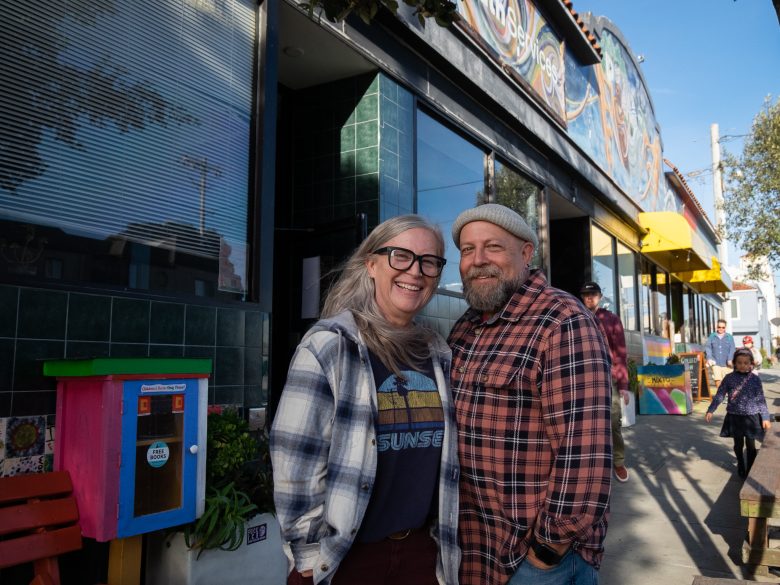
Dawn Stueckle had been a Sunset resident for six years when she walked into a neighborhood video store in 1998 to rent a movie.
And there it was, a piece of paper at the register: a petition to kick her nonprofit out of the area.
“Oh my god, this is about us,” She thought. “I don’t even know what to say.”
Stueckle had just become the executive director of Sunset District Community Development, which would later become Sunset Youth Services.
The nonprofit is now one of the biggest youth service providers in the city, with $2.6 million in revenue, 80 percent of which is public funding. It hosts art and music programs, offers case management at Juvenile Hall, among other services for some 400 to 700 teens, young adults and families every year.
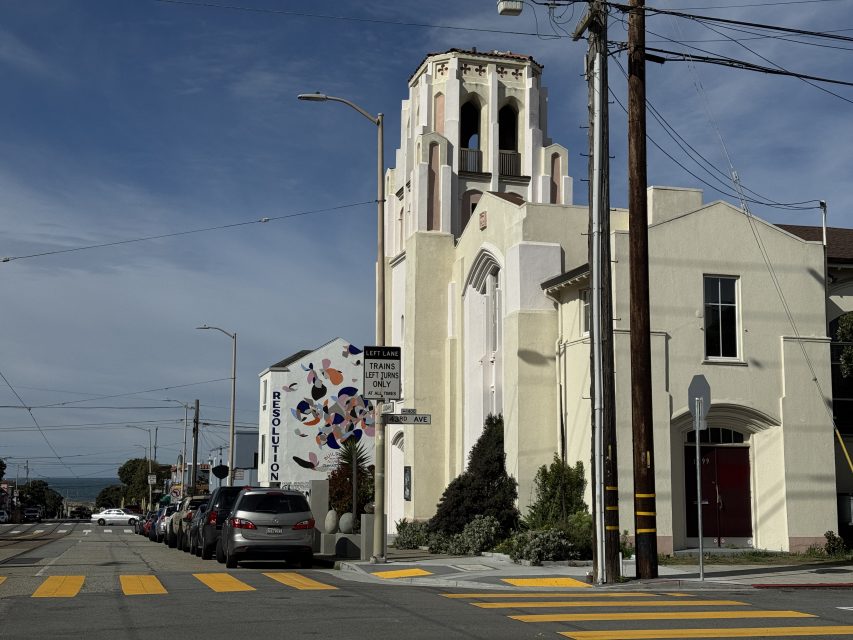
But it didn’t start out that way. “The community didn’t want us here,” Stueckle recalled. That was three decades ago when she was in her 30s. Now 60, Stueckle and her co-founders are working to make the organization a permanent fixture by purchasing the St. Pauls Presbyterian Church a few blocks from its Judah Street office.
Getting to this point was not easy.
Soon after seeing the petition in the video store, Stueckle organized a community meeting at the same church she is now close to buying.
There, residents asked: Would “bad kids” hanging out at the center bring burglaries and graffiti in the neighborhood? Would the corner of 7-11, where drug dealers already gathered, become more sketchy with at-risk youth around?
Many of the nonprofit’s clients were in foster care, the family welfare system, or the juvenile or adult justice system. In 2025, 32 percent of them were African American and 25 percent were Latino.
The only thing Stueckle could do was make her case and plead for trust.
“Our goal is actually to build relationships with kids and improve their opportunities, get them off the streets, help them make better decisions,” Stueckle told residents. “The proof is in the pudding. Give us a chance to prove that we can actually have a positive impact.”
Winning the cops over
In the mid-1990s, Stueckle said, the nonprofit had a “complicated” and “dicey” relationship with the Taraval Police Station.
“Cops showed up with guns drawn because somebody fit the description of someone being called in,” she recalled. On Judah Street, cops “roughed a kid up, grabbed him by the neck and had him up against the fence.”
At one point, Stueckle had to go to the police department’s morning and evening briefings, and explain what the nonprofit does. “If something is going on, work with us,” she remembers telling the cops. “We are not the enemy.”
The relationship only got better when Captain Keith Sanford became the Taraval Station captain in 2003. For a while, the outgoing police captain or the district supervisor made a point of bringing new captains to meet staff at Sunset Youth Services.
Earning the Sunset’s trust
Even in the early 2000s, when Sunset Youth Services was already around for a decade, “tensions” remained between the organization and its neighbor Other Avenues, a co-op grocery store on Judah Street since 1974.
Customers complained about “a gauntlet of justice-involved kids who sometimes were acting out and harassing them” on the sidewalk, recalled Ralph Lane, who owned the Other Avenues building until he sold it to the grocery store in 2013.
When the kids first got to the nonprofit, they were not “the best behaved,” Lane said — many of them came straight from Juvenile Hall. But within six months, with counseling, volunteering, and building relationships with peers and staffers through music and art programs at the center, most became “different kids,” Lane said.

The teens did a lot to win over the neighborhood:
- They cleaned graffiti in the Sunset that wasn’t of their own doing. In 1999, when someone left “nasty” anti-Asian hate mail on cars in the Sunset, a group teens at the nonprofit printed out signs reading “no-hate zone” and organized an anti-hate march alongside then-Mayor Willie Brown.
- In 2014, they joined others across the city to urge the San Francisco Unified School District to remove “willful defiance” as a reason to suspend or expel students, a category that had been used disproportionately on Black and Latino students. They won. “It was a cool moment of really helping kids find a pathway to leadership,” said Stueckle, “helping them understand that their voice matters and they can affect change.”
- They became stewards at the Playland at 43rd Avenue, now the Shirley Chisholm Village, which was a community space opened in 2016 with a playground, skate park and garden. The teens worked to clean up the park and locked it at night, while being paid a stipend.
From 1995 to 2023, Sunset Youth Services also organized the Sunset Community Festival, a free street party where its young clients help to set up, engineer sound and perform original songs on the main stage.
“They started that because [at the time] the Sunset didn’t really have big celebrations and big gatherings,” said Lily Wong, director of the Sunset Chinese Cultural District.
The nonprofit eventually won over their next-door neighbor. These days, Lane said, the Outer Avenues grocery store works with Sunset Youth Services on “everything.” Shanta Sacharoff, a co-owner of the grocery store, signed her new book at Sunset Youth Services in 2016. When Other Avenues held a ceremony honoring two co-owners who passed away in 2018, the reception was at the nonprofit next door.
“We’ve been here longer than everybody else at this point,” Stueckle said. The organization has outlived elected officials who have come and gone, and has watched their teen clients grow into adults — some ended up working at the nonprofit. “We just proved that we’re responsible, that we care about the neighborhood and the kids. We’re not going anywhere.”
Owning property, and a future
In its three decades in the neighborhood, the Sunset Youth Services has had many homes: Stueckle’s garage on 28th Avenue, a storefront on Taraval Street, then 3911 Judah St. and 4001 Judah St., and now at 3918 Judah St., where they’d been for 23 years.
Every time the nonprofit moved, Stueckle said, she felt the destabilization and concern about “whether you’re able to stay in the market, because San Francisco is so expensive.”
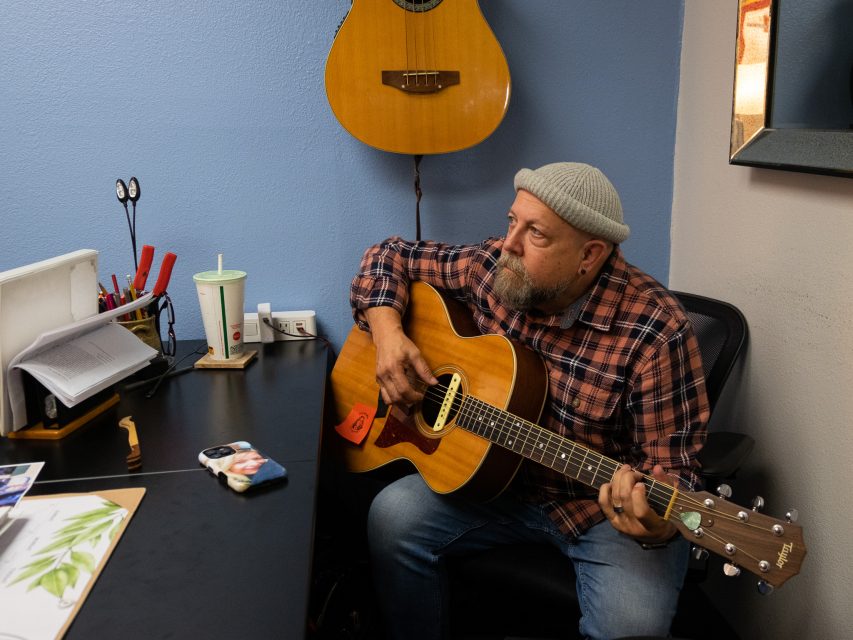
The potential of buying St. Paul’s is huge. In the much bigger space, Stueckle envisioned more recording studios, a kitchen for culinary programs, and a performance venue where kids can learn running the lights, sounds and stage productions.
“The only thing we believe in is that relationships are a tool for change for all of us,” she said. She has seen it in the youth she served: Kids from different neighborhoods got to know each other through making music. In the end, those who were initially “at war” with each other, became like brothers.
“They found their way past all of history through music,” she said, “and by being in a space that allowed them to gently find their way into each other’s humanity.”
Sunset, a sanctuary ‘to come and be kids’
For Stueckle, it was almost a necessity that the nonprofit exist in the Sunset, not elsewhere.
“We serve kids from all across the city and we can’t be in a neighborhood that belongs to anybody,” Stueckle said. “We need to stay in a neutral territory where we can serve everybody we serve.”
The center initially only served kids who had ties in the Sunset, but by 2004 teens from other high-stress neighborhoods like the Bayview, the Fillmore, and Potrero Hill made their way to the Outer Sunset for the nonprofit.
The tranquil outer lands far away from their daily life became a sanctuary, a place to “come and be kids,” said Ron Stueckle, the nonprofit’s co-founder and Dawn’s husband. “They’ll take the bus for an hour to come here, because they’d rather us stay here.”
But residents from the quiet westside neighborhood don’t always want the troubled teenagers there.
Some hostility centers around race. “A youth center like this is fine in the Bayview. But it doesn’t belong in the Sunset,” Stueckle recalled someone’s complaint.
At those times, Stueckle’s job is to be a mama bear to stand up and advocate for her young clients.
When residents gathered at a community meeting about the Playland in 2015, some residents cornered the Black teenagers and asked where they lived, assuming “our kids didn’t belong here and couldn’t have input into something if they weren’t residents,” Stueckle said.
Stueckle was furious. She called up then-Supervisor Katy Tang, saying they would stop attending those meetings “because our kids get attacked in so many places. I don’t need one more.”
Tang promised her she would stop the bullying and insisted that the teens should be part of the discussion. And she did. Those teens managed to advocate for a skate park at the Playland, and after it was built, maintained it.
Wong, of the Sunset Chinese Cultural District, grew up in the Sunset and said that whenever words like “at-risk” or “system-involved” were used, people assumed the worst, especially when these teens are from other neighborhoods.
“They don’t have any relationship with these young people,” she said. “They don’t know who they are. They just hear a word and they’re very concerned.”
But as residents see those teens setting up the stage at the Sunset Night Market, or giving out groceries at the food pantry, they just see them as “young human beings” in the Sunset.
“The kids get to exist and just be themselves in the community,” Wong said. “Outside of their external appearance, these young people, to me, are Sunset kids.”
