
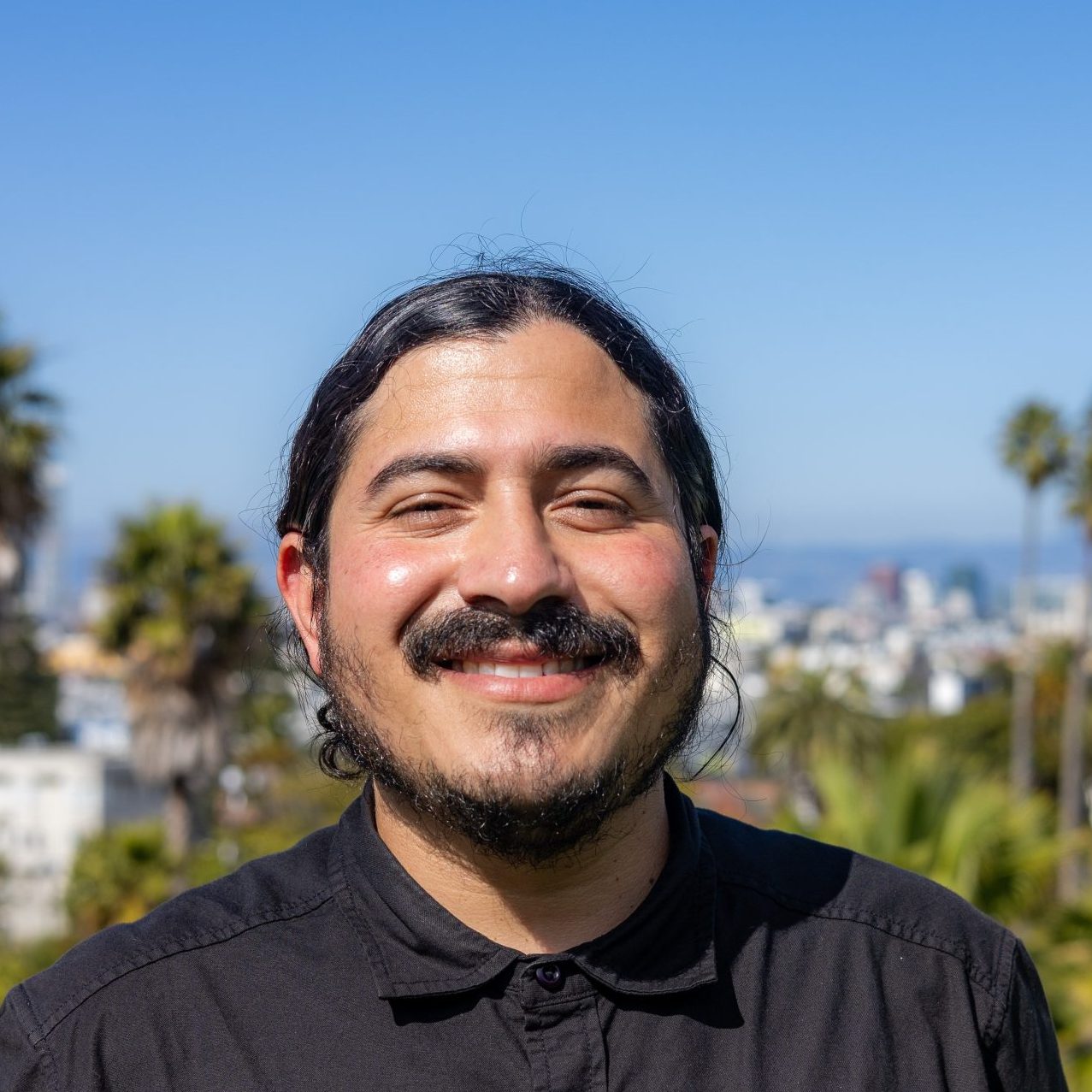

In the world of affordable housing, the single-room-occupancy hotels near the 16th and Mission intersection, nearly all privately held, are among the most distressed.
And yet Sam Devdhara, a longtime hotel investor and manager, has figured out a way to make money while renovating the run-down buildings.
Devdhara, who migrated from India in 1993 and owns 14 buildings in San Francisco — 12 in partnerships and two on his own — said he’s identified a business model that allows him to purchase buildings in need of repair that will likely to remain SROs or supportive housing. His approach often relies on city and nonprofit support.
Recently he purchased the three-story SRO at 3032 16th St. after a fire in 2022. When it reopens later this year, the main tenant, the Recovery Survival Network, will run it at a gain for Devdhara.
“I’ve been in San Francisco long enough that I’ve seen that there’s a need for these types of housing,” said Devdhara, pointing to transitional housing, supportive housing and SRO hotels of the kind he buys and refurbishes.
Even with rents in the stratosphere, landlords can’t depend on returns on market-rate housing, he said. That’s not the case for subsidized housing.
The “low-income housing market, which is often subsidized by local, state and federal government, stays always consistent,” he said. “I may not get the benefit of a high market like today, but then I will also not be a part of when everything goes down.”
Of course, the city can also prove unreliable, as Devdhara found recently at 374 5th St., a transitional housing that the city will be pulling out of, and 711 Post St., a 280-bed shelter that is also losing its contract with the city.
Still, Devdhara sees opportunity.
His latest venture, at 16th and Wiese streets, is the site of a 2022 fire that displaced the ground-floor tenant Taqueria Los Coyotes and 22 residents, most of whom were lodged in a transitional housing facility managed by the Recovery Survival Network.
The latter is a nonprofit that, for the last 30 years, has connected people exiting the criminal-justice system and unhoused people to housing, schooling and skill training.

Two years after the fire, its owner, Katherine Doyle Rodriguez, had failed to get substantial repairs underway. When Devdhara heard that Rodriguez wanted to sell the property, he was immediately interested.
“After looking at it, I figured it’s the project that I can definitely do,” he said. “I’m happy. I like that location. I think there’s a shortage of housing in that area.”
So, in 2024 Devdhara purchased the property for about $1.1 million, according to real estate sites Realtor and Property Shark, an amount which Devdhara later confirmed.
The building’s purchase took place just months before a crackdown on drug use and dealing in SoMa and the Tenderloin displaced many to the Mission District, worsening street conditions in the area surrounding 16th and Mission streets. Nearby residents described Wiese Street as a “drug carnival.”
Still, Devdhara had no regrets. Location — so close to a BART station — and the demand for cheaper housing made it attractive. And the price was right.
“It will require a lot of money, and it also requires a lot of patience, because of the time that it takes to put things together,” said Devdhara.
“I’m thrilled that I’m able to put it back together and bring it to the market as housing.”
When the fire occurred, the building had two bathrooms, one for every 12 units. Devdhara’s renovations, which began in January and will finish in about six to seven months, include a private bathroom for each room.
The $1.1 million purchase price, plus some $2 million in renovation costs, will put his debt at just over $3 million; a doable number, because the rooms will be rented to the longtime tenant, the Recovery Survival Network.
The nonprofit will manage 23 of the building’s 26 rooms under contract as transitional housing funded by a variety of subsidy programs, according to Network Executive Director Lou Gordon.
Devdhara said each room will rent for $1,200 a month, just $100 above the pre-fire prices. The building’s commercial space on the bottom floor will likely go to the former tenant, Taqueria Los Coyotes.
It appears that Devdhara investment will reap a nice return. If he rents 23 rooms at $1,200, he would total $27,600 per month. A monthly payment on a 30-year mortgage with a six percent interest rate — interest rates for commercial spaces in San Francisco currently average 6.4 percent — comes to $17,987.
And that isn’t counting the rent from the three tourist rooms or the commercial tenant.
The Mission National Bank is currently financing Devdhara’s project.
A rehab that ran into trouble, but reaps a return
Not all of Devdhara’s rehab efforts have proceeded so smoothly.
In 2014, he bought the former Eula Hotel at 3061 16th St., located nearly across from his new acquisition, for about $2 million. Again, he set out to add individual showers and bathrooms to each room. During renovations, however, the city discovered unsafe conditions while tenants were still living there.
Moreover, an inspector found piles of demolition materials on residential floors that showed the presence of lead and asbestos, and a faulty fire safety system and raw sewage in an “open sanitary facility on the occupied floor,” according to tests by the Department of Public Health conducted around the time of the inspections.
Devdhara acknowledges that his permits were not in order and, in 2018, he paid the city $2,153.89 in penalties. An additional lien for $1,426.50 was applied to Devdhara’s tax bill in 2017, according to the Department of Building Inspection.
He said that after spending another $2 million on renovations — Mission Local could not independently confirm this number — plus years of carrying costs on insurance, property tax and mortgage, he approached nonprofits to test their interest in managing the building.
In 2022, the city purchased the building from Devdhara for $5.6 million, using funds from a state program and from local Proposition C.
The city finished another set of renovations through its partners, Mission Action and Mission Housing, which included the addition of a communal kitchen, rehabilitation of the first floor, repairs to the windows and some electric and plumbing work.
The city, through the previously mentioned funds, invested an estimated $3,026,977 in those further renovations.
The 25 rooms became Casa Esperanza, a permanent housing complex run by Mission Action for youths between 18 and 24 years of age.
“Did I make money? Maybe, maybe not,” said Devdhara. “What feels good is that I converted that property into a real deal, and it’s in use today.”
‘Meticulously high-quality work’ — but not always
Sam Moss, the executive director of Mission Housing, described Devdhara as a better steward than a lot of other single-room-occupancy hotel owners.
Another fan is Randy Shaw, the executive director at the Tenderloin Housing Clinic, a local nonprofit that, among others, provides legal assistance to low-income tenants and that secures SRO units through the Master Lease Program.
“He just does meticulously high-quality work,” he said.
Devdhara, who is also the CEO of Core Hotels LLC, a property-management company with a portfolio of more than 21 properties, was a co-defendant of multiple lawsuits filed between 2015 and 2016 that alleged uninhabitable living conditions at the Winton Hotel at 445 O’Farrell St.
The suits were all settled before they went to trial, according to Steven A. MacDonald, the real-estate attorney who represented most of the cases.
Devdhara said he inherited the conditions and that, if anything, he tried to fix them. According to documents from the Office of the Assessor Recorder, the partnership bought the building in February 2015, but quickly sold it six months later.
The first of the lawsuits was filed the same month Devdhara and partner bought the property. He says he did not make any money, and that he din’t have to pay anything.
Last year, the city attorney secured an $810,000 settlement from three hoteliers, including Devdhara, who owned and managed buildings in Chinatown, for providing poor living conditions for years.
Devdhara, for his part, argues that he and his partners were treated unfairly. The buildings were in poor structural condition when they bought them, he maintains.
He remembers Department of Building Inspection staff visiting the site about three to four times a week and citing them for burned-out or missing light bulbs, clogged toilets and inoperable stoves.
“You get bombarded with notices of violation, and that process continued for years. I mean, we just couldn’t get anywhere,” Devdhara said, adding that there was also a communication barrier with the monolingual Chinese senior residents who lived in the building.
Devdhara has rehabilitated other hotels, both tourist and SROs, throughout the city. He was one of the developers who bought and renovated the building known as “the horror show” at 250 Kearny St., where pigeons and their excrement and corroded sinks and toilets had taken over the building.
He joined others in 2014 and turned it into home for veterans.
Other examples are 376 Ellis St., which Devdhara bought in 2012 with partners. The Alder Hotel at 175 6th St., a permanent supportive housing managed by Episcopal Community Services and funded by the city, which was bought in 2021.
While he likes working with the city and nonprofits, those partnerships don’t always go as envisioned.
Devdhara renovated the building at 374 5th St. and leased it to the city for a 44-unit transitional youth housing in 2013, generating some $600,000 a year for Devdhara and his partners, according to the Department of Homelessness and Supportive Housing.
The city is also ending its contract with Devdhara and partners at 711 Post St, which will go from a 280-bed shelter to a single-room-occupancy hotel.
“It’s unfortunate the city is walking away from this,” he said. “We still have a shortage for this kind of housing.”
The comment about Devdhara’s investment reaping a nice return is based purely on simple math of rooms times rent minus interest rate on loans. It fails to take into account insurance, utility, taxes and maintenance repairs. Just using the numbers provided in the article implies he’s making $115K a year on the property which isn’t the case.
.
On a more realistic basis, it also needs to consider the following for a $3M – 24 unit SRO building based on purchase price or number of units:
– Property tax of $35K/yr;
– Insurance between $30-50K/yr;
– Water, sewer and electric between $62-90k/yr.
.
The restaurant would be responsible for paying their own utilities and insurance if and when it ever gets rented. This is also a rough part of town so rent from the commercial space won’t be worth much to offset expenses.
.
Based on the above, you’re looking at a break even scenario with tax deductions or an operating loss. The owner is not running off to the bank every month with a pile of cash.
Yes, I wonder if the author of this article rents as he doesn’t seem to appreciate all the secondary costs that go into running a business like this. I am not a landlord any more but I generally reckoned I was doing well if I had a net 5% return run rate. And that isn’t much more than I could get in a money market fund!
I give credit to Devdhara for taking this on. In the same situation I’d be tempted to instead Ellis them and then convert the buildings to short term lets, tourist rooms and so on.
Thank god that building is reopening soon – it’s absolutely criminal Katherine let it languish as long as it has
He also needs to pay property taxes and building insurance, that’s another $15k a year total.
Add utilities, maintenance and repair, that’s another $20k.
That the city spends millions to house derelicts is reason to realize … it will NEVER RECOVER. Best for everyone with money better leave … let it sink further into a ghetto. You don’t have to participate or pay for the madness. NO state taxes inTexas and beautiful homes for a fraction of what you pay in San Francisco. For the price of a mansion… you get a mansion! I’ll buy a second home in Hawaii for what I’ll save on taxes. Yes… a free home in Hawaii !