

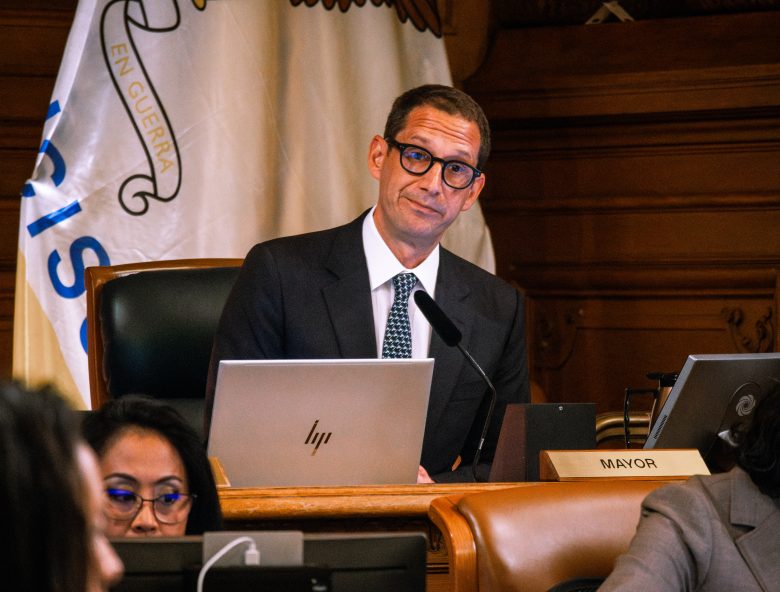

Mayor Daniel Lurie and Board of Supervisors President Rafael Mandelman proposed three November ballot measures Thursday to reform San Francisco’s charter, a document that sets the rules for how the city works.
The propositions, if approved by voters, would expand the power of the city’s executive branch, including the powers of the mayor and city administrator. They would take power from city oversight commissions and the legislative branch, the Board of Supervisors.
The current system, Lurie and Mandelman wrote in a letter to the city controller, “locks in bureaucracy, diffuses accountability, and protects the status quo.”
Lurie and Mandelman wrote that voters find it “difficult” to know “who is accountable when services fall short.” Giving more power to the mayor, they continued, would create more “accountability.”
The initiatives will each need to gather about 51,000 signatures, or 10 percent of the city’s registered voters, to make it onto the ballot. They will each require a simple majority of votes to pass.
The measures closely resemble recommendations laid out in the think tank SPUR’s report from November 2025. At the time, the report was widely viewed as a prelude to a future ballot proposition.
Starting in January, a 31-person working group assembled by the mayor and Mandelman called the Charter Reform Working Group were invited to give their input on the mayor and Mandelman’s proposals.
Those proposals have now been drafted. Here is a summary of each of the measures.
Mayoral power
This measure shifts power from city commissions to the mayor.
Here’s what the proposition does:
- Gives sole power to the mayor to fire and hire most department heads. Currently, some commissions have some say over hiring, by providing a list to the mayor from which he must choose a new department head, for instance.
- Changes commissioners to at-will employment, which means they can be removed by the official who appointed them for any reason. Currently, if an official wants to remove a commissioner, they need to provide a specific, legitimate reason.
- Gives the mayor more power to reorganize departments.
- Removes prohibitions on employing deputy mayors, who can oversee department heads. Currently, the mayor is technically the direct report for nearly 50 department heads.
Ballot Access
This measure will make it more difficult to put measures onto the ballot for city elections.
Here’s what the proposition does:
- Requires a majority of the Board of Supervisors to support a measure for it to qualify for the ballot. Currently, it only takes four supervisors.
- Removes the ability of the mayor to put measures directly on the ballot.
- Requires proponents of a measure to gather signatures from 8 percent of registered voters (about 40,000, at the moment) before a measure can be placed on the ballot. Currently, the requirement is 2 percent.
City administrator power and contracting
This measure expands the power of the city administrator, especially over the city’s contracts.
Here’s what the proposition does:
- Allows the city administrator to make rules for contracting that apply across departments.
- Extends the city administrator’s term from five years to 10 years.
- Gives the city administrator the authority to propose laws around contracting, though the mayor or Board of Supervisors can veto or vote down.
- Raises the threshold for which contracts need to be voted on by the Board of Supervisors.
- Puts the city administrator in charge of the city’s technology and capital projects
All of these resemble the proposal that Lurie and Mandelman brought to the working group in January.
One idea that was in Lurie and Mandelman’s original proposal that seems to have been discarded was a plan to limit the amount of city money in baselines. Baselines are measures, passed by voters, that dedicate portions of the city’s budget to specific causes such as libraries, parks, and schools.
At last tally, baselines accounted for about $2.2 billion of the city’s budget.
Mandelman has said that, while he supported limiting baselines, it’s too much to tackle right now.
At the working-group meetings, some expressed skepticism that Lurie and Mandelman’s proposals would appeal to voters.
“I think voters are going to be very concerned with what will appear to be a consolidation of power and possible corruption come November,” said Kim Tavaglione, the executive director of the San Francisco Labor Council, at one meeting.
In February, the mayor hinted that he would pursue a proposition to limit future ballot measures after expressing displeasure at the CEO Tax, a tax measure sponsored by labor groups that made it to the ballot, which is now competing with a tax from San Francisco’s business leaders.
Other working-group members openly approved of Lurie’s plans.
“We do need stronger executive authority,” said Steven Buss Bacio, the co-founder of the political pressure group GrowSF. “The correct balance of power is that if voters don’t like that executive, they vote them out in the next election.”
As Mandelman sees it, the changes give the mayor power that “align with people’s expectations of our mayor. We are a strong-mayor city, and people expect the mayor to be the CEO, but we have a charter that doesn’t really allow for that,” he said, adding that he still thinks there are checks on the mayor’s power.
More measures are likely to join the ballot through the Board of Supervisors, which has its own goals regarding streamlining. The board is currently considering recommendations from a task force deciding whether some of the city’s commissions should be cut, restructured, or stripped of some authority.
Supervisors Bilal Mahmood and Mandelman want the board to also consider moving some departmental responsibilities from the charter to the administrative code, which can be amended more easily. Mahmood hopes this will allow city permitting laws to be changed to speed up housing construction.
Mandelman, for his part, is optimistic that all three of the measures introduced Thursday will pass, because Lurie is “incredibly popular.”
“People want to see him succeed, and these measures will help him be successful,” Mandelman said.
he wants to put this shit-ass thing on the ballot and then take away public power to put other things on the ballot WOW
No thank you to giving more power to someone who has never held office.
If this passes, and the ballot measure access thresholds are raised, then it will be an extinction event for progressives, who at used to go to the ballot to convince voters to insulate commissioners from corrupt manipulation by their appointing authorities.
Inflation indexed living wage, sick time for low income workers, tenant protections, walls on the waterfront–never again.
Now, not only do progs refuse to go to the ballot with their own new ideas, ideas that they don’t have, they refuse to defend past victories.
Stick a fork in the prog political class, they’re done, hoisted by their own petards.
These “commissions” meet four times a year, if that. Oftentimes they don’t have quorum. The people on them don’t even all live in San Francisco. And we’re told this is “democratic” and that these unelected commissioners have power over major policy decisions that impact us all.
Yes, take their power away. Take it all away and have our city operate like a NORMAL large city. And if you don’t like the politicians, vote them out.
right now, the federal government is making a great case against having a king in power, do we really want a smaller version of that in the city? sure commissions may need a revision but are we really doing away with the idea of separation of powers and checks and balances at the local level? maybe the rich feel like they will stay in power but are they sure they want to give all the power over to a social democratic mayor who decides they need to make drastic changes without any opposition?