


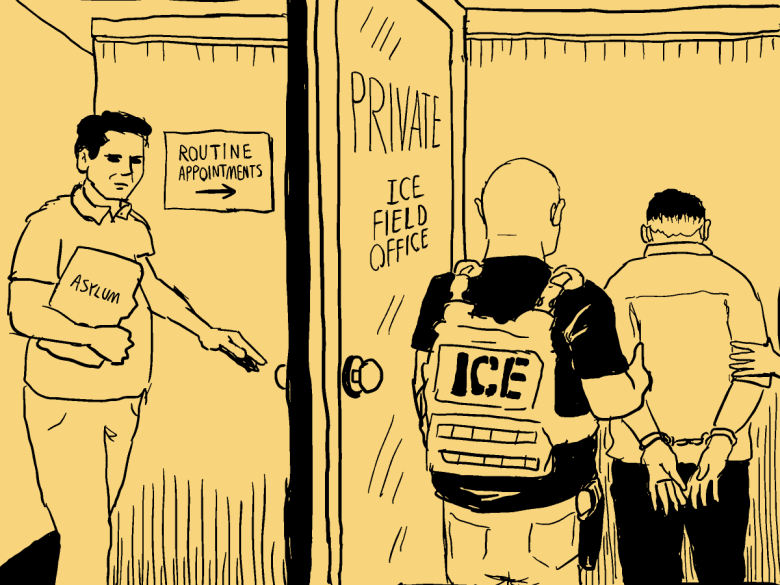

On Nov. 13, a 60-year-old grandmother from Venezuela came in for a routine check-in appointment with Immigration and Customs Enforcement at the agency’s field office at 630 Sansome St. in San Francisco. The check-in took place not in one of the building’s public courtrooms monitored by lawyers and the press, but in a private room, one of several locations where immigration officials hold scheduled appointments with immigrants.
The grandmother was an asylum-seeker with no criminal record. But she never made it out of the building that day. Instead, after she arrived for her check-in — an appointment where immigration officers typically deal with routine updates like address change or share information about upcoming court hearings, she was arrested and taken to a holding cell on the sixth floor of the federal building, under ICE custody.
The 60-year-old grandmother is one of at least 539 people arrested at such routine immigration appointments in the first 10 months of President Trump’s administration, according to an analysis of arrests in the San Francisco area by independent researcher and mathematician Joseph Gunther and published for the first time by Mission Local.
Unlike arrests at court hearings, which Mission Local has been tracking since late May 2025, the arrests at immigration field office appointments are done in private. Up until Gunther’s analysis, it was unclear how many immigrants were arrested at these routine appointments.
The 539 arrests at routine immigration appointments are in addition to the 147 arrests made after immigration court hearings, and 193 arrests likely in the community.
The data covers arrests in the San Francisco area, including San Francisco proper, San Mateo County, Alameda County, Marin County and portions of Contra Costa and Sonoma Counties. In the vast majority of these arrests, immigrants are sent to the holding room on the sixth floor of 630 Sansome St. in downtown San Francisco.
The 539 arrests at ICE field offices happened outside of the public eye. Immigrants arrive for appointments that can be for anything from a credible fear interview – the interview that determines whether an immigrant’s asylum case can move ahead – to what is known as an “ICE check-in,” a required appointment for immigrants who are applying for varying forms of legal status, often asylum or a green card through marriage to a U.S. citizen. They differ from immigration court hearings, which happen in front of a judge.
The grandmother was in for a routine “check-in” appointment that day.
Arrests at these check-ins made up about 53 percent of all arrests in the San Francisco area during the first 10 months of President Trump’s administration.
More than half of ICE arrests in S.F. happened at immigration appointments
Arrests, where the person arrested was first detained in downtown San Francisco, by location.

immigration appointments
53%
in the community
19%
immigration
court
14%
other
14%

immigration appointments
53%
in the community
19%
immigration
court
14%
other
14%
Chart by Kelly Waldron. Source: Joseph Gunther. Note: Data covers ICE arrests that occurred between Jan. 20 and Oct. 15 2025 and excludes arrests that appeared to be transfers from criminal custody, or arrests originally made by non-ICE agencies.
Because these appointments occur in private, very little has been published about how ICE arrests immigrants in these circumstances and what happens after they do.
But immigration attorneys have been filing detailed “habeas corpus” petitions that have been successful in getting immigrants who are lucky enough to have an attorney released after arrest. The 60-year-old grandmother from Venezuela was eventually released through a habeas petition, which argued that her arrest was unlawful.
However, the vast majority of immigrants who go to appointments do not have a lawyer to accompany them and thus do not get released through a habeas petition.
Mission Local reviewed her court filings along with at least 82 other court petitions and interviewed at least six attorneys who had clients arrested at immigration appointments in order to illustrate the nature of these lesser known 539 arrests in and around San Francisco.
Click the cards to read stories from the court filings.
Illustrations by Neil Ballard.
Did the 539 immigrants arrested at immigration appointments have a criminal record?
President Trump campaigned on an agenda of deporting immigrants who are violent criminals.
But immigrants showing up to immigration appointments, like those who attend court, are often people desperately trying to follow the rules.
Attorneys say ICE is exploiting that compliance and using the appointments to bypass the legal process and fast-track immigrants to deportation.
“The easiest way for them to capture people is to find people who are complying with the process and proceedings and just have them come to their offices where they can detain them — like a trap,” said Milli Atkinson, the director of the Immigrant Legal Defense Program at the San Francisco Bar Association.
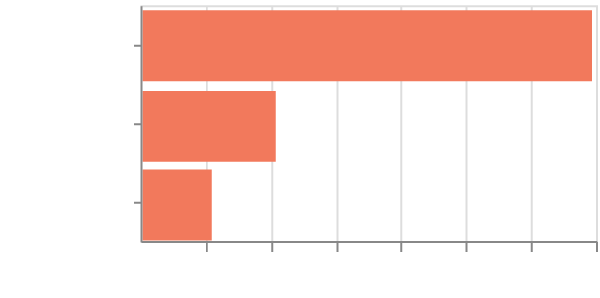
Data shows that of those arrested at immigration interviews, 69 percent of immigrants had no criminal record at all.
Of the 20 percent that had a criminal conviction, the range of crimes committed is wide. The most common offenses were DUIs (16 cases), re-entering the country illegally after being deported (12 cases), traffic offenses (9) and drug trafficking (4 cases).
In a smaller number of cases, more violent convictions were recorded.
Over two thirds of immigrants arrested at immigration appointments had no criminal record
ICE immigration appointment arrests in San Francisco, by criminal background.
No criminal
record
Criminal
conviction
Criminal
charges
20%
40%
60%

No criminal
record
Criminal
conviction
Criminal
charges
20%
40%
60%
Chart by Kelly Waldron. Source: Joseph Gunther and the Deportation Data Project. Note: Data includes arrests between Jan. 20 and Oct. 15, 2025.
“ICE is now arresting a whole group of people that they would have never arrested before,” said Bonita Gutierrez, an immigration attorney who founded Open Immigration Services, a nonprofit that provides legal services to immigrants. “It just did not happen. It just straight up did not happen … [Now,] anyone and everyone that they can arrest they will.”
A 37-year-old barber from Mexico who came to the United States when he was 3 years old and has two children with autism, is just one such case of an immigrant detained at his San Francisco routine ICE check-in appointment. In his case, ICE alleged that he violated his GPS monitoring because he went to Stinson Beach. Court filings say the man’s case manager had given him permission to go there. The man had a GPS ankle monitor because he had been detained earlier that year for entering the country illegally, though court filings say he had “spent virtually his entire life here” in the United States.
How check-ins work
Immigrants who are in the process of applying for asylum, or immigrants working to get their green card through marriage to a U.S. citizen, are the kinds of people who, until last year, could expect to show up to a routine immigration appointment, go home afterwards, and return again on future dates. Many of them arrived in the U.S. years ago, presented themselves to immigration officials, were briefly detained, and then released by ICE so they could go through the legal process of applying for asylum.
ICE requires immigrants to check in with an immigration officer periodically to ensure that they are not a “flight risk,” or a “danger to the community.”
Many immigrants check in weekly or monthly by phone, and once or twice a year at an in-person appointment. Failure to appear at an in-person appointment is grounds for an automatic deportation order.
These in-person check-ins often mean showing up as early as 6 a.m. to one of the field offices, waiting in line for up to two hours outside of the building and then going into a private room to be questioned.
Unlike courthouse hearings, where volunteer attorneys staff an “attorney of the day” program, private check-ins offer no such safety net. Immigrants may bring their own attorney if they have one, but many show up alone.
One such case was a Brazilian man, married to a U.S. citizen, with no criminal history. He was seeking a green card on the basis of his marriage, and had arrived with his spouse for an interview at the United States Citizenship and Immigration Services (USCIS) office on the second floor of 630 Sansome St. He had overstayed his tourist visa by almost four years; ICE agents arrested him at the conclusion of his interview and alleged that he was in the country without authorization.
Like the courthouse arrests, often no reason — or seemingly arbitrary reasons — are given for arrests at these appointments. One 44-year-old mother of four and asylum seeker from Ecuador was detained at an ICE check-in appointment at 630 Sansome St. in December, after agents alleged she had missed an appointment.
According to court filings, the digital app used for immigrants to keep track of appointments and submit virtual check-ins, did not show any such appointment.
A 34-year-old Guatemalan man living in San Francisco was told at a November check-in to return in December with documentation proving no criminal charges were pending against him. He did, and was detained.
When his attorneys spoke with the deportation officer, they were told the man’s “police contact” was the basis for his arrest, despite the fact that no criminal charges had ever been filed against him. Court filings listed one citation and one arrest in the man’s past, neither of which resulted in charges or conviction.
Deceptive tactics
In some cases, court filings show that immigration officers have used what attorneys call “deliberate deception” to detain people.
A 59-year-old surgical technician and father of two from Mexico, who had lived in the United States since 1990, arrived at a scheduled Green Card interview in Fresno with his son and attorneys. The man had failed to bring at least one of the documents required for his interview.
Midway through the meeting, the examining officer asked everyone to vacate the office, citing technical difficulties. His attorneys called the pause a “ruse,” suspecting the officer had used the moment alone in his office to contact ICE. When the man and his counsel returned and concluded the interview, two ICE agents burst through the doors and took him into custody.
In August, a 44-year-old man from Guatemala showed up to the downtown San Francisco immigration office at 630 Sansome St. for his “reasonable fear interview,” where asylum-seekers are meant to describe the harm they experience in their home country, to make the case that they cannot return for fear of persecution. He had been in the United States for six years.
For over two hours, the man recounted the abuse and death threats his family endured in Guatemala. Sitting in the office, he told an officer over speaker phone about his fear of returning to Guatemala. Court filings detail that he was threatened multiple times by a wealthy landowner, including with a gun and a machete. He said the landowner even went as far as threatening to kill him and hurt his family. After the man fled Guatemala and arrived in the United States with his daughter, the “wealthy landowner” burned down his family home, prompting his wife and son to also flee Guatemala.
As the man told his story, “an armed ICE guard sat outside the office, watching him through a narrow glass panel,” according to court documents.
At the conclusion of the interview, the man was told by an officer he could leave for lunch alongside his attorney. When they returned an hour later, an asylum officer told the man, over speaker phone, that he did not pass his reasonable fear interview and would be detained. No justification was given for his detention.
Shortly thereafter, an ICE officer wearing latex gloves handcuffed and detained the man. His attorney handed the officer a written request to not detain him, explaining he does not have a criminal history and has two young children at home enrolled in Oakland schools, but ICE told the lawyer later in the hallway that “the decision was final.”
The 44-year-old was fingerprinted and his belongings taken. His attorney called his wife to let her know her husband would not be coming home that day. He was taken to a temporary holding cell at 630 Sansome St., (cells that eventually were ruled to be inhumane), and his lawyer was told her client would be soon transferred to another detention center.
His attorney wrote later that her client had been “arrested like a criminal when he had been fully compliant with legal requirements.”
“I wasn’t even the one arrested and I was so shocked and traumatized by it and so angry,” said his attorney.
Additional reporting by Margaret Kadifa and Nicholas David.