

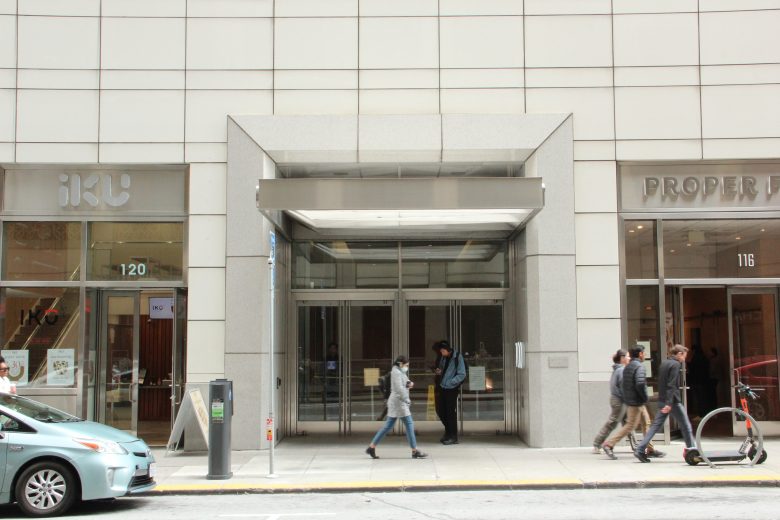

At least 500 people were ordered “removed in absentia” when they did not show up for their court hearings at the San Francisco immigration court this week, said Milli Atkinson, director of the Immigrant Legal Defense Program at the San Francisco Bar Association.
Now they may lose the chance to apply for legal status or protection in the U.S. and could be arrested and deported without a future hearing. The exact number of people who received removal orders is still under review, Atkinson said, and could be higher.
The number of people scheduled for hearings at the 100 Montgomery St. immigration court from Monday through Wednesday was larger than usual, Atkinson said. Dana Leigh Marks, who worked as an immigration judge in San Francisco for 35 years until retiring in 2021, said the federal government was likely mass-scheduling hearings in a bid to ramp up deportations.
“They’re counting on these people not showing up because otherwise you wouldn’t have that many cases on that day,” she said. If everyone scheduled had arrived in court, she added, judges would not be able to hear all their cases.
“They are compromising fairness and due process in order to have dramatic numbers of deportations,” Marks said.
There were so many hearings this week that judges from across the Bay in Concord — Julie Nelson, Marlem Nava and Jacob J. Stender — were presiding over cases. The San Francisco court has been decimated over the past year and has lost almost all of its judges, with only two judges left of the original 21 when President Donald Trump started his term.
The Concord judges heard cases alongside San Francisco judges Frank A. Seminerio and Steven M. Kirchner, and a San Diego judge, Samantha Begovich, who regularly hears cases in the San Francisco immigration court remotely. Atkinson said she had never seen Concord judges brought into San Francisco court.
Shira M. Levine, a former immigration judge who was fired by the Trump administration in September last year, said that in the four years she presided in San Francisco, she would have an average of 30 individuals a day for these kinds of hearings. Of those, about two to four people wouldn’t show up.
This week, however, Mission Local observed only a small fraction of people scheduled for hearings appearing in court.
Although no-shows to immigration court have increased since ICE began arresting immigrants at courthouses last year, Levine said the high rate of absences this week was alarming. “It raises concern that it was intentionally calculated to lead to these removal orders in absentia,” she said.
Levine said she knew of asylum-seekers whose hearings had been set “years in the future” but who were mailed notices telling them to appear this week. “That kind of action is actually calculated to lead to more no-shows because people often will not get those notices in time,” she added.
Levine said there’s a history of problems with “notices to appear” mailed to noncitizens and, if there are spelling mistakes or errors in the addresses, people may never receive the notices. They then risk deportation if they are ordered removed in absentia.
A removal order can have a lasting impact, as people might no longer be able to apply for certain types of immigration relief for the next 10 years. Immigrants who receive a removal order in absentia can file a motion to reopen their case based on exceptional circumstances, such as serious illness, or if they can prove that they never received notice of their hearing.
“They are going to have a more difficult time moving forward with their cases, and they are at higher risk of being removed and detained,” Atkinson said.
The Executive Office for Immigration Review did not respond to Mission Local’s questions about this week’s hearings. “The Executive Office for Immigration Review does not comment on cases before the agency,” said in an email Kathryn Mattingly, EOIR’s press secretary.
Atkinson said she does not yet know if the trend will continue next week, but as of Friday, there were no judges from Concord scheduled to hear cases in San Francisco.