

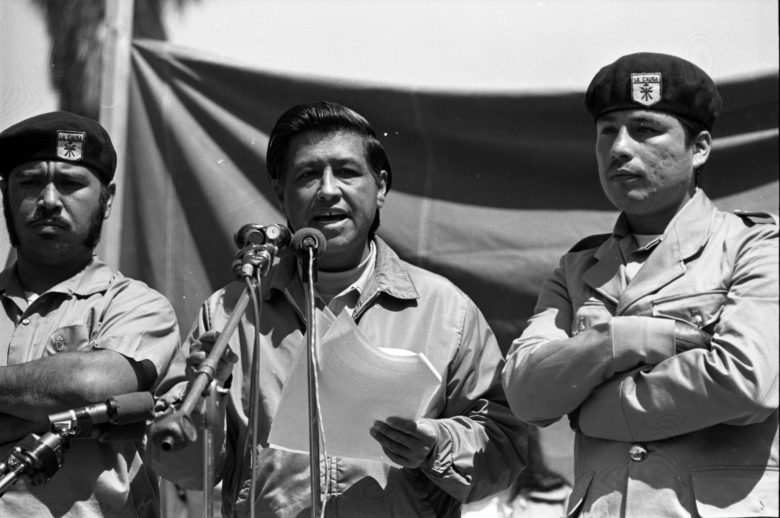

In 1995, then-District 9 Supervisor Tom Ammiano cried, standing beside Eva Royale, the San Francisco regional manager for the United Farm Workers from 1990 to 2002, as the city unveiled the new signs renaming Army Street to Cesar Chavez Street.
Ammiano and Royale had embarked on an initiative seeking to pay tribute to the former United Farm Workers founder, who had died two years earlier.
Ammiano feels very differently today.
“It’s very shattering to hear these revelations,” said Ammiano, who faced strong opposition when he sought to rename Army Street. Opposition, he said, that led to death threats, name-calling, bigotry and even a failed ballot proposition by Noe Valley residents.
On Wednesday morning, the New York Times published a bombshell report five years in the making that Chavez had sexually abused at least two underaged girls between 1972 and 1977.
Labor icon Dolores Huerta, 95, also told the Times on the record that Chavez sexually assaulted her twice — and that two of her children were, secretly, his.
“I just hate it for Dolores,” Ammiano said. “I hate it for the survivors. I hate it for all of us who really believed in him, and to hear this is very unsettling.”
Ammiano is one of many Mission residents and Latino leaders reached by Mission Local who reacted strongly to the allegations. They called the news highly disappointing, shattering and deeply sad, and reiterated their support for Huerta.
Most importantly, they said, Chavez’s alleged actions should not undermine the farmworker movement and the ongoing fight for labor rights.
Olga Miranda, president of SEIU Local 87, said local organizers are still processing the news.
“I love Dolores Huerta. We’ve grown up with these names in our households: Dolores Huerta and Cesar Chavez,” Miranda said. “It pains me to know that she’s endured this.”
Chavez’s presence in San Francisco is widespread. The student center at San Francisco State University and an elementary school in the Mission District are named after him.
The street named after him runs three miles through Districts 8, 9 and 10, and bisects the Mission. District 8 Supervisor Rafael Mandelman said he would defer to his Latina colleagues — Jackie Fielder and Myrna Melgar — when it comes to stripping Chavez’s name off the street.
But, Mandelman said, “the current name’s days are numbered.”
District 9 Supervisor Jackie Fielder said in a statement that her “office will support community efforts to remove Cesar Chavez’s name from any District 9 institution.”
Melgar said talk of renaming would come later.
“My heart is aching and crying. … For all the folks calling for renaming things and cancelling things: Let’s center those who are harmed FIRST,” she posted.
Changing the name of a street in San Francisco is typically a deeply arduous process.
City policy on street-name changes typically requires input from up to five departments — the Department of Public Works, the Planning Department, the Police Department, the Fire Department, and the Department of Building Inspection — and multiple actions from the Board of Supervisors.
Even after that, it may be difficult to truly erase Chavez’s name, as city rules typically require a street’s former name to also be featured on street signs for a period of five years. Army Street, incidentally, is still featured on Cesar Chavez Street signs.
The last major street name change undertaken in San Francisco came in 2018, when a street near City College’s main campus was renamed after Frida Kahlo. She replaced James Phelan, the father of San Francisco’s openly racist and anti-Asian mayor and, later, U.S. senator of the late 19th and early 20th century.
In 2014, after former Polish president Lech Walesa made deeply homophobic statements, the small street near City Hall bearing his name was changed to honor Gay Games founder Dr. Tom Waddell.
In 2012, the city changed the street name in the Excelsior to Edinburgh, because the capital of Scotland had been misspelled on San Francisco street signs, for years, as “Edinburg.”
On smaller-scale changes, a student at San Francisco State who works at the student center’s front desk told Mission Local that they were instructed to obscure Cesar Chavez’s name on the front desk.
As for changing the name of the elementary school in the Mission, a spokesperson for the San Francisco Unified School District said “the district is closely monitoring the situation” and “shares the community’s concerns regarding the recent allegations involving Cesar Chavez.”
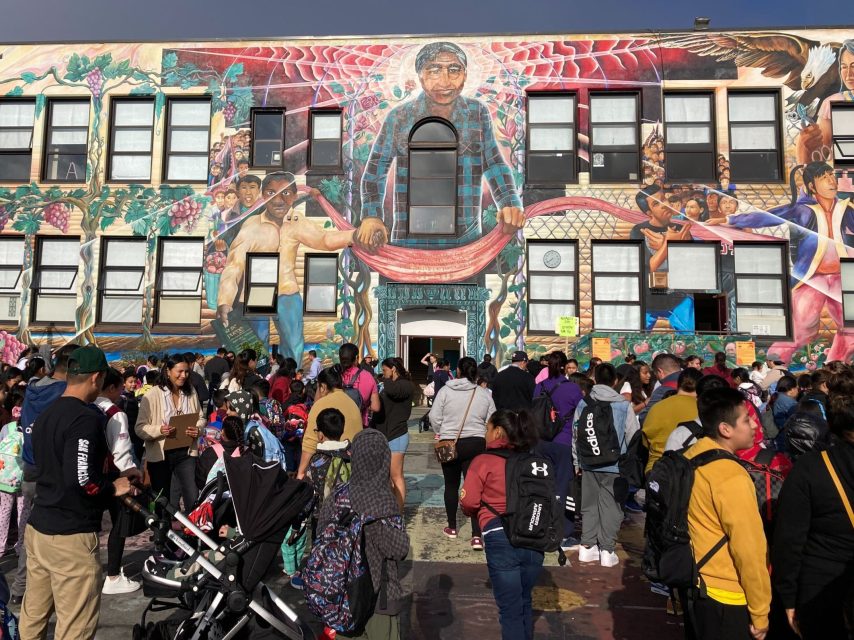
Miranda of SEIU Local 87, for her part, said the revelations shouldn’t overshadow the importance of the United Farm Workers’ mission: To improve labor conditions for people who put food on our tables.
“This is not an opportunity to whitewash murals and rename streets,” she said. “This is a time to take accountability and recognize that there’s still a lot to work for.”
Ani Rivera, executive director of Galeria de la Raza, called today’s news devastating, but celebrated Huerta’s bravery.
“This didn’t happen in isolation,” said Rivera. “This is why we need a women’s agenda. I always say believe women. We have to believe women.”
Spokespeople for Huerta said she is not granting interviews at this time.
Former District 9 Supervisor David Campos, who met Chavez during Campos’ undergraduate days at Stanford University, echoed Rivera. Especially wrenching, he said, is the loss of what Chavez had represented for the Latino community: a symbol of empowerment and community organizing.
He was “very sad to see what has come out, especially because he’s the only major figure who’s represented us,” Campos said. “The allegations are very serious and are very credible.”
Knowing that Huerta “suffered in silence for decades,” he said, was wrenching. “I’m very proud of her courage to come forward and to talk about something that is so painful.”
Additional reporting by Joe Eskenazi.
This story has been updated to include additional street name changes.
Hey, here’s a crazy thought: Let’s stop naming schools, buildings and streets after people!
Written weeks ago:
I do not believe in naming public places, such as airport terminals, streets, buildings, organizations after people, no matter how much admired, no matter where in history they reside. (think Justin Herman, Diane Feinstein, confederate generals…) Eventually we will learn of their unsacred behavior, which may cause us to have to argue what name replacement should occur. Rather, we should just name them after geographical characteristics, aesthetic ideas or animals that are loved.
Alas, it would appear that SF’s very own Jon Jacobo and Kevin Ortiz have been operating in the tradition of Cesar Chavez all along.
He is not a hero, but a criminal.
Rename everything Chavez to Huerta.
Problem is that there’s already a Dolores Huerta Elementary.
Why can’t Supervisor Jackie Fielder go on camera with KTVU to defend her position?
Has anyone ever seen Jackie Fielder talk to anyone?
Hahaha. This is what my husband texted me when the news broke: “Going back to Army?”
You find this situation humorous?
Congrats SF Supervisors on coming together at lightning speed to rename a street that was named after a rapist and PDF.
Great to know you guys are capable of operating at a fast pace. Would be awesome if you showed the same urgency for the drug markets and underground economy that’s been allowed to operate in the Mission.
As tragic and disappointing as it is to see a major historical figure be posthumously scandalized, it seem to me like renaming things isn’t really a high priority for SF voters. Affordable housing, homelessness, schools, crime, public transportation, permitting reform, roadway design, and small business support all appear to be more pressing issues facing the city as far as I can tell.
Let’s wake (woke 😉 the past and bring back Army Street.
Huerta Blvd. would intersect Dolores Ave. nicely up in the heights, and in San Franciscan be “Where da Bullavard”–pleasing both tour guides and Abbott and Costello fans.
Dolores Huerta Street occurred to me, as well, but your solution is much more elegant.
Agree. Is this not too good to pass up?
I do like Huerta intersecting Dolores. But the Abbot and Costello thing is dumb. How could I delete my post?
Just confirming, we’re gonna keep the schools named after white presidents who owned humans, raped them, and defended that system, but we’re going to rename the things named after the brown Latino guy who also raped young girls ?
To be fair, he did improve the material conditions of indigent workers. Therefore, his legacy must be destroyed. It is the liberal way.
He was vehemently opposed to illegal immigration. Isn’t that enough to be erased in our “sanctuary city”?
Rename that street John Waters Way. He’s a good person.
Not sure, but it seems likely that some important people had to have known.
The appearance of the window in the center of the Chavez Elementary School mural seems strangely appropriate. I wonder if the artist knew something when it was painted.
‘Funny’ howthe City is quick to change the name of a street named after a Mexican-American, but Columbus St. will live on… This is completely racist.
Both need to go
Is he any worse that other men who have been remembered with a street name? Don’t be so quick to erase. School name should go.
I find it sad and disgusting to see women defend keeping anything named after pedophile rapists.
So if Cesar Chavez Street is getting renamed, I have a question. We have a Jefferson Street in Fisherman’s Wharf and the Marina named after Thomas Jefferson, who in addition to being an enslaver is well known to have raped a person he enslaved. Will that rapist’s street be renamed too? We’re not even talking about the enslaving here, just the rape. The same crime Cesar Chavez is accused of. Will the result be the same? Or do consequences not apply to our heroes when they’re white?
We can just collectively decide it’s actually named after Jefferson Airplane.
Look, our heroes aren’t heroes, just products of their time. Huerta should be supported. In the 1990s while traveling Mexico, I was horrified at the performances of misogyny that were considered normal but as a guest, there was nothing I could do. That is fortunately changing.
This policing of the past only confesses a powerlessness in the present and little to offer for the future. If we dig deep enough, everyone in the past violated the standards of today. How many of our great/great/ … /great grandmothers were married at 13 years old in the old country?
What we should celebrate is that the US and much of the world has changed so much for the better on issues involving women and race in the intervening six decades, as is evidenced by how difficult it is to believe that events similar to what we see in “Mad Men” were actually the norm.
In the future, people are going to look back on us in this time, and retroactively police us after we’re dead for all sorts of indignities that are the norm now but will be considered beyond the pale in the future.
Rape of children was not merely because he was “a product of his time.” This is a recent time in the late 20th century when raping children was illegal, immoral and indefensible. As it is now.
The age of consent in Mexico was 12 up until the past decade. Contemporary standards in this regard are a recent development.
All manner of behaviors now deemed bad were commonplace in the past. Behaviors now deemed acceptable will in the future be condemned.
People are products of their times. Some lag behind, some are on the avant garde, but that all happens with the context of their day.
What’s politically unseemly is the performance of two minute hate on the past while we are at enormous peril in this current moment.
Re: “age of consent”.
Per the NYT, “Mr. Chavez had sexually assaulted her [Huerta] on one occasion and manipulated her into sex on another, encounters that produced two children. A New York Times investigation detailed strong evidence that Mr. Chavez had sexually assaulted several women in the farmworkers’ movement, including two young teenagers.”
Aside how reprehensible it is that some older, powerful dude is chasing after girls half his age, I fail to see any “consent” here.
What a marvelous example of whataboutism; attempting to justify and somehow put in “perspective” the rape of children — not to mention his adult colleague. All in service of keeping an eye on the “bigger picture”, amiright? Bravo, you must be so proud of yourself! ✌️- out!
Nobody’s justifying anything. There had to be a feminist movement to end that because it was the norm. It is truly pathetic to police people in the past who were acting well within the norm.
>The age of consent in Mexico was 12 up until the past decade. Contemporary standards in this regard are a recent development.
Cesar Chavez was born in Arizona in 1927. And still THIS DOESN’T MATTER.
> All manner of behaviors now deemed bad were commonplace in the past. Behaviors now deemed acceptable will in the future be condemned.
Raping two FEMALE CHILDREN, and your fellow labor leader TWICE, is INDEFENSIBLE.
>What’s politically unseemly is the performance of two minute hate on the past while we are at enormous peril in this current moment.
This is NOT a “two minute hate”, this is a lifetime of bearing the suffering and shame of those three that got raped by someone they trusted, at least one for the sake of everything they fought for for FIFTY SIX PLUS YEARS.
WE SHOULD NOT CELEBRATE PEOPLE WE KNOW THAT RAPED.
WE ARE NOT HAVING THIS DISCUSSION ANY FURTHER.
SO you think that the US/Mexico border is a hard border, that culture did and does not pass freely across it, that Mexican Americans are wholly divorced from Mexican culture?
You are suggesting that Arizona in the 20s and 30s was a feminist place and were early adopters of the values of 2026?
Your outrage is meaningless to everyone else but very important to you.
RAPE WAS NEVER OK BRO
There is a term for this “presentism” used by historians. Judging historical figures by contemporary morals.
Above there is a criticism of Jefferson. Contemporary notions of “consent” did not exist, and it is hard to know what the actual relationship between him and sally hemmings was. Certainly his treatment of his “chattel property” overall was progressive for its time.
Move even to 1850 and it would have been unacceptable. Last slave owning president was Zachary Taylor (1849-50). Grant inherited a slave from his father-in-law in 1859, but immediately freed him, which was very progressive at the time.
This said, in the United States in the 1970-80s, it was not acceptable for a 40 year old man to be having sex with 13 year old girls. Likewise rape – even of your brothers partner – was not acceptable.
There is no sin of presentism is saying what Chavez did was horrible,
And one final note. IMHO it is reasonable to judge Chavez by standards in America in the 1970-80s, not Mexico. It was where he lived, and where he victimized people.
RAPE of women and children was never OK
Lydia did not run the comment where I said that when I was a teenager, attending a Star Trek convention in downtown Dallas in the mid 1970s, I remember seeing k1dd13 p0rn magazines for sale along with the dirty magazines at a news stand.
In California, the law that said that spousal rape was not rape was repealed by Gavin Newsom in 2022, AB 1171.
How many songs are there that celebrate adult men having sex with teenage girls? Ringo Starr anyone? There are so many more.
Younger people do not realize exactly how long the Mad Men libertine ideology held sway in the US.
Perhaps Lydia will run this.
Penal Code 262 was enacted in 1979. Jerry Brown was governor. It eliminated the exemption for spousal rape (perpetual consent). The law was strengthened in 2011.
“You want a higher standard of living? Forget it. Instead, we’ll crush your standard of living and put the gains in our pockets, but we’ll let you name your streets and schools after heroes of your own choosing. We’ll let you topple statues that remind you of the history of your repression, we might even give you a holiday, and you’ll shut up and be good, submissive workers.”
“oppression” meant instead of “repression.”
You know what I mean…