


On Dec. 8, 1941, Florencio “Flor” Cortez awoke to the sound of war. He didn’t realize it yet. He was only five years old. When he saw the low-flying shapes on the horizon of his family’s farming village on the Philippines’ northern coast, he thought they might be giant dragonflies or swarming bees.
They were Japanese airplanes, his father told him. An elder from their village had died of a heart attack upon seeing them. But Cortez didn’t feel afraid.
His father, Ponciano, was part of an underground network of farmers that supplied food and provisions to Filipino resistance fighters during World War II. “They knew the places of the enemy,” Cortez said. Japanese soldiers visited their village once, but his father persuaded them they wouldn’t find any guerrillas nearby. They never returned.
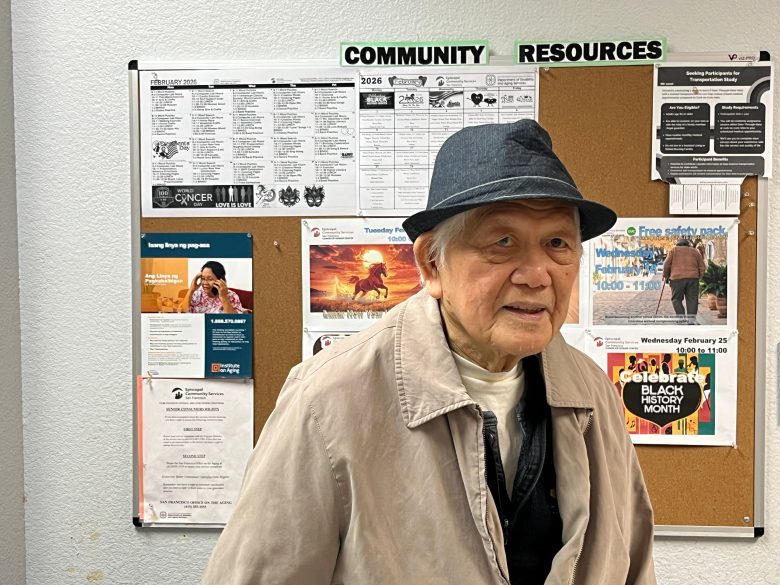
Cortez, 89, practiced communicating the story of his life in a writing class at the Canon Kip Senior Center in the South of Market neighborhood. At the center, he has also learned tango, Filipino folk dances and how to use a computer — a lesson he described as “the most treasured gift that I shall never forget as long as I live.”
Cortez and his wife, Felicitas, arrived in the U.S. on June 20, 1993. Cortez was 57 years old, Felicitas 52. Before they moved, both had worked as dentists in the Philippines’ public health system. They made so little money that they were forced to take on outside work, like raising cattle and sewing children’s clothes.
Leaving for the U.S. was not an easy choice. They were devastated at the prospect of leaving their adult children behind — Frederick and Florecita (so named by combining “Flor” and “Felicitas”). But America, to them, represented hope for economic prosperity.
After a week, doubt set in. Months passed, and they could not find work. A passage from the Bible recurred in Cortez’s mind: “Man cannot live by bread alone.” They wondered when they would find the stability they had been searching for.
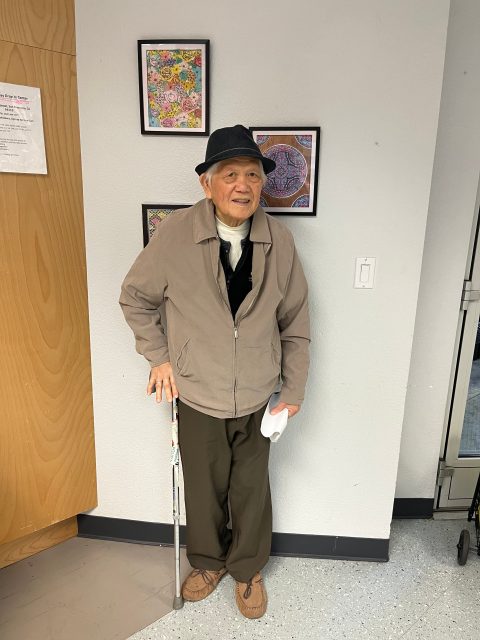
Then, one day, a fellow kababayan (Filipino compatriot) in SoMa told Cortez to meet him at San Francisco International Airport. There, his kababayan brought Cortez to the employment office and introduced him as a new applicant for a security job. A week later, Cortez got a letter telling him to report for job training. Soon, Felicitas found work at the airport, too, where they remained employed for 14 years. To supplement their incomes, Cortez sometimes moved cars at a rental center, and Florecita tagged merchandise at Macy’s.
“We were happy,” Cortez said.
Over the years, some of his fellow kababayan have moved back to the Philippines. “Others are gone forever,” he said. “This neighborhood was full of veterans, veterans of World War II — U.S. and Filipino veterans,” he said, speaking of the SoMa he first knew. “But their families are still here.”
As life gets more expensive in San Francisco, Cortez sometimes wonders what life would be like back in the Philippines. “All of my co-dentists in Baguio are gone. There is only one left who I know,” he said. “I didn’t realize then that, when I grew old, I would think about going back for economic reasons.”
But moving back would mean leaving another life behind. Some of his favorite memories are at the senior center. Cortez now serves as senior president to the Canon Kip advisory council.
When other seniors who visit the center celebrate a birthday, he organizes gifts. When they get sick, he organizes resources to help them. He keeps in touch with people who visit the center, reaching out to them before an event to make sure they haven’t forgotten and that they aren’t feeling lonely.
He is grateful, in particular, for the writing class. Emigrating to the United States was a confusing time, he said, and writing helped to bring him clarity. Even now, when he tells the story of his life, he cannot separate his life in San Francisco from his life in the Philippines.
He remembers swimming in the “silvery tinted” China Sea with his cousins, his father leaving to work in Hawaii to save money for the family, the “American soldiers with golden hair” who passed out Baby Ruth bars to the children in his village, the cloth he used to wrap his father’s body when he drowned in the sea. He remembers his mother’s work to provide for the family afterward, surpassing his father’s fourth-grade education when he graduated from university with a degree in dental medicine, his mother’s gentle suggestion that he marry Felicitas, the birth of their children.
He also recalls their first steps together in America, the care he received at Kaiser Permanente Hospital when he fell ill, the kababayan who told him to see the director of the Canon Kip Senior Center when he needed help.
He doesn’t want to have to choose.