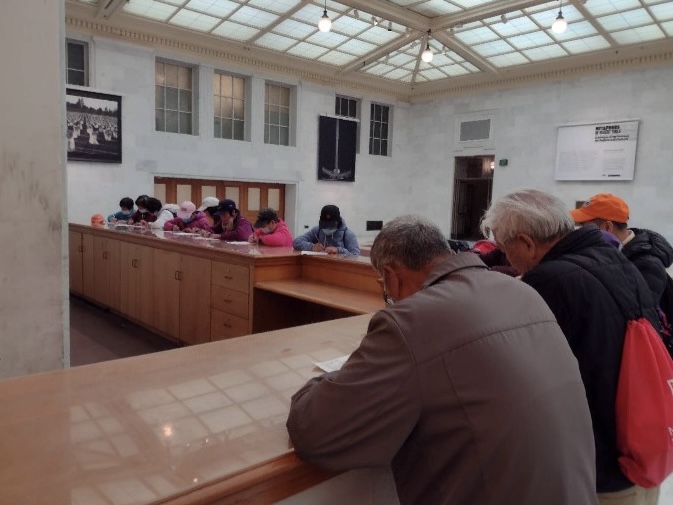
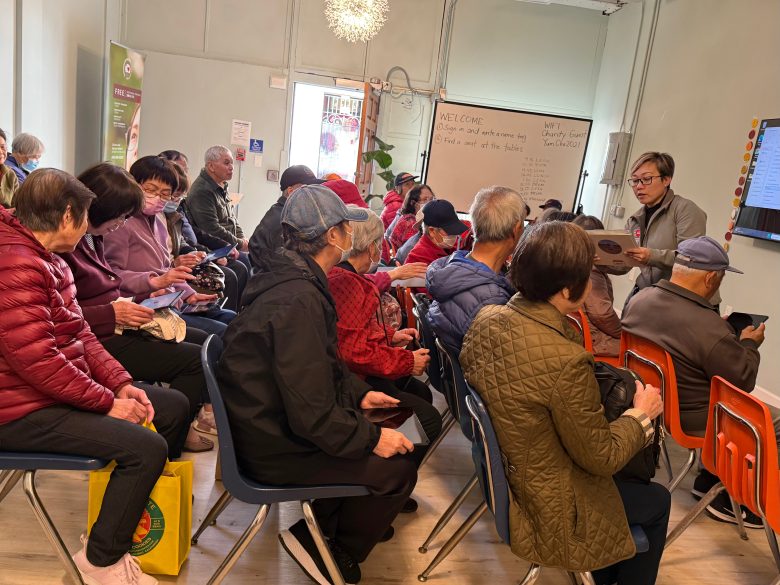

San Francisco’s Chinese seniors are a power bloc in local politics, legendary for their ability to show up by the dozens at San Francisco City Hall meetings and political rallies when a key piece of legislation or candidate needs to be pushed across the finish line.
Showing up has paid off. It has delivered senior housing, rent assistance and senior jobs programs to an impoverished community that needs all of the above. But Chinese elders’ organizational acumen has always been counterbalanced by a massive challenge: Cantonese.
The language barrier between English and Cantonese speakers has made it difficult for monolingual Cantonese seniors to communicate with the city’s largely monolingual English-speaking political structure. It has also made elders vulnerable to bilingual political operatives who have a lot to gain by using them as silent political props — and mistranslating speech in both directions.
But all that could change. While still no substitute for a skilled interpreter, apps like Microsoft Translator and Google Translate began to roll out translation from Cantonese to English, and vice versa, in 2024 with the help of large AI models.
Since then, this type of interpretation has leveled up to the point that local seniors are beginning to use it at city hearings and City Hall offices to communicate directly with officials.
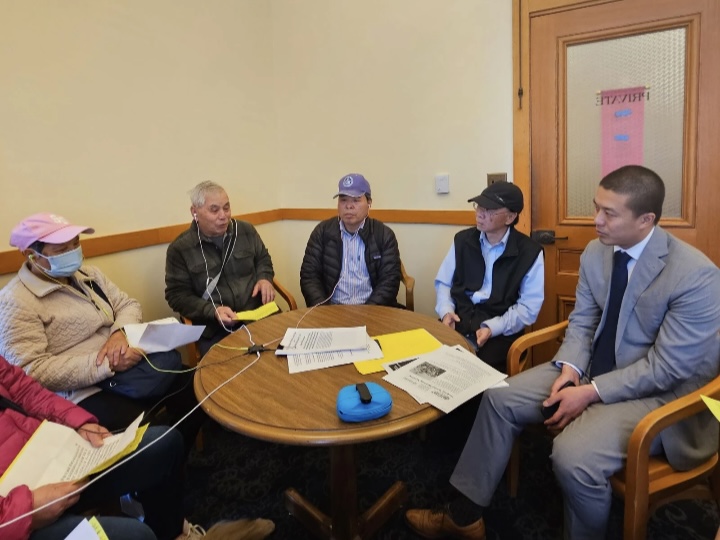
“AI can be a big game changer right now,” said Supervisor Alan Wong, who recently tried a lobbying session with the seniors with the help of Google Translate.
In the last year, seniors have used automatic translation to advocate for more accessible public transportation at a Sept. 11 planning commission meeting and to complain that live translation from English to other languages at public hearings has to be requested days in advance at a July 25 San Francisco Democratic County Central Committee meeting, and voiced support for the Sunset Chinese Cultural District at a Land Use and Transportation Committee meeting on April 21.
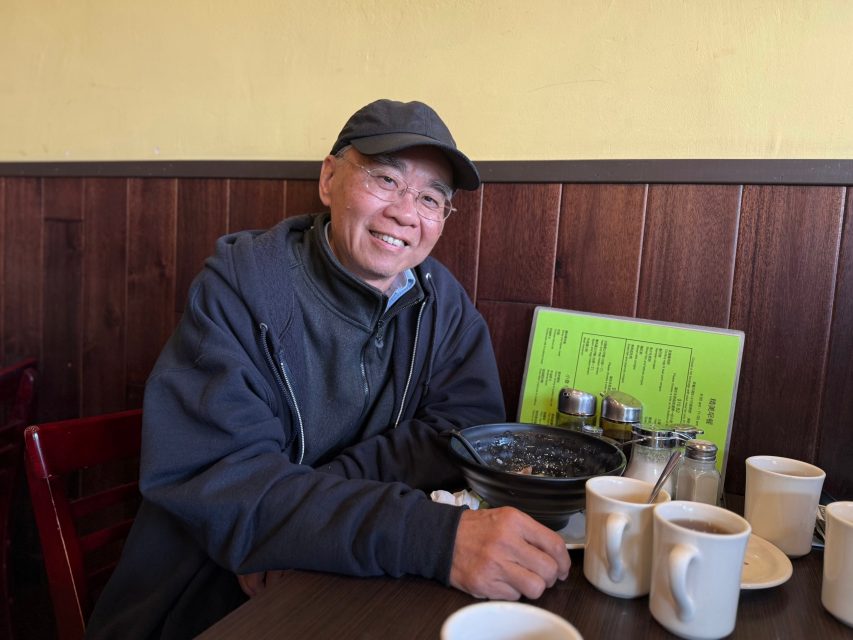
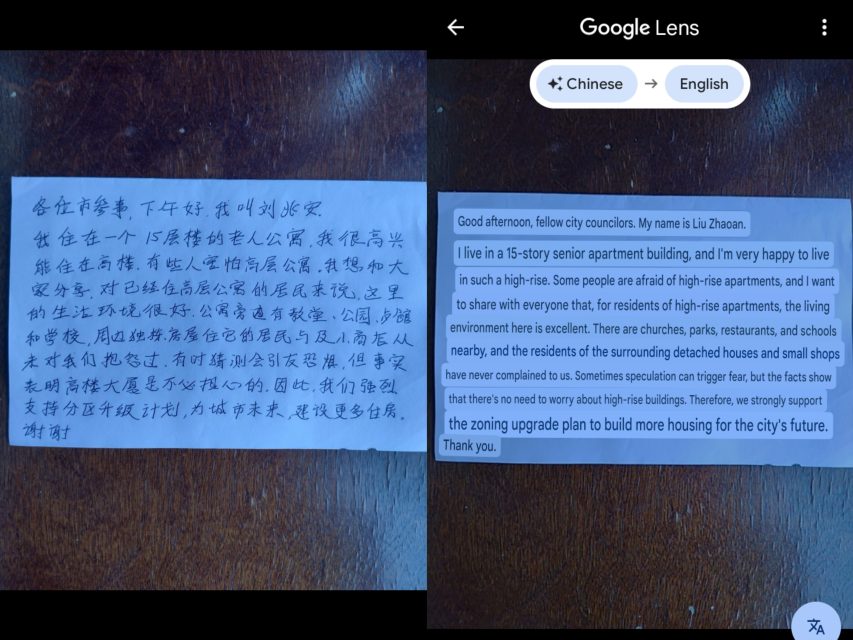
“For us, the density and height of the housing units are not an issue,” said 75-year-old Siu On Lau, at that June land use meeting, first in Cantonese and then in English via a robotic-sounding automatic translation. Twelve-story buildings sounded just fine, he added. What was important to him, though, was accessibility. It was very important, he continued, that new housing be close to public transportation.
The effect was emotionless. But the translation was accurate.
‘Why can’t we hear their voices?’
With Lau was Leon Chow, 65, a former organizer for the SEIU and a board chair for the Chinese Progressive Association who has traveled a circuitous path in San Francisco. Chow is among a handful of local Cantonese speakers who have benefited from their ability to serve as a go-between with politicians and Cantonese speakers. In 2024, Chow oversaw Chinese outreach for former Mayor London Breed’s failed reelection campaign.
His enthusiasm for automatic translation appears to be undercutting his own leverage as a gatekeeper, but he’s kept pushing it for the last two years. Requesting free and professional interpreters from City Hall for city meetings usually requires at least 48 hours’ notice. Some non-native English speakers work around this by bringing a bilingual friend or paying for their own interpreter.
Chow has become a booster for normalizing the use of automatic translation in city spaces — not as a replacement for skilled interpreters, but for situations where an interpreter isn’t on the premises.
Cantonese speakers notice the difference. As the robotic voice continued to address the land use commission in June, Lau recalled, he saw the supervisors’ expressions become intensely focused.
Lau, who moved to San Francisco from Guangzhou in 1996 but found the gulf between English and Cantonese difficult to cross, said the experience was moving. “People keep talking about freedom of speech in America,” Lau said, “but they can’t even understand what we are saying.”
“Some of these seniors have lived here for as long as 30 years,” added Chow. “Their opinions about this area matter a lot. But why can’t we hear their voices?”
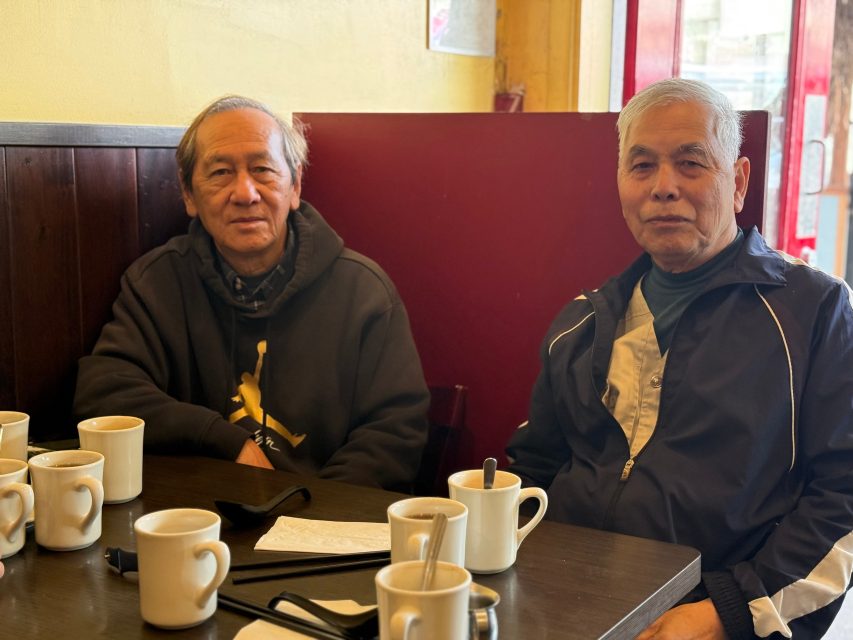
Chi Koo Lam, 73, moved to San Francisco from Hong Kong in 1992. He has come to care deeply about local issues, but had never made a public comment before last year because nobody could translate for him.
“I was so excited the first time I spoke at City Hall,” he said in an interview. Lam has lived in the Sunset for three decades and said the conventional wisdom in city politics — that Westside Chinese residents were up in arms against it — was inaccurate. “The opinions that have been expressed by the community about the Great Highway actually don’t represent mine. Turning it into a park is fine. I don’t use it much anyway.”
What Lam was excited about, though, was taller buildings. “In Tsz Wan Shan [in Hong Kong], buildings are 30 or 40 stories tall,” he told Mission Local. These buildings, he added, have food markets right on the ground floors, and elderly people can live entirely within the building without leaving, he said during an interview.
“I want San Francisco to thrive. I love this city dearly. All three of my children are here,” he said. “But in San Francisco, even going out is difficult for us. I wish we had high-rise buildings too, with shops on the ground floor where we could live and shop. That would be ideal.”
Lili Liu, a San Francisco interpreter who’s certified in three varieties of Chinese and mainly interprets in the educational field, said there are limitations to AI.
Human interpreters can “catch the tone of voice, catch the emotion of seniors” and detect various dialects of speakers, but “AI, at this point,” is not able to do that, she said. Also, human interpreters are responsible for what they translate, especially in court settings, raising liability concerns if and when AI makes mistakes.
Still, human interpreters are not often used when Chinese seniors go to political events — often it is just a politician’s aide who speaks Cantonese and wears two hats.
AI doesn’t veer off script
When dealing with the monolingual communities, poor translations, whether intentional or not, can often sail right through in San Francisco politics.
In 2022, a speech given by District Attorney Brooke Jenkins to a largely monolingual Cantonese audience in Chinatown was twisted by an amateur human translator from the mayor’s office. The light and celebratory tone of Jenkins’ actual speech was mistranslated into a promise that she would “bring all the bandits who attacked Asians and our community to justice.”
Nobody caught the slip-up until Mission Local’s subsequent article. At the time, multiple veteran politicos suggested that it was not uncommon for amateur Chinese translators to veer off script.
“It’s important to bring your own translator to the event,” Mission Local was told. “Sometimes translators like to rile people up, they’re doing a rah-rah. And you’re at their mercy.”
Jenkins’ words were spared such butchering three years later in 2025. At another community meeting before a largely monolingual Chinese audience, the DA’s explanation of the $950 felony theft threshold was (correctly) translated by AI into spoken Cantonese. (During the pandemic, many in the Chinese community had pointed to an oversimplified interpretation of the $950 felony threshold as the scapegoat for the perception of increasing crime rate.)
Chow envisions a future in which seniors can speak freely, without scripts or interpreters, at community meetings, in City Hall offices, at nonprofits, or even in Sacramento. He even wants the city to adopt a resolution that says “‘Yes, we accept AI translation,’” he said. And not just in San Francisco. “I want not only City Hall, but also the state, not limited to Chinese, but all languages.”
A group of Chinese seniors recently had a lobbying conversation with Sunset Supervisor Wong in his City Hall office. The seniors spoke in Chinese about the need for senior housing, and Wong, who speaks conversational Cantonese, responded in English. Using Google Translate and earbuds allowed them to understand each other in real time.
Before that Wong usually wrote English sentences into Google Translate and showed the translated results to his monolingual Russia- or Spanish-speaking constituents. “It’s still in this developmental stage, but with how AI is exponentially getting better, soon it may even be more accurate than other forms of interpretation,” he said.
Ashley Cheng, the executive director of Charity Cultural Services Center, has given a series of digital literacy classes to seniors with Chow. A major part of their workshops is teaching seniors how to use automatic translation for such challenges as reading appliance directions, operating washing machines when babysitting grandchildren, to fill in forms for their doctor’s appointments, to understand prescription labels and to read the nutrition labels on food packaging.
“We are enabling them to be independent, which is very important,” she said.
Chow is troubled by some politicians’ lack of enthusiasm to ditch gatekeepers and hear directly from monolingual constituents. But he says he’ll keep pushing the new technology. “It’s a free app to hear more voices, a diverse voice, but they don’t want to do it. I have kept pushing for two years. The only reason is yes, they want to keep the astroturf.”
“For now, it’s just me trying to do the best I can.”