

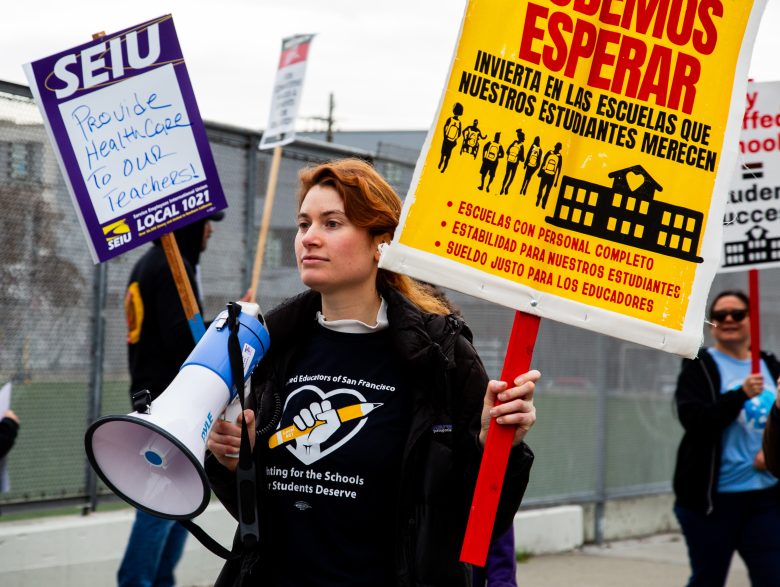

The San Francisco teachers strike, the city’s first in nearly half a century, is over.
The teachers union and the school district reached a tentative agreement early Friday after an all-night bargaining session. The sides announced the two-year deal near 6 a.m.
Students will be back in classrooms Wednesday. Schools had already closed for Friday, and both Monday and Tuesday of next week are district holidays.
The biggest sticking points were all resolved. The teachers won their marquee ask: fully funded dependent healthcare. For teachers with families, this does away with costs that often stretched to perhaps 20 percent of take-home pay, eating up recent wage gains.
It’s a benefit that one teacher on the bargaining team, who pays around $1,500 a month for his children’s healthcare, described to Mission Local as “life-changing.”
The fully funded family healthcare comes at the expense of raises below the teachers’ initial ask. Rather than the 9 percent raise the union desired, teachers will instead receive 5 percent over two years. “Certificated” staff like paraeducators, who are paid less, will get 8.5 percent over two years; the union had asked for 14 percent.
Special education teachers will get some case-load reductions, but not to the extent the union asked for. The union also won other changes, like security guards being given the chance to become full-time employees.
The district, in its pre-strike proposals, had made its offers contingent on reducing existing benefits, like prep time. The final deal does not give away much for the union, but does pause teacher sabbaticals for one year.
“We know our work is not done,” the United Educators of San Francisco wrote. “While we didn’t win everything we know we deserve,” she said, the new contract was “a foundation for a stable district.”
Superintendent Maria Su celebrated the deal in a morning press conference and thanked the union for “staying at the table.” But Su issued a warning: “There is still a long way ahead where difficult choices remain. We will need more support in the future.”
Layoffs and budget cuts, she said, are possible. “That has always been on the table.”
The strike was San Francisco’s first educator walkout since 1979 and was far shorter. The work stoppage 47 years ago lasted more than six weeks and involved court orders requiring teachers go back to the classroom and Mayor Dianne Feinstein urging a resolution.
This time, Mayor Daniel Lurie made a last-minute plea for more time, but only seriously involved himself days before teachers walked off the job. The strike had been brewing for months, and the two sides formally declared impasse on Oct. 10, when negotiations ceased until picking up again last week.
Lurie, in a statement Friday morning, wrote that he was “grateful that our educators and school district have reached a tentative agreement,” and thanked both sides for their work.
Educators demonstrated at every school site in the city in the mornings, 30 minutes before the first bells usually ring. They held daily mass rallies at Dolores Park, City Hall, and even Ocean Beach. City officials joined the picket lines, and the head of the country’s second largest teachers’ union flew in to show support.
Negotiations took place at the War Memorial Veterans Building, where the more than 100 educators who were part of the union bargaining team sat down with the district’s representatives every day since Thursday, Feb. 5, save Sunday.
Talks often lasted well into the night. The two sides quickly came to an agreement on proposals that would cost the district little: Codifying protections for undocumented students, continuing its “Stay Over” program for homeless students, and implementing regulations for AI in classrooms.
The economic package — wages and healthcare — and a new work model for special-education teachers were more contentious. But, once the district agreed to cover family healthcare Thursday evening, the other measures were passed within hours.
Additional reporting by Marina Newman and Joe Eskenazi.
The power of organized labor is unparalleled. Day after day of tens of thousands of workers and allies marching in the streets scared the s—-t out of power. A better world is possible, one can hope this is just the beginning.
Reminds me of current politics … liberal versus conservative .. republican versus democrats … in reality it’s the rich and powerful versus the common individual
School district and teachers are all on th e same team and obviously won like the rich and powerful ( Epstein like )
The victims are the Students .
How often do we hear union bureaucrats crow about reaching an “historic deal” only to find out later that workers were betrayed by devils in the details?
We are learning from most news this morning that the teachers will get virtually everything they demanded.
If so, we should all rejoice because that means others have a better opportunity to similarly strike and win improvements to their jobs!
Something doesn’t add up.
The history of “tentative agreements” follows a well-worn path.
They typically involve the union bureaucracy using secrecy, delays, and legal/administrative tricks to demobilize the rank and file workers and smuggle concessions through.
Will the workers have time to carefully read and absorb the details of the agreement before voting to ratify them? (They should be given at least a week).
Will the the teachers and paras allow the ebullient mood of victory and hype to smother their questions and reservations?
Now is the time when they should be especially alert!
Can the teachers be certain that, in spite of all the benefits they are being promised today, they won’t lose their jobs one day due to any factors they failed to take into account? They put their trust in the bureaucrats to do that for them.
For years, both capitalist parties have been determinedly working to dismantle public education and replace it with for-profit schools.
Other news this morning includes ominous warnings that the BART system faces certain death unless it is better funded.
Remember the last time the BART workers went on strike?
In this case, “UESF bureaucrats” are actually educators. Member leaders, not paid staff.
Your critique applies more to unions that are led by paid staff, not member leaders. It’s a good critique!
Hopefully the educators won’t lose their jobs with budget cuts in the future, but this is a huge victory for a well-organized union that fought with discipline and astonishingly broad public support.
It’s a huge victory for the public school families who are rejecting austerity and demanding our electeds check their math and fully fund SFUSD schools. The next fight is against budget cuts, and we will win that one too, together! Sí se pudo!
Direct Action gets the goods. WTG UESF!
Marc, what do you even know about school district financing? You’re on social media all day long, heckling the mayor for ‘doing nothing’ (as if you have a clue—were you on the bargaining team?), blaming parents for being angry that their kids suffer while adults play games (again—some of us are still traumatized from the endless covid lockout), then blathering elsewhere that the district ‘had the money all along so they could’ve stopped this!’ Girl just stop. You don’t know how any of this works. You’re just a truly tiresome labor groupie who also hates poor people and rails against supportive housing being built near your condo. And also, we’ll see what the California Department of Ed says about this new expenditure when enrollment drops again in August.
Sabbaticals sacrificed. Key missing detail.
Sabbaticals on pause for one year.
Sabbaticals are a privilege and not an employment right.
The real problem with this deal is that it is more than the district can afford. And you know what that means – layoffs, hiring freezes and school closures.
So a better deal for a smaller number of teachers. A Pyrrhic victory?
Stop paying people at the district office,and anyone else that does not have direct contact with students 6 figures,and start thinking about selling property,since S.F is not going to every get the student population that it once had back,plus women are not going to reproduce no matter what tRump offers them to increase the-White population.
Recently spoke with a 3rd generation policeman,who actually lives in San Francisco, on why police get better pay than teachers, and he simply stated, that the police has a stronger union. He went on to say, that his mom, who was a teacher, retired at 90K and that’s with a Master’s, while police want into the academy at 110K and when they graduate, they get more money if they have a college degree, speak another language and don’t forget over time-Go figure!