

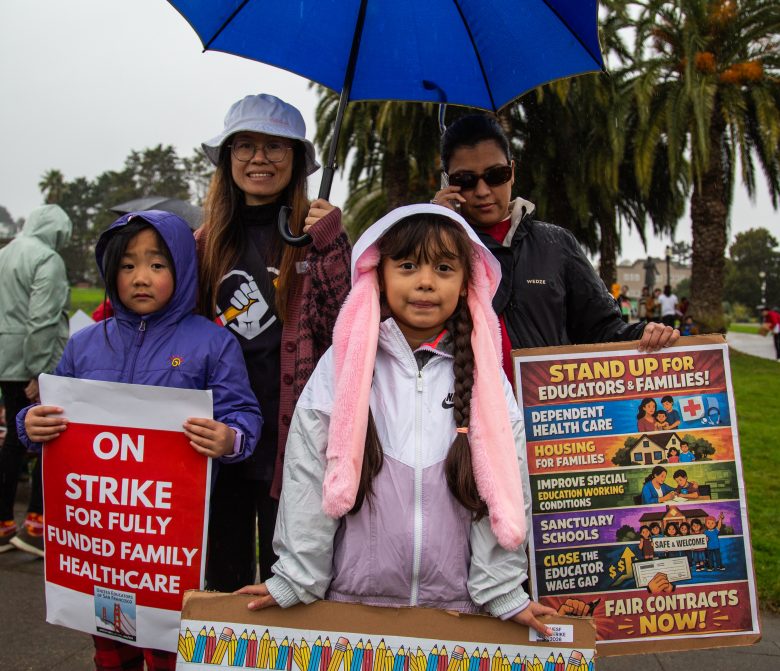

Chimnaz Shahbazzade was relieved to secure a last-minute spot in a community-based childcare program for her daughter yesterday morning, as the San Francisco educators’ strike continued with no end date in sight.
It means she will have someone minding her 5-year-old for the foreseeable future.
With public schools closed, the single mother, who works full-time as a lawyer, had no choice but to bring her daughter to work on Monday. “It was really, really difficult for me to take care of my child,” Shahbazzade said, adding that, with her daughter around, she did not get much work done.
While the childcare program offers some relief, Shahbazzade still has to leave work early to pick up her kid. She said she has postponed much of her work this week, which could hit her bottom line; compensation is tied to finishing her projects.
San Francisco educators have been on strike since Monday, demanding better wages and family healthcare, and more resources for special-needs students, among other things. Negotiations between the union and the school district are ongoing.
As public schools remain closed, many parents of the district’s 50,000 students are scrambling to arrange childcare.
Kim Chau, who works from home, has kept her 5-year-old daughter with her while her 9-year-old son attends his after-school program, which was expanded to cover daytime hours during the strike. Still, it’s been challenging.
“I’m definitely, like, maybe only 40 percent productive,” she said.
Should the strike last, “that would be really stressful, in terms of just having to pay for that extra childcare,” she said.
For many families who cannot afford to take time off work or pay for extra childcare, options are limited.
The Department of Early Childhood has offered free temporary childcare for children under 5 who are enrolled in the district’s transitional kindergartens or preschools. Other community-based organizations, like the nonprofit Mission Graduates, have expanded their after-school programs to offer free activities for children during daytime hours.
But their capacity is limited. Eddie Kaufman, CEO of Mission Graduates, said they are having to turn people away.
“We are tapped out by the sites we’re at,” said Kaufman, adding that they do not have the capacity to serve more than about 200 students during the day, compared with the 1,600 students their after-school and summer programs usually reach.
“We’re really focusing on the students that need the most support,” Kaufman said. That means giving priority to students from low-income families, whose parents cannot afford to take time off work or to send them to paying programs, he explained.
Even then, it’s a temporary solution. Kaufman estimates his organization is spending an extra $2,000 per day to run all-day programming. “We focused first on making sure we have sites open, and then we knew we would figure out how to make the extra costs,” he said.
The group has secured spaces to accommodate students for the rest of the week, and is working on securing those spaces for a longer period of time, should the strike extend past Friday.
The school district and the teachers’ union have been in contract negotiations for nearly a year, and so far have failed to reach an agreement. Over the weekend, the parties made some progress in the negotiations, with the district agreeing to strengthen sanctuary-school policies.
But the sides remain far apart on wage increases, healthcare for dependents and staffing and funding for special education programs. Educators say they will remain on strike until their demands are met.
Both parties have stressed the urgency of reaching an agreement. Many parents are also hoping for a speedy resolution.
Makinde Pecanha is a father of three public-school children. The youngest has been able to attend his daycare during the strike. The middle child, who is 6, has attended his regular after-school program during the day. The eldest, who is 11, is staying home.
“I don’t see it being resolved anytime soon, but I’m hopeful,” said Pecanha, who said he supports the educators’ demands, particularly regarding wage increases.
“In general, people need better pay to be able to live here. This is one of the highest-income areas,” he said. “I’m sure that they have the resources to be able to pay for all of it. But it’s just about better coordination, and the administration needs to get it together. And really, I think they can do it.”
Shahbazzade said she also supports the educators’ demands. “But at the same time, hopefully, it’s going to be resolved very soon.”
The teachers are being too greedy. They are already one of the highest paid teachers in the country. Have full summers off every year and yet they want more?!
May the strike end soonfpr the wellbeing of the students and all the families being affected.
tell us indirectly “I do not have children, nor do I know any teachers”….
It’s not just about the teachers. It’s about the paraeducators who work with them. It’s about the head office employees who make $300k+ while we shutdown schools and lose educators to districts which function normally. If your employer consistently paid you the incorrect amount if they paid you at all, constantly invested in overhead management, and left you overworked as a result – what would you do? SFUSD will NOT have educators if they continue down this path. Charter schools and adjacent districts are able to provide ample compensation plus meet the barebones requirements any employer is held accountable to.