

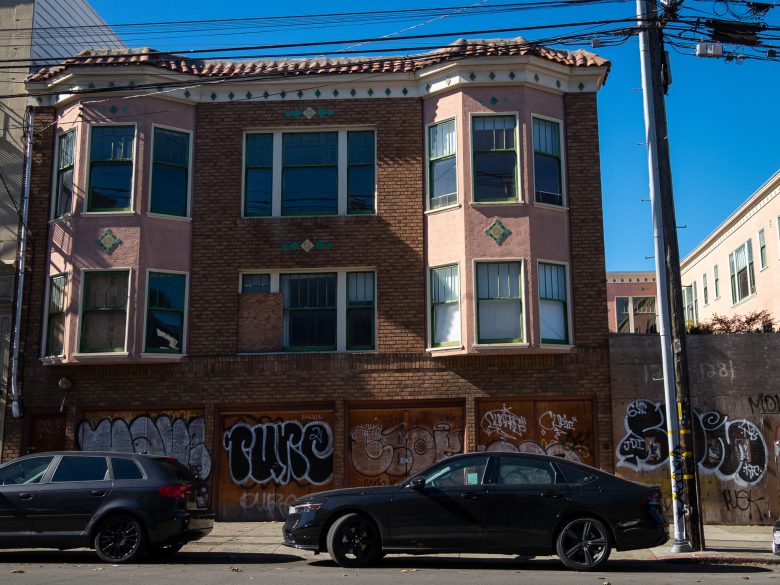

“You have to be prepared that this is not going to wrap up quickly,” a city worker warned the tenants of 1275-1281 Eighth Ave.
The building’s owners, he said, were “probably going to draw this out as long as they can” in order to stop long-term tenants from returning to their rent-controlled units.
Nearly three years after an August 2023 fire at the apartment building, that warning has proved prescient.
Only a handful of tenants are still waiting for repairs at the 24-unit, three-story building at Eighth Avenue and Irving Street. Most have moved on, abandoning hopes of return. The building was rendered uninhabitable that August after the fire from the nearby Progress Hardware store leapt to the building.
It’s been a saga. The building’s insurer disagreed that its electrical system had to be replaced, but declined to pay for it, according to the Department of Building Inspection. The building’s owner, Socrates Mamakos, then died in July 2025 at 94 years old. His son, Nick Mamakos, took over the property.
“It’s been difficult to get the son of the now-deceased owner to deal with his responsibilities as a property owner,” said Mike Farrah, a legislative aide in Supervisor Myrna Melgar’s office, to a group of Inner Sunset merchants on Tuesday. “The last call to the owner was not returned.”
The city approved a building permit in October last year. But, according to Melgar’s office, the bidding process for the repairs is still underway, and won’t conclude for several more months. The building also needs a transformer from PG&E that would add uncertainty and time to the process.
According to the Department of Building Inspection, it will take 12 to 15 months to complete the renovation once construction starts.
“Everybody who goes through a fire gets this master’s degree in bureaucracy,” Farrah said. “It’s very frustrating. It’s a brutal education.”
For the remaining tenants, any news is good news. It’s “a light move in the right direction,” said Uli Zinnkann, who had lived in the building for 18 years and raised her son there. “But not sure I believe anything is happening until it actually does.”
A paradise of opera and spaghetti
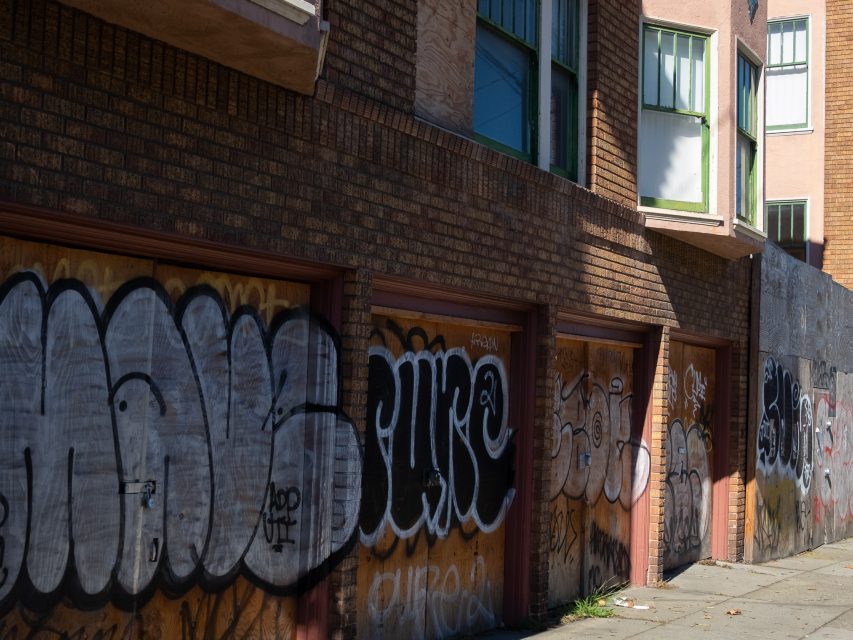
In order to return to their former apartments, tenants have to leave their original rental deposits with the building’s owner, even as they continue paying rent elsewhere. At 1275-1281 Eighth Ave., many have given up and asked for those deposits back. But a few dreamers are still holding on.
One of them is Stephan Crawford. When he first moved to the building in about 2008, Crawford remembers it as a full sensory experience. As he walked into the building’s courtyard, he saw a child’s bike leaned up against the wall, and heard one neighbor practicing opera, as the delicious waft of another neighbor cooking pasta drifted by.
It was, Crawford said, “a beautiful little community.”
The other tenants were architects, harbor pilots, people in the arts and working for nonprofits, Crawford said: “The people that make the city hum.”
“It was young. It was old. It was across all generations,” he said. “It was a beautiful little community.”
Trouble in paradise
Before the 2023 fire, tenants said they had repeatedly experienced and warned the landlord of electrical issues in the apartments.
In a back unit, Zinnkann said, one of the walls would get so hot that the key fobs hanging on hooks would melt. The radiator was “absolutely crazy,” said another tenant, and would go full heat, without anyone turning it on, during random times of the year.
Crawford experienced at least two fires during his tenancy: One on the roof, and one in the closet of a neighboring unit.
The Department of Building Inspection shows a long list of complaints about the building over the years, including malfunctioning outlets, wastewater leaks and weeks with no heat.
Tenants even went to a hearing at the department in 2019 over code violations. Afterwards, Mamakos fixed some issues, but it was “not good enough,” Zinnkann said. “The building was just not up to code, and he didn’t really care.”
Paradise lost
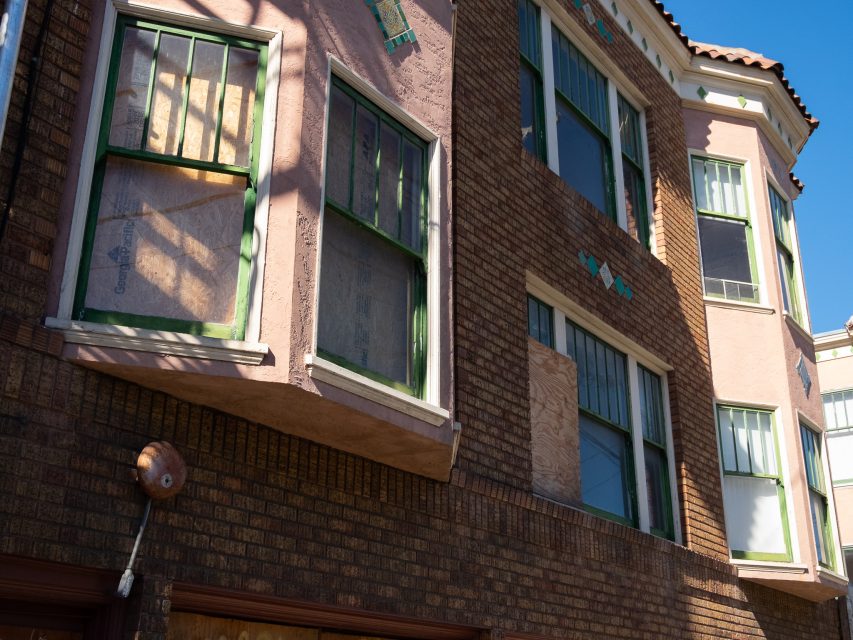
In August 2023, immediately after the fire, the American Red Cross was the first on site to provide food, clothing and temporary housing relief for displaced tenants, who received a few hundred dollars for hotels.
Then, the San Francisco Human Services Agency sent representatives to talk to the tenants. Some were eligible for rental assistance, which pays for the difference between the tenant’s current rent and a comparable unit leased at market rate for up to two years.
The agency helped an elderly tenant with two cats relocate to an SRO unit near Ghirardelli Square. But tenants who made over 100 percent of the area median income or had household assets over $60,000 did not qualify.
In the first few months, tenants banded together, holding regular meetings at Zinnkann’s architecture office, getting advice from the San Francisco Tenants’ Union, and keeping a collective spreadsheet of resources.
After about half a year, the energy began to fizzle.
“There’s very little structure around how our city responds to a fire, of displaced tenants, displaced businesses and what we do with this mess that has been left by this disaster,” said Emma Hare, a legislative aide at the District 7 office, at an earlier merchant meeting.
To start, the office is trying to create a centralized resource guide for both tenants and landlords that outlines everything that they need to know when dealing with a fire. That could include tenants rights, being aware of looting, contact information for the Department of Building Inspection, and instructions for filing construction permits.
With a resource guide like that, the legislative aide Farrah said, “we’d be in a much better place.”
“But that’s no one’s responsibility right now, and it’s not getting done.”

Brendan McHugh, a writer and worker at Green Apple Books on 9th Avenue, lived at 1281 Eighth Ave. for two years. He still misses the high ceilings and the sliver of the Pacific Ocean that he could see through the window on a clear day.
He also remembers how, when he was allowed back into the building to collect his belongings, there was ash all over the apartment, even inside his toothpaste cap. He found a place in Lower Nob Hill two months later, with help from Binc, a booksellers group that helps bookstore employees with emergency financial needs.
McHugh abandoned his plan to return after learning of Mamakos’ death, and decided to reclaim his deposit.
“It was, ultimately, really exhausting,” McHugh recalled. “I just chose to start over.”
Romane Vigouroux, a student at the University of California, San Francisco, had only moved to her third-floor unit in the building a week before the fire. She later found a place in the Lower Haight, and kept her $2,000 deposit for two years. But after hearing that the construction wouldn’t begin until 2027, she, too, forfeited the right to return.
“Those first months, we kept having to go back, get our stuff, relive that experience over and over again,” Vigouroux said. “I started to associate the Inner Sunset with this bad memory, because it was so stressful and traumatizing.”
“I just wanted to move on from it.”
You make it sound like three years is a long time but in reality the elapsed time to get insurance approval, architect plans, buildings permits and then do the constructions is easily going to be three years, and five years is more common.
And the fact that the owner died during this time makes it worse, as until probate is complete, nobody can make any decisions about the work, nor sell the property, and so on.
If a building is condemned as uninhabitable due to fire you are probably looking at at five to seven years before anyone can live there. The fact that the rent ordinance gives tenants the right to return, whilst it sounds fair, also carries an elevated risk that the process is not fast-tracked.
Exactly this.
Both can be true – for the tenant, experiencing a fire can be traumatic for the reasons listed above. For the landlord in San Francisco, getting a new design reviewed, approved, and built can take years.
12-18 Months for construction? If the building owner will need PG&E to come out and connect power to a new transformer it’ll be more a matter of years before that building will be done with construction. I completed a rehab of a small apartment building 3 years ago in the Sunset, and we’re still waiting for PG&E to come out and connect power to the new main service panel. (Fortunately we can still get power through the old panel in the meantime so the units can still be occupied at while we wait for PG&E to get off their ass and do their job).
Well, that’s the estimate from DBI, and we all know how professional and trustworthy they are.
I’ve just been through this buying process, hunting for properties in SF and you see a LOT of crap. Mold, sagging floors, rats, just tons of crap. Even properties where you’ve had a fire or some units are simply unlivable.
The thing is, if you buy a vacant unit or building like this, you can put in 100k or 200k and have something rentable. And, since it is vacant, you can rent it for whatever you want.
But you know what NOBODY will buy? A property where they need to do half a million dollars of work, and when you finally do it, bring back rent-controlled tenants who’ve been there since the 80’s.
The thing is, the money doesn’t work. My mortgage on a 4 plex is 7k/month. One tenant in a 2 bedroom pays like 1800/month while others pay 2-3k. I’m fine with it. People come and go. These people, however, aren’t going anywhere and they’re going to be thrilled to come back to a renovated place. So who is going to buy it? Nobody.
The only thing that’s happening here is the owner waiting for them to give up so he can sell it unencumbered.
This isn’t an opinion, this is just what’s happening. I don’t have a solution here, and I can’t think of a legal one that works.
Yup. Rent control has an initial sugar high that inevitably gives way to people feeling stuck in decaying housing stock.
I live near there and remember that evening. I didn’t know however that the fire jumped from Progress Hardware to the apartment complex. The hardware store was completely emptied and rebuilt with a new interior and awning but unfortunately it was apparently too expensive for them to reopen, and it remains vacant, while much of the neighborhood experiences a retail, and especially, culinary renaissance of sorts.
I have come to learn over time that Rent Control is like housing projects, maybe worst. It chains people to a place until the day they die. These people never get to experience anything new. Just the same ugly faucet for 20+ years. There is no innovation in anything. They never get to experience new neighborhoods, new cities. It’s actually pretty terrible. The tenants of Rent Control are basically “stuck” because the rent is basically frozen. I hate that it did this to my parents and I hate that we had to grow up like this. I wish people would wake up! Don’t be a prisoner! It’s a total cover-up!
Yeah, I know someone who has lived in the same crappy apartment for 40 years now. He originally rented it with his college buddies. But one by one those buddies moved on with their lives. And he is left endlessly rotating new roommates with whom he increasingly has nothing in common due to the fact that they are mostly young and he is over 60 now.
With a crap job and no prospects, he clings desperately to this unit. It feel like he thinks that having it is his greatest achievement. So sad.
Props to the folks who didn’t act like helpless little flowers and moved on with their lives.
Simple. The city should provide an interest-free loan to the affected renters for the entire amount of their deposit, so they are not out of pocket waiting for the landlord to rebuild. The other alternative is escalating penalties to stop the landlord from running the clock.
Great Idea ! Why not use escalating penalties to force vagrants and drug addicts from San Francisco? Could be used for the Honduran drug/murder trade too!