

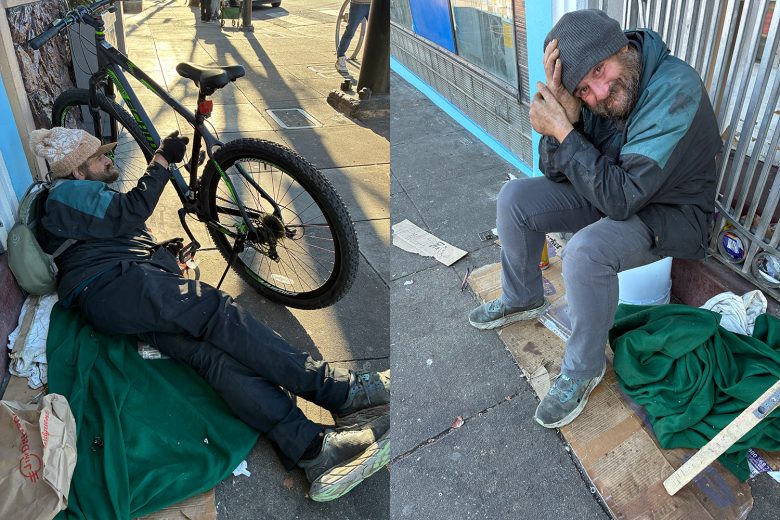

When I pass Junior’s sprawling sidewalk encampment between the bus stop and the laundromat at 30th and Mission, I say, “Junior, for God’s sake, clean your room!” and Junior chuckles and giggles as if I were the wittiest person, and he’d never heard me say it before.
He has lived on that corner for at least 21 years — nearly half his life, maybe longer.
Art, who owns the Wash Place, says, “He’s been here since I bought the place in 2004. Every laundromat has a guy that comes with it when you buy it, and Junior came with this one.”
Javier, the owner of the Nicaraguan restaurant next door, has fed him generously over the years, as Junior’s collection spills over to his entrance.
“We offered to get him a room somewhere. Then we asked the police and the health department to get him to stay away, and they posted a stay-away order. They talked to him, but he always comes back.” He sighs, “He is a good person.”
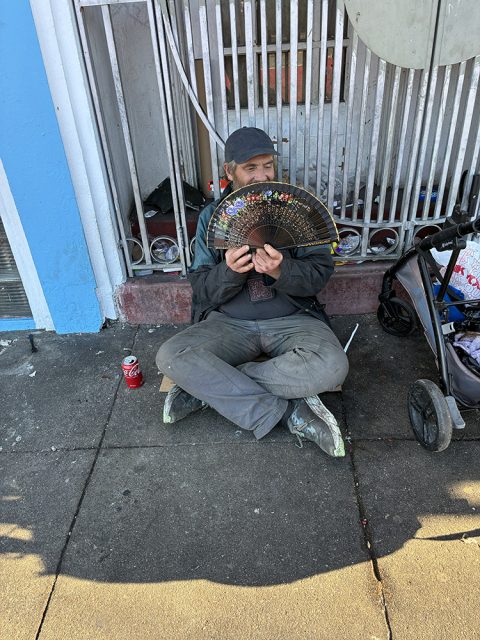
Junior’s “room” can house a bike-repair operation, a wheelchair or two, mattresses, cakes, fried chicken, Oreos and Lorna Doones, ponchos, gloves, gear, boomboxes, dismantled phones, and female flotsam who wash up on Junior’s shore, never for very long.
One warm January afternoon, he fanned himself with an elegant lacquered fan one of his women companions had left behind. She’d been shrieking at him and the world for a few days and finally left.
“Junior,” I said, “you sure can pick some doozies,” and he laughed heartily, “Yup, I have to agree with you on that one!”
I can place Junior back to when he was clean, housed, and wore a red beret and an orange safety vest, a uniform he modeled on New York’s Guardian Angels, a crime-prevention group formed 40-odd years ago. He proudly rode the buses, standing up front next to the drivers, helping lift baby strollers up and assisting wheelchair users down. He even called out the stops.
But that was a long time ago.
He had hair and teeth then. He was tall and strong, polite, if a bit too loud and bossy. The drivers tolerated but largely ignored him, their volunteer conductor.
But decades of living rough — plus various run-ins with other street people, fisticuffs with his ladies (they usually win), multiple jail stays, some bad bike accidents and hospitalizations — have knocked out his teeth and torn off his hair.
“Happy Tuesday, Norma,” he calls out to me (having misheard my name a gazillion years ago), or “Happy Wednesday!” or “Feliz Domingo!” (Junior speaks passable Spanish) or “Two more weeks to my birthday!”
New Jersey to San Francisco
Junior was born Norberto Pine in Trenton, New Jersey, on Dec. 30, 1982, and came to California with his siblings and his parents around 1997, he thinks.
“Norberto, really?” I ask skeptically.
“I was named for my dad: Norberto Senior, and he was named for his doctor. He told me so.”
“Are you Latino?”
“Oh no, I just picked up Spanish around here. I am Irish and Italian.”
There was a period of group homes here in his teens, then his parents died, “My mom in ’06, and my dad in ‘07, and my siblings left me to the streets.”
When a neighbor retired to Michigan (he was a meticulous CPA for the IRS), he appointed me to dole out the weekly $10 allowance he paid Junior.
I continued for a while, then let it go, and Junior never asked for it.
He is not a lazy guy, and doesn’t panhandle. As far as I know, he doesn’t use drugs.
You might get the wrong impression, because he sleeps during the day, when people riding the bus, doing laundry or shopping are all around him, and it’s safe.
He comes to life in the afternoon, doing his many jobs: He pulls out the trash bins for the Nicaraguan restaurant, he helps cart in bottles of booze to Club Malibu a few doors down, he pulls out bags of empties for the recyclers and helps load them clatteringly onto their trucks.
There were even years when he worked inside the laundromat.
Art, the owner, says, “Junior was mechanically inclined, even helped me to repair some of the machines: Take them apart and put them back together. He helped me move the big machines, too. He was that strong.”
And he adds, grinning, “If I had one big customer for laundry pickup, he would come with me and help me with the bundles, he was much more presentable then.”
Junior shuffles and bellows through life
That was then, and this is now: Mostly, Junior lounges and avidly watches his intersection, as if he had the greatest view in the world. He knows the corner’s rhythms and schedules, reminding forgetful neighbors when to move their cars for the street sweepers, banging on their doors urgently, like Paul Revere, shouting “STREET CLEANING!!!”
Junior has a distinctive bellow, a trumpeting sound like an elephant seal, and he can be heard across four lanes of Mission Street traffic when he wants your attention.
Junior says he has no ID, so he can’t get a phone; he has no documents that prove he exists, so he can’t get an ID. His version.
If you could get a room, anywhere, where would you live? “Just anywhere around here, is all, right here,” he says.
He keeps a tent behind the Burger King on Bayshore Boulevard, but that is only for very late at night. A few years ago, he was hit by a car on Bayshore while riding his bike and was hospitalized.
When he came back to his “room,” he was in a flimsy wheelchair. The neighbors took up a collection and got him a strong, durable wheelchair. We thought he was done for and would never walk again. But he recovered.
As Art says, “His very strength is that he is completely indestructible.”
There is an ineffable sweetness about Junior, a gentleness and a desire to be helpful. He was violent in the earlier years, threw punches in frustration, but he is on the losing end of any dustups these days. What’s left is the bellow.
A shuffle and a bellow.
Whether due to injuries or arthritic stiffness from sleeping on concrete, he has a Chaplinesque gait, rocking a bit from side to side when he walks, accompanied by a fleet of wheeled contraptions: Buggies, bicycles, shopping carts, strollers, scooters.
He’s his own parade.
He’s also something of a mystery; he is not a linear narrator.
Easier to know his favorite food is spaghetti, and his favorite music is “James Brown, Diana Ross and the Supremes. The Temptations, what my parents used to play.”
When asked to explain why he continues to live outdoors, he pauses the music on his player and stops untangling a rope. “’Cause I got tired of being in the programs. Yeah, I was in programs my whole life, me and my family were in all the programs. I am done with programs.”
He laughs heartily, “I don’t have to answer to NOBODY, to NOBODY,” he stops laughing, “Except for SFPD. I have to answer to SFPD, but I try to stay out of their way.”
“Besides,” he adds, “I can’t leave the restaurant without no one watching it all night.”
“I am like their guardian angel. I am still a guardian angel.”