

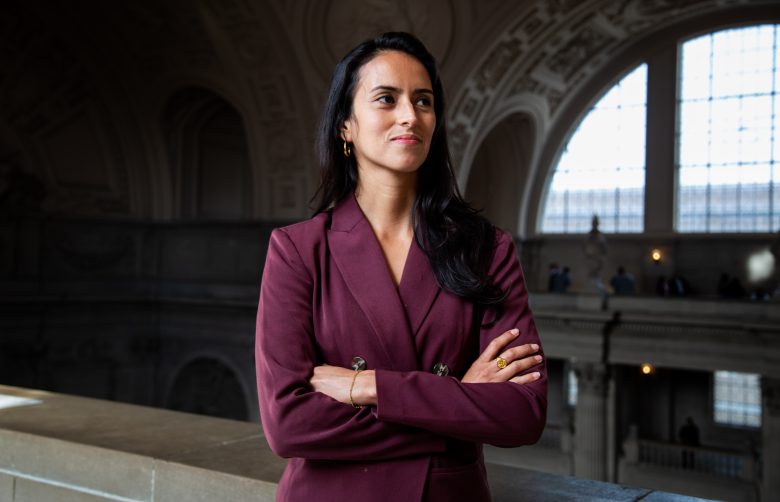
San Francisco Supervisor Jackie Fielder will introduce a ballot measure on Tuesday that would tax financial institutions to create a municipal public bank, the first of its kind in the country. The public bank would let the city issue low-cost loans for affordable housing, small businesses, and green infrastructure.
The measure is the most concrete step a city official has taken to create a public bank here since 2023, when the Board of Supervisors unanimously greenlit a plan to stand one up. Fielder said a public bank would help entities that have struggled to get funding from traditional banks get loans from the city instead.
While Wall Street is oriented towards profit, Fielder said, “a San Francisco public bank is not out to seek to maximize profits, but to support projects and industries that Wall Street can’t extract much profit from.”
Fielder’s proposal would increase the gross receipts tax on commercial banks, credit unions, hedge funds, and investment funds from its current range of 1.5 to 3.36 percent, to 1.69 to 3.85 percent.
The measure would need the support of at least three other supervisors to make it onto the ballot. She said she will lobby her colleagues to sign on in the coming months.
In October, supervisors unanimously passed Fielder’s resolution for a “green bank,” a smaller-scale entity that would also provide low cost loans. Supervisors Rafael Mandelman, Shamann Walton, Connie Chan, Matt Dorsey and Myrna Melgar were among the 11 who voted in 2023 to accept a plan created by a city working group for standing up a public bank.
Once on the ballot, the measure would need to be passed in a simple majority vote by San Franciscans, who are also being asked to consider two other tax measures in November: a parcel tax and a regional sales tax, both of which are intended to help address a Muni deficit.
Fielder is optimistic. An Oct. 6 poll commissioned by the San Francisco Public Bank Coalition, which Fielder led before her turn to elected office, showed that 67 percent of San Franciscans support creating a public bank.
The San Francisco Chamber of Commerce, a business advocacy group, is skeptical. “The city is managing serious fiscal pressures and considering several record-setting new taxes. We think it is worth asking whether now is the right moment to create a new regulatory institution while even further taxing our largest employers to fund it,” David Harrison, the chamber’s public policy director, said.
Starting up a public bank requires $400 million in initial funding, according to a working group. It is an involved process: First, the city must form a “municipal financial corporation,” a precursor to a full bank that can issue loans but cannot take deposits.
Fielder’s measure would raise $40 million to $50 million annually for that corporation — the tax funds would be earmarked for the city’s “Public Bank Fund” until 2035. The money would mostly be used to fill the municipal financial corporation’s coffers so that it could begin issuing loans by 2029, Fielder said.
If the municipal financial corporation proves successful, the city would then apply to the California Department of Financial Protection and Innovation and obtain FDIC-insurance to convert the entity into a fully-fledged public bank by 2032.
The tax would not go away, however. After 2035, revenue raised by the measure would go to the city’s general fund.
Public banks are not retail banks — individuals would not be able to open accounts and make deposits. But a public bank would give the city the option to manage and store its money in-house, which would let it avoid a reliance on Wall Street banks, Fielder said.
The city has been contemplating creating a public bank since 2019, when California passed a state law that allowed cities to create them. In 2021, San Francisco launched a working group to develop a proposal for creating a public bank. The plan created by the working group was passed by the Board of Supervisors in 2023.
Though public banks are common worldwide, the only one that currently exists in the United States is a state bank, the Bank of North Dakota, which was founded in 1919.
“This measure is a monumental first step to start a public bank,” Fielder said. “It’s part of a larger vision of taking San Francisco back for working people who have been who are not wealthy and still deserve a place in the city.”