
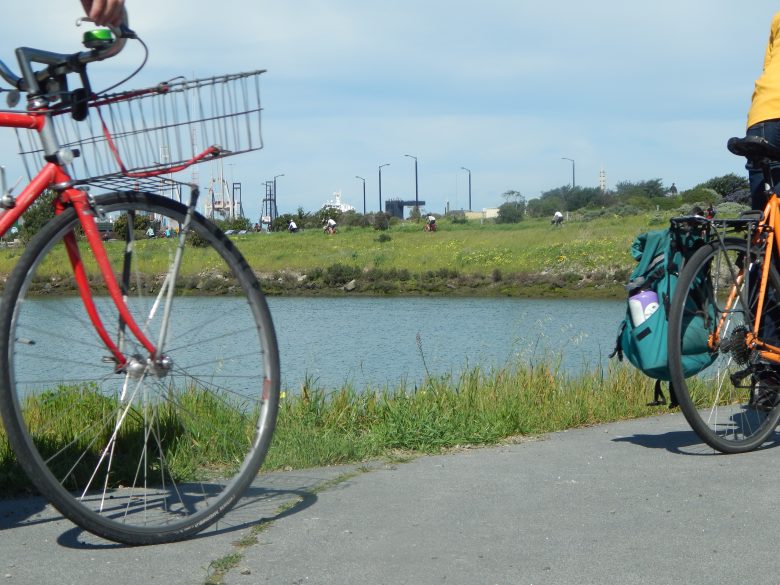

Bayview resident Janet Allen-Williams has been to 19 Black History Month events this year, but this was the first in which she spent the whole time sitting on a bicycle seat.
The 63-year-old was one of around 150 people who attended San Francisco’s first-ever Bayview Black History Month bike ride on Saturday. The 4-mile ride, which went from the Martin Luther King Jr. Fountain in Yerba Buena Gardens to the Ruth Williams Opera House in Bayview, started at 10 a.m. and ended at around 1:30 p.m.
Kat Fernando and her boyfriend Michael traveled from Salinas to attend. Fernando said it was their first time biking in the city.
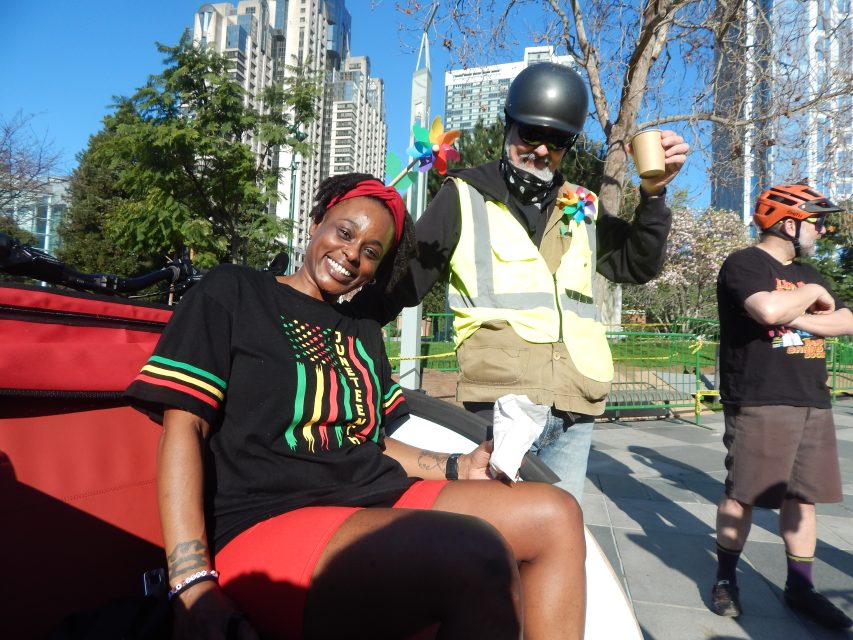
“We should get our bikes an award or something,” she said, noting the accomplishment. “But they gave us pinwheels and a bell, so those are never coming off now.”
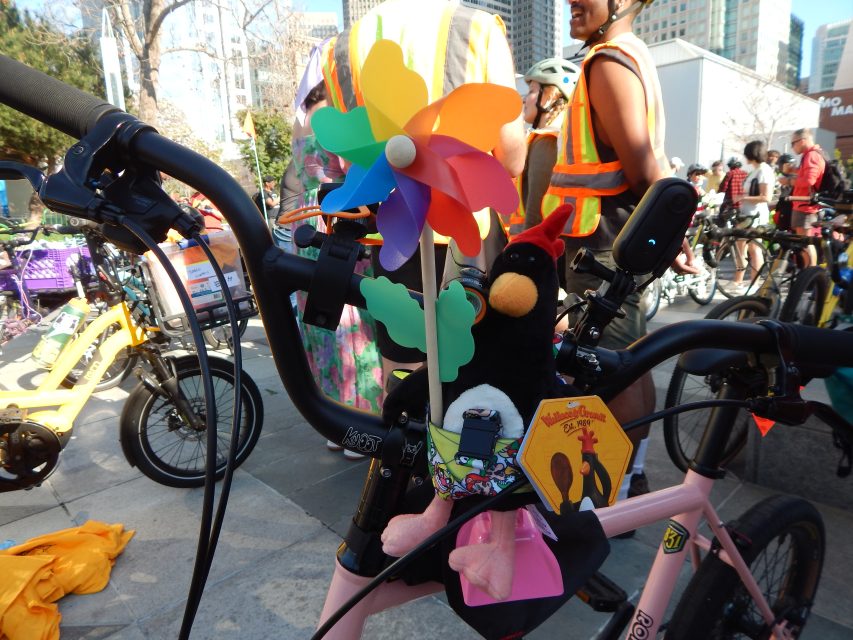
The event was part-exercise, part-history. At each stop, cyclists learned about historical Black figures.
At South Park in the South of Market, Shariff Wynn from the San Francisco Bicycle Coalition, a co-organizer of the event, taught the crowd about Mary Ellen Pleasant, a Black woman born in 1814 who became a multi-millionaire and, in 1859, funded John Brown’s famed raid on Harper’s Ferry, according to an interview she gave a reporter in her later years.
When Brown was hanged, a note in his pocket read: “The ax is laid at the foot of the tree. When the first blow is struck, there will be more money to help.” It was reportedly from Pleasant.
Pleasant became a financier and key part of the Underground Railroad in California; she was known as the mother of the California civil rights movement. Pleasant owned property across San Francisco and was called “Mammy Pleasant” in the city because she worked as a domestic servant, reportedly to hide her wealth. She listed her occupation on the 1890 census as “capitalist,” according to the National Park Service.
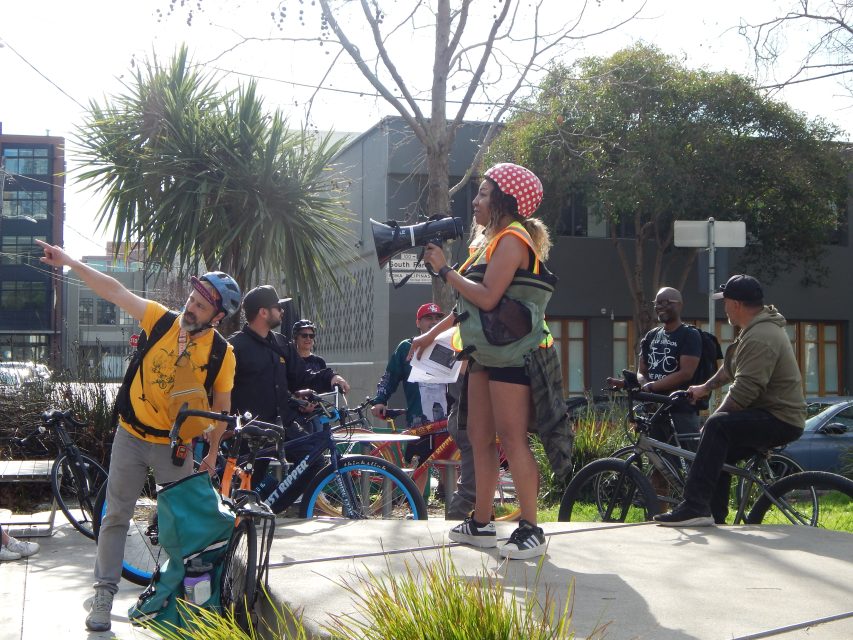
After sharing facts, Wynn challenged the crowd to trivia.
“So who was one of the African pioneers that lived here in South Park?” asked Wynn. When a crowd member answered, “Mary Ellen Pleasant,” Wynn cheered. “You get a prize!” she said, gifting them a zine designed by Oakland-based artist Fred Noland.
At Crane Cove Park, Noland, who also designed the event’s art, spoke about William Alexander Liedesdorff, a ship merchant and captain who was born in St. Croix in 1810.
Liedesdorff traveled widely in his youth and eventually launched the Bay Area’s first steamboat, said Noland. The businessman was appointed consul to Mexico in 1845, making him the first Black diplomat in the United States — and perhaps one of its first Black millionaires.
He was instrumental in establishing San Francisco, according to a profile in the San Francisco Examiner, and a two-block stretch of the Financial District still bears his name.
For Derek Lockett, these and others were new names.
Locket particularly mentioned learning about the “Big Five:” five Bayview women who spearheaded affordable housing efforts in Bayview in the ‘60s and ‘70s — Eloise Westbrook, Ruth Williams, Rosielee Williams, Osceola Washington, and Julia Commer. In 1973, the women secured $40 million from the federal government to create affordable housing in the city.
“There’s a lot of history here that doesn’t get talked about,” Lockett said. “It gave people who didn’t know how much Blacks contribute to San Francisco more information.”
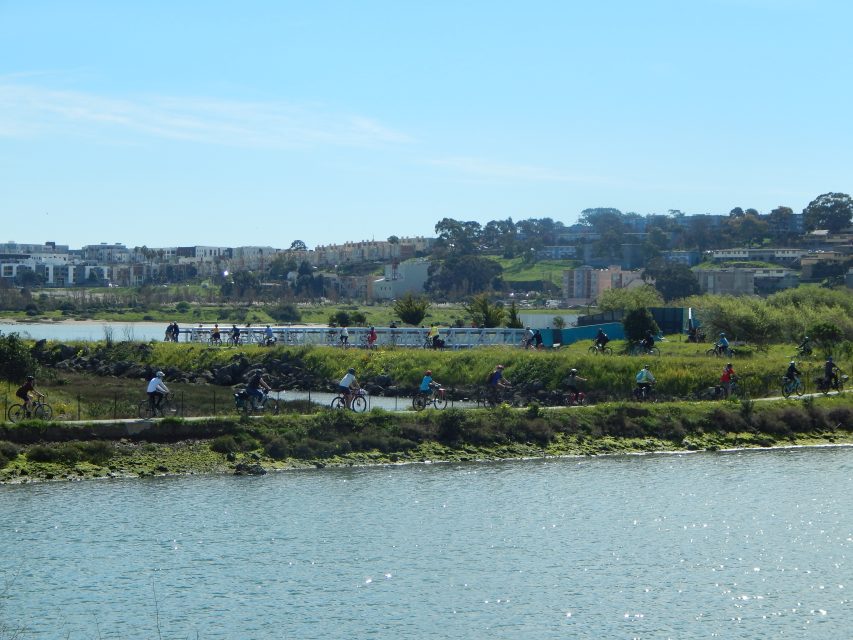
The event was organized by the Bicycle Coalition and the group Livable Cities. Al Hawley of the online show Spokes & Folks, who served as one of three tour guides, said organizers “wanted people to be intrigued by their city.”
For Noland, the ride was also a way to get Black people out to “enjoy the outdoors more.” Black people tend to bike “because of necessity,” he said, “but I think it’s good to do it for enjoyment as well.”
Future Tissere Edwards, a Bay Area native and lifelong cyclist, noted that although the event was to celebrate Black History Month, the crowd itself wasn’t exclusively Black — in fact about a quarter appeared to be so.
“As far as I’m concerned, cycling is something so universal that we all need to get back to,” he said. “It keeps us together and unified, no matter the color, the skin, the nationality, we are all brothers and sisters.”
The riders went down city streets, up steep hills, and through crowded bike lanes. Many were meeting for the first time: Jonathan Jones and Tyna Moore sat on a rickshaw tricycle in the morning after getting to know each other.
“He’s gonna drive it, I’m gonna race in it,” said Moore. “We’re getting acquainted.”
The ride was generally safe, although at one point in Bayview a blue car impatiently pushed through the street, ignoring the crowd.
“It was kind of shocking,” said Maureen Persico, a volunteer for SF Bicycle Coalition. “There was a little kid pedaling away and some guy couldn’t wait.” It was a reminder that, despite San Francisco’s pledge to zero-out traffic deaths by 2024, the city has failed in its promise.
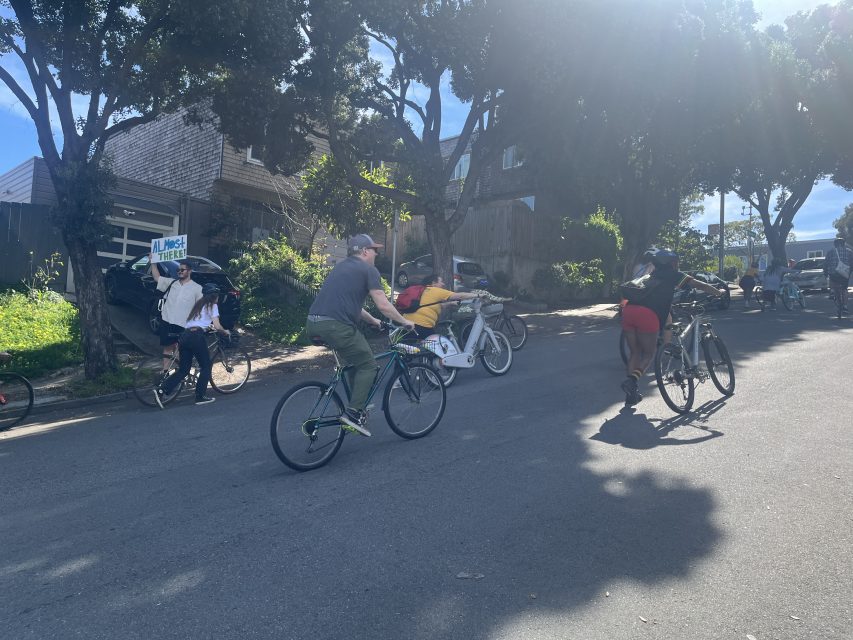
As the ride came to a close, cyclists pedaled up the steep hill on Mendell Street in Bayview. Volunteers held up signs saying, ‘Almost there!’ and ‘Hills are hard!’
The event ended at Smoke Soul Kitchen for a block party. Wynn and other members of the SF Bicycle Coalition and Livable Cities raffled prizes, including coupons for free bikes at Mission Shop and free vouchers for tacos at Tatos.