
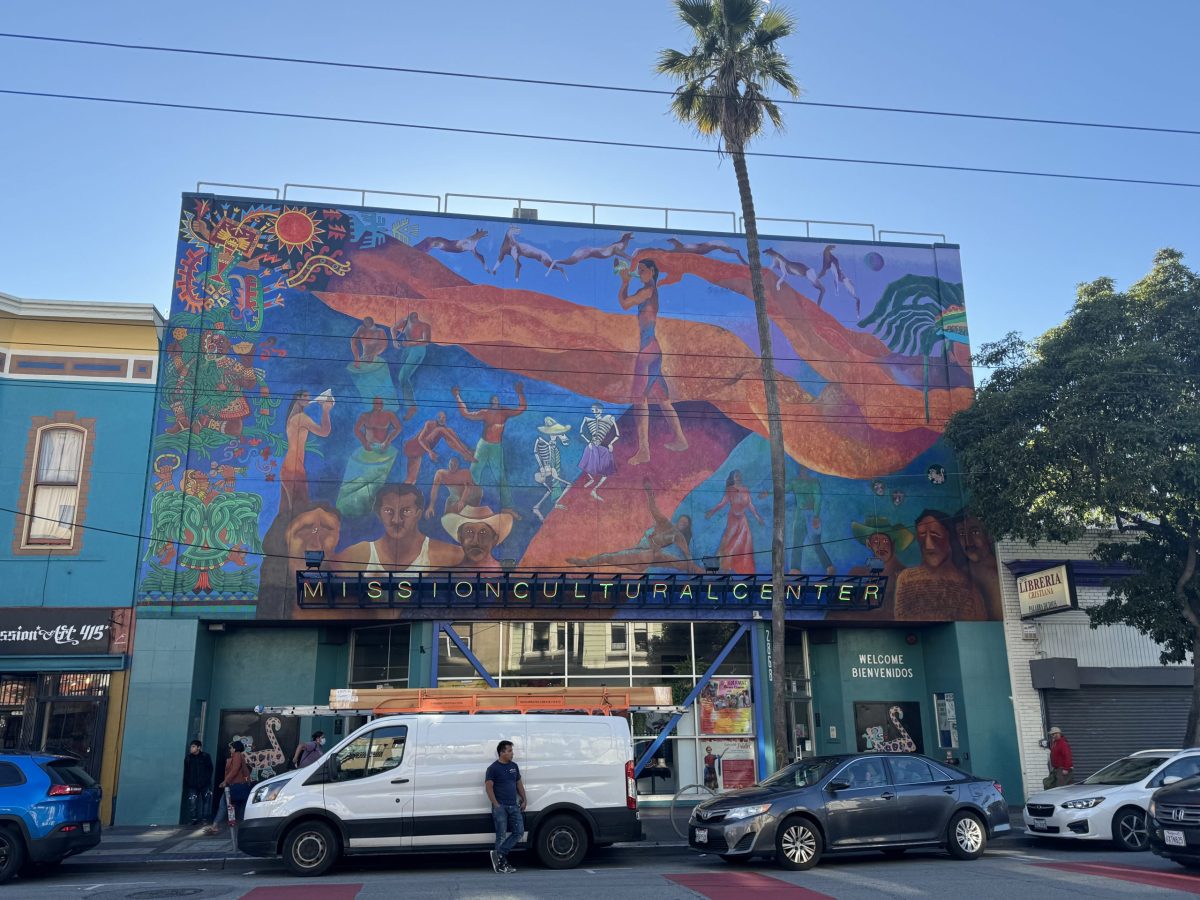

Nearly a week after news broke that the Mission Cultural Center for Latino Arts was closing indefinitely, the center reopened its doors Monday night to talk about saving it.
More than 300 Mission residents, artists, community leaders, business owners, activists, former employees and board members filled the building’s theater with one goal in mind: Figuring out how to secure the 49-year-old institution.
The place has served the neighborhood as a space for printmaking, dancing and theater since 1977 when it opened in a former furniture store, The Shaft.
As of Dec. 31, the center only had $400 in the bank, according to board member Rob Sanchez. Now, supporters are trying to raise $500,000.
“We’re going to acknowledge that there are fears,” said Susana Rojas, executive director of the neighborhood association Calle 24, and the meeting’s host. “Today we are here, in a place of uncertainty.”
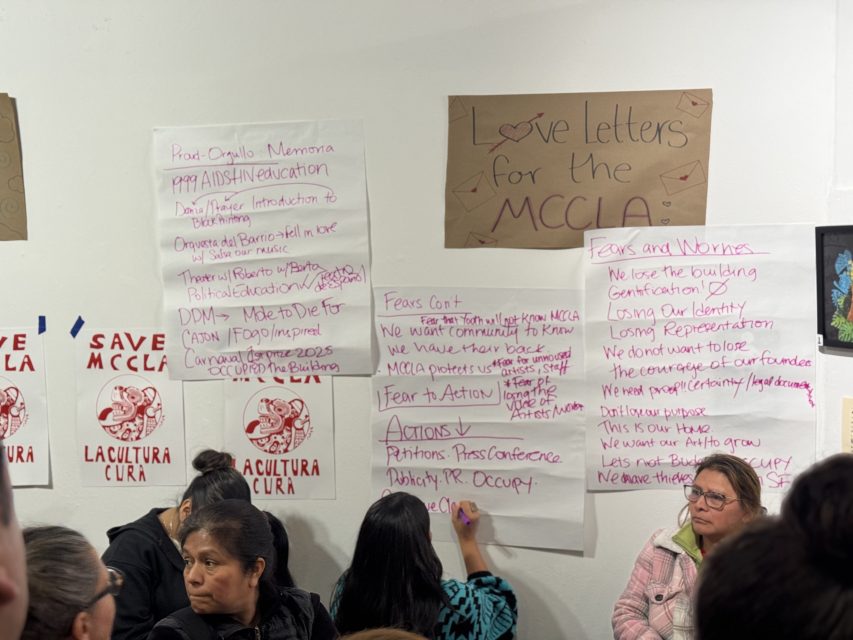
“It is a place of uncertainty. But it’s not a place of closure,” she added. “It is not an end. It is just a new beginning with new blood, new tears, new sweat. And we’re going to move it forward.” Rojas at times sought to encourage the otherwise concerned, motivated and somewhat concerned crowd.
“Whose center?” she chanted.
“Our center!” replied the group.
While outside revenue grew substantially in the last two years — from $772,379 in 2022 to $1,875,823 in 2023 and $1,841,204 in 2024 — the center’s salaries and compensations as well as programming expenses also grew, according to the center’s tax filings.
The former director, Martina Ayala, who made $84,000 a year for the first two years of her contract, earned $131,000 in the final years. Earlier, she raised staff salaries and the total salaries rose from $504,000 in 2022 to $939,000 in 2024. Program service expenses nearly doubled, from $574,400 in 2022 to $1.137 million in 2024.
Alongside Rojas sat Roberto Ariel Vargas, son of two of the center’s co-founders and a former member of its youth board; Jose Carrasco, co-founder of Loco Bloco; Valerie Tulier-Laiwa, co-founder of the Latino Task Force; Robert Sanchez, board member of the center and president of Casa Sanchez Foods; Eva Martínez, a volunteer archivists at the center; and artists Nataly Ortiz, Nancy Pili and Metzi Henriquez.
Arts commissioners Patrick Carney and Debra Walker also attended, as did Jennifer Ferrigno, a legislative aide to District 9 Supervisor Jackie Fielder.
In January, the center’s board contacted the arts commission — which disburses the center’s annual grant from the city and oversees the center’s city-owned building — in the hopes the department would advance a payment scheduled for late March. That request was denied.
Sanchez and then-interim director Derek Jentzsch wrote an email to the arts commission on Jan. 14 detailing a dire economic crisis.
Without new funding, the center’s choices were few, and poor: Declare bankruptcy, merge with another nonprofit, have the center under the oversight or fiscal sponsorship of a Mission aligned organization or the Arts Commission, or undergo a “total reset” that would rebuild the center as a much more stripped-down organization.
The city then moved to secure the building and temporarily close the center later in January. The MCCLA’s board moved the center’s archive into storage.
“We took the archives, pulled them out from here, because archives belong to you,” said Sanchez. “We couldn’t leave them in this building, because this building, as old as it is, we don’t know what’s going to happen.”
A retrofitting and modernization project is scheduled to start early next year. Already, the center was looking for new quarters while that retrofit is underway.
At Monday’s meeting, attendees broke into six groups to share memories, fears and discuss ideas on how to save the center. Each breakout circulated a sign-up sheet to join working groups to plan for what needs to take place immediately, in the near future and when the center reopens.
After about 40 minutes, the breakout groups were over. A representative from each shared their fears: losing community, losing culture and being erased from history.
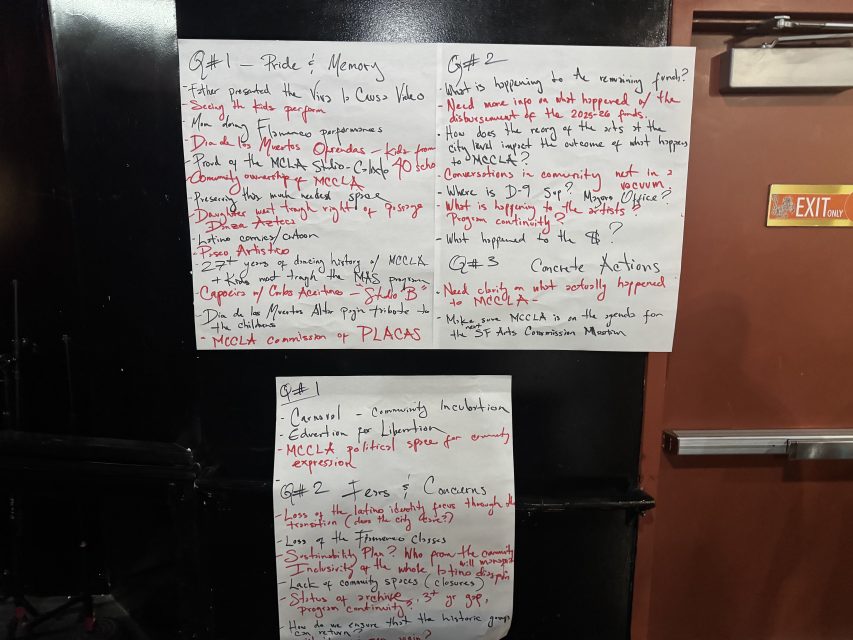
They then shared ideas about what to do next: Take care of the artists who perform at the center, take care of laid-off staff, rebuild the center’s board and rewrite its bylaws. They suggested collaborating with other nonprofits, attending city meetings together, and creating programming off-site.
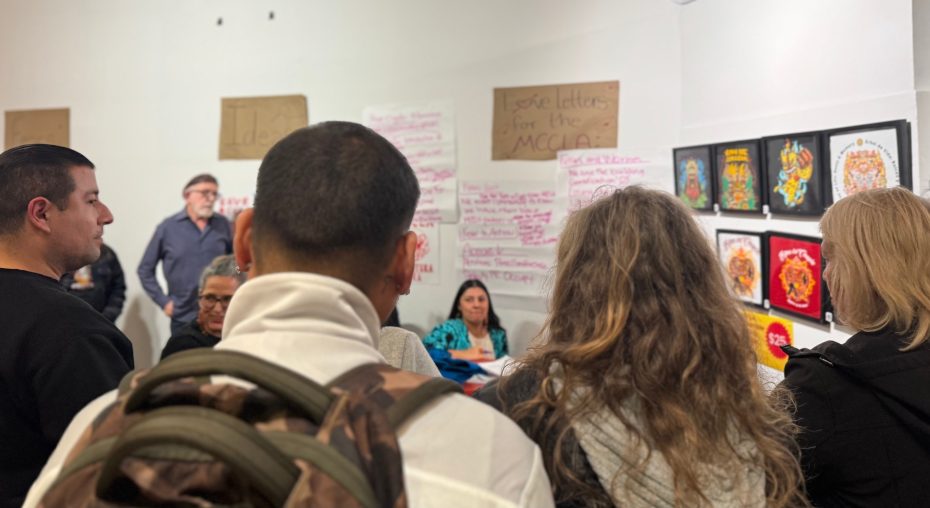
To close the night, Rojas asked attendees to make one more commitment. Before another community meeting in a month, Rojas wanted the group to collectively raise half a million dollars.
“I am challenging all of us to bring more people in,” she said, “ in a month, we’ll do the unprecedented fundraising of $500,000 so we can go back to the city and say, “Look, yes, we got it,” she said.
This is why more money is not always the answer. They did just fine for years with a ~$1M budget. But once they got a ~$2M budget, they more than doubled their expenses and went bankrupt. How to save the center? Go back to being a lean nonprofit on a $1M budget
Sounds like this previously stable organization was run into the ground like a doomed Silicon Valley startup. More money in followed by even more money out.