

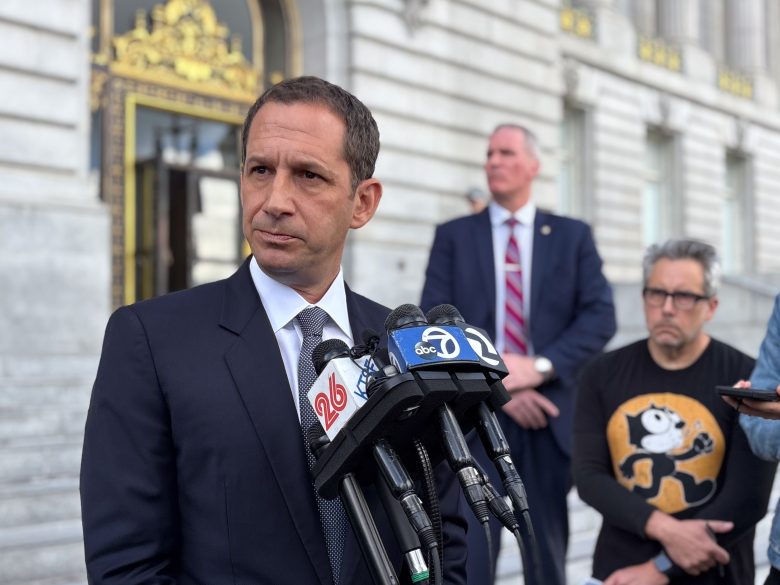

San Francisco’s Sunshine Ordinance Task Force, the commission that oversees public-records law, voted unanimously on Wednesday that Mayor Daniel Lurie improperly withheld documents about his call last year with President Donald Trump from disclosure.
That Oct. 22 call presaged a withdrawal of federal forces from the Bay Area, and some worry Lurie may have struck a deal with the White House during the call. Lurie’s office said no promises were made, but has still denied some public records requests for documents related to the call.
The Sunshine Ordinance Task Force, which has 10 voting members, said today that Lurie may have violated the law by being too broad in claiming records were exempt.
The mayor’s office wrote in a letter ahead of the vote that the issue has been misrepresented, and that there are no records related to the call besides a “legal consultation” between the mayor’s office and the city attorney’s office and related “attorney work product.”
It is declining to release these records, the letter continued, because they fall under attorney-client privilege, and are therefore exempt.
The mayor’s office added that these unreleased records from that day are not related to the phone call with Trump, but rather to an executive directive Lurie ordered to prepare for the deployment.
“We did our most diligent effort when this request was submitted,” said Dexter Darmali, the mayoral aide responsible for records. But, he said, there simply are no records, except those where the mayor’s office was seeking protected legal advice.
The task force refused to accept that answer. Attorney-client privilege might apply to some records, but not all. They urged Lurie’s office to revisit the request and release more information.
“I have to think there’s some privileged documents here, but I also have to think that there is — possibly, possibly, likely — documents that don’t qualify as privileged,” said Dean Schmidt, an attorney on the task force.
If Lurie’s office released the requested documents, Schmidt added, even if they were heavily redacted, that would help the commission determine if Lurie’s office was asserting attorney-client privilege too broadly.
Near the end of the nearly three-hour deliberation, several commissioners grew frustrated with the mayor’s office because it had, initially, failed to even pass along call logs for the day — normally public documents that include the date, time, or participants on phone calls.
“Do they really believe that we are that stupid?” said Ankita Mukhopadhyay Kumar, a documentary filmmaker who sits on the commission.
“I co-sign with you, Member Kumar; I’m not that stupid,” said commissioner Maxine Anderson. “I would urge the office of the mayor to recognize that they are servants of the public, of the citizens of the city of San Francisco, and that they should approach these hearings and requests for public records in that spirit.”
In December, a three-member group of the task force said unanimously that Lurie had broken public-records law by withholding documents from that call.
The mayor’s office has implied that there are no notes, transcripts, read-outs, or other documents detailing the call. The only record of the call that has been made public was a calendar event released in October, in response to a public records request made by the San Francisco Public Press.
That read simply: “7:30 pm – 7:55 pm Phone Call with Donald Trump, President of the United States re: calling off potential federal deployment in San Francisco. Attendee: Donald Trump, President of the United States.”
Trump and Lurie spoke by phone that Wednesday after Trump promised a “surge” of immigration forces to the region. Billionaire allies of the mayor reportedly intervened on San Francisco’s behalf and, after the conversation, both Lurie and Trump said that the president told Lurie he was calling the surge off.
The vote Wednesday was 9-0, with one member absent. The matter has now been sent to another committee of the Sunshine Ordinance Task Force, which could decide that the mayor committed a “willful” violation if records are not subsequently produced.
That could advance the issue to the city’s ethics commission, though the powers of both commissions to actually compel the mayor’s office to release documents are limited.
He’s just another billionaire, like Trump. Why wouldn’t he cover it up?
This deal is getting worse all the time.
He is complicit .
The release of the Lurie/trump call will be released at the same time as the Epstein files..the call was probably 2 millions seconds long..2 M like the newly discovered Epstein files…. they need to hire a bunch of people to listen at it first like for…….and first go to Walgreens and buy black markers to cover anything embarrassing..like for the Epstein files..just go ahead and blackmark the entire page, just leave the punctuation and Clinton’s name…like for the Epstein files..