

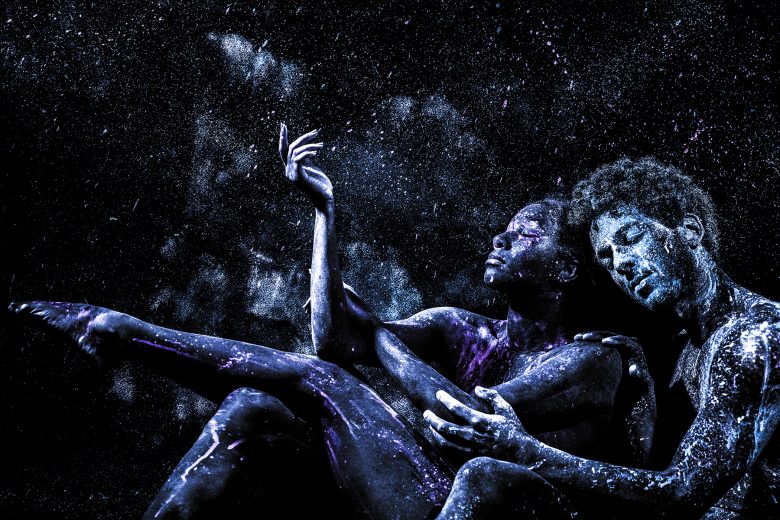
Nigerian American photographer Mikael Owunna’s life-size, shimmering images of ancient deities in outer space set the tone for “UNBOUND: Art, Blackness and the Universe,” MoAD’s stellar exploration of the African diaspora in the eternal and the infinite.
“UNBOUND,” which runs through Aug. 16, 2026, is MoAD curatorial chief Key Jo Lee’s most ambitious exhibition to date. Over three floors, she presents an African diaspora that is “unbound” from earthly and chronological conceptions of diaspora.
Lee, who started talking with theoretical physicists while a graduate student in art history and African American Studies at Yale, says, “I was having equally generative conversations with artists and could see a shared curiosity around astrophysics and cosmology emerging across their practices in exciting and unexpected ways.
“Wanting to capture that moment of convergence between artistic inquiry and scientific thought was central to how ‘UNBOUND‘ took shape.”
Unlike the Oakland Museum’s magnificent 2021-2022 “Mothership: Voyage Into Afrofuturism” exhibition, “UNBOUND” looks backward and alongside, as much as forward.
Lee encourages visitors to consider Blackness through philosophical, historical, and astrophysical contexts. In fact, the word “Afrofuture” only appears a couple of times in the show’s three floors.
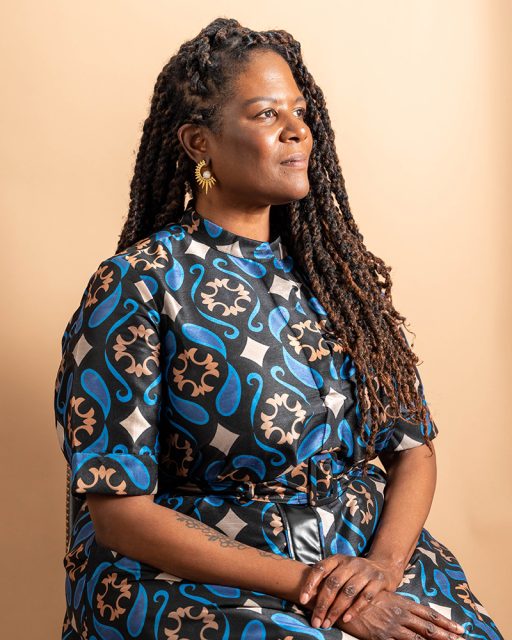
Lee says that was intentional. To her, Afrofuturism asks: Will there be Black people in the future? In “UNBOUND,” that’s a given.
“I think that Afrofuturism as a category has been a super useful tool, but it’s insufficient, because I already know we’re going to be in the future,” Lee says.
“I was interested in artists and artworks that were like, ‘Well, I already know that. This Blackness is material for me, and how do I manipulate that and show different versions of that?”
Lee will be in conversation with artist Dr. Nia Imara on Saturday, Jan. 10, from 2 p.m. to 3:30 p.m. The talk, “Painting the Cosmos,” is free with registration.
For his part, Owunna casts Black models gilded in iridescent paint as goddesses and gods from Igbo, Dogon and Egyptian cosmologies. They gleam against the darkened, star-speckled walls in the hallway linking the MoAD and St. Regis lobbies.
The placement of the celestial figures in the dim, narrow passageway creates the illusion that the viewer is also among the stars. Clearly, this show is about something bigger than Afrofuturism; Owunna is putting these eternal deities in the present, as in: We were always here.
I experienced Lee’s inclusion of science, ancient African beliefs and diasporic perspectives as metaphors and questions; enlightening information that provoked different ways of seeing Blackness.
In an email, she described the academic integrity behind the exhibition. “’UNBOUND‘ is not about mystification or nostalgia,” Lee wrote. “It is about rigor, experimentation, and the serious intellectual labor artists are undertaking to imagine Black presence and Black futures.”
Lee continued, “Where science enters the exhibition, it does so as a framework for thinking. … This approach allows viewers to encounter scientific ideas with curiosity and respect, without being asked to accept simplified or distorted versions of complex research.”
“UNBOUND” is divided into three categories, each using multiple artistic practices: Geo-cartographic, or cosmic and terrestrial, is most often represented by abstract, sculptural and mixed media works; religio-mythic, sacred and creation stories, are often figurative presentations; and techno-cyborgian, “Blackness at the threshold of the posthuman,” according to the wall text, offers metal sculptures, video, holograms and bright, saturated colors.
Most of the works were made in the past six years, several in 2025. Lee says that a couple of artists were inspired by the concept and made works for the show.
One was her old friend Michi Meko, who created a large, mesmerizing abstract painting of what looks like an electrical storm along the coast of a large city. The whitecaps in the foreground resemble sound waves on an audio track.

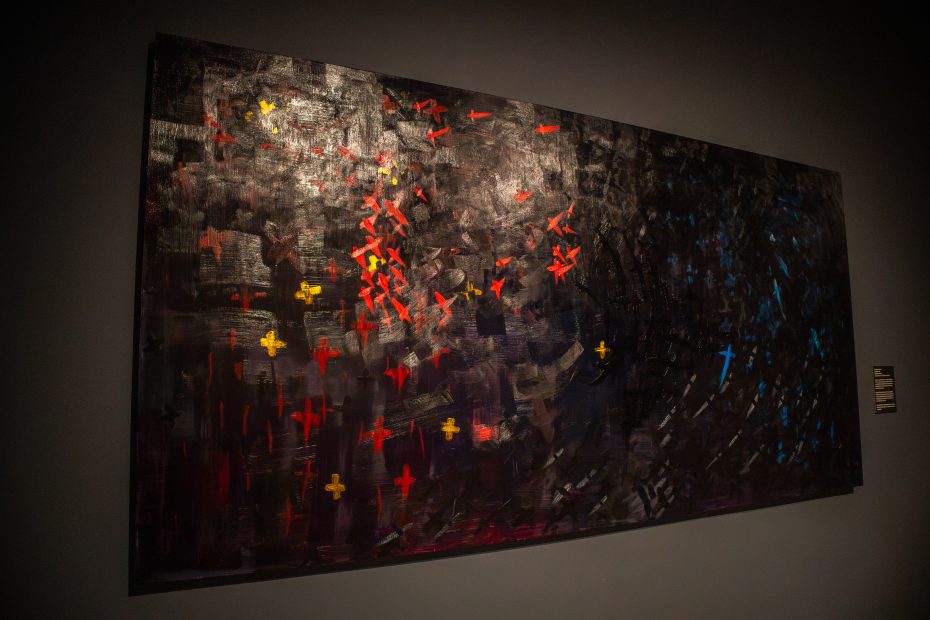
Allison Janae Hamilton’s “Dark Nebula” (2024) was a favorite of mine. Little crosses travel in eddies or air currents across a shiny black space. Are these stars, birds, planes, or fish? Dark sky or deep sea?
See it up close and from a distance, because the black oilstick surface changes under different light angles. The reflective medium gives depth to the blackness.
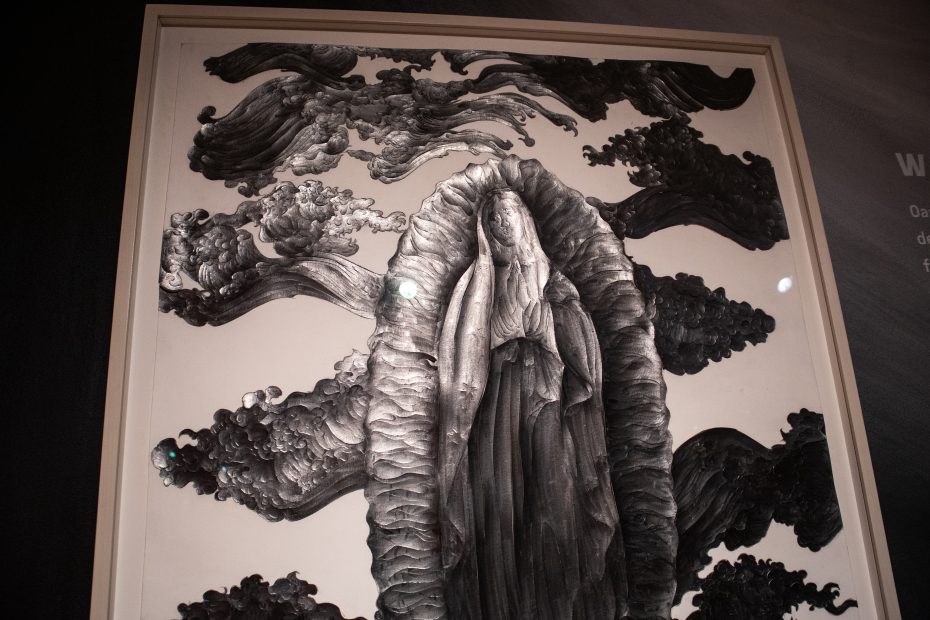
Oasa DuVernay makes graphite pencil look like oxidized, hammered silver, divining precious potential from a humble medium. By this point in the exhibition, I had fallen into seeing loose, poetic links between science and Blackness: graphite is carbon. Carbon like me.
M. Carmen Lane’s multidimensional multimedia installation, “You Weren’t Ready for Mami Wata (or How We Became Black Marrow)” occupies its own small gallery. Combining film, photography, painting, installations and performance, this is the only work MoAD commissioned for the exhibition.
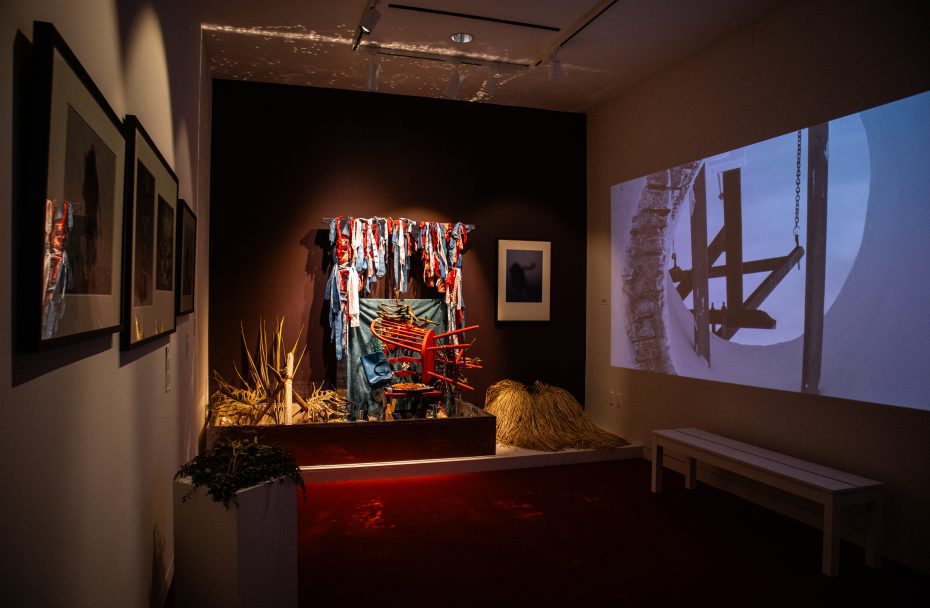

Lane’s work considers how places and objects contain memories and evoke ancestral spirits.
At the gallery’s entrance there is a postcard-sized video of Niagara Falls. The installation’s three major elements offer different layers of Lane’s family history. A film features an arched portal at El Mina Castle in Ghana, an important site in the Middle Passage slave trade.
Presented upside down, the arch’s curve recalls the hold of a boat and one can imagine captive people crammed between the roof’s beams.
The wall text notes that Lane “traces their own ancestral roots to Cleveland.” Most of us descendants of chattel slavery can’t know enough about our pre-Middle Passage forebears.
I appreciate that, even though Lane acknowledges the “before” history with the El Mina video, they don’t privilege that over what is most accessible to most of us: The part we can know from family stories and photo albums, the part that begins in this country.
This is doubly true for Lane, who is also Haudenosaunee (Mohawk/Tuscarora).
“Masquerade i (Egungun)” and “Masquerade ii (Protection or We will not be able to lend this work to you at this time)” 2025 includes a photo of a sculpture of a mother and child from Côte d’Ivoire that Lane’s ancestors brought to the Cleveland Museum almost a century ago. The museum declined to let MoAD borrow the sculpture.
An enlarged photograph of Lane’s family from around the time of the sculpture’s transfer, features Lane’s handwritten commentary on each relative in white pencil. Looking at the black and white photograph, I wished someone had done the same for my elders’ photos.
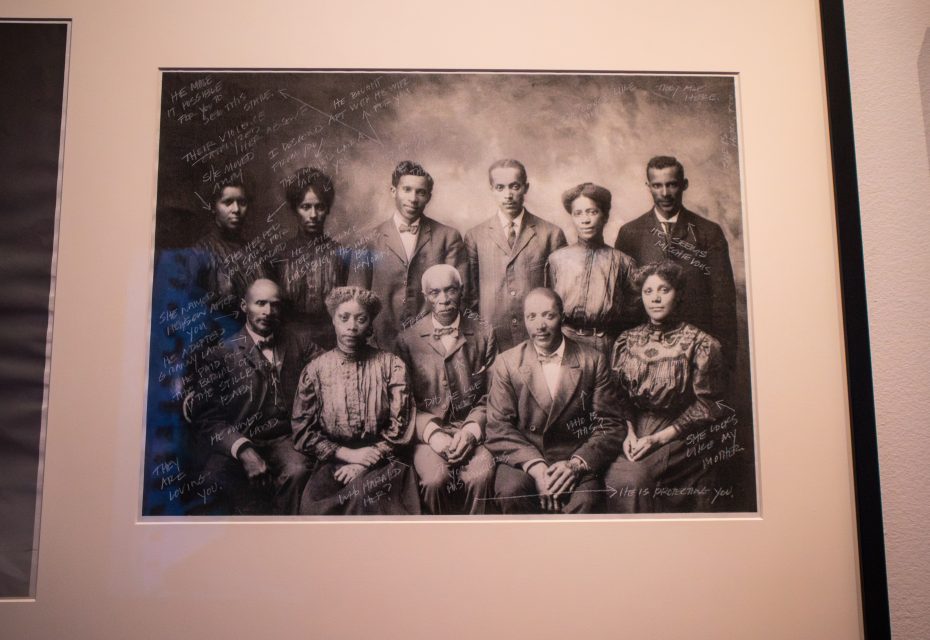
Even though Lane is too young to have known any of them, they evoke their ancestors through relaying the inherited stories. An egungun, Yoruba for “masquerade,” is a masked deity who channels the collective spirits of dead ancestors to bring their guidance to the living.
Lane is only visible through the writing on the photograph, honoring their dead and being a witness for them against the other “masquerade,” the Cleveland museum’s denial.
The third element is an altar with chairs, dishes, glasses, a blue purse, water from the San Francisco Bay, and herbs from a local botanica arranged on a platform tiled in tiny mirrors.
“It is really kind of a fulcrum of the exhibition in the way that you feel when you enter that space is meant to give lie to all the ways you’ve been told you are earthbound,” Lee said. “So, that connection to Cleveland is also that connection beyond. And that’s all of ours.”
Lee met Afro-Brazilian artist Gustavo Nazareno, who is based in São Paolo, Brazil, at Expo Chicago in March, and they got to talking about astrophysics. As one does.
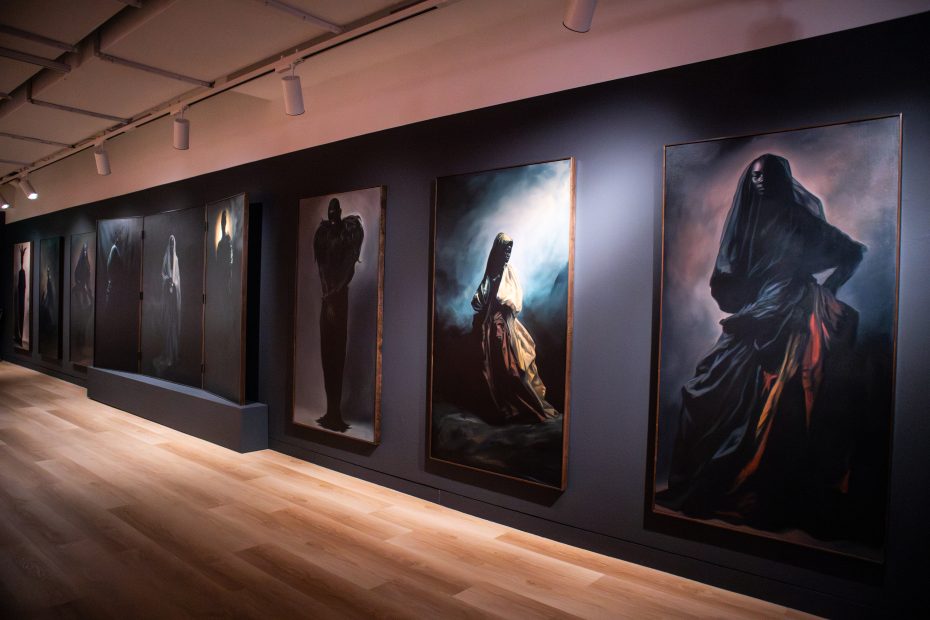
Liking the concept for “UNBOUND,” Nazareno proposed a suite of paintings depicting the planets as Orishas, divine beings that originated in Yoruba religion and spread throughout the African diaspora, including to Brazil, where they are called Orixás. In four months he painted the nine huge oil portraits glowing darkly on the third floor.
Lee asks visitors to spend five or more minutes with a piece and see how they are feeling in their bodies.
“Approach artworks, which are very easy because they don’t talk back, and see if you can sense those kinds of subtle forces,” she says. “It just explodes how you understand who you are in the world. And if humans could meet themselves with that kind of expansiveness, Whoo!”
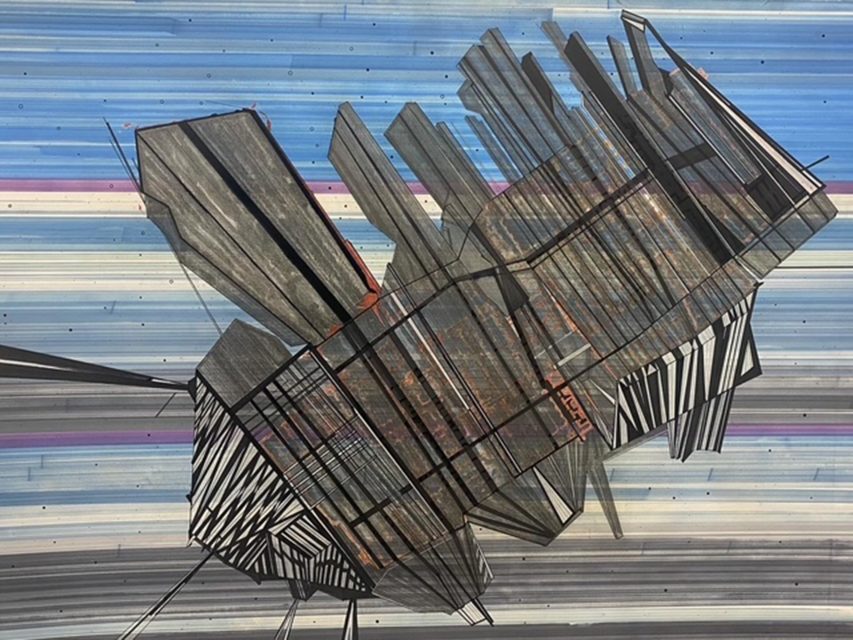
Rodney Ewing, Light Years: A Cenotaph for a Better Place,2025 Silkscreen,ink, colored pencil, and graphite on paper. Courtesy of Rena Bransten Gallery, SF and the Artist 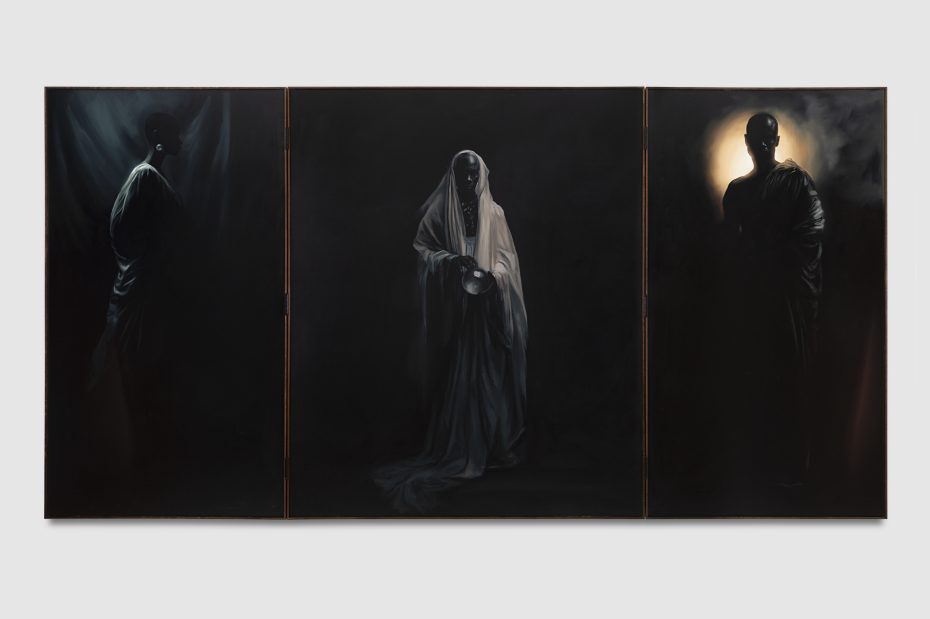
Gustavo Nazareno,The Secret Matrices of Creation,2025 Oilonlinen (triptych) Everton Ballardin Courtesy of GUSNStudio and Opera Gallery 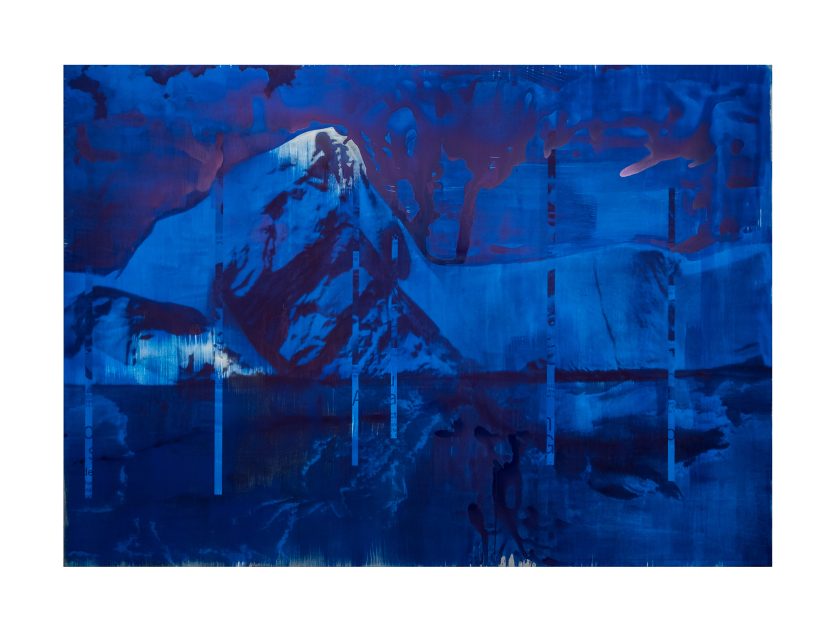
Lorna Simpson, Blue Turned Temporal,2019 Ink, watercolor, and screenprint on gessoed fiberglass1Photo by James Wang, Courtesy Dallas Museum of Art
More events: MoAD Mix | A Spirited Discussion on Art & Culture with Mikael Owunna, a featured artist in “UNBOUND: Art, Blackness & the Universe,” Wed., Jan. 28, 6 p.m. to 7 p.m. Tickets: Pay what you can. Event Location: Virtual; Zoom link shared following registration