

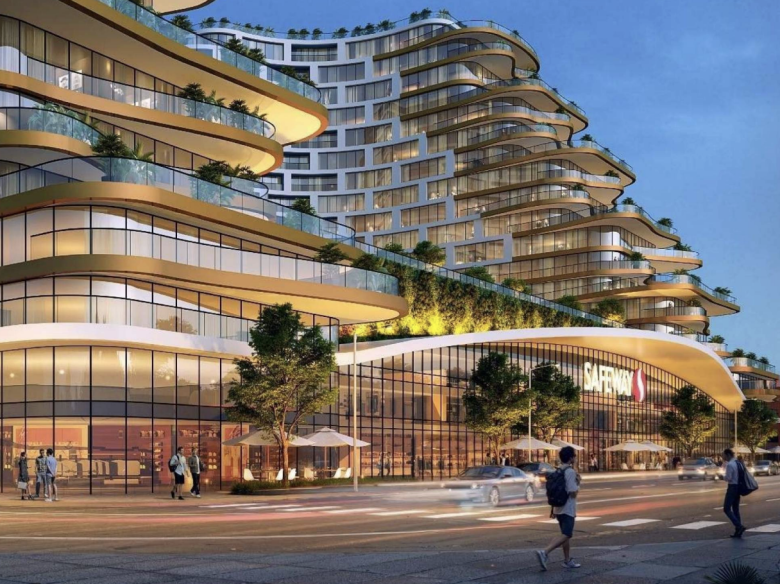

On the one hand, a 25-story, nearly 800-unit megadevelopment replacing the “Tales of the City” cruising spot Safeway would be a jarring addition to the northern waterfront.
On the other hand, it’d be big, garish, ostentatious and loud — just like every guy at Geelou or Bar Darling on a Friday night. It’d fit right in in the Marina.
Assuming this isn’t all a galactic head fake to distract from even bigger Safeway housing proposals in poorer neighborhoods, constructing such a building in the Marina would be far from a trifle.
The soil beneath the Dateway is a mixture of 1906 rubble and Cream of Wheat. Federally controlled land borders the parcel on two sides and, as you might expect in a place called “Gas House Cove,” there is toxic remediation to be done.
But if the developers can overcome these physical obstacles, there are relatively few metaphysical obstacles the city could add.
Recent state laws trump the longstanding San Francisco antidevelopment formula of sclerotic permitting, enraged neighbors and endless process. And that’s the case even when you’re proposing to raze the Mont-Saint-Michel of Safeways.
Is a sprawling, 25-story glass and steel “behemoth” on a site zoned for four stories the result of state law working properly? Or is it a ridiculous and outrageous turn of events?
Por qué no los dos?
The inability of local politicians to actually do anything about this plan has not deterred them from performative fist-shaking. The preemptive steps the city actually did take to shield development on this very expensive slice of waterfront turned out not only to be useless; they may be worse than useless.
More on that in a moment.
Many years ago, a city legal source told me that moral turpitude was “one of those vague terms lawyers use to ensure there will always be a need for lawyers.”
Along similar lines, the current juxtaposition of our state and municipal zoning laws makes other dark forests of the legal arts resemble a child’s experiment.
Ever-evolving state housing laws “are hard to understand,” says Emily Brough, a partner at Zacks and Freedman, a San Francisco law firm specializing in real-estate litigation and land use. “Even for land-use attorneys.”
Imagine a committee of James Joyces writing physics equations, and you’ll be close to the experience that is parsing current state law in its intercourse with local law.
Mission Local is informed that the Planning Department has three employees who are working full time just to assess how state laws impact local projects currently under development.
It purportedly took the department two weeks to reverse-engineer the math the Marina Safeway’s developers were using to come up with the unit count for their proposal using the current state rules. And, yes: The developer’s math was correct.
How does that math work out?
State laws passed in the last handful of years are crucial. But so is the surprisingly dense zoning of the land adjoining the Safeway. Even the Planning Department is uncertain if that is the result of this Sears Roebuck Catalog of an ordinance put before the Board of Supervisors by Mayor Ed Lee in 2017 and passed unanimously.
Regardless, because of the downtown-like zoning in the adjoining neighborhoods, the amount of units you can legally put on the Safeway parcel is high.
Some local politicians are delighted at the prospect of nearly 800 new waterfront units right on multiple transit lines. Others are reacting as if the Dodgers have been offered a victory parade down Marina Boulevard.
If you opposed this project in its current iteration — and both Mayor Daniel Lurie and Marina Supervisor Stephen Sherrill do — could anything have been done before the plan was set in stone (or, more accurately, set in rubble and Cream of Wheat)?
Theoretically, yes.
It would have required Sherrill to call for something called an Interim Zoning Control — which would, in essence, downzone the land adjoining the Safeway, which would result in reducing the maximum allowable density on the Safeway parcel.
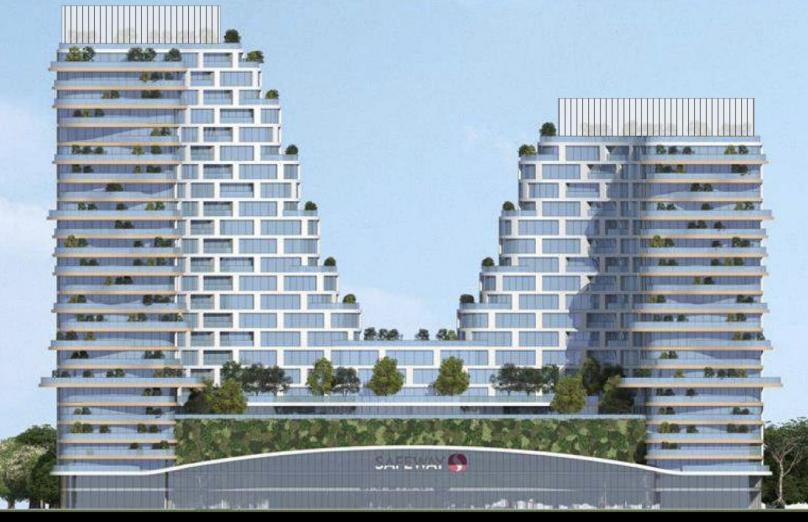
It might have seemed paranoid if Sherrill proposed such a thing seemingly out of left field, but the Marina Safeway, has, for lack of a better term, always been a very invadable beach: A big chunk of single-story real estate with waterfront views in a very expensive and desirable neighborhood.
When the first Chronicle article dropped in early November regarding developer Align and Safeway teaming to propose a massive new development at the shuttered Fillmore Safeway site, it was clear to those in the know that the last card to be played would be the Marina Safeway.
Knowledgeable sources, who may or may not have lurked in shadowy parking lots and resembled Hal Holbrook, could simply answer your questions with questions: Where does every land-use battle in San Francisco end up?
Well that’s all you need to know.
The answer: The Waterfront. Obtaining an interim zoning control can be done in a matter of weeks. It requires a supervisor to submit a resolution, and does not involve the Planning Commission.
This is the sort of thing that could be done, easy-peasy, up until 2019. It would be harder now: SB 330 forbids cities from making such a downzoning without a commensurate upzoning, which seriously ramps up the degree of difficulty, especially on expedited legislation.
A representative of Sherrill’s office said they did not consider seeking interim zoning, and they are unaware of such a thing being used to limit housing. The Planning Department says the requirement to simultaneously upzone to offset downzoning would have made this infeasible.
Others disagree. “This might have worked,” says Brough. A bevy of current and former city officials feel the same way.
Instead, the city took steps to discourage development on the Marina Safeway site that absolutely won’t work.

What did happen is that Sherrill added an amendment to the mayor’s citywide upzoning plan that, in effect, exempted the land under the Marina Safeway from the plan.
It attempted to limit any structure on-site to 40 feet. In actuality, however, because this is a corner lot, the height limit stayed at 65 feet. But that’s still a far cry from the waterfront towers now proposed.
But the Marina Safeway’s would-be developers knew their state law, and moved fast. Under SB 330, the rules in effect when a developer makes its submissions are frozen in place.
The developers submitted their plans after the vote for the new upzoning plan, but before its adoption, meaning they’re now entitled to build hundreds more units on-site.
In fact, both outside attorneys and city officials say the city’s 11th-hour move to remove the Marina Safeway site from the citywide upzoning plan could actually be worse than useless.
The raison d’être of the upzoning plan was to concoct an attractive alternative for developers otherwise inclined to use state incentives to erect towers throughout the city, as Mayor Lurie and his allies warned about.
Now, the city has made it much harder to have that discussion regarding the Marina Safeway, if the developer was inclined to have it at all.
Not only has the city nailed the barn door shut after the horse has bolted, it can’t easily let the horse back in if it returns.
The Marina Safeway proposal feels as though it was specifically designed to drive city officials crazy, and not in a romantic way.
Right as the mayor and his allies were selling the people of San Francisco on the merits of tall and dense development — and threatening them with the prospect of big buildings in places they didn’t want if they didn’t comply with the mayor’s zoning plan — here it comes: A very big building in a place where all those proponents of tall and dense development absolutely don’t want it.
Right as the mayor and his allies were selling the people of San Francisco on the merits of developing in wealthy, low-density neighborhoods, here it comes: Forcing proponents of developing in wealthy and low-density neighborhoods to say “But not there!”
If a 25-story complex resembling the tail end of a Princess cruise ship is a bad look, so is this about-face.
The powers that be can still attempt to deploy San Francisco’s world-renowned institutional torpor to slow-walk an undesired development. Yet state law now makes this a dangerous game — and, this, too, contradicts Mayor Lurie’s frequently uttered promises to streamline and rationalize the city’s permitting and building process.
It’s also a tight spot for Sherrill, a YIMBY-aligned politician who is now shaking his fist at a development that would bring more affordable housing to his district than it’s seen in over a decade.
Perhaps this is because he’s dealing with constituents who will not be satiated by merely reducing the size of what gets built here. They want it stopped.
That’s not going to happen. University of California, Davis professor Chris Elmendorf is a specialist in California land-use and housing laws. He notes that, even if Sherrill had pulled off an Interim Zoning Control and vastly reduced the number of permitted units on the Safeway parcel, he couldn’t have limited the height.
So Align could’ve instead built even taller than it’s currently proposing, just with fewer units. It’s not clear if that would make anyone happy — though, with a less lucrative potential structure, the city might have had more leverage than it does now.
In the end, whether you love the Marina Safeway proposal or detest it the way Marina denizens loathe carbs, you have to admit: State housing laws are shaking up city government.
“I don’t have a personal view on this particular project, but I think it’s an example of how powerful the law is,” says Brough. “The point is to build more housing, and that is what is being done. It will be upsetting in some circumstances, and applauded in others. This is a perfect example of both of those things.”
It’s a sin that most Safeway locations in the city haven’t had maximalist housing built on them. They tend to have huge footprints with oversized surface parking lots, and be near transit. This location, the Potrero location, and especially the Castro location(!) should be developed to within an inch of current density limits. Safeway stores can go right back in as the ground floor retail anchor with multi-level parking garages. Newer stores in the city have done this with great success (Whole foods at 4th & Harrison and Dolores & Market, Safeway at 4th & King). The entire city needs strategic infill housing just like this wherever we can find it!
“wherever we can find it”. That’s the point of contention here. The project looks hideous, and expect condos (plus HOA) priced to attract billionaire type buyers, not the regular San Franciscans who goes to work every day to pay their bills. And no, the vast majority of us doesn’t qualify, or is interested in getting on a BMR unit waitlist.
Daniel, that location is already affluent and expensive. You will not be able to afford this location if this project gets built. And you won’t be able to afford this location if it doesn’t get built.
But there are folks who can afford these new condos, and they need homes too. Else they might come after yours.
“they need homes too”. Poor things, as if there wasn’t plenty of existing ultra-luxury stock to chose from. And no, the kind of buyer looking at this won’t be coming after my humble crib. They’re looking for a second (or third) place to use as a pied-a-terre. Otherwise, you’re perfectly making my point: Whether this comes to existence or not, it’s not going to make a difference to everyday San Franciscans beyond the opportunity of us looking at this eyesore. So why ruin the place to mostly just cater to stratified RE clientele?
“And no, the kind of buyer looking at this won’t be coming after my humble crib.” The vast majority of gentrification in San Francisco for the last 50 years has been this exact process. Old housing originally built from a catalog becomes bid into the stratosphere because it’s the only thing available, and the original tenant is priced out.
YIMBY keep saying this, but I’m not seeing rich people breaking down the doors with offers for our Mission condo like I regularly get unsolicited offers for my land in socal.
The best you’ve got are well heeled newcomers outbidding regular working people for vacant rent control units when they revert to market.
marcos, there have been numerous cases of well-paid new arrivals out-bidding locals for existing housing, whether the units are for rent or sale.
And also cases of a new arrival buying a rental building and Ellis’ing the existing occupants.
As a well-paid new arrival in SF in the 1990s, I wanted a new-build condo in the Mission. But there were none. So I bought a 3-unit building, did a OMI, and now that formerly rent-controlled building is 100% owner-occupied condos.
And I forgot to add the VRBO angle: Depending how it’s set up, said RE clientele might also envision a play at renting the place out when Sail GP comes to town.
And, don’t forget the 30% affordable units…
That means each tenant earns over 100k/ year.
Calling that affordable for real blue collar workers in the service jobs SF also depends on? Not so much.
Which means earning over $100,000.
That’s their definition.
Great back and forth here. Honestly, I think Jim and C make some valid points about one way gentrification works – our tight housing supply does add to overbidding. We do see well paid newcomers outbidding peeps of middle income and below. This is a problem because SF is one of the greatest cities in the world – drop dead beautiful with fantastic world class economic opportunities. For me, the well heeled crowd who are truly buying their only, primary residence, I say welcome, congrats. The City needs to amp up its programs/create new ones to help middle and low income people compete for homes, too. For owner move-Ins causing displacement, wealthy people buying their 2nd, 3rd homes- we definitely need strict regulation in the market. For real estate investment trusts and other corporate/investment entities? We need the greatest restrictions. All tools on the table.
Heathy cities grow and change. It cannot be 1978 forever.
There are plenty of misguided housing developments and projects from the ’70s, just look around. Developers sit on their perch waiting for an opening, in the city. Pays for it for decades within unsightly building that should have never been put in place. Housing yes, but not this at that location.
The city’s transportation infrastructure is not up to massive growth all across town, not without additional subway lines. We can do modest growth, with some neighborhoods being more amenable to significant population increases than others (though they need space cleared for parks). This build as much as possible everywhere is downright weird – and is definitely not smart urban planning.
These wars are always over beautiful locations. Is there a YIMBY North Dakota group, I’m missing?
Your vision for the ‘future’ is fugly excuse-making.
Good. This is absolutely hilarious. Love it how Lurie and Sherrill have to contort themselves into an M.C. Escher contraption. And that it pisses off Marina residents is just the cherry on top. I hope this will be a lengthy construction project that enrages people for years to come.
So for you it’s just pure revenge, is that it? Merry Christmas.
Not revenge. Just Schadenfreude.
It’s a unique and beautiful design — built it!
Uniquely ugly and won’t be build as advertised in ‘artwork’ obviously, but keep drinking the yool-aid.
I actually like the project and agree with the design. San Francisco will always need to adapt and change. Housing is needed and people ( yes, even wealthy people) moving into the area is not a bad thing. Built it and stop the paralysis of over analyzing it
This is a great article, thank you. Nothing like a “Fontana towers west” to send all the hill dwelling nonagenarians into shock.
The expression “cutting off your nose to spite your face” comes to mind. Wonderful Christmas spirit.
Some wanted 8000 housing units . Some wanted 0 at the site . Seems like a fair compromise . I actually think the 0 came out ahead . Everyone is upset and had to give a little .
Build it. This city could use a little glitz
Campers,
I’ve been reading Joe for over 20 years and this is one of his best in my opinion.
Lots of spiffy allusions to add levity to a space of tenseness and anger.
On an aside I’m curious as to whether the 2 down votes that seem to automatically appear on whatever Marcos or I write are from the same poster if if so, are they a robot ?
I like the new building’s design.
It’s not really blocking sunlight or views as most of the area behind it is flat and the view from the back is really cool as you’ll have the Dimaggio Diamonds (did you know he wanted the City to pay to put his name on his boyhood baseball field ?) and above that is it Russian Hill that rises with its mansions ?
The more parking lot the better as I just read a piece that says that Vertical farming is 7x as prolific as dirt and private cars will soon be a thing of the past as Musk has his way with us so to speak and what I read said that 35 high rises of this kind of food production in NYC could feed the entire city which sounds about right cause I also read about 50 years ago that Havana residents were producing 90% of their city’s yummies in their back yards.
I wasn’t here yet for Fontana Towers is it ? but this place will blend better and it kind of reminds me of the Coliseum in Rome no kidding; anyone else get that vibe ?
go Niners !!
h.
This is the nightmare of the wall on the water. Instead of allowing heights to increase as you go away from the water gradually, we have this big ugly building right on the waterfront. Russian Hill has really tall buildings, but they are on top of the hill, so they don’t block the shorter buildings. We don’t need giant buildings to build a lot of housing if we just allow 4 story buildings everywhere.
I cackled reading this article. Informative and entertaining!
Next up, let’s upzone Bernal Heights, 500′ luxe condo towers lining Cortland from Mission to Bayshore as well as the entire 67 route.
No one is going to want a condo on Bayshore at Cortland.
I do
I wonder whether there’s a safe way to build on what was aptly described as “a mixture of 1906 rubble and Cream of Wheat.” The destruction in the Marina was bad after Loma Prieta. It’s hard to imagine this (proposed) modern wedding cake of building faring well in the next big earthquake — but if there’s a way to make the foundation more secure in the fill underneath it, I’d be very interested to hear it.
Yes, the soils can be made more dense through compaction an the building is supported by piles or piers that pass through the fill. The finished building will be much safer than the antique structures surrounding it.
Highrise building was invented in Chicago in the 1880’s -, the soil of which is soft, wet clay and slit– basically a swamp. Accordingly, we have over 150 years of extraordinarily successful experience in building very tall buildings in such soil conditions.
When was Chicago’s last 7+ Magnitude quake, tapdancer?
Will this prospective toxic remediation adhere to the same standards, flimsy as they seem in actuality, to which the Mission Bay and adjacent environs appear to have? Not to mention the liquefaction “known unknown” intrinsic to the ground upon which the Marina sits. The liquefaction map on Krishnan.com seems to just include it, and it had to be reconstructed after Loma Prieta, if memory serves. That said, since climate resilience may no longer be a doctrine in favour amongst captains of industry in San Francisco, or anywhere else, where the ideological suzerainty of Mammon, or the Ancien Regime, say, are in (manifest) ascendancy, whatever mitigation gambits cap that dubious locality may not suffice to stave off the empirical consequences of our current inactions. So much the worse for us.
This is a great opportunity for compromise and deal making.
In exchange for lowering to 12 stories, offer to develop the old fort Mason milistary housing- surely a couple hundred units to add there.
The city doesn’t own that land.
Land-use decisions are SF planning dept, BOS auspices.
Thanks to the new pro-housing state laws — not anymore! 🙂
What a monstrosity–and I don’t mean its size. The article mentions Mont Saint Michel (ironically to describe the Wurster-designed social center of Safeways) and I took it literally. Would I mind if my view were blocked and my neighborhood altered by the construction of Mont Saint Michel in our city? No. I would welcome it. If a developer builds something that beautiful and interesting I would not object–even if Gothic is not my favorite style. Happy holidays, everybody!
Sir or madam —
Alas, the Mont-Saint-Michel is a one-off. But climate change may do a number of its own on the Marina’s tides.
JE
Re #1: Mt St Michelle, FYI Gramercy residents prefer having Grace Cathedral views to south-facing views even though the latter are panoramic. Point taken, though. Sadly, only casino operators would splurge to build ornately articulated facades anymore. RE #2: the Marina’s SLR is a more serious issue than inappropriate architecture because SF (and most Bay Area communities) lack a comprehensive plan (if there can be one for +13′ rise). SF Port is developing mitigation but only has jurisdiction over its own perimeter that includes Fishermans Wharf but does not include Aquatic Park and parts west such as the Marina.
We need housing, definitely, but I find it literally incredible that such a monstrous, out of scale, grotesque project will happen at that location. Can’t find a part of the city where it would be a better fit? Somewhere South of Market, for example? To build it right at the waterfront, across the street from Ft. Mason, is nauseating. Fontana Towers all over again.
Readers,
And yet, most of you will probably vote for Scott Wiener for Congress ??
go Niners !!
h.
Most certainly, because he’s — hands down — the best legislator and advocate for the people of San Francisco that the City has ever produced — including the soon-to-be-retired Nancy Pelosi!
One horrible part of the article is that it calls “state law” what is Wiener’s pro-developer agenda. Your comment raises the issue, but doesn’t give it context. The meme that SF has too much local control and therefore developers need free reign is a trope that this newspaper should challenge, as your comment, if put cleanly, would do.
Greed knows no bounds. It will utterly collapse our fragile city, and the planet too, if we do not fight to stop it. Such “laws” empower developers and the ultra-wealthy to cannibalize our lands, at a time when Americans, above all, should be learning the meaning of “degrowth”.
For Americans are 4.5% of the world’s population, but use 25% of all its resources. Clearly this is unjust.
“When you lose touch with inner stillness, you lose touch with yourself. When you lose touch with yourself, you lose yourself in the world.” Eckart Tolle
Ariane Eroy, Ph. D.,
A textbook example of how absurd and utterly delusional NIMBYism can be.
Quite amazing coming from a psychologist. Heal thyself, doc!
You are a perfect example of YIMBYism then.
Trolling, zero substance, and microaggressions.
Part of degrowth philosophy is reducing the environmental impact of human activities, Building infill housing in San Francisco, where we have relatively low carbon footprints due to low heating/cooling requirements and low transportation related C02 emissions is compatible with degrowth. Degrowth doesn’t mean “let’s just stop building housing and hope people stop having babies.”
“It will utterly collapse our fragile city, ”
That is a good point – as someone who’s studied physics, I believe that the gravitational effect of having such dense housing may cause a runaway collapse, leading to a black hole that will consume the entire city and even some of the suburbs such as San Carlos.
The City needs to fight state mandates for putting condo towers in residential neighborhoods. The “worst” the state can do is “punish” the city by withholding state housing money, but the City would be preventing the death of the Marina neighborhood. Put high rises in Tracy, San Francisco already has too many.
The city needs to build more housing.
No. The City needs to protect its character while ensuring our middle and working classes are not run out of town. This is a Democratic party run city with a highly educated citizenry. Trickle down affordability is not going to fly here. The ballot box will back this up.
The city doesn’t need more market rate housing, it needs affordable housing – and not the $100,000 yearly salary version.
YIMBYism is a sellout and a charade paraded by useful morons.
The city needs to build actually affordable housing to affect the housing crisis, rather than appeal to YIMBY liars pushing gentrification in plain sight.
Huntington Beach tried this and it went very poorly. At the moment the builders remedy is in effect, which means builders can build whatever they want, regardless of zoning.