

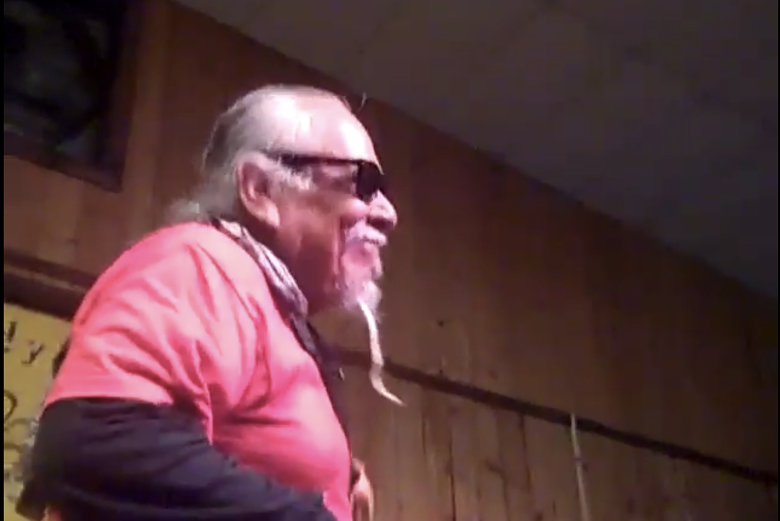

For most of his career, Dr. Loco has been the life of the party.
Now, celebrating his life is the point of the party.
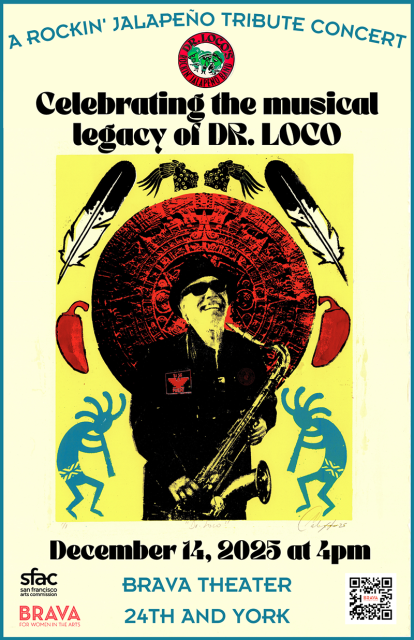
The saxophonist, accordionist, vocalist and leader of the Rockin’ Jalapeño Band, Dr. Loco is the musical alter ego of esteemed anthropologist Jose B. Cuéllar and the subject of an era-encompassing concert Sunday afternoon, Dec. 14, at Brava Theater Center.
In academic circles, the 84-year-old Cuéllar is best known as a groundbreaking scholar who spent two decades as chair and director of San Francisco State University’s Cesar Chavez Public Policy Institute. At the same time, as Dr. Loco, he took on iconic status as an avatar of the Chicano culture he studied and documented.
More than a side hustle, the Rockin’ Jalapeno Band became a vehicle through which Cuéllar explored the protean possibilities of Mexican-American life and identity. It’s a quest that inspired Mexico City’s popular rock en Español band Maldita Vecindad, known for its 1991 hit “Pachuco,” to hail Dr. Loco as “the last pachuco.”
Presented by Brava! For Women in the Arts and Grammy Award-nominated producer Greg Landau, A Rockin’ Jalapeño Tribute Concert: Celebrating the Musical Legacy of Dr. Loco had been on the drawing board for some time.
When Cuéllar started to feel shortness of breath while featured at a Herbst Theatre Francisco Herrera concert last June, scheduling the event took on new urgency.
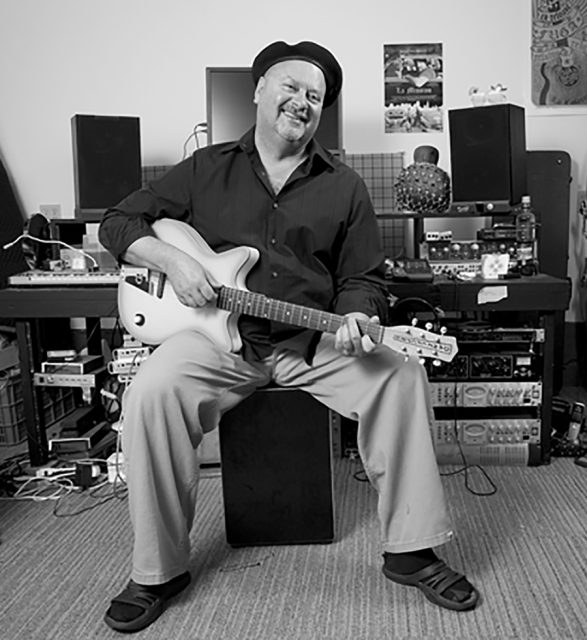
After a series of tests, Cuéllar “was diagnosed with lung cancer that metastasized to my liver,” he said in a recent phone call with his wife, Stacie Powers Cuéllar, and Landau. “I was given weeks or months, though I’m doing well right now.”
Landau, who’s been working as a producer with Dr. Loco since the 1998 album “Barrio Ritmos & Blues,” secured the date at Brava and put out the word.
“I called up all the musicians, more than 20, and every single one was down to do it,” Landau said.
It’s an expansive cast of players who’ve defined the Rockin’ Jalapeño sound since the late ‘80s, an evolving blend of border blues, old-school New Orleans R&B, Afro–Cuban grooves, Mexican ranchera and vintage soul.
The concert features a succession of Rockin’ Jalapeño eras, starting with the band as it came together at Stanford University in the late 1980s with players like multi-instrumentalist Chuy Covarrubias and trumpeter Glenn Appell.
Saxophonist Hafez Modirzadeh, better known as a jazz composer and explorer, plans to present a solo tribute to Dr. Loco, followed by an acoustic version of the band that performed as Amorindio with guitarist and vocalist Francisco Herrera, and multi-instrumentalist Miguel Govea.
The most recent Rockin’ Jalapeño edition wraps up the timeline with pianist/trumpeter Marco Diaz and bassist Saul Sierra, both longtime members of the John Santos Sextet, and Camilo Landau on guitar. Throughout the evening Charlie Gurke, also a member of the John Santos Sextet, handles the Dr. Loco’s saxophone chair.
Because the band was born at Stanford and included several of his students, Cuéllar cultivated a study-hall ethos “where we were able to hang together and learn together,” he said.
“I was guiding them through learning the older-time music, and I was learning the newer music. Later on, the Latin jazz component came in through Pete Escovedo, Wayne Wallace and John Santos. This isn’t just a tribute to the legacy that I’ve left. It’s been carried forward musically. Chris Gonzalez Clarke, Charlie Montoya, and Chuy have Rasquache Liberation Front, which is an extension of the Jalapeño Band, but featuring their music.”
Powers, Cuéllar and Landau have also created a slide show that illustrates the arc of Cuéllar’s life, from his San Antonio roots and early gigs playing R&B with the Del–Kings in the late ’50s to his stint in the Air Force, and his journeyman years as a musician in Hollywood and Las Vegas.
“We’ve got these great photos of him with Johnny Otis and Red Foxx,” Landau said.
In many ways the Cuéllars, longtime Mission residents, have been at the center of the district’s thrumming cultural scene for decades. Stacie Powers Cuéllar was the longtime executive director of Brava, and oversaw the center’s creation of the adjacent cabaret space. She also served as the Rockin’ Jalapeño’s manager.
Over the years, Rockin’ Jalapeño Band played dozens of benefits, dances and community events around the neighborhood, including some seminal gatherings.
Even before Cuéllar adopted the moniker Dr. Loco, he was on the scene, providing the music at Galería de la Raza on the fateful Cinco de Mayo in 1984 when José Antonio Burciaga, Marga Gómez, Monica Palacios, Richard Montoya, Ric Salinas, and Herbert Siguenza first came together as Culture Clash.
“The Rockin’ Jalapeño Band was formed here in the Mission at 23rd and Alabama,” Powers Cuéllar said. “Both of our work has been immersed in the Mission. Our daughter went to Buena Vista and SOTA [Ruth Asawa San Francisco School of the Arts].”
Ixchel Cuellar is carrying on the family tradition. She made her Broadway debut in 2016 in “Finding Neverland” before completing her undergraduate degree at Pennsylvania State University.
“She trained at Dance Mission and is now in ‘Wicked’ on Broadway,” Powers Cuéllar said.
But Dr. Loco’s legacy extends far beyond his own household. As a professor for five decades, he’s taught and influenced thousands of students.
And as a bandleader, “there’s an extraordinary roster of organization’s he’s raised money for,” she said, including the United Farm Workers and Friends Outside. “He’s uplifted a whole community through his music.”
Gracias por todo Loco. You are a role model to so many for your unique integration of musician, educator, revolutionary, activist, mentor and so much more. Saludos from Viana do Castelo, Portugal!
Estimado Carnal Dr. Loco: I was so proud of myself when I earned my doctorate degree, that Esposa Rita and I hired y’all to play at our celebration dinner-dance. WE ALL LOVED IT! It was un BENDICIÓN para todos. 🙏🏾🙏🏾🙏🏾 Cuídate mucho, Dr. Joel Ruíz Herrera y Rita Duarte Herrera