

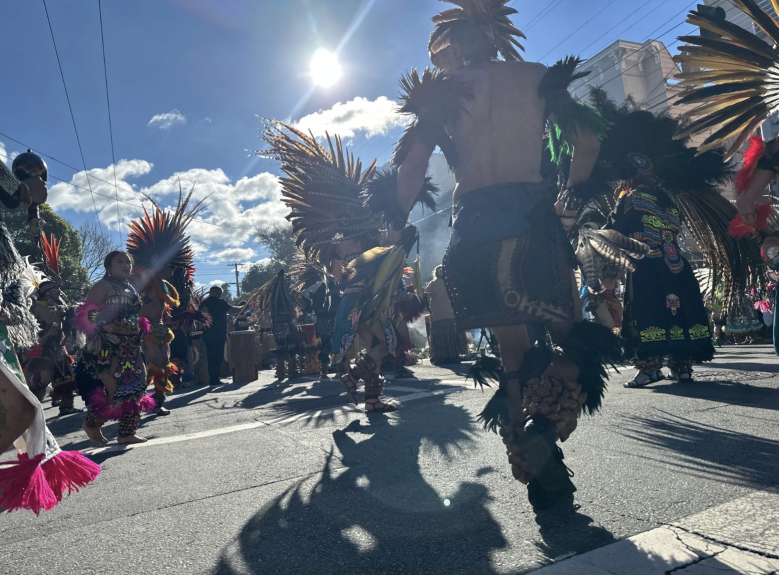

The drums started just after 10 a.m. Saturday, and suddenly there was nowhere to stand but in the middle of it; 100 dancers arrived in feathered headdresses and traditional regalia, their ayoyotes rattling with every step, like rain on metal.
The sound hit the chest hard. Smoke from sage and copal filled South Van Ness Avenue, the sharp smell of incense thick in the cold morning air.
A confused Zoox self-driving car tried to navigate the closed street, its sensors unable to process the ceremony blocking the way. It turned around.
Hundreds gathered outside Mixcoatl — the Mexican craft shop at 24th Street and South Van Ness — to honor Ricardo “El Tigre” Peña, who died earlier this month at 54.
For six hours, the Mission said goodbye to the man who had lived in the neighborhood for more than 30 years, teaching Aztec dance and traditional drumming to generations of kids, greeting neighbors in multiple languages, and running his shop with a generosity that endeared him to the multilingual neighborhood.
But this wasn’t just a memorial. It was the community doing what Ricardo had always done for them: Showing up, making space, and feeding anyone who came.
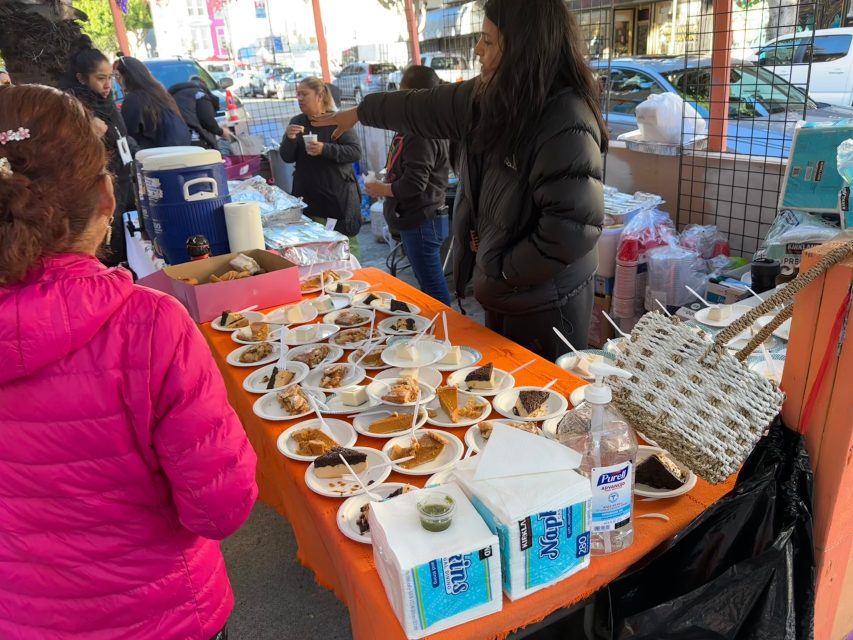
Outside Mixcoatl, right where Ricardo used to set up his sandwich board with lucha libre masks every morning, tables held free food for anyone who wanted it. Burritos de jamón and turkey. Chocoflan and gelatina. Coffee, tea and atole steaming in the 50-degree morning.
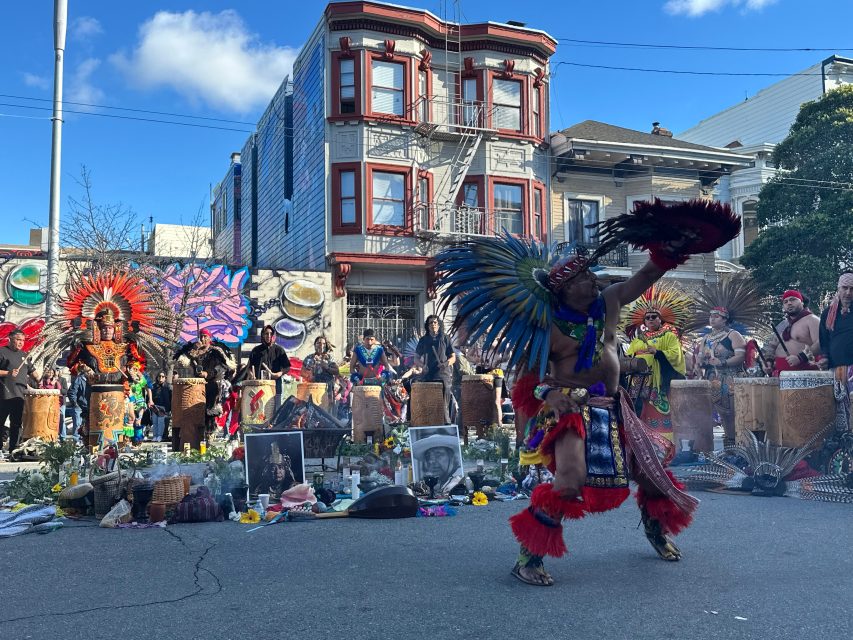
In the middle of South Van Ness, an altar held Ricardo’s photos, surrounded by flowers, candles, and a Huehuetl semi-circle. Nearby, a group of women sat pasting Ricardo’s photo onto small boxes of matches, making hundreds of them so every attendee could carry a piece of him home, and the fire to light candles in his memory.
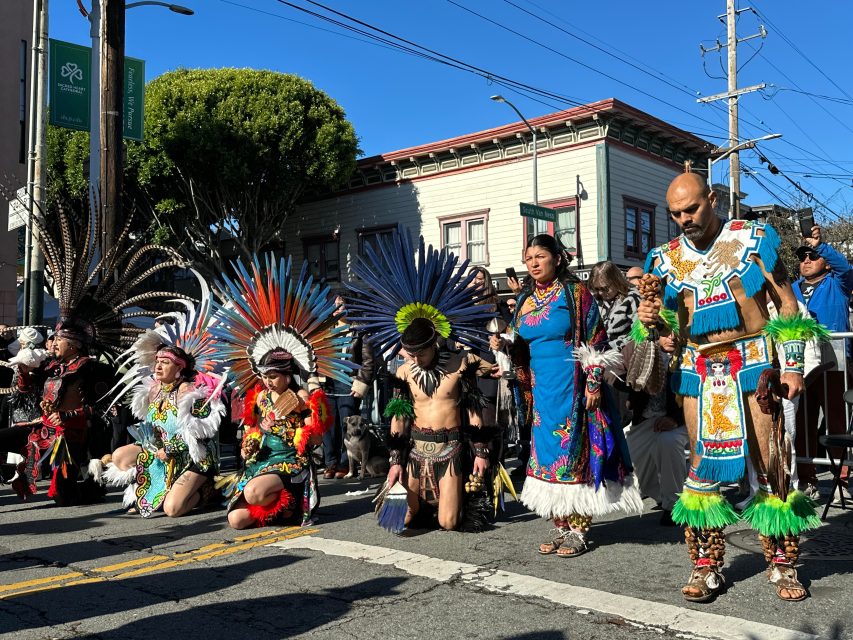
The crowd was all ages, all mixed together. Dancers wore towering feather headdresses in bright colors, their bellies and legs exposed, their ankle rattles well strapped.
On their feet: Traditional Mexican leather sandals, Tevas, Jordans, toe shoes; some danced barefoot. Others stood next to their neighbors in snapbacks and street clothes. People wore Oakleys against the sun that broke through mid-morning.
Elders settled into lawn chairs on the sidewalk for the long ceremony ahead, while kids ran between the adults, playing as prayers and songs filled the street in Spanish, English, and Nahuatl — Spanglish flowing naturally between all of it.

By the time community viewing began at noon, dancers had been moving for hours in the cold, faces covered in sunscreen and sweat. Inside the alley, Ricardo’s casket rested with its own altar at the foot; fresh tamales were among the offerings.
Volunteers walked through the crowd with trays of banana slices and oranges, water bottles passed hand to hand. This was ceremony as endurance, as offering, as work.
“Aquí sangramos, aquí sudamos, aquí lloramos,” said Alejandro Quetzalmiyahuatl, 26, who has been dancing since he was 13. “Esto es la ofrenda. Este es el sacrificio que hacemos.” (Here we bleed, here we sweat, here we cry. This is the offering, this is the sacrifice we make.)
Languages of love
For 25 years, when Ricardo Peña saw Tita Liza at dance practice, he greeted her in Tagalog. “Kumusta ka, Tita?” How are you?
She’d answer back, “Mabuti, kapatid” — fine, brother.
Liza is Filipino. She doesn’t speak Spanish fluently. But Ricardo learned the very basics of her language, just to make her feel welcome.
“He would look right through us and give us energy and positivity and love,” said Liza, 65, who has danced with Ricardo’s group for a quarter century. “You don’t find a lot of people in this world who will just stop for a minute and get to know you, like, really be there for you.”
Marco Flores drove up from Los Angeles on Friday, leaving his grandchildren at home, just to be here. He’s driving back tonight. When asked what he remembers most about Ricardo, he didn’t hesitate: “Cuando me ofreció una cerveza.” When he offered me a beer.
It’s a pattern that ran through the obituary published this month, through the comments people left, through the interviews on Saturday. The coffee he brought. The bread he shared. The tamales. The way he’d stop and really listen.
Ricardo didn’t invent this generosity. Mexican and Latino communities have always broken bread together. But he practiced it daily on 24th Street. He was a keeper of tradition, not its inventor. He showed up every single day and reminded people what it meant to be in community.
Passing the mallet
The drums didn’t go silent when Ricardo died. His son, 17-year-old Cuauhtémoc, has been playing them for the past year or two, learning the rhythms his father held for decades.
“Almost as if Ricardo knew he needed to pass his gift,” said Liza. “And his son was there to receive it.”
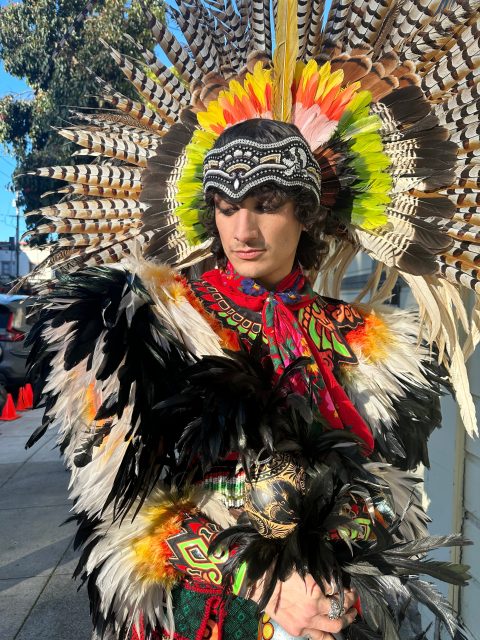
For Alejandro, a San Jose native who is moving to Las Vegas, Nevada, soon, the question of how to carry this forward feels urgent.
“Bailar es igual de importante que respirar,” he said. As important as breathing. “This is how I release everything. I come here to heal myself,” he said in Spanish.
Hours into the ceremony, he paused to chat, still in shock: “If there’s no original discipline, what will you hold onto?”
Ricardo gave them something to hold onto. The danza connects dancers from the Mission to Los Angeles, to San Jose, even to Humboldt, where Marco Flores’s son reopened a university dance group, which now the children of other danzantes follow. “The seed is planted,” said Marco.
Connie Rivera, El Tigre’s widow, stood near the altar as the ceremony continued. She said Ricardo wanted this: The street closed, the community gathered right here outside Mixcoatl, where they lived and worked for 21 years.
“They are now in charge of their father’s legacy,” she said, gesturing toward Cuauhtémoc and Xochi, their daughter aged 25. “I know he’s happy right now, seeing all this, and he’s drumming and dancing with us.”

The store stayed closed on Saturday; too many people, no one to watch it while Connie held vigil. It would have been good for business, she said, but that wasn’t important today.
On Monday, Mixcoatl reopens.
The ceremony lasted until 4 p.m., drums echoing down 24th Street and beyond. In a moment when Latino and immigrant communities face intensifying fear over immigration enforcement, hundreds of people claimed South Van Ness Avenue loudly and visibly, refusing to make themselves small, refusing to hide their grief or their joy.
As the day wore on, people lined up to take their matchboxes, Ricardo’s face printed on each one, ready to light candles for him in the days and years ahead. Everyone carried fire home.
The drums will start again. Cuauhtémoc knows the rhythms. Xochi embodies them. The seed is planted.
What a beautiful piece and showed me what a neighborhood is through one person. He brought everyone together, even in the end.
He sounds like a very nice human being who cared about people and lead by good examples, bless his soul!
Descants en Paz, Tigre.
I really enjoyed reading this article. Sounds like Ricardo created a large community in the Mission district, RIP.
I do have a nagging question though; where exactly does 24 st intercepts with South Vanness?
Sir or madam —
South Van Ness and 24th intersect … at South Van Ness and 24th! It’s right where Napper Tandy is, and The Jelly Donut.
JE
This is such a beautifully written article-and it taught me stuff I did not know. Bless Tigre! Bless Mission Local! And can we read more from Liliana?