


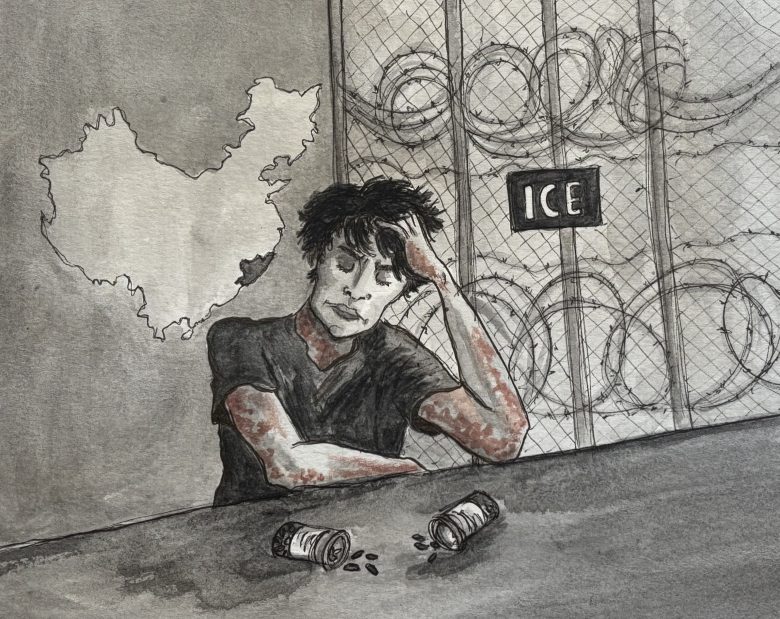

She arrived in the United States 13 years ago, fleeing China’s one-child policy and the control of her husband’s family, who wanted her to give up her second daughter.
In the years since, she built a brand new life: Becoming a U.S. citizen, finding a new partner, giving birth to two more children and preparing her two older daughters for college.
Just as life in the South Bay seemed to be working out, her fiancé was unexpectedly detained on July 1 during a check-in at San Francisco’s Immigration and Customs Enforcement field office.
Five months later, she has exhausted every possible legal avenue to free him, and is struggling to keep her life and family together.
Her last hope? Marrying him inside an ICE detention center, an unusual and complicated undertaking.
National media have detailed the surge of Chinese immigrants crossing the U.S. border on foot after the pandemic, but the fates of the broader group of Chinese undocumented immigrants remain largely unreported, and it is unclear how many Chinese nationals are currently detained by ICE.
At least four Chinese citizens have died in U.S. immigration authority facilities this year, including three inside ICE detention centers. ICE has reported a total of 25 detainee deaths this year.
Most Chinese people who are facing deportation are reluctant to go public because they fear retaliation, both from U.S. authorities and, if sent back home, from China.
Several Chinese immigrants told Mission Local about their lives disrupted by ICE. Because Lily — a pseudonym — is a U.S. citizen, she is in a comparatively better position to share her story.
Mission Local has reviewed key documents and verified major life details. We are withholding her name to avoid damaging the case of her fiancé Charles (also a pseudonym).
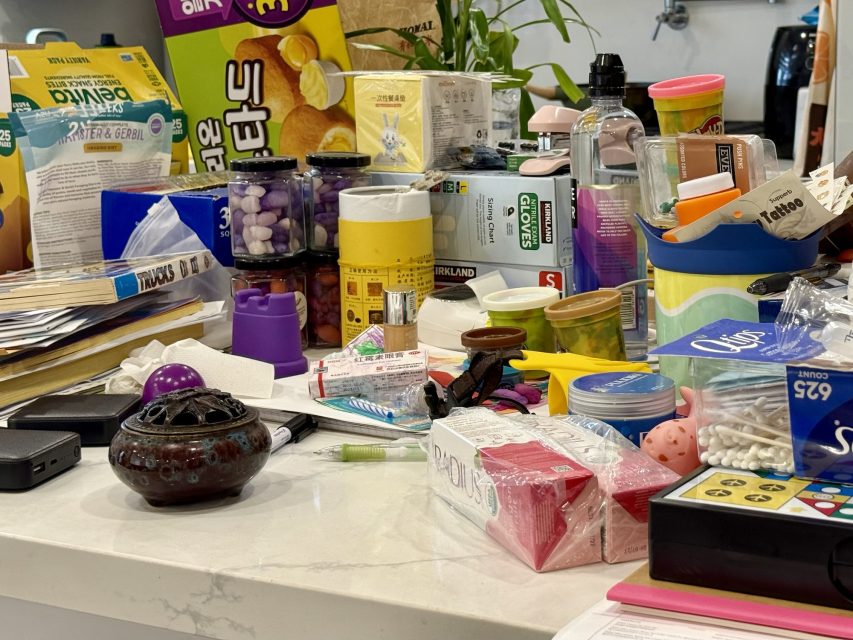
Lily said she feels compelled to tell her story. “I want everyone to understand this is actually causing harm to many people,” she said.
The detention has taken a severe toll on her mental health. Throughout hours-long in-person conversations in Mandarin, Lily casually mentioned thoughts of suicide more than once.
“Every time I think about what’s coming next, I feel like I should start getting my coffin ready,” she said. She added that she’s had similar conversations with her therapist.
A flight to the United States
Lily was born in the 1980s in Fujian Province, a region even more conservative than the country’s broader culture, and one that favors men over women. She dropped out of school after middle school, and was forced by her mother into marriage, she said. Her first child, a daughter born in 2005, was not recognized by her in-laws as part of the family, she said.
When Lily became pregnant again, the regime’s one-child policy forced her into hiding to avoid hefty fines or a forced abortion. In 2007, after the birth of her second child, another daughter, her mother-in-law told her that a deal had been made with someone interested in adopting the newborn.
“She told me that, ‘As long as we send the baby there, they would put an apartment in Fuzhou [the provincial capital] under the baby’s name,’” Lily said. “She hoped to lure me into agreeing, but to me, it felt like selling a child.”
It was child trafficking. Lily refused and kept the baby, but the one-child policy meant the newborn was unregistered with the government for years.
Lily said her husband watched in silence while his family “psychologically abused” her. Anxiety became chronic in the rural house she shared with her in-laws’ family, she said.
So when a friend described a rosy American life, she left her two daughters with her mother in 2012 and entered the United States alone on a tourist visa.
Looking back, Lily has no regrets.
“Neither food nor clothing matters as much as mental comfort,” she said. Working as a waitress for long hours in the first several years, she went to bed each night with aching feet, but she said, “As hard as the work was, it made me happy. I don’t want to go back to Fujian. That culture doesn’t respect women at all.”
She won asylum, citing China’s one-child policy, and brought both daughters to the United States in 2017. The following year, she filed for divorce, but the process stalled for years over minor issues, she said.
Meanwhile, she had met the man who became her fiancé, and approaching 40, she wasn’t getting any younger. Lily and Charles had two sons, now 2 and 4 years old.
Charles, also from Fujian, had entered on a tourist visa in 2013. He had a checkered legal history as an immigrant.
During the first Trump presidency, in December 2017, he received a removal order from an immigration court in Honolulu, Hawaii. After his appeal was dismissed in 2019, he had to wear an ankle monitor for several months, and the family paid some $35,000 in immigration bonds to keep him out of detention, Lily said.
In the past few years, however, Charles’ construction business grew, allowing Lily to stay home. They bought a house in the South Bay, which they have rented out. Rare among her peers, both of her daughters got into college. Lily and her four children are U.S. citizens. She sent money back to her parents, and even invited them to visit her here.

“Apart from not being able to get married officially, these past few years have been the happiest time of my life,” she said.
Then, at the end of June, right after Charles’ regular ICE check-in, he was asked to appear in-person again. They assumed it was routine, as the couple had been so busy with their own lives that they paid little attention to the news.
“I didn’t even realize so many people had already been detained,” Lily said.
On July 1, Charles drove to the ICE field office in San Francisco with Lily’s second daughter to help with English. After his sudden detention, the girl, who had just turned 18 and couldn’t drive, called her, crying, “‘How am I supposed to go back now?’” Lily sent a mechanic friend to bring the girl back.
Without his income, the family lives close to the edge. Lily operates a small daycare business that she started late last year but, she notes, “with two little kids, I can’t take on any other work.”
Meanwhile, legal fees continue to mount.
So do the costs for the 4-year-old’s ongoing speech therapy. The boy, who began speaking only a few months ago, now speaks Chinese in a way that’s unintelligible even to Google Translate. That, coupled with the fact that he doesn’t understand instructions in English, has made school especially difficult, Lily said.
Like many others who have loved ones detained by ICE, Lily faces the crisis alone. She hides Charles’ detention from her landlord and pretends everything is normal at the daycare, fearing her one employee might quit.
Some of Charles’ construction workers know, but she keeps it secret from his clients. She hasn’t told relatives in China because, based on her experience, the way they express care would only put more pressure on her.
Friends help her vent but can’t help her out financially. Lily is reluctant to apply for public benefits, fearing it could hurt Charles’ future green card application.
Her doctor has increased her daily dose of allergy medication for stress-induced hives to four pills (for most patients it’s one or two). Lily now keeps some traditional Chinese angina-relief pills with her at all times in case more bad news triggers an attack.
If Charles is ultimately deported, the couple face years of separation before Lily can even try to get him a new visa. Since Charles won’t be able to support the family financially from China, Lily has already had to warn her two daughters that they may need to pause college to support the family.
Both agreed.
The marriage plan

Lily’s long-awaited divorce was approved in mid-September.
If she could marry Charles, she says, everything might work out. But marrying someone in ICE detention is complicated, at best.
She investigated the process on ChatGPT, which outlined a daunting list of steps, including hiring a local pastor thousands of miles away in Arizona, where Charles is being held. Furthermore, there’s no certainty that ICE would okay the marriage.
ICE policy states that detainee marriage requests are reviewed case-by-case. “Ordinarily, a detainee’s request for permission to marry will be granted,” reads an official document from the agency.
“I’m going up against the government. I just can’t win,” she said.
Lily is more resourceful than many newer immigrants: She understands how American society works. She reached out to her congressional representative, speaks adequate English and has two college-age daughters and a longtime lawyer on call.
Still, she remains trapped in limbo. At the end of August, she took three of her children to visit Charles at the Florence Correctional Center in Arizona. When it was time to leave, her eldest son tugged at his father and asked, “Why isn’t daddy coming with us?”
She told him, “Daddy has to go earn money somewhere else.”
For Lily, the past four months have overturned what she thought she had learned in the United States: That she can shape her own destiny. “Now ICE simply has so much power, my fate is no longer in my own hands,” she said.

I would think that a marriage at this point would not save him. Because he already broke the law and that alone is justification for deportation.
My understanding is that all marriage does is provide a basis to apply for a green card. It does not ipso facto create the right to stay.
There are a series of visas – the K series – for aliens married to US citizens. He would need to leave and then apply for one of those at a foreign US embassy or consulate.
What are your legal credentials? Why is your gut suggestion believable to anyone?
Enlightened future generations will recognize and reject the inherent cruelty that now allows the US government to arbitrarily target benign and vulnerable people, disrupting their lives and their pursuit of happiness.
Not only are our government’s actions an abomination and inhuman, they are intentional.
They are intended to send a message of intimidation not just to illegal immigrants, but to anyone who would challenge what is truly becoming America’s most “unwelcome guest”– the construction of a dictatorship.
The silence of good people is inviting in a dark and ugly regime which is overwhelming their prayers and replacing every ideal once encapsulated in the notion of “Liberty and Justice for All.”
Who is fighting on behalf of these targeted individuals? Who is calling out the Trump administration for being the fascist regime it is? Where are the Democrats? The Democratic Socialists? The labor union officials?
Never going beyond self-serving empty gestures, they are all burying their heads.
What has not worked won’t work any longer. What worked must be remembered: a revolution that rid us of kings and queens, a civil war that rid us of slavery.
What is called for is the elimination of gross inequality and a ruling class that requires a dictatorship to protect its obscene ill-gotten gains.
They stand behind Trump– not the masses who joined in the “No Kings” rallies.
so tragic…so cold…so unnecessary..so cruel…this is the new America, I mean Germany 1936. On the other hand, a large number of her community voted for the dude…very unfortunate but predicted.
@littlesea77 – The whole coded “her community” remark is odious and is part of the thinking that your first sentence disdains.