

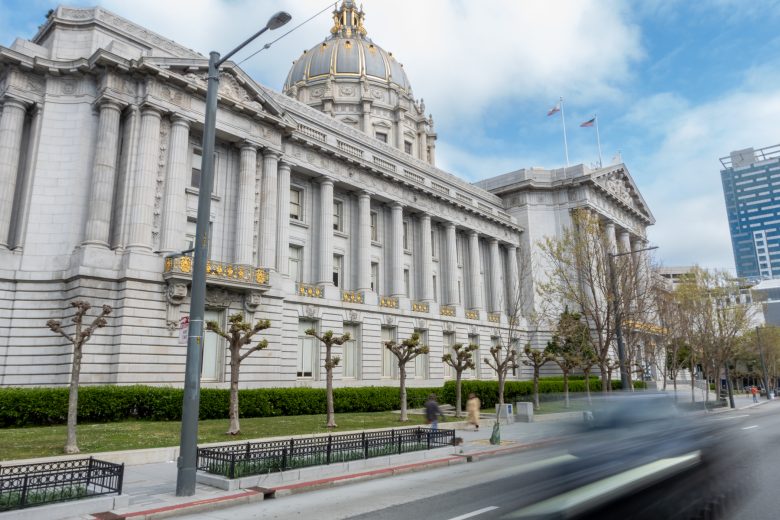

After a seven-hour meeting stretching into the night, the final amendments to San Francisco’s plan to upzone vast swaths of the city had all been laid out Monday.
They include removing historic landmarks from the plan and increasing the proportion of family-sized units with three or more bedrooms. Most won’t be formally adopted until the zoning plan is next considered on Nov. 3.
The state-mandated upzoning, which allows developers to builder taller, denser buildings in the city’s north and west, has split San Franciscans, who gave more than four hours of public comment on Monday.
Supporters see it as a landmark step for a city long resistant to growth, arguing that, as more housing is produced, housing costs will ease for future generations.
Opponents foresee a different outcome, one in which residents and businesses are displaced by new development without enough new housing to improve affordability.
At Monday’s meeting of the Board of Supervisors Land Use and Transportation Committee, supervisors wrangled over the plan and additional amendments.
The city is limited in what changes it can make to the upzoning plan. The state is mandating that San Francisco create the capacity for 36,000 additional units of housing or face the “builder’s remedy,” where it loses the ability to approve and reject new housing developments.
While the proposed plan currently complies with the state mandate, San Francisco shouldn’t introduce “potential constraints on development,” Paul McDougall, a senior program manager at the California Department of Housing and Community Development, warned San Francisco’s Planning Department.
McDougall gave several examples of such constraints, including: Labor provisions that would require certain wages or union participation when building new developments, removing certain parcels from the plan, affordability requirements, adding permit procedures, and more.
Before supervisors began introducing amendments, District 5 Supervisor Bilal Mahmood asked some pointed questions about HCD, the state department in charge of ensuring San Francisco complies with the rezoning mandate.
“What has [HCD] said about this plan?” Mahmood asked the Planning Department. “Are there any amendments that they’ve said they will not accept?”
The state agency “provided cautionary advice, essentially saying that if we make future amendments that would reduce the capacity [for adding new units], we need to make up the difference,” Principal Planner Lisa Chen responded.
And with that reminder, the amendment spree began.
District 7 Supervisor Myrna Melgar introduced an amendment to remove rent-controlled housing with three or more units from the plan.
That amendment was formally voted into the plan, since it had already received the blessing of Mayor Daniel Lurie, the sponsor of the legislation, and the Planning Department, which found that the rezoning was still compliant with Melgar’s changes.
The other amendments had not yet been formally integrated.
The most popular of the day — introduced once by Supervisor Chyanne Chen, and then again by Supervisors Danny Sauter and Stephen Sherrill jointly — was to increase the proportion of units with three or more bedrooms. This, they argued, would ensure that the “Family Zoning Plan,” as the mayor branded it, is truly family-friendly.
Chen also suggested removing from the plan so-called “priority equity geographies.”
These are areas of the city with high proportions of poverty, people of color, seniors, youth, people with disabilities, and other vulnerable populations. While the rezoning mostly focuses on “well-resourced” areas in the city, small parts of the plan loops in blocks with vulnerable populations.
Mandelman, meanwhile, introduced an amendment to exempt some 300 historical landmarks from upzoning.
Putting forward more ambitious versions of many of these amendments was District 1 Supervisor Connie Chan.
While Mandelman’s amendment proposed removing historic landmarks, Chan’s suggested removing all historic resources, which also include the city’s numerous historic districts.
While Melgar’s amendment removes rent-controlled housing with three or more units, Chan’s amendment removes all existing housing from the plan.

These changes, she argued, should be compliant with the state mandate because the city was only supposed to predict that sites that were already residential were only given a 2 percent chance of being developed under the new zoning plan.
On top of those changes, Chan added more. One implemented fees on new development that would go toward infrastructure improvements.
Another removed “density decontrol,” which allowed developers to build any number of units on a lot, so long as height limits weren’t exceeded. Instead, density would be determined by a different program that requires developers to build a larger proportion of units with two or more bedrooms.
Over the next two weeks, supervisors will meet with the mayor and the state to finalize the amendments and ensure they are in compliance. The official vote to adopt amendments will occur at the board’s Nov. 3 meeting.
“Over the coming weeks, my team and I will continue to review amendments to ensure we can help families afford to live here while keeping San Francisco in control of how we do that,” Lurie wrote in an emailed statement.
Ahead of the 1:30 p.m. land-use meeting, Chan had hosted a rally to discuss concerns about the plan.
“It is our full intention to make the state housing mandate, but I believe that San Francisco can develop and meet this goal without displacement,” said Chan. “Displacement of tenants and small businesses should not be the cost of doing business for developers.”
At the rally, speakers frequently took aim at the state laws requiring San Francisco to rezone.
“Over the last decade, representatives we have sent to Sacramento have eroded rights of working people who do the jobs of building and constructing all types of property here,” said Mike Casey, former Local 2 leader and the president of the San Francisco Labor Council, who was one of several labor leaders to join the rally.
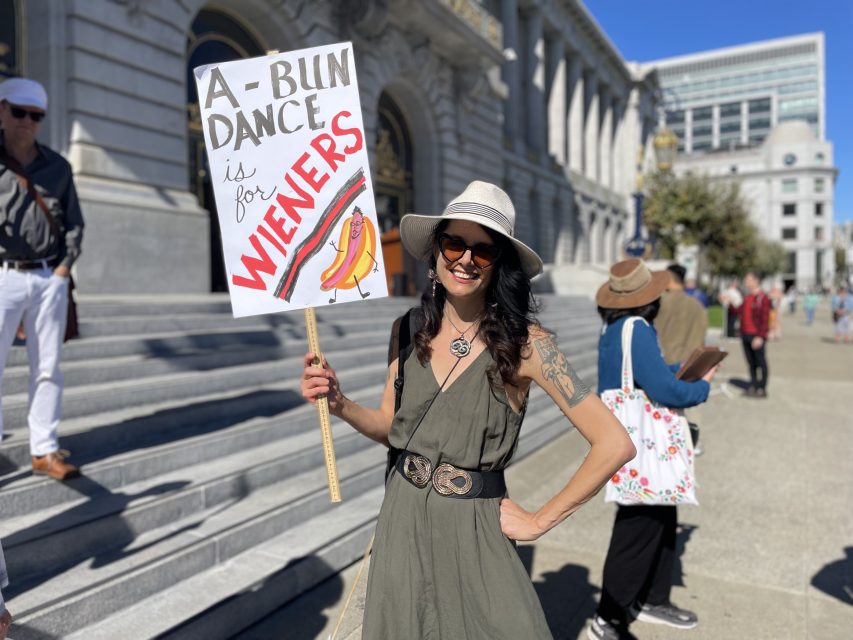
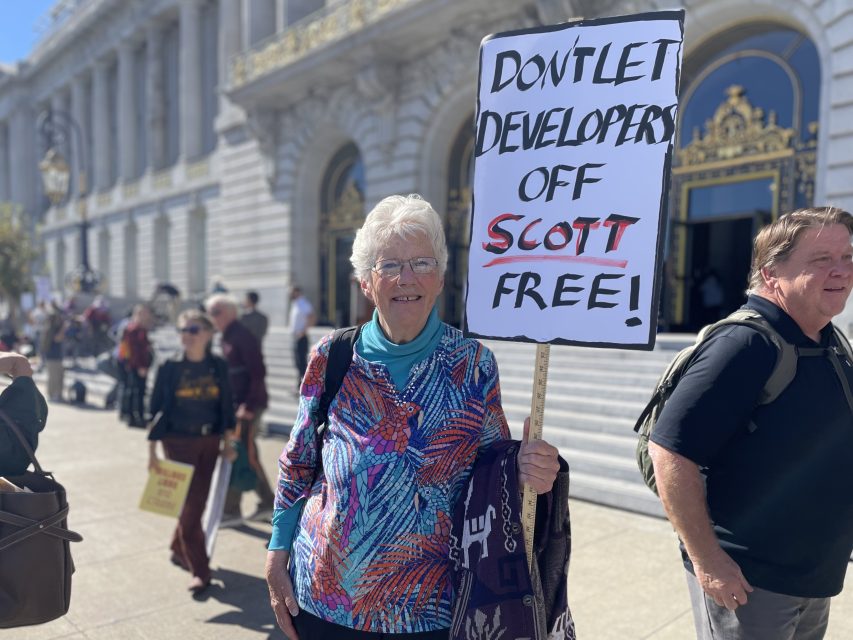
At the rally, many people held signs referencing San Francisco’s state senator, Scott Wiener, who wrote some of the laws requiring San Francisco to rezone. “A-bun-dance is for Wieners,” one said. “Don’t let developers off Scott free,” said another.
The final speaker at the rally was District 2 supervisor candidate Lori Brooke, the co-founder of Neighborhoods United, who has been working against the rezoning plan since 2023. She told rally attendees to demand that the supervisors change the plan.
“If they really want to change the plan to address our concerns, they can,” she said.
The rally ended with Chan leading the crowd in a chant: “Yes we can! Yes we will!”
Excellent factual reporting and clear, explanatory writing – thank you.
Hopefully, our housing focus will center on how to address the housing affordability crisis, and not how to further enable gentrification, or the destruction of San Francisco’s unique neighborhoods, our small businesses and unique character. All Supes should condemn the Builder’s remedy and work to have it repealed. The threat it poses to our city was uncalled for.
Bill, did you miss the high school civics class where they taught that state law overrides local law?
Ok David,
Perhaps I need to clarify – SF Supervisors should get on the horn and lobby officials who decide this stuff in Sacramento. Word has it, our Supes may even personally know a few key players wrapped up in all this. Can you imagine? Some may even be available to have lunch together today. 🙂
the updated numbers in the state law were proposed by the state legislator from san francisco. he got state laws passed for this process, why do you think any other local politician would have more sway in the state legislature than our legislative representative?
Wiener is a manipulator.
David doesn’t understand law once again.
Affordable housing built with union wages. What an oxymoron! Progressives in this city are as dense as our fog!
Affordable housing built with Union wages. Why don’t you try it and report back!
My business on Valencia was ruined by crazy vagrants and drug addicts. Not “gentrifiers”. I’m so glad to live in a safe rational society now, opposed to a crazy neo-marxist wasteland of drugs, crime and the zealots who champion despair and misery.
I hope you enjoy paying 3-4x more rent for the privilege of pretending gentrification isn’t a problem in SF.
Just build more housing! Stop arguing and get to work.
No thanks! Build more LOW INCOME HOUSING or GTFO with that NOISE. We have THOUSANDS of vacant units across the city with no one forcing them to ever go on the market as speculators sit on them for tax write-offs. Deal with that first, building takes years and years.
Pictured: Boomers, homeowners, and the supervisors that are at their beck and call rally together to shackle more weights to the future of the city. We are in this affordability crisis today because nothing has been built for 50 years. These very same people would cry at the sight of a 20 story building benefit directly from the lack thereof at the expense of those poorer than they are.
When SF finally grows into the city its meant to be, history will not look kindly on these obstructionists.
Chan’s demonstration is for show. Peskin’s coalition is going to try and take some B.O.S. seats after this plan inevitably passes. Why would you lead a procession of NIMBYs and professional racketeers ridiculing Family Zoning, RHNA, and the need to build housing on the Westside, then submit a proposal that both the City and Sacramento regulators are supposed to believe is in good faith? Mission Local does an uncharacteristic poker face with the merits of Chan’s amendments. Why would H.C.D., or any zoning regime today, approve a zoning system that makes all inhabited places impossible to ever allow new homes on them? What’s next? No more parks on open space uses? No more businesses in commercial zones? City Hall has been an extortion racket for so long that people forgot that land-use is about identifying suitable uses for land, not getting payouts and campaign contributions.
There already is housing on the west side. Gentrify Pac Heights and the Marina, then come for the low-income families you profit-seeking goons.
I would like a straight answer to my
question Will property tax increase on owner occupied single family homes?????
Taxes never go down. Expect that much.
no, prop 13 ensures it will not.
The west side of San Francisco is an overwhelmingly upper middle class area. It has been that way for decades. This fantasy where you and REP-SF people pretend the Sunset District is Bayview-Hunters Point, Oakland or even the Mission from 30 years ago is laughable.
Uh, no. Upper middle class for the Bay Area is making over 200k a year, so you’re objectively and factually mistaken in a major way.
YIMBY sellouts always sell out.
Mahmood asked softball questions for which he and we already knew the answers. Lame. Sauter’s & Mahmood’s districts include the most densely built high rise areas (the Tenderloin and Chinatown) with low income tenants. In its current form, Lurie’s upzoning plan lacks proper or enforceable protections from eviction/displacement and demolition for local small neighborhood serving businesses and low income seniors, families and tenants. Equally lame: this garbage plan fails to include any enforceable requirements for developers who use density bonuses to build, and by so doing, mightily clog existing public transit and street traffic (including private profiteer entities like Uber, Lyft, Waymo, Amazon). The current plan does not require developers or multibillion-dollar businesses to pay for increased passenger loads on public transit and streets resulting from added density. These two considerations alone are proof that Lurie’s plan is crap.
Eff off to Weiner . May he go the way of Joel Engardio. Don’t let the door hit you on the way out.
He’s running against NANCY PELOSI.
God I hope she rubs his nose in it when she wipes the floor.
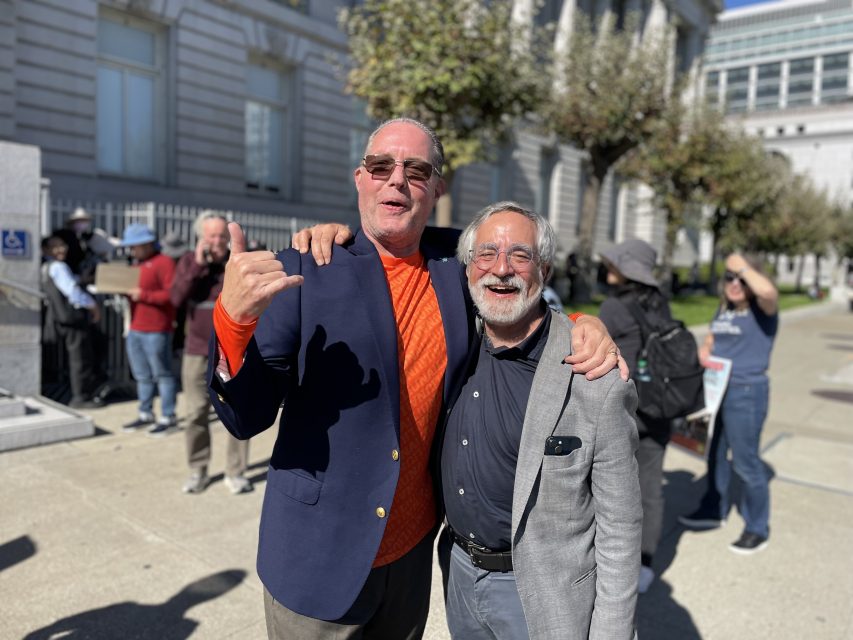
The picture of Aaron Peskin gleefully endorsing “Run Ed Run” thug Vince Courtney, an advocate for park privatization and gentrification, is telling!
What most people don’t realize is that Builder’s Remedy that is being used as a Boogeyman has already been with us since London Breed’s days when she took away the right of neighborhoods weighing in or providing input on any developments. In today’s San Francisco, all plans including demolitions are approved so long as the project adds ONE ADDITIONAL UNIT to an existing building.
And Builder’s Remedy does NOT enable developers to go beyond the existing maximum height or mass within our zoning laws. All it does is requiring the City to approve all development projects ministerially, aka, rubber stamping developers’ plans, which they already do anyway.
So why keep bringing up the Builder’s Remedy? Because it’s a convenient Boogeyman to scare San Franciscans into accepting this latest upzoning.
“And Builder’s Remedy does NOT enable developers to go beyond the existing maximum height or mass within our zoning laws.”
It allows for STATE zoning laws to supplant local restrictions.
you’re wrong there. ask cañada flintridge and goleta what the builder’s remedy meant for them.
Spit it out.
it will be satisfying when connie chan loses her run for congress. i will take joy in her loss. she’s wrong about sunset dunes and she is wrong about zoning.