

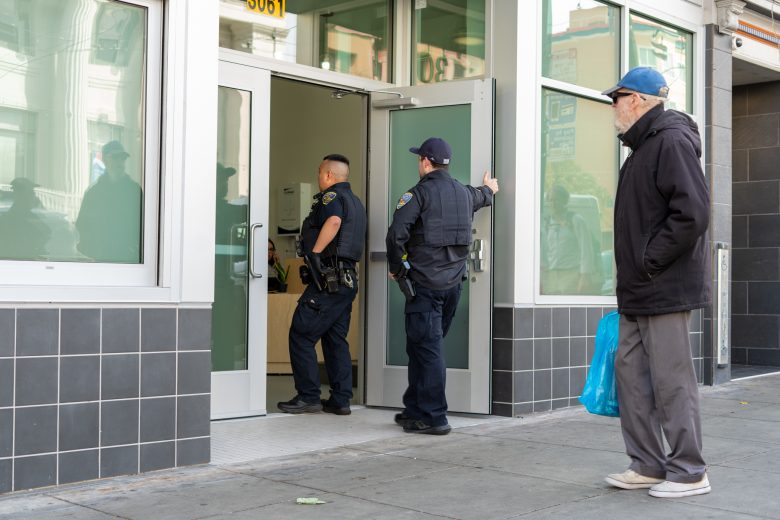
Boots on the ground are in demand.
In community meetings and public surveys, San Franciscans repeatedly say they want to see more officers walking their neighborhoods.
Over the years, the San Francisco Police Department has imagined a map of 52 foot beats, each covering a discrete part of the city. They may be a few blocks of a busy business corridor, like Clement Street in the Richmond. Or they may be geographic areas, like Civic Center Plaza.
But you likely won’t see officers in most of these designated locations. As of September, SFPD was staffing less than a third of its foot beats — just 16 of 52, according to data obtained through a public records request by Mission Local.
Foot beats remain popular
At neighborhood meetings held throughout September to discuss the selection of SFPD’s next police chief, many attendees said they wanted to see more officers on their blocks.
It’s no surprise as to why. Officers on the beat form relationships with community members and address quality-of-life issues, from broken streetlights to homelessness, policing experts said. Research shows that reports of theft and assault decline when more officers are assigned to foot beats.
It’s an age-old sentiment: In 2008, 90 percent of community members who responded to a survey from the San Francisco controller’s office said foot beats were necessary.
Every few years, the city pursues policies that require more robust foot beats.
In 2006, the Board of Supervisors voted to require walking beats despite police concerns that doing so would hamper their 911 response time.
In 2017, SFPD announced that it was doubling the number of foot-beat officers. In 2023, local legislation was approved to require SFPD to implement a strategy to add more beat cops.
Last month, Tenderloin Captain Matt Sullivan said at a community meeting that four officers would begin patrolling the Tenderloin by foot, and was applauded by two dozen residents in attendance.
Despite all this public support, the vast majority of foot beats remain unstaffed. There simply aren’t enough officers, police experts said, and SFPD has other priorities.
Despite “working aggressively to hire more officers,” the department remains some 500 officers short, SFPD spokesperson Evan Sernoffsky said. “If we don’t have that staffing filled, then putting an officer in a foot beat who can’t respond in a timely matter to a violent crime in progress is not as efficient.”
‘No staffing to support’
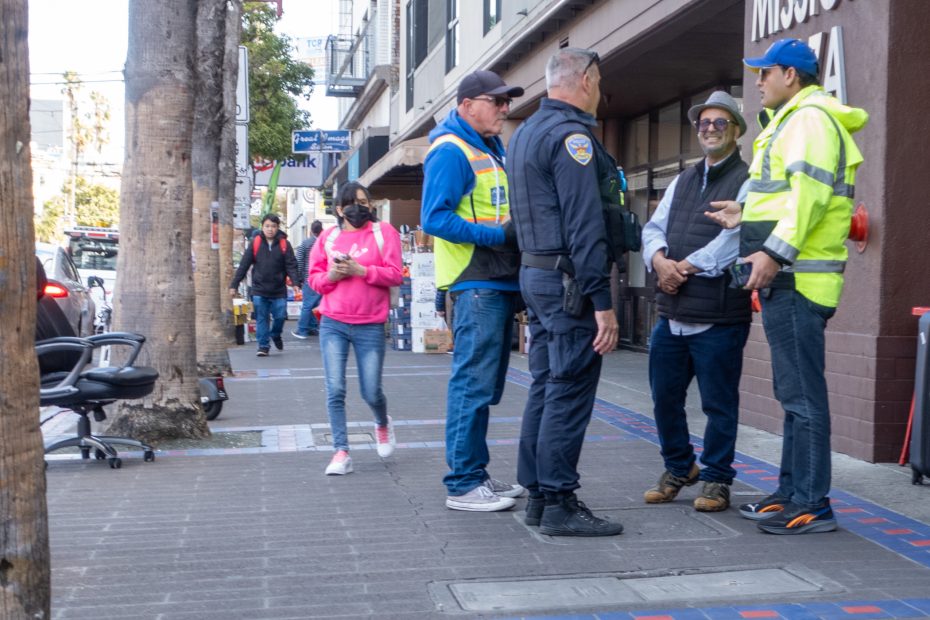
Although there is no official criteria, a foot beat is typically considered fully staffed if there’s one officer assigned to it, or maybe two, current and veteran officers said.
SFPD would not provide the number of officers that staff each foot beat, citing “secret investigative techniques or procedures” that could not be disclosed.
As of September, nine foot beats across San Francisco were filled by on-duty officers.
Six were filled by officers working overtime. One was filled by officers working overtime to staff a police bus — a “mobile command unit” — parked at Union Square. The rest, SFPD noted on several occasions in its records, had “no PD staffing to support.”
Beats that were filled did not necessarily correlate to high-crime areas. Three adjacent beats in SoMa that include the Sixth Street corridor, an area notorious for illicit drug use, were not staffed.
Nor were any of the eight foot beats filled in the Tenderloin, which are all also designated as “special operations” beats, police sources said.
SFPD staffing shortages are nothing new. Which foot beats get staffed depends on factors like the amount of crime in an area and how quickly an officer can move through its boundaries, Sernoffsky said.
There also has to be interest from each district, said an officer who asked to remain anonymous. Working a beat, he said, is seen as a “luxury gig” for more senior officers: You suppress crime “just by being seen,” having a “chill day,” and going home.
“Most significant crime isn’t being done by people on foot,” he explained. So, he continued, foot beat cops are addressing “low priority quality-of-life issues,” rather than “chasing down bad guys.”
Which neighborhoods get foot beats may also be a matter of the squeaky wheel getting the grease: “Community outrage and money can dictate staffing,” said Carl Tennenbaum, who was a San Francisco police officer for over 30 years before he retired in 2013.
A thing of the past
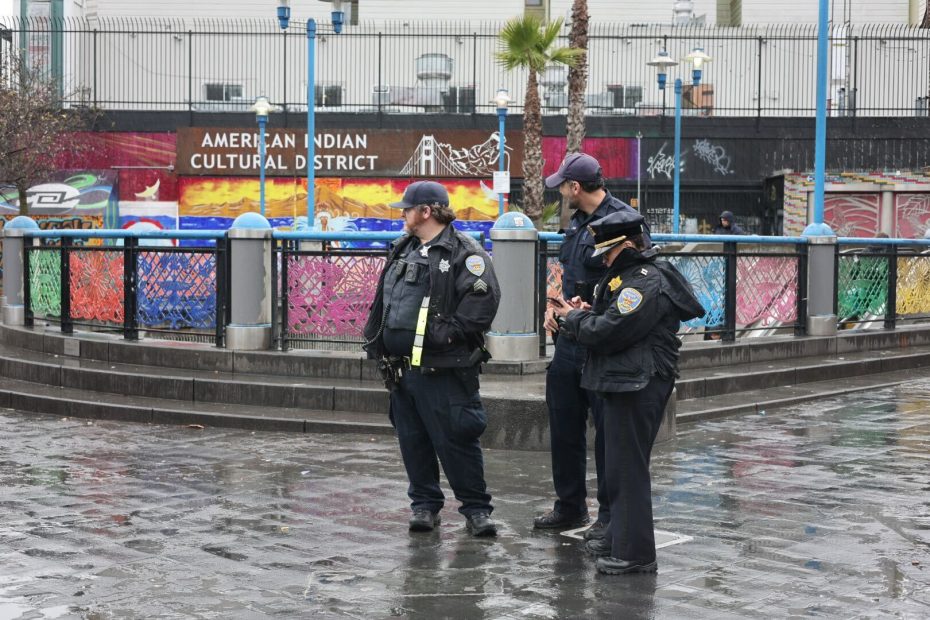
Veteran officers and academics consider foot beats “old school policing.”
In John Gallagher’s day, if a resident wanted to reach someone from Northern Station, where he was an officer for 41 years before he retired in 2011, they’d call their beat cop’s direct phone number.
Al Casciato, a former Mission Station captain in the ‘80s, remembered escorting a woman and her mother to a mahjong parlor to settle a business dispute. The now-retired Tennenbaum recalled walking from one end of his Tenderloin foot beat to the other — or at least taking Muni, if he was in a rush.
Today’s foot beats look different. In the ‘90s, Tennenbaum said, faster police response times to radio calls began to take priority. Now, he said, most officers stick to their cars.
Shown Mission Local’s map of staffing levels, Tennenbaum said he was surprised to learn that the city had “let it get to this point.”
Even if an officer is assigned to a foot beat, there is no guarantee they are physically on site. If there’s a more pressing assignment, foot beat officers are the first to go, Tennenbaum added.
This year, a current officer said, foot patrols have been regularly pulled to participate in drug operations as part of the city’s effort to crack down on narcotics. SFPD said it had no responsive records showing if, or how often, this had occurred.
James Taylor, a University of San Francisco professor who has served on SFPD committees, said that the department could fill the gaps with community ambassadors, who conduct wellness checks, refer people to social services, and report emergencies.
These non-sworn officers are already being used to staff the Clement Street business corridor.
Casciato said he hopes that new technologies like surveillance drones free up more officers to walk the beat again.
Of course, “community groups want a visible face they can identify with their neighborhood,” Casciato said.
At the same time, given the department’s shortages, he wants the public to remember that an officer can be “mentally on the beat” without physically walking it.
So long as neighbors know there is someone at their local police station they can always reach, he said, it matters less whether the officer is on foot.
We have been asking for foot patrols (as local residents and small businesses & shops) for 15 years. Getting cops out of their cars is good for cops, good for residents, good for local businesses and bad for crime.
The SFPD has consistently given the middle finger to the citizens in SF so this is hardly new. In the last wave of “reform” this was a prominent reform enthusiastically supported by the SFPD, and it came to nothing. BTW this is not about cops but a hopelessly sclerotic bureaucracy backed by the Police Officers Association, the only real power in the City when it comes to “law enforcement”. Expect Lurie, Dorsey and the others to take this up and say “this is the way to go — give the SFPD more money, more and more” — its never enough, especially when you’re paying guys overtime to sit inside a bus on 16th.
my perception over the past couple decades has been that SFPD spends a LOT of time hiding in their cars, being “ready” to swoop down and get the bad guy. The thing is, that’s “measurable”.
When a beat cop comes wandering down the street and 2 guys were about to get into a knife fight, they dial it back and no fight. How do you measure that? When some neighborhood lady wants to go to the bart station and doesn’t get mugged because she walked with the beat cop, how do you measure that?
It’s hard to measure something not happening, so they’re always looking at 911 response times and the ability to be in their car and on the road when a request for backup comes.
This ALL day. there was a hard stop on beat cops in 2010. There was a palpable change on the street. Also a requirement should HAVE to be that all SFPD are SF residents. without skin in the game …. They dgaf.
Two words : Ed Lee.
Not only did we do the heavy lift to build a veto proof supermajority at the Board of Supervisors for foot patrols in 2006, overriding a Newsom veto, but Ross put points on the board by running Prop M 2010 where the voters passed an ordinance, a local law, that required foot patrols.
Law enforcement at SFPD, for its part, decided the law did not apply to law enforcement, so law enforcement decided to not follow that law. And there have been no consequences for law enforcement for declining to follow the law.
Cue “Sympathy for the Devil,” in which Brian Jones carries the melody on piano, reducing Keith Richard to tambourine and minimal lead guitar during the chorus and Jagger sings “”Just as every cop is a criminal/And all the sinners saints.”
How did two dozen people become the voice of the Tenderloin? With a population of 29,000, 24 citizens hardly indicates a groundswell of enthusiasm for beat cops, statistically speaking. And the bold if somewhat hysterical headline “S.F. residents want cops on the street” is fit for a politician’s talking points, not for a site claiming to offer “fiercely independent news.” It’s also false. I’ve lived in San Francisco for 35 years now, proudly calling the TL my neighborhood for 33 of those. I and many of my neighbors don’t want more cops on the streets any more than we want Trump’s national guard or ICE roaming around. There are enough people with guns here as it is. Besides, SFPD has its hands full “compassionately” arresting people unhoused and facilitating the destruction of what little property they have. Regarding that methodologically flawed 2008 PSSG study Mission Local sloppily references, the 90% figure refers to a non-random cherry picked survey of about 2,100 people, more than half of whom already belonged to safety groups. It is not a representative poll of San Francisco residents, and it did not ask respondents about resource tradeoffs or their willingness to expand police budgets. PSSG has a poor methodological history regarding its biased findings including It’s gravely flawed 2020 Vallejo report. That Mission Local obviously did not critically examine its 2008 SF report begs the question, “Why not?” Was it simply sloppy reporting or does it have a drum to beat?
If we’re going to be forced to fork over > $2/3b per year for SFPD, I’d wager that most TL residents prefer that SFPD make their presence known doing foot patrols on the streets to see if they can’t keep the sidewalks clear then for them to sit in their cars and not really work.
“At the same time, given the department’s shortages, he wants the public to remember that an officer can be ‘mentally on the beat’ without physically walking it.” (Retired SFPD officer Al Casciato)
Made me laugh out loud. Does SFPD understand the whole purpose and meaning of “on the beat?”
You could be mentally at work while you’re physically on a beach in Hawaii.
“ from broken streetlights to homelessness”, oh my… if it were ONLY just that. People need to realize there is a big difference between “homelessness” and what we find find at 16th/mission BART stop. What we find here is open narcotic sales/use. Illegal vending of stolen merchandise, public intoxication, theft and more recently a spate of shootings- all with in a two block radius of Marshall Elementary School. Mission Local, let’s do a bit better and be honest as to what’s really happening here.
Wow, is this a sea change. How many days has it been since the majority of progressives wanted the police department defunded?
Campers,
Mark is correct that the only power the cops respect and obey is their union.
Hell, when their union told them to stop enforcing the law they obeyed.
That was when they threatened entire community that they’d stop ‘Serving and Protecting’ if Chesa was elected and they did just that.
Over the decades I’ve seen merchants and citizens and politicians give up and hire entire new agencies to do SFPD’s job.
The only way to get the department fully staffed and to see officers walking the beat is to take away every bit of their power to hire and fire and suspend without pay and give it to a Police Chief elected by the people.
Mayor Lurie can start that ball rolling by announcing he’s going to give the power to choose the San Francisco top cop back to the people.
How about the Niners last night ?
lol
h.
Every mayoral election, communities across SF place ‘foot patrols’ on their list of things that the new mayor needs to invest in, and every election, we do not seem to get the results we hoped for.
Foot patrols mean police get to know the communities they work in. They walk the streets and learn the landscape. They stop in to chat with business owners and hear the gossip. They ask the guy hanging on the corner, who’s always in trouble, how he’s doing. Where’s he living? Is he still in a beef with so-and-so? This is not harassment; this is a reminder that we are all here together, and we see each other.
Foot patrols are a reminder that we belong to a community and that there are rules we need to abide by.
(revised)
Two dozen people at a meeting don’t represent 29,000 Tenderloin residents—hardly a groundswell for beat cops. Mission Local’s headline, ‘S.F. residents want cops on the street,’ sounds like a political talking point, not independent news. It’s also untrue. As a 33-year Tenderloin resident, I and many neighbors oppose more foot patrols. SFPD already has their hands full aggressively targeting unhoused residents while stripping them of their limited property in the name of compassion.
The cited 2008 PSSG study relied on a biased survey, heavily weighted toward safety groups—not a valid citywide opinion. It involved about 2,100 participants, mostly already active in neighborhood safety organizations, and didn’t address resource tradeoffs or willingness to increase police budgets. PSSG’s similarly flawed 2020 Vallejo report further undermines their credibility. Mission Local’s failure to critically examine these issues begs the question: Is this sloppy journalism or advocacy?
Surely it depends if the crooks are on foot or in a vehicle?
A cop on foot is not going to catch a getaway car.
David, I think you do not understand what foot patrols are for. It’s not a chase scene from “The Streets of San Francisco.” It’s about making a connection with the community.
Which is why we need cameras on every corner and I couldn’t care less about privacy on public property.
Thanks for reporting
Interesting to see the map
Please notice there are zero areas marked in the Tenderloin or Lower Polk Street Area
These neighborhoods which have high crime rates , persons and addicts on every corner get no help
Not a fan of Trump but we need law and order here now
If city cannot get control then outside help is necessary
Why do drug dealers control and run the Tenderloin and Lower polk street area?
Time to remove the drug gangs , thugs , zombies , vagrants and persons who think they can live on the streets , show no respect for others or the law , and act selfishly to ruin everyones wellbeing?
This game is getting old here .
“Not a fan of Trump but we need law and order here now” – the voice of irony?
What does being a fan of trump have to do with it? It’s a matter of public health and safety.
> Why do drug dealers control and run the Tenderloin and Lower polk street area?
Spend an afternoon walking around those neighborhoods and then come back and give an honest assessment.
Next time can you get even more irrelevant people to tell “back in my day” stories? 🤣😂