

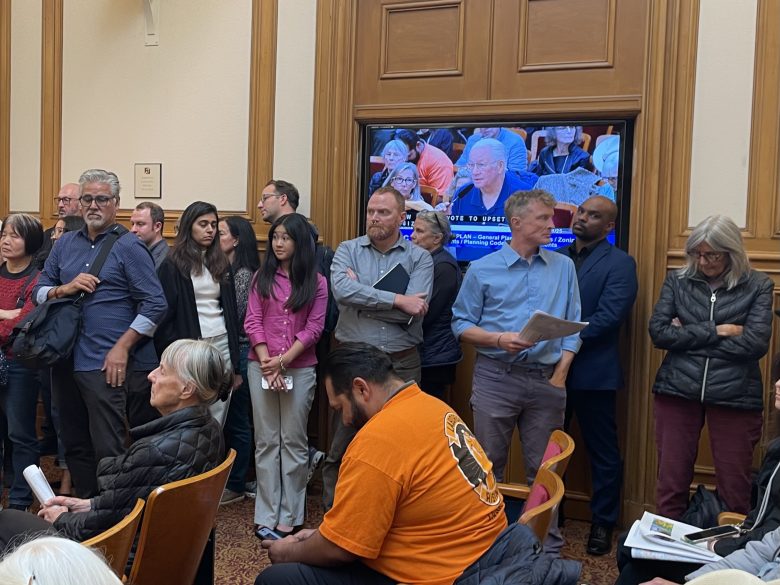

In a marathon meeting that lasted more than 10 hours, the San Francisco Planning Commission voted 4-3 late Thursday night to recommend that the Board of Supervisors pass Mayor Daniel Lurie’s plan to upzone vast swaths of the city.
The proposal, branded by Lurie as the Family Zoning Plan, took a long-standing project to rezone the city’s western neighborhoods (until April, it was known as the Western Neighborhoods plan) and expanded its reach and scope.
If adopted by the Board of Supervisors, it would allow developers to build higher and denser on the west side of the city, as well as in portions of North Beach, the Marina, the Castro, NoPa, Noe Valley and the Haight.
Speaking to a room filled mostly with Planning Department staff at 7:45 p.m. (most public commenters left after saying their piece), Planning Commissioners advocated for amendments and legislation to accompany the plan.
Particularly, they sought protections for small businesses and tenants displaced by new development, plus better guardrails to ensure that affordable housing, not just market rate housing, will be built.
These amendments and bills were enough to satisfy four members of the Commission.
“We’re stuck in a decades-long cycle of housing scarcity. That scarcity creates uncertainty, fear and inequality,” Commissioner Lydia So said. “Mayor Lurie’s family zoning plan offers a relatively reasonable, locally driven path forward.”
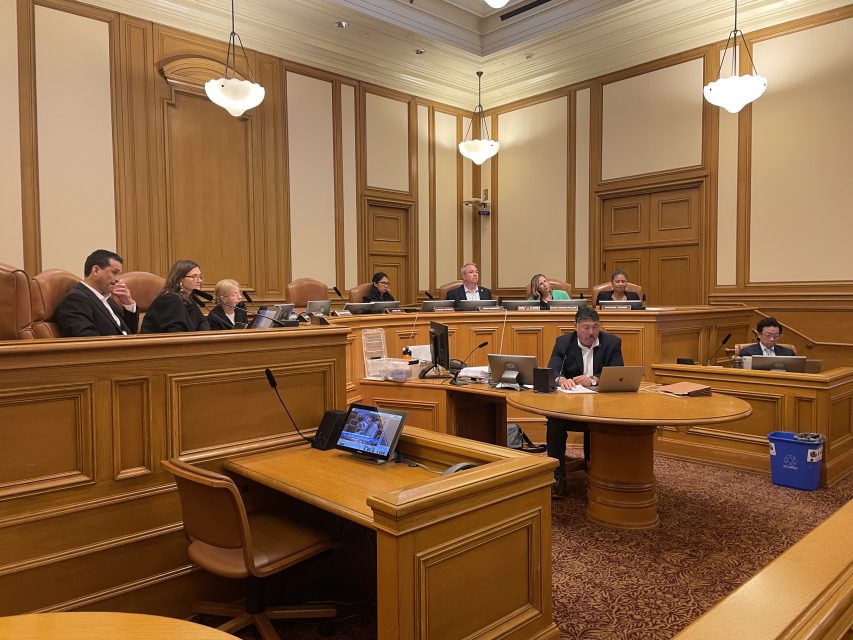
But Commissioner Kathrin Moore was not satisfied. “What we are looking at today is not a plan,” she said. “It is a document primarily responding to a mandate for numbers without a vision.”
The numbers in question are San Francisco’s Regional Housing Needs Allocation, which requires the city to rezone to create the capacity to build 82,000 housing units between 2023 and 2031, 42,000 of which are required to be for people with low to moderate incomes.
If the city fails to create this capacity, the city would lose millions in funding, and would be forced to hand the power to approve housing projects over to the state.
Though Moore called the planning department’s effort “heroic,” she wishes that the zoning plan included more of a vision for what the future of the city would be like, plus a plan for carrying out the construction that would happen under it.
Commissioners Theresa Imperial and Gilbert Williams, the others who voted against the plan, also expressed a frustration with the Planning Department’s iterative process, saying that the frequent changes to the zoning map meant the public struggled to stay informed and, ultimately, felt betrayed.
Areas of the city that people hadn’t anticipated being included in the map ended up getting rezoned, and the heights and densities allowed also changed throughout the process.
In the end, the four mayoral appointees approved the plan and the three board appointees dissented.
“We’re losing the public trust, because we’re saying one thing and doing another,” Imperial said.
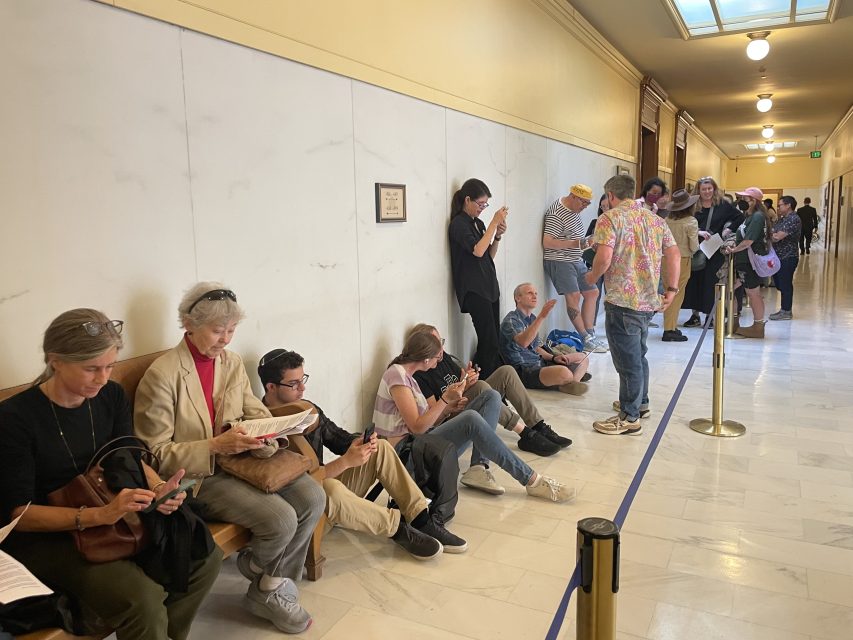
And indeed, people’s frustration with the city was clear during the more-than-five-hour-long public-comment session. Many commenters came from a testy rally and counterprotest on the steps of City Hall and waited in the hallway and overflow room in City Hall for hours for their two minutes to speak.
Many railed against the plan for its lack of protections for tenants and small businesses, plus the lack of a plan for financing affordable housing production.
Others wanted to preserve their neighborhood character. San Francisco has the benefits of suburbia, and the benefits of a city, said one commenter, arguing for the status quo.
“I don’t want it to be like Hong Kong,” said another, through a Cantonese translator.
“I shouldn’t have to feel guilty for wanting to raise my son in a single-family home,” added a third.
Several suggested that elected officials who voted for the plan could face recalls, like the one looming for Supervisor Joel Engardio next week. “I believe the subtext of that recall election is the conflicting views of what the future of the Outer Sunset will be,” a commenter said.

But almost as many were pleased with the plan, and spoke out in support.
“I’m tired of watching my friends leave,” said one college student who grew up in the city. “I’m tired of looking at the salaries for entry-level jobs, and then looking at Zillow and realizing that it’s just not going to be able to work.”
“To those who worry about neighborhood character, I ask, what character is there in a neighborhood where businesses close because they can’t hire workers? Where schools close because teachers and families are priced out? Because this is where the status quo has led us,” he added.
As the meeting wrapped up at 10:10 p.m, Planning Department staff were in a celebratory mood. They had gotten the commission’s approval, and heard earlier that day that the state had given the zoning plan its preliminary blessing.
“This is the beginning of the end,” one said.
The next stop will be a doozy, though: it’s off to the Board of Supervisors.
Many people still do not realize that the up-zoning plan will happen regardless of whether it is designed by the city or the state. At this stage, the focus should not be on debating whether or not the plan will happen, but instead on creating a strategy that meets the required housing numbers and truly addresses the needs for affordable housing for lower- to middle-income residents. Who will do a better job at it, the city or the state? Those are the options.
“a strategy that meets the required housing numbers and truly addresses the needs for affordable housing”
Sorry, those are incongruent, impossible.
Let’s all remember it was Scott Wiener and the corporate RE developer interests behind him who came up with the “requirements”. Done properly, they’d find the money. But of course not, why bother when you can cook up an unfunded housing mandate instead.
it’s pretty cool to see added density in noe valley, it can absolutely support it.
You’re actually not seeing that. None of that has happened yet.
Nice try parrots, cart before horses before slogans before BS, all in the name of gentrification and faux-futurist BS.
They promised lower rents and lowered housing prices, YIMBYs lie constantly and are always moving the goalposts towards their actual goal, gentrification and eviction of low income longtime SF residents and lower classes.
But no, you have not seen anything built that at all moves the needle. False.
Of all places, YIMBY Valley would be the ideal candidate for this upzoning. Not only because this is the neighborhood that gave rise to Schmuck Wiener’s career but also because it’s the neighborhood with the most number of centi-millionaires who’ve already tanked $4MM+ on those McMansions. Let’s see how many of them will have a change of pro-developer ideology when a 6 to 7-story building goes up next to them. There goes their views from their roof decks!
get over yourself
Hey Jym you need to stop trolling. If you have nothing to say, say nothing at all.
Lots of energetic commenting here, very few sources cited except for poor old Jane Jacobs.
Personally I’m undecided on the whole issue and if I’m going to be convinced it will take citations and explanation of why the cases cited are similar to our situation in San Francisco 2025.
But instead I get the same tired name calling and personal brand polishing…
I really don’t get the concern about displacement of small businesses. We can all see the insanely high level of retail vacancies in the city. Commercial tenants don’t have rent control. So can’t businesses find a new storefront if their building is demo’d? The only exception would be a decrepit building that rents at a steep discount because it’s a dump, and sorry, but those should be demo’d to make way for larger buildings with housing above retail
First, it’s not as simple as you or me moving to a new apartment. Building out a cafe/restaurant space can cost six figures.
Second, vacant storefronts may not be a size that works (many vacant storefronts on Mission Street are narrow and deep, which doesn’t work for many businesses), may be new construction and command higher rent, or may need extensive repairs. Another problem is that landlords may have financed the construction or purchase of a building based on a valuation for the retail spaces that was too high. You might think any rent would be better than zero rent, but accepting a lower-rent commercial tenant devalues the building and puts them underwater on their loan: hence, long-term vacancies.
Jane Jacobs wrote in _The Death and Life of Great American Cities_ that neighborhoods need a mix of new and old buildings because some kinds of businesses just can’t work in newer, nicer buildings: they need the lower rent that comes with old, and yes, kind of decrepit spaces to be viable. This is still true. SF still has a few used bookstores, guitar stores, and cafes where coffee is only $3, but you’re not going to get those things in a brand new building.
If cities need a mix of old and new, then clearly San Francisco’s problem is not enough new buildings. The stock is ancient and gets more ancient every year. (Obviously you only believe the part of Jacobs that is convenient for your argument.)
You really don’t understand what makes SF cool or why this is a threat. You really don’t get the concern. I’ll cede that. Why is it everyone else’s job to explain the obvious to YIMBY newcomers? The small businesses are locked in. Moving their properties to market rates make their businesses inviable, and they go away. If you are happy about that and see no problem with it, I really don’t understand you.
“We’re losing the public trust, because we’re saying one thing and doing another,”
I’m sure you have no problem with that either.
What makes San Francisco cool is everyone living in drafty 100 year old apartments, the middle aged middle class moving to Phoenix, and young people not coming in the first place. Got it.
The real NIMBY agenda is to keep new arrivals out of SF, and keep the dirt poor rent control mob here. Because the latter vote progressive and the former do not. It is gerrymandering in a different form.
Q, it is not about “gentrification” per se but rather an acceptance of the need that we need more homes at all feasible price points. And not just “affordable” AKA subsidized housing.
That said if gentrification means better maintained housing, less crime and blight, and a more productive populace, then that is good too.
Finally, a YIMBY who outright admits gentrification is their sole concern and they’re all for it.
Why not just call yourself YGENTRY?
“that we need more homes at all feasible price points.”
YIMBY sellout-itis does not accomplish that.
You’re just being a useful tool of Billionaire private equity speculators. Do think twice.
Or are housing prices going down in your neighborhood, hmm? Didn’t think so.
YIMBY lies never come true. It’s a grift.
It’s an obvious one too.
Please go soon.
“Think”,
“YIMBY newcomers”, really?
Nativism in full display.
Commercial rent control!
Here’s why:
Joe has a little butcher shop. The building he’s in is 80yrs old and the owner died and left it to his 3 kids who don’t even live in the bay area. There are 6 residential units in the building, but the kids have been wanting to sell the place, and they know it will sell for more if the units are empty, so they don’t re-rent after people leave. Pretty soon, there are like 3 people living in the place and Joe’s butcher shop. Now, before, the building may sell for 5M because they could probably buy out the 3 remaining tenants, kick Joe out, and rebuild some nice luxury condos there (which happens all the time), but the payout really isn’t quite enough, because they’ll only be able to put in 6 more units that are newer and no longer under rent control. The profit really isn’t much. BUT, if you can put in 12 more units, then the profit is DEFINATELY there. Basically, Joe and his little shop only exist because the rent is cheap and the owners know they can’t get someone new in there if Joe leaves, but the new owner doesn’t want Joe…. he’s going to have a super fancy new building and new condo owners who will want an art gallery or a starbucks or something.
Now…. I’m not saying this is exactly what is going to happen, but I’ve seen this story before. Joe is screwed and he knows it. The owners are looking to make a fat pile of money and 99% don’t even live in the city.
These economics have been in place along the corridors in the Mission since 2008 with Eastern Neighborhoods with much greater land value price differentials that we see on the west side yet we’ve not seen this fear play out in pract
“We have not seen that fear play out” ???? Have you not compared the mission of 2008 to the mission of 2025? It has played out and people have lost their lives. Displacement is death.
Amazing how the NIMBY side always concocts these convoluted one-off scenarios to explain why nothing can ever change. (Except the skyrocketing rents, of course.)
YIMBY tools pretend they’re doing all the Billionaire’s work just to lower the rents and housing prices – just one problem, the rents and housing prices NEVER EVER ACTUALLY GO DOWN, because they are LIARS. Gentrification is their only actual goal. Get well soon, we’ve had enough of your schtick.
So to clarify Q, what you’re saying is that theoretical YIMBY policies are increasing rents, rather than the status quo of NIMBY policies that have been in place for generations? Interesting take!
“what you’re saying is that theoretical YIMBY policies are increasing rents”
The proposed upzoning absolutely yes. It’s not “theoretical” so much as Lurie’s plan that the BOS has apparently signed onto because 5/11 are bought “moderate” tools of Billionaire private equity real estate speculators that have the donor cash.
Or did you miss the last 10-20 years, were you out traveling the world, YIMBY? Prices didn’t go down anywhere in SF because of concessions to developer groups from London Greed. Pay attention to your own slogans maybe?
“f you can put in 12 more units”. Exactly, and it’s going to be mostly 1BRs and studios. Go raise a family how we’re being told upzoning will support.
Access improves equality. Is this the best way? Of course not. Take this as the next step in a conversation that must continue and keep pushing…onward and upward!
Mindless. Almost none of this will happen for years to decades if ever.
If you think building market rate towers is going to bring “equality” or lowered costs of living for anyone, you are high on someone’s supply.
Go on Zillow as if you’re going to buy a place and see what it costs per month. Now add 15% to that for taxes and fees and other costs and you’ll see the *minimum* rent someone will charge for that place. That’s the problem. There is literally no way to buy a place and then rent it out for a profit unless you have a pile of money to start with AND rent it for a pile of money.
So what happens with “more housing”? Well, it depends. We had property in SOMA 15yrs ago, is it cheaper now? Surprise! We added a bunch of housing and the property values went up and the rent went up and people now want to live there. That’s how it works. So, there is literally ZERO truth to this “more housing = lower rent”. That’s the new trickle-down economics of SF. Maybe later we can talk about how adding 5 more lanes to a highway doesn’t actually decrease traffic?
Anyway, the only solution I’ve seen that works is to have apartment buildings contracted exclusively as rent-controlled buildings that are owned and operated by the city or a city subcontractor. The moment it goes to join “the market”, then the entire purpose of capitalism – to make more money – basically takes it away from those who need it and gives it to rich people and outsiders.
Let’s help people in SF succeed and not just make rich people even richer. It’s harder and messier than just deregulating everything and saying, “well, that’ll do it!” and walking away.
Are you crazy? SOMA is definitely cheaper to live in today than it was even 20 years ago. Every condo there is deeply underwater.
” SOMA is definitely cheaper to live in today than it was even 20 years ago. ” Is bullshit.
Indeed.
Hence why developers stopped building and told us “we need rents to go up before we can build more”
Exactly, and also why there’s a whole block, practically, down by Salesforce Sour that has just been an empty hole in the ground for the last like five years. Well, that and it was given a green light for a major property development conglomerate from China to buy that property and develop it, and then after they tore it down they went bankrupt and all funding disappeared… And it’s just been sitting there since then not doing anything. Yay corruption, yay bureaucracy, boo citizens wanting to be happy with the city that they live in. Boo to the poor, unwashed masses. (If you can’t tell this is a sarcastic post, you need to go back to grade school).
Yimbys can try to pass around the cool aid all they want. That won’t change the record: the pre-pandemic real estate explosion brought one of the largest eras of gentrification and displacement in San Francisco history – period. The small businesses that survived had their rents hiked, leading to local inflation, putting even more stress on the wallets of the remnant middle and working class. Despite thousands of new units built in Soma, Mission Bay and beyond, housing costs continued to skyrocket until the fed hiked interest rates. Now, we are asked to do it all over again. Not Acceptable.
“thousands of new units” is a grossly insufficient number.
Tens of thousands of units are required in order to mitigate continually rising housings cost due to chronic housing scarcity resulting from 5+ decades of NIMBY-led anti-housing policies initiated by the “original sin” of the 1970’s citywide downzoning.
The impactful damage of this, Scott Weiner’s and Lurie’s upzoning density scheme (falsely named the “Family Zoning Plan”) will be felt and seen for the next 40-50 years and beyond. The bogus “family zoning” plan provides for development of thousands of cells: tiny studio and 1 bedroom units, but not for 2 and 3 bedrooms where growing young (or senior)families can live together. And if we’re going to discount people for growing old as a way to diminish their (or a group’s) reasoning in the upzoning wars, then let’s also examine the sanctimonious talking point of proffering one’s recent decision to “start a family” as a justification. These are un conceived children but still…. the spawn of the entitled must be prioritized over existing citizens and elders!! Meanwhile, the nation and world are on fire as fascists disappear the mothers and fathers of San Francisco’s actual living, breathing children, but the unformed fetuses of the entitled will need a place to live when they grow up so…….. Weiner and Lurie’s density giveaway for market rate devellpment will fuel increased real estate speculation thereby triggering evictions. Demolition of existing affordable housing will displace residents in order to upzone all of the neighborhoods across the city. As Commissioner Moore stated “It’s a numbers plan” with no implementation plan whatsoever. Shameful.
It is wild watching how people like you characterize building new apartment buildings to replace aging, often decrepit and abandoned commercial buildings and housing stock. This happens all the time, all over the world, with little to no controversy, but for some reason here is it turned into a morality play where the NIMBY conservatives pull out all the stops to prevent anything from changing.
It’s funnier because when they started out, nobody pretended it was morality play. It’s just they had to couch it as such later to get the steady stream of government funding for advocacy nonprofits that claim to represent the marginalized. Nothing more hilarious than a pro-Latino government funding group arguing against building housing which employs a largely Latino workforce and decreases displacement pressures on their community. It’s all a farce.
Do yourself a favor. Listen to the debrief after public comment where the various commissioners discuss and raise their concerns about the density plan. Learn something.
“often decrepit and abandoned commercial buildings and housing stock”.
Displaced residence of the Filmore have entered the chat.
Clear cutting black neighborhoods is not the same as turning an abandoned diner on Geary into a 4 story apartment building for people to live in. But you know that.
Who owns the building and do they accept less than 50k a year to live there under any circumstances?
Oh, so we’re going from “often” to “one”. Thanks for clarifying. I already worried I needed to see the eye doctor for missing all that desolation. /s
What’s the problem with the rest of the city getting similar zoning to what the rest of the city imposed on the Mission in 2008?
“Why can’t it all be downtown” because it isn’t. “Why can’t we turn the mission into a golf course” because people live there. Repeating mistakes isn’t fixing the underlying issue for anyone, or did you think the Mission was more affordable now than before? Please, think.
you’re going to get immediate downvotes from yimby people for stating basic facts
That’s how they roll. You’re questioning the validity of their money tree, it’s a threat to their gentrification desires.
Not only did Lurie’s upzoning pass, but SB-79 passed out of the Assembly on Thursday.
The responsibility for this rests solely with San Francisco’s “progressive” housing grandees who were unable to block or stop Scott Wiener and who have gleefully severed connections with “privileged” residents, all while shifting all undesirable land uses onto lower income communities of color.
They lost. YIMBY won. These legislative wins are merely implementation details of a debate that was not even a contest. This will take some development pressure off of the east side.
And it was largely because a cartel of San Francisco nonprofit housing developers hijacked progressive politics to keep city dollars flowing into their agencies while Scott Wiener rampaged unhindered.
Will there be any consequences for those who led us to this total collapse, or will they double down on stupid, file lawsuits or run ballot measures that will threaten to put the city out of compliance with state mandates, further clustering undesirable land uses in vulnerable communities?
Wouldn’t it have been more fruitful to have told the nonprofits to sit down and shut up and to have organized and mobilized San Franciscans towards self determination over the past 15-20 yr?
It is like whenever Calvin Welch demands anything in writing, we end up getting the precise opposite on steroids. If these people continue to be allowed to dominate housing policy, continue to get city money, then that is prima facie evidence that they are being paid to contain popular politics.
YIMBY has barely won. There is a ton of work left to do: condo defect reform, permitting processes, loophole cleanup, etc.
The NIMBYs started killing cities 60 years ago. It will take decades to undo the damage.
YIMBY’s are the ones killing the cities- the rents are not going down, you lied and you continue to lie as if that was ever the actual goal. Gentrifiers be damned, you don’t need to make excuses for it.
From the Housing Element Rezoning Program
https://citypln-m-extnl.sfgov.org/Commissions/CPC/4_10_2025/Commission%20Packet/2021-005878CWP.pdf
“Requirements
Our (added: City&County) legal obligation is to demonstrate we are creating capacity to meet our RHNA, but since we do not build housing, the state will not decertify us if the housing is not built. Instead, the failure to produce enough units may result in other actions. The City’s role lies in demonstrating that it can accommodate the 82,069 units
over the RHNA period (2023 – 2031) accounting for both known development projects projected to be built during the period and the number of units that could be
built on reasonably available parcels based on zoning rules. State guidelines necessitate that we plan for at least 15% more capacity than our RHNA production
target, or about 94,300 units. The buffer is intended to account for uncertainty on the included sites.”
Remember it is Scott Wiener who brought us this mess. There are no funds from the state level to support San Francisco in building out housing for this.
Daniel Lurie put the cherry on top by cynically calling this “Family Zoning”, when the plan remains at the “units” level. There is no provision to build housing that would actually support raising families. Not that people who do the actual work in this city could afford buying or renting a 2/3 BR in any of the newly constructed buildings in the first place.
!!! We are being sold down the river right here and now, and it is happening in plain sight for all of us to see.
SB21 (on Newsom’s desk) would facilitate destruction of SROs, including the Altamont and the Apollo. These and other SROs near transportation could be replaced with high-rise buildings. I do not believe that the timing is a coincidence.
https://thefrisc.com/gavin-newsom-could-make-sro-demolition-easier-sf-affordable-housing-advocates-arent-protesting/
In the 2000s, the Plaza Hotel SRO at 6th and Howard was demolished and replaced as an affordable SRO to contemporary standards.
The interesting thing about that project is that Willie Brown insisted that the City of San Francisco be the developer instead of farming the job out to one of the housing nonprofits close to his then nemesis, D6 supe Chris Daly.
Never ever forget: Gavin Newsom is where he is today because he is a real estate developer first.
I am not opposed to up zoning or displacement, as someone mentioned above buildings fall into disrepair and it’s often better to rebuild. My beef is the shear number of units – 82,000! For who??? (Not to mention that 1/2 need to be affordable, this is America, a land of opportunity to go out and make it. Too many entitled crybabies in USA who don’t realize the opportunities out there.)
Back to the number of units: We no longer have international folks migrating here, AND fact is we are simply not growing in population, so there is no need for 82,000 units that would house say 160,000 people. That’s a 20% increase in our current population.
If there’s no more international migration (and even in that case there will still be domestic migration occurring, plenty of non-immigrants move in and out of the city all the time), then that’s the best case scenario in terms of supply vs demand.
Just look at what happened during the pandemic. As rents lowered in the city and the population fell, people who previously couldn’t afford to live alone (but wanted to) decided to move into studio or 1bed apartments.
Essentially, increasing housing supply is as much about giving more options to existing residents as it is about accommodating new ones, whether it be in terms of location, housing type, or # of roommates.
This is why I strongly believe that even if the population of the US stays exactly the same in the next 30 years, we should still build a lot more housing.
Building market rate housing in SF is a money-making affair, not actually aimed at putting low income housing into a market absolutely screaming for that state and nationwide.
Do not believe YIMBY lies, they never come true, the prices never come down as a result of upzoning – poor families are displaced, that is it.
Not opposed to displacement? Then I’m opposed to you!
YES. This is the spirit of people who care about fellow people.