



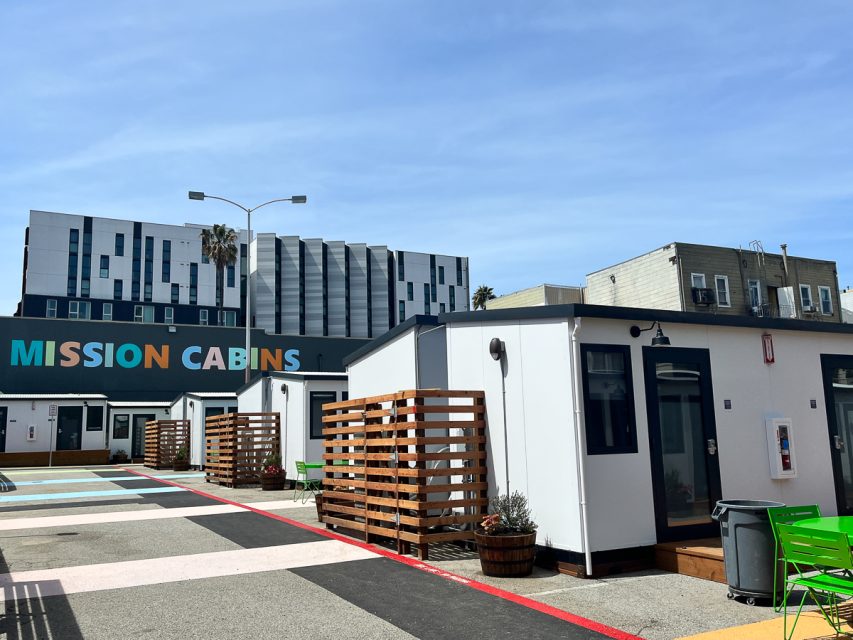
Mission Cabins, which has stood for 18 months, is closing so that construction can begin on affordable housing.
Most residents of the 60 tiny homes near 16th and Mission have already moved out.
Residents by and large said they were glad they came to the cabins, but still expressed frustration with staff and strict rules.
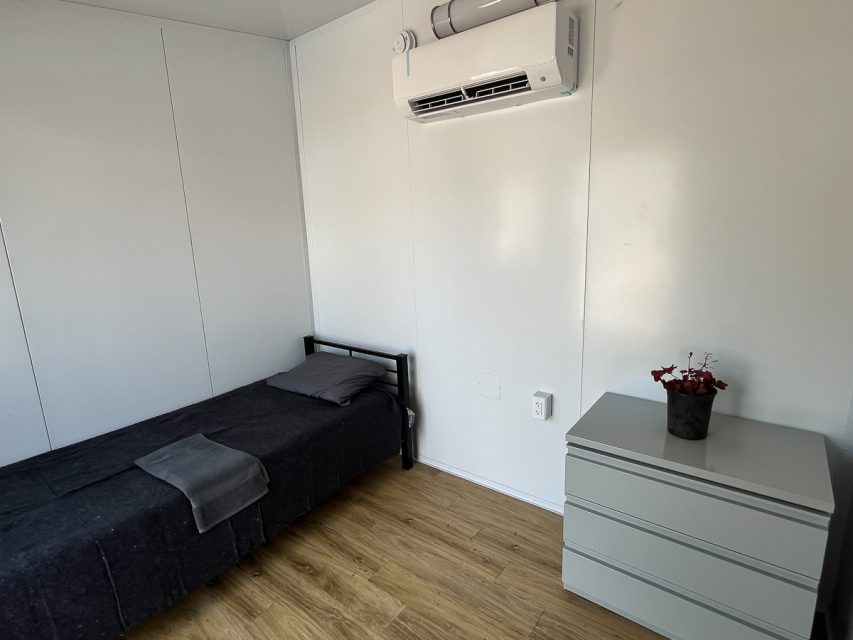
“When I come in here, the place, my room, everything looks awesome to me,” recalled Antrinette Jenkins, who in May 2024 was one of the first to move in and is now one of the last to leave. “All I had was two blankets and a couple bags. But now it looks like a one-bedroom apartment.”
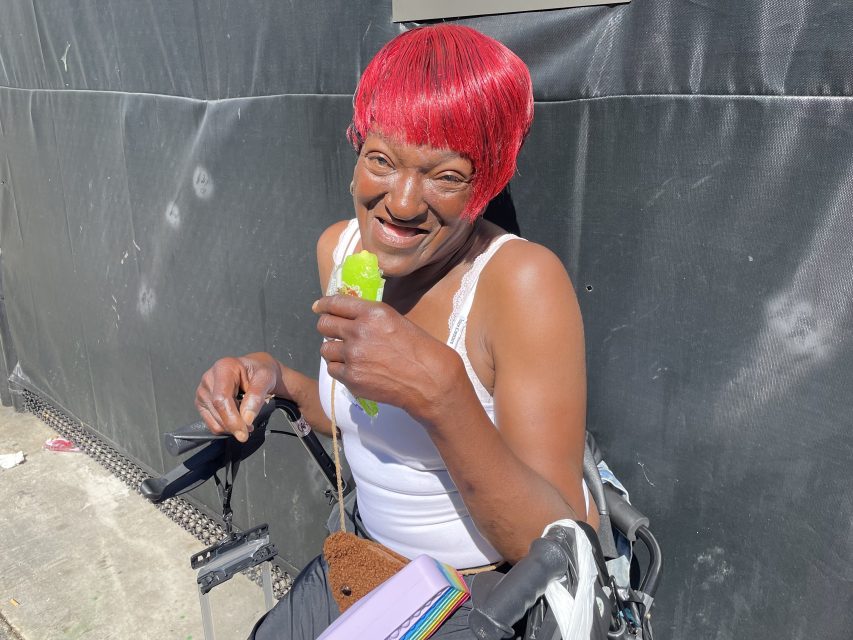
Jenkins had been living on the streets of the Mission. Then one day, a member of the city’s Homeless Outreach Team checked in on her and offered a spot at the Mission Cabins.
“Five minutes later, I’m inside of this place here … out of the cold, out of the water,” Jenkins said.
It wasn’t all sunshine. Jenkins felt that there were too many rules and restrictions. “We don’t even have a key to our own door,” she said.
Then there were the staff members, who she says picked on her, telling her she couldn’t keep certain things in her room or eat in there. She said they would go into her room when she wasn’t there, and claims that one stole her ID and debit card.
Jenkins is looking forward to moving into a single-room-occupancy hotel and leaving the Mission behind.
“I’m hoping to be in my own place, way out of this area of drug activity and crime,” she said. “I want to be somewhere where it’s quiet. A little bit of scenery and a nice next door neighbor.” She plans to find a husband and get “a couple of puppies.”
As Jenkins sat outside the cabins on a recent day, John Debella, a former resident who had already been relocated to permanent housing, walked by with his dog, Peaches.
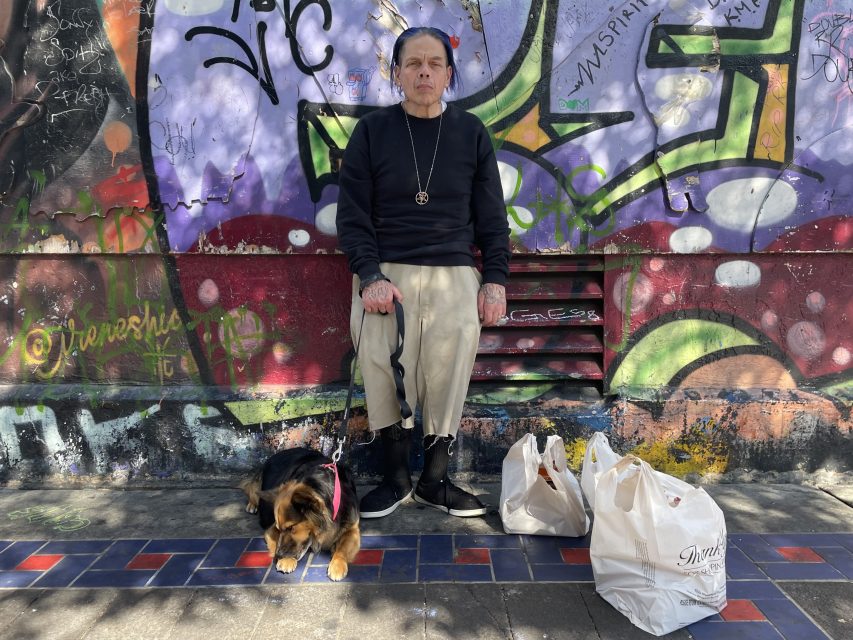
Debella moved into the cabins in June 2024 after more than 25 years of living on the streets of San Francisco, including in the Mission, where he grew up.
When he moved in, he was struggling with fentanyl use, but decided he needed to give Peaches a stable home. “If something happened to me,” he thought, “no one was going to take care of my dog.”
Though Debella was grateful for the stability, he was less fond of the cabin’s restrictions, something that homeless people have frequently cited as a reason for not wanting to move into shelters.
“The staff was hella policing me,” he said. They would search him, and at one point told him that if he forgot to muzzle Peaches again, she would have to leave the cabins, even though she is his service dog. Like Jenkins, he also reported that he’s had stuff go missing from his room, including lottery tickets and some of his knick-knacks.
But still, he is glad he went. “If I wasn’t there, I’d probably be in jail,” Debella said.
Steve Good, the president and CEO of Five Keys, which operated the site, said that residents frequently get frustrated with restrictions after having “unabashed freedom” while living on the street.
“In order to maintain the security, sanitation and safety of the Mission Cabins or any homeless shelter, we had to have a series of rules,” he said.
He added that these rules include regular room checks to ensure that residents are alive and safe, and that the rooms are clean. There are prohibitions on bringing open food containers inside, since that could attract rodents and bugs. He hasn’t had to fire any of his staff members for stealing, he said.
The cabins were intended to serve people like Debella who have ties to the Mission, said Santiago Lerma, who leads the Mission’s Street Team.
“Giving people the option to be in the place where they know people, they feel community, they feel safe, helped to motivate a lot of people who had been long-term unhoused make the decision to come inside,” Lerma said.
Lerma said he saw a lot of “really good success stories” come out of the cabins. “There’s people that I’ve been dealing with for years that I thought were too far gone. I see them now and I’m like, ‘What? Like, you — you’re totally different, and doing well and healthy,’” he said.
Though the site closure takes 68 shelter spots out of the Mission, homeless department spokesperson Emily Cohen said that 62 additional spots are set to open at Mission Action, another shelter in the Mission, at South Van Ness Avenue and 21st Street, on Oct. 1.
In the meantime, the city and Five Keys are looking for a “new location” for the cabins, said Good. The announcement could be made “in the next week,” he said.
Some neighbors who live on Capp Street near the cabins wish they could stay put. Five Keys operated under a “good neighbor policy,” providing round-the-clock security on the block to clean graffiti, move drug users away, pick up litter and generally keep the block clean and safe.
The agreement came after fierce opposition to the cabins from Capp Street neighbors and parents at Marshall Elementary School, which is at the corner of Capp and 15th streets.
“We were definitely concerned about concentrating a population of individuals that have potential history of drug abuse and other issues next to an elementary school,” said Naomi Fox, who lives on Capp Street and is the PTA Treasurer at Marshall.
Then-District 9 Supervisor Hillary Ronen approved the project anyway, with a promise to residents: “I feel comfortable now looking you all in the eye and saying that this is going to make the neighborhood better,” she said.
Fox and other neighbors say that Five Keys lived up to its promise.
“Having the guards there has been a positive thing for our block,” Fox said. “I know that guards, from talking to them and getting to know them personally, really cared about helping the school community.”
“I think Five Keys has been a positive presence on the sidewalk, and I think they’ve been very helpful and respectful of both people that are unhoused and the residents,” Aaron Wojack, a Capp Street resident, said.
Now, once the site is cleared, Fox and Wojack worry that street conditions will worsen. “I think when they go away the quality of life on the streets might suffer a little bit,” Wojack said.
Why can’t Mission Local name this project for what it is: “Permanent Supportive Housing,” substance and psych inpatient treatment, that was opposed by Marshall families, the Marshall PTA and the elementary school’s principal?
This is not affordable housing, it is a substance and psych treatment center and it is adjacent to an elementary school overrepresented with homeless, low income, immigrant and students of color.
First a homeless cabin village goes in over the objections of the community and two months later 16th and Mission is designated Tenderloin South Fentanyl Central, now a drug treatment center is to be built over the objections of the community.
It is totally not racist and totally not classist that Mission Local carries water for Luis Granados ($363K in taxpayer subsidized annual salary in 2023) of MEDA and Sam Moss (275K in taxpayer subsidied salary in 2023) of Mission Housing and totally not racist that self described Mission Community Leaders put their business before the wellbeing of students..
The article was not completely correct. Instead of affordable housing they are building housing for drug addicts! How stupid with all the drug dealers and temptation and crime right here! Next to an elementary school. Brown kids don’t seem to matter much in Fielder’s district. Their safety isn’t important.
Build the original plan that Mission Housing, the City Homeless agency, the supervisors approved – of affordable housing , including for homeless families. Drug addicts don’t get clean where temptation is right outside. The city has had the funds to create treatment beds. Mayor Breed had announced it. Where did the funding go?
Oh, it’s “affordable.” It’s built with other people’s (taxpayer’s) money. It’s lifelong housing given over to actively using drug addicts with no behavioral or sobriety preconditions. They can continue to use, and the drug dealers can continue to work to supply them in our neighborhood. If it means continued crime and squalor, that’s just too bad for residents.
I’m losing hope that anything ever will change.
There might be an appropriate place to house addicts so that they can use behind closed doors as opiate treatment is rarely successful. And Mission residents are just fine with the City financing and even building affordable housing. The fact that the housing nonprofits can build some decent affordable housing is not a ticket for them to dominate the politics of D9 and ram through their projects without giving any consideration but hostility to residents.
But that place is not right next door to an elementary school full of at risk kids.
One of the concerns was that after so long on the street, it would be hard for long-term unhoused folks to acclimate to apartment-style living. It has to start somewhere. It seems that the folks profiled here took a step toward being housed. Let’s hope a new location is found and the program continues. We should applaud an innovative idea that was effective, and be sure to keep the residents’ belongings safe.
Conditions at the 16th Street BART station have deteriorated sharply, but Homeless Services continues to use the Mission as its dumping ground. “Emily Cohen said that 62 additional spots are set to open at Mission Action, another shelter in the Mission, at South Van Ness Avenue and 21st Street, on Oct. 1.” She hasn’t disclosed where she’ll recycle the “tiny cabins,” but we can be certain that it won’t be close to the mayor’s or supervisors’ homes.
Free food, Free housing, yet still can’t follow rules.
TBH the STAFF 5-Keys were great at dealing with the dreck smoking fentanyl in front of Marshall elementary.
Many of those residents were often caught up in the DPW vending enforcement actions at 16th and Mission. Hopefully they find safer places to go. Maybe there could be temporary housing places other than Mission/Tenderloin/SoMa?!
This is city belongs to everybody, including the homeless, and this whole attack on attempts to house them is just people having no empathy and is mentality that is on the rise with Trump’s crowd and makes it acceptable for people to look at the homeless as all drug addicts and, honestly those people who commented, their solution is either prison, passive death on the streets, and wouldn’t be too upset if they were executed. I was born in his city, and they don’t represent San Francisco, values
Instagram: @missioncarnival
What happens to the buildings? Can they be moved elsewhere and used again ? Ot is that too much like an RV and this illegal in San Francisco?
Excellent questions. If the County doesn’t continue using the cabins, I speculate they will simply be repurposed and written off on taxes in some way. More of a chance seeing the cabins used for popup office space by the city.
LOL, I told you so, Naomi. 🙂
What do you find funny about the misfortune of others?
Nothing, just softening the “I told you so” comment.
Those cabins were helping people, but hey can’t have that, can ya, San Francisco? “Boot straps” and all that.
Now please define “affordable”.
What does “affordable” mean to you?
What does “affordable” mean to Ms. Jenkins?
The Five Keys organization loves to brand itself as some “life-changing” nonprofit, but anyone who’s actually stayed in their shelters knows the truth: they treat homeless people like trash. Instead of compassion, you get power-tripping staff who act like mini-dictators, flexing their tiny scraps of authority to harass, humiliate, and intimidate folks just trying to survive. It’s not support, it’s control. They weaponize rules, threaten people for speaking up, and create an environment where people feel unsafe, in the very place that’s supposed to protect them. This isn’t care: it’s cruelty wrapped in fake charity branding. Five Keys doesn’t uplift people: it pushes them down and gaslights the public into thinking they’re doing good. The impact? More trauma, more distrust, and more proof that not every nonprofit deserves the halo it hides behind.
Five Keys is notorious for treating people badly.