

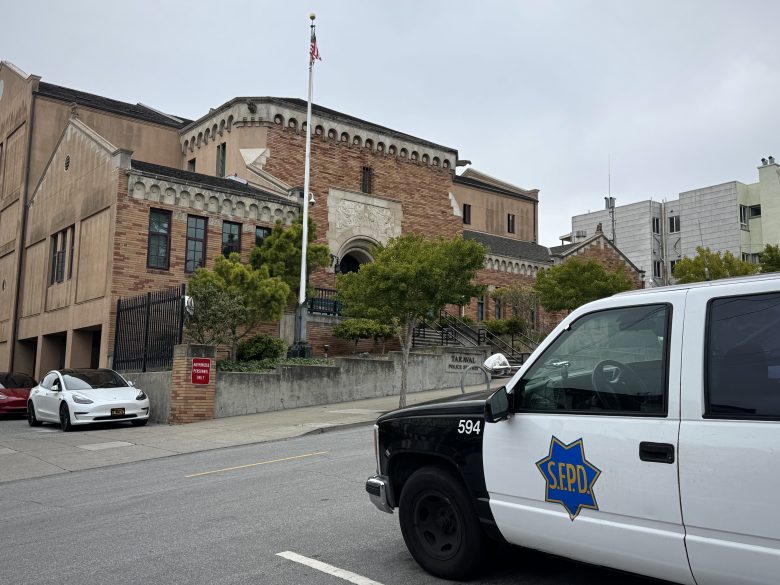

The San Francisco Police Department will continue its policy limiting traffic stops for minor infractions, after a judge dismissed a lawsuit this week brought by the police union trying to undo it.
San Francisco Superior Court Judge Joseph M. Quinn found “legal defects” in the police union’s arguments against so-called pretext stops — a practice of stopping drivers for things like a broken taillight to question them or search their cars for criminal activity.
San Francisco’s police commission passed a historic policy in 2023 restricting police officers from using pretext stops. The stops are disproportionately used against people of color, and limiting them has been shown to reduce racial disparities in policing.
The union was, from the inception of the policy, opposed to it and in October 2024 filed suit. It claimed that the policy prevented officers from obeying the state vehicle code, which it said should take precedence over city policy.
The lawsuit contended that the defendants — the city, the police commission, and then-Police Chief Bill Scott — were prohibited from enacting policy on matters covered within the vehicle code.
Quinn, however, ruled against the union this week, stating that its lawsuit “failed to identify a single case” in which obeying the vehicle code would prevent officers from following the pretext stop policy.
The pretext stop policy brought the police commission to the forefront of city politics last year. It spurred the highly funded Proposition E in March 2024, to limit the commission’s powers and reduce its oversight of the San Francisco police department.
When he came into office, Mayor Daniel Lurie removed police commission Vice President Max Carter-Oberstone, who led the charge to limit pretext stops.
Though Prop. E passed and Carter-Oberstone was ousted, the pretext stop policy remains in effect today.
“Judge Quinn elegantly debunked the POA’s radical and unprecedented legal theory,” Carter-Oberstone said.
“I hope the elected officials who have been breathlessly touting how much crime is down don’t forget to credit a policy that has saved thousands of officer hours that would have otherwise been wasted on worthless stops that have never served any legitimate public safety purpose,” he said.
Under the policy, officers are no longer able to stop drivers solely for a shortlist of infractions like missing a front license plate, recently expired registration tags or a single broken taillight, but may still pull over a driver for more serious infractions.
The policy also restricts officers from asking investigatory questions or requesting to search a car without reasonable suspicion or probable cause of a crime.
Quinn wrote in his ruling that cities are within their rights to curb officer discretion.
“Policies that limit officer discretion are often essential to fair and lawful police operations,” Quinn wrote.
He compared the policy to other rules determining when officers may engage in high-speed chases or are required to wear body-worn cameras.
Quinn’s ruling this week effectively ends the union’s endeavor, which started when it fought the policy during contract negotiations. As noted within his ruling, the union has a separate, still-pending case before the Public Employee Relations Board regarding the policy and its passage.
Union spokesperson Dustin DeRollo declined to comment “due to the ongoing litigation.”
Police commissioners were not immediately available for comment.
Expired tags is not a pretext. Anyone who doesn’t pay for registration is highly likely to not pay for insurance which is way more expensive. Those cars need to be taken off the streets immediately
The policy limits stops, but not enforcement, so you can still get a ticket (or any other enforcement measure) for expired tags. The policy also allows police to make a stop if the tags have been expired for over a year.
So, Mission Local, help us out here. Clearly most of us want to end this policy. That’s why we voted for Prop E. So, how do we do it? Thanks in advance for your journalistic help on this.
” The stops are disproportionately used against people of color”
Is that actually true? 90% of the time the cops cannot see and do not know the race of the driver until after the stop has happened.
So if it is true at all, could it be because some ethnicities are less diligent about fixing broken tail lights etc. than others? In which case “disproportionate” does not seem like the right word to use there.
My sibling in fsm, if you want to sling around statistics and percentages and stuff then you need to cite sources. If you follow links in this article (and a couple intermediate links in other ML articles, very easy to do) you arrive here: https://injepijournal.biomedcentral.com/articles/10.1186/s40621-019-0227-6
I have no technical knowledge in this area but my lay person’s reading is that the study is consistent with the statements in this story.
Your turn, present sources if you have them and we can discuss the relative merits.
I did not make a statement. I asked a question about a statement made in the article. And I asked about the claim because it is not an easy thing to identify the race of the driver of a vehicle before a stop.
So logically it seems probable that there is no intention to stop drivers of a certain race. But rather that some races are less diligent about tags, tail lights etc. than others. And so they get stopped more, but that doesn’t mean that any racism is going on, which was what the article was trying to imply.
“could it be” that you are playing dumb? Just asking a question!
Sorry but if an article makes a claim that traffic stops of non-whites is “disproportionate” then we are entitled to know the basis of that claim, as it seems counter-intuitive to many.
And no basis was given.
So you are saying you made up numbers with so sources at all? Or am I missing something?
No, I am asking a question about the logical and empirical basis for the article’s claim that traffic stops of non-whites is “disproportionate”.
Disproportionate to what?
Dog-whistle much?