

Japanese comics and graphic novels, known as manga, have a rich past, a phenomenal present and, perhaps, a transformative future.
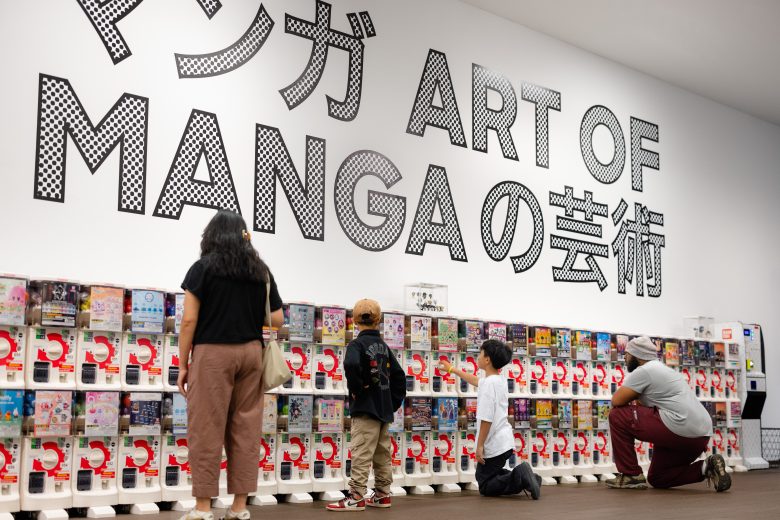
Now, the Fine Arts Museums of San Francisco is recognizing the cultural zeitgeist that has permeated pop culture around the world with “Art of Manga,” the largest manga exhibition ever staged in North America.
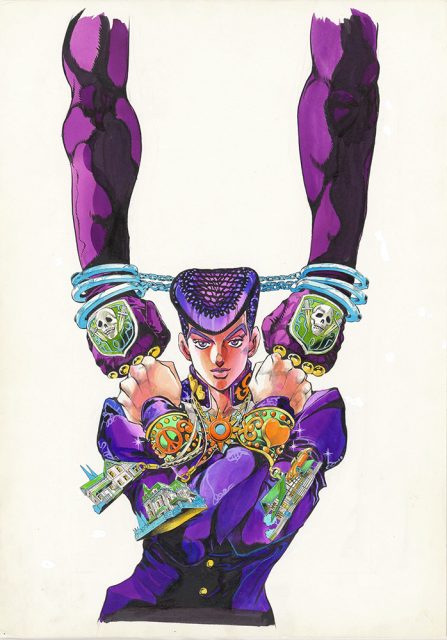
The exhibition, opening at the de Young Museum on Sept. 27, features rarely displayed genga (original drawings) by 10 major artists, including Araki Hirohiko, Oda Eiichiro, Tagame Gengoroh, Takahashi Rumiko, Yamazaki Mari and Yoshinaga Fumi. More than 600 drawings will be on display.
There will also be teachable moments, such as an installation taking visitors through the creative process of how manga is made.
Below, aficionados discuss how manga has become an integral part of their lives.
The exhibition’s curator: Nicole Coolidge Rousmaniere
“There is a manga for everybody,” Rousmaniere said. Genres include fantasy, crime, sports, history, sexuality, friendship, food, science fiction, martial arts, humor and the human condition.
Rousmaniere, the founding director and current research director of the Sainsbury Institute for the Study of Japanese Arts and Cultures in the UK, curated a more historically themed manga exhibit at the British Museum in 2019.
The “Art of Manga” exhibition showcases original drawings of notable contemporary artists. Two masters, Kelich Tanaami (1936-2024) and Fujio Akatsuka (1935-2008), will also be represented.
“Once you see the drawings, you can’t unsee them,” Rousmaniere said.
The exhibit will also guide visitors unfamiliar with manga on how to read it. “It’s the future visual language,” Rousmaniere said. “Manga is already in textbooks in Japan. The images are carrying the content. It goes to another part of your brain. At the end of the exhibition, you will be fluent in manga.”
As a teen, Rousmaniere became fluent in Japanese by reading volumes of manga. A personal favorite artist celebrated in the show is Takahashi Rumiko, who often uses humor in her art and has broken gender barriers in the male-dominated manga industry.
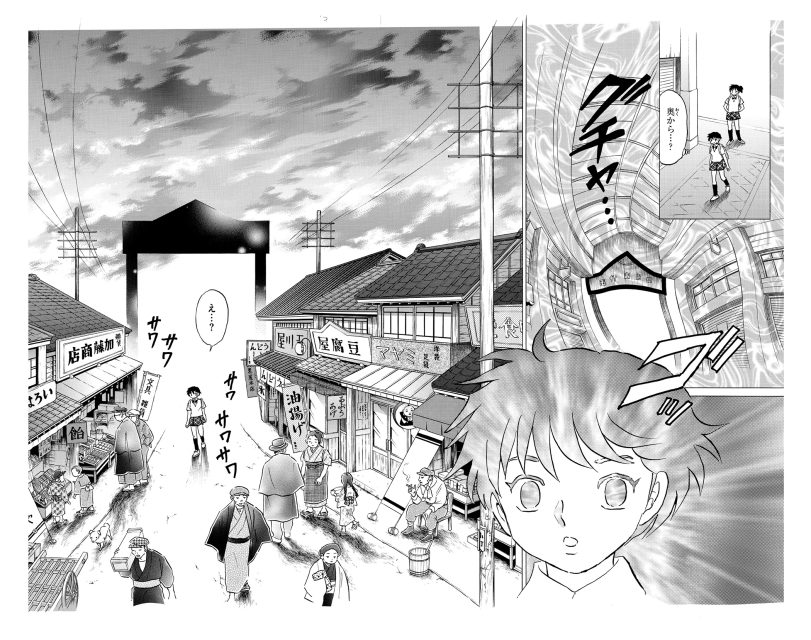
Her latest hit, “MAO,” is being made into anime, or Japanese animation. “It’s gripping because it tells you about spirituality in Japan,” Rousmaniere said.
A section of the exhibit uses MAO as an example to take the visitor through every stage of getting a manga made, from hand drawing to a bound publication.
The tattoo artist: Mimi-Sama
Award-winning, globetrotting tattoo artist (Anna) Mimi-Sama, started specializing in manga designs six years ago.
She created a signature style she calls “Mangala,” which combines manga characters and themes with background geometric patterns, inspired by historical Japanese Kamon (family crests) and contemporary pop culture.
Sama, 38, who lived and worked in San Francisco continuously from 2021-2024, tattooing at Black Serum Tattoo studio in the Mission, now leads a nomadic life. She has made art in more than 20 countries, including Japan, Singapore, France, Germany and Nepal.
She travels to tattoo conventions and expos all over the United States, and returns to Black Serum periodically to work, mostly on repeat clients.
“I never do the same ‘Mangala’ design,” she said. “I have my own style, with my own colors, that no one else uses.”
Born in Portugal and raised in France, Sama had no formal art training, but she has been drawing since she was a child. She got introduced to manga by a friend when she was eight years old.
The series was “Battle Angel Alita” (known as Ganmu in Japan), a 1990s series created by Yukito Kishiro. “It’s sci-fi, and has a female hero,” Sama said. “It was very aggressive and dark.”
“I like the way manga artists create a universe around the images. I can see emotion on the paper — the body positions, the eyes, the clothing — it all carries emotion. I like to translate that from the paper to the skin. I love how the skin reacts to the needles. I love to create something that’s alive.”
The bookstore owner: Brian Hibbs
At 16, Hibbs was working at a comic book shop in the Haight. By age 18, Hibbs was managing the small chain of three stores while attending City College of San Francisco. It was then that he decided to open his own shop at a space on Divisadero St., which he named Comix Experience.
That was 36 years ago.
Even though the style of art, the pace of storytelling and the frequency of releases might be different in Japan, he said, “What people like about them is that they’re never-ending stories in a big world with vast mythologies. Some are 70 or 80 years old.”
His shop carries about 8,500 books. Manga accounts for 10 percent of sales, and Hibbs loves introducing customers to new creators and genres. “There’s nothing more fun than setting someone on fire,” he said.
The superfan: Kevin Tagupa
On social media, Tagupa, 30, uses the moniker Kana Manga. He frequently goes live on TikTok, because he likes talking about and answering questions about manga. He’s attentive, even if only a handful of followers are in the chat. “It’s fun to talk to people about manga and anime,” he said.
Tagupa sees himself as an O.G. manga resource, who relishes sharing his knowledge about manga.
Born in Berkeley, Tagupa said he was introduced to anime at age two by his mother. The Academy of Art graduate with a degree in film got heavily into manga 16 years ago.
He prefers the print medium to anime. (Successful manga serials are often produced as feature-length anime or as a series.) “As a collector, I want that physical thing,” he said. “It’s more impressive on the shelf.”
Tagupa, a Walnut Creek resident who manages an escape room, has spent more than $15,000 on manga materials and activities in the last six years. He goes to several conventions and watches streaming anime platforms, such as Crunchyroll. “It’s an expensive hobby,” he said.
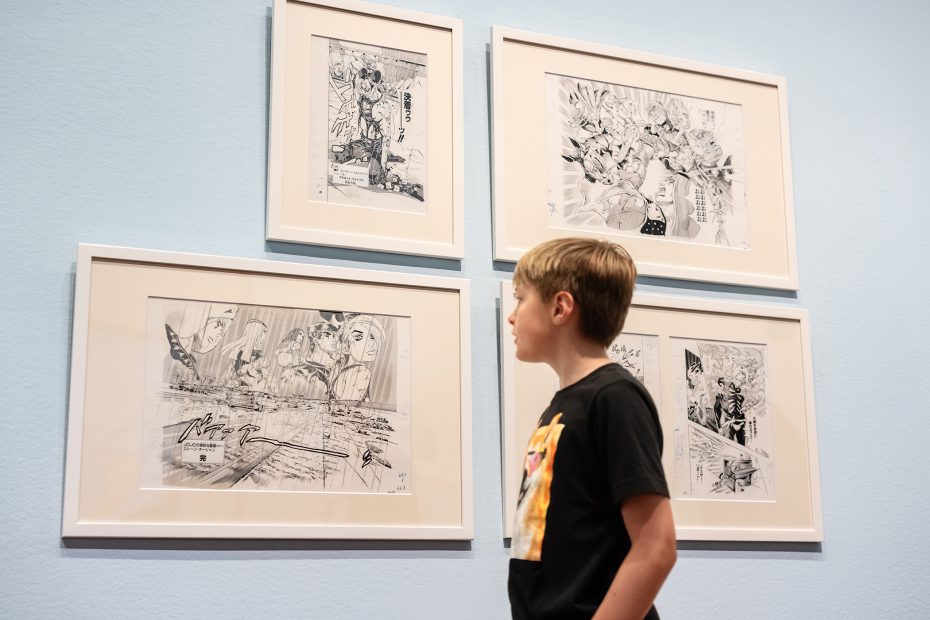
He is looking forward to visiting the “Art of Manga” exhibit, especially the section showcasing the work of Araki Hirohiko, who is best-known for the long-running, multiple iterations of, “JoJo’s Bizarre Adventure.”
“He has a unique art style that stands out,” Tagupa said. “He pulls his inspiration from fashion magazines and Renaissance statues.”
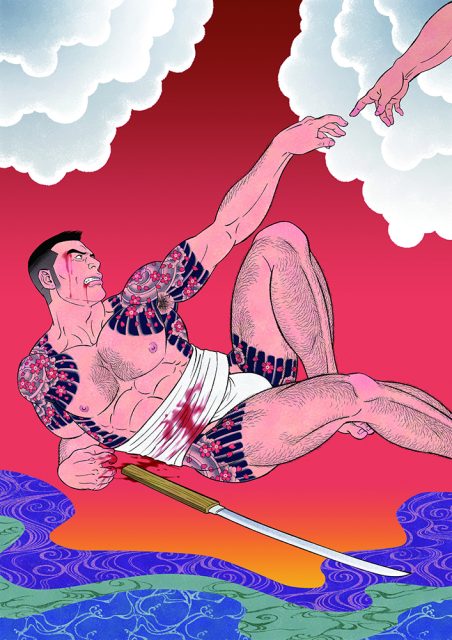
Tagame Gengoroh (田亀源五郎) (born 1964). Cover illustration of the book Christian Art Without Honor and Humanity [Old Testament Edition] (「仁義なき聖書美術【旧約篇】」表紙用装画), 2020 ©Gengoroh Tagame 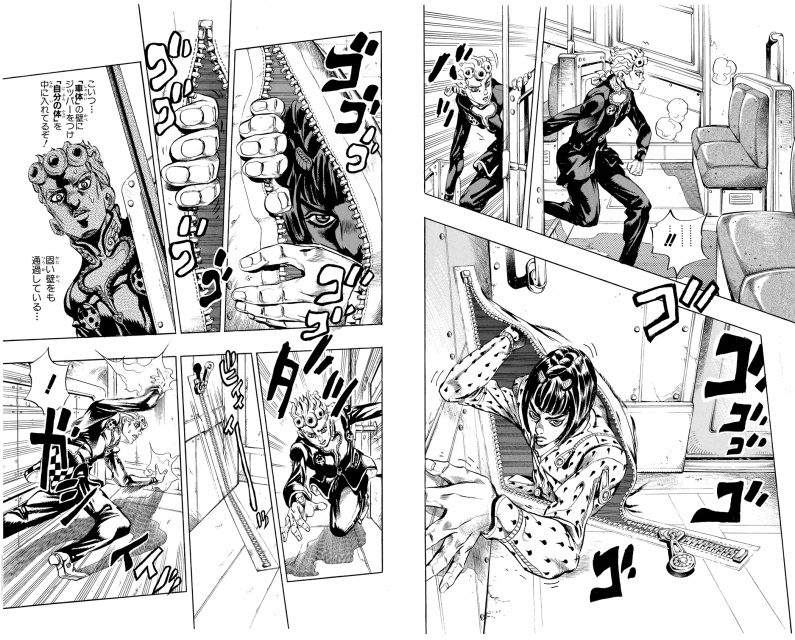
Araki Hirohiko (荒木飛呂彦) (born 1960) Shueisha Inc. (Publisher).. JoJo’s Bizarre Adventure:Part 5 Golden Wind (ジョジョの奇妙な冒 険 第5部 黄金の風), 1995-1999 ©Hirohiko Araki & LUCKY LAND COMMUNICATIONS/Shueisha 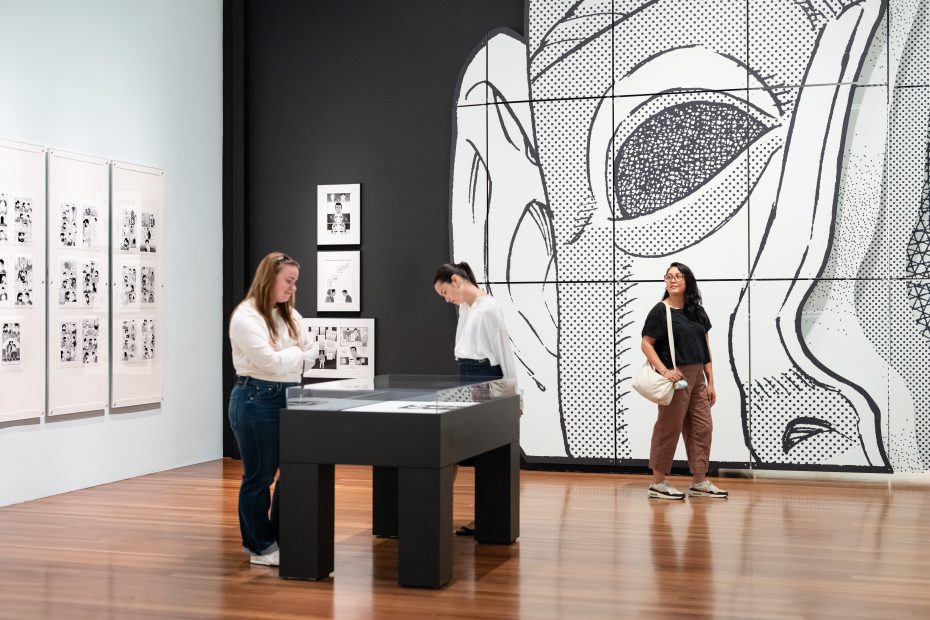
“Art of Manga” on view at the de Young museum, San Francisco, 2025. Photographs by Gary Sexton, courtesy of the Fine Arts Museums of San Francisco 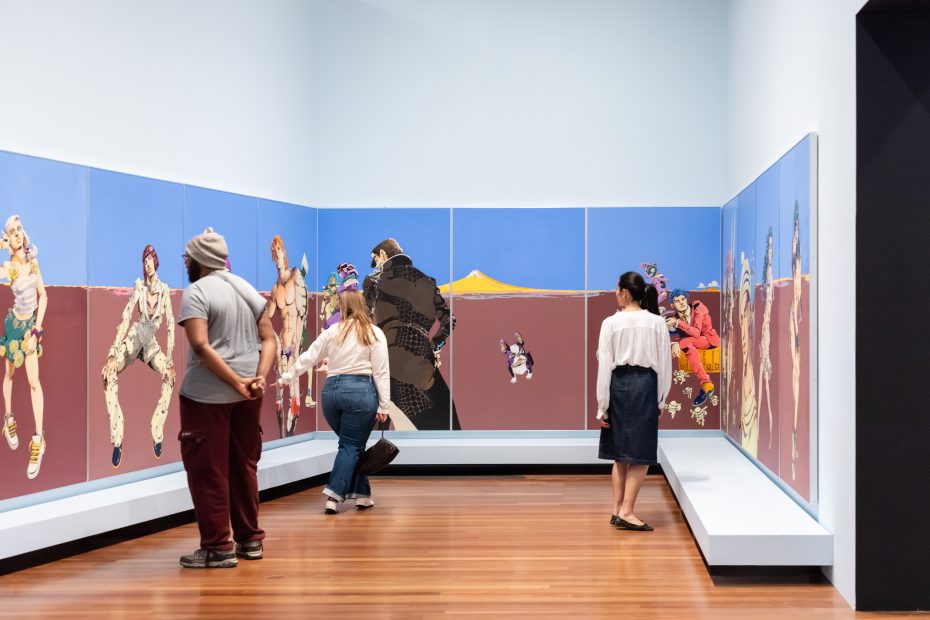
“Art of Manga” on view at the de Young museum, San Francisco, 2025. Photographs by Gary Sexton, courtesy of the Fine Arts Museums of San Francisco “Art of Manga” on view at the de Young museum, San Francisco, 2025. Photographs by Gary Sexton, courtesy of the Fine Arts Museums of San Francisco
“Art of Manga” is on Sept. 27, 2025, to Jan. 25, 2026 at the de Young Museum, 50 Hagiwara Tea Garden Dr. Click here for more information.
It all looks exactly the same.