

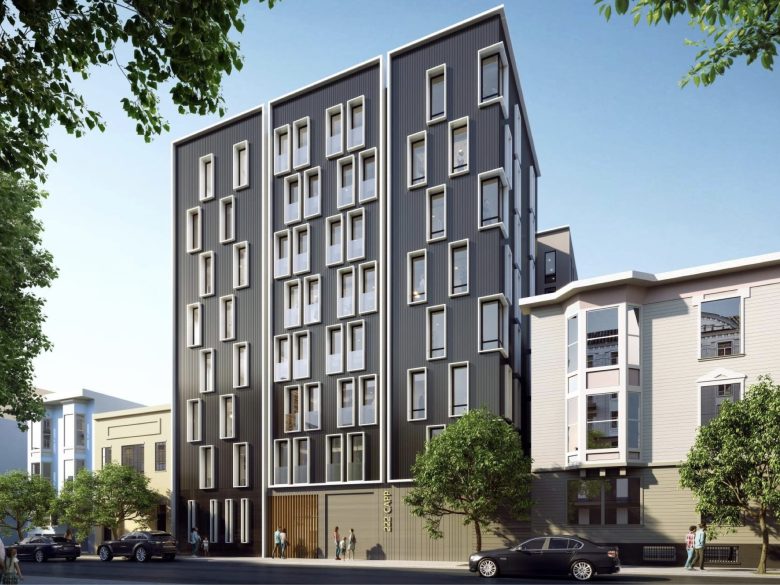

Capp Street will soon host an 84-foot apartment complex that is the latest to make use a California streamlining law taking power over housing projects away from San Francisco city officials.
Developers presented plans and renderings for the eight-story, 70-unit building at 222 Capp St. to the Planning Commission on Thursday afternoon.
The structure, which will sit between 17th and 18th streets, will fill in a space that is currently being used as a parking lot. Eleven of the units, as planned, are designated for low-income tenants.
The plans also show 6,735 feet of retail space on the ground floor, which will sit next to the bar formerly known as the Uptown. Preliminary permits for the project were filed on June 26.
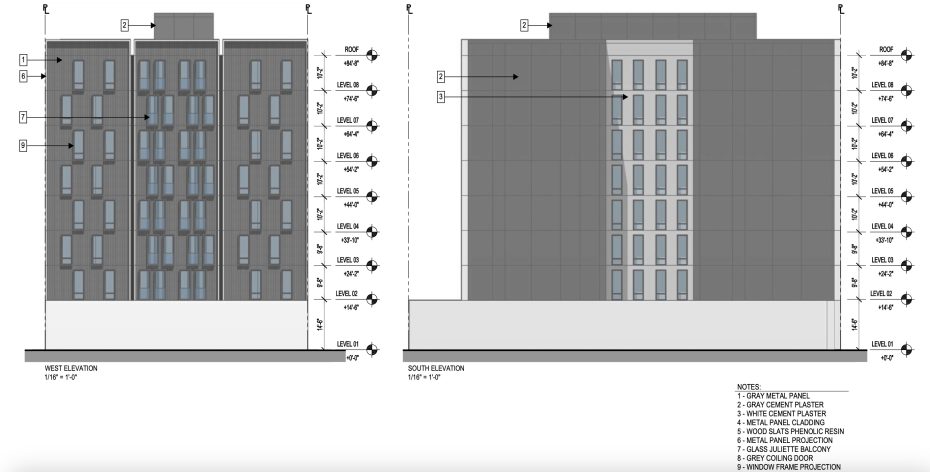
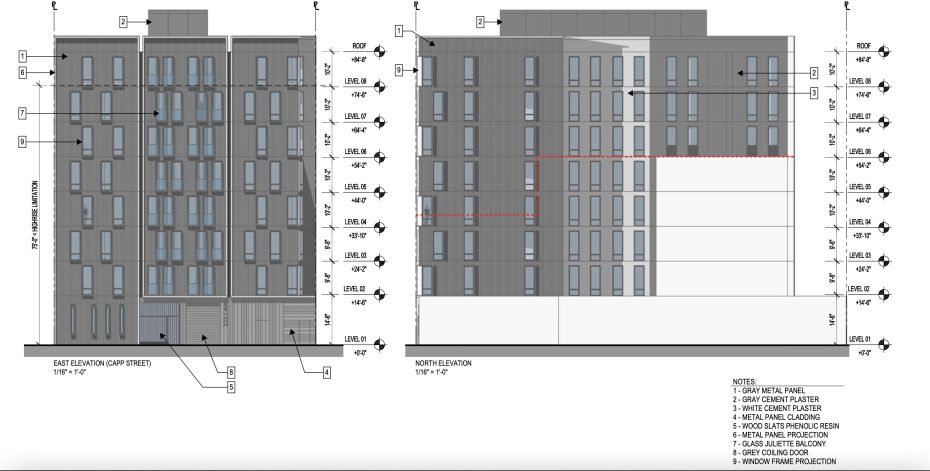
The project is a beneficiary of the state’s density bonus, and of Sen. Scott Wiener’s SB 423, which streamlines housing projects in municipalities — like San Francisco — that have not met their housing goals.
San Francisco has to hit milestones set by the state, including approving 82,000 units by 2031. Until those goals are met, planning commissioners don’t have the ability to approve, disapprove or request any changes to the project.
This made commissioner Kathrin Moore question why any proposal covered by SB 423 even comes before the Planning Commission.
“I’m not as much criticizing what you were doing,” said Moore to architect Steve Perry and attorney Mark Loper, who had come to present 222 Capp. “I am deploring that the commission has to spend time with SB 423 projects.”
Commissioner Theresa Imperial disagreed with Moore’s take. Projects should still come before the commission to create a space for community members to comment, even if those comments don’t have any effect on the building’s approval.
Commissioner Amy Campbell deemed 222 Capp a positive addition to the neighborhood.
“I think it’s exactly what SB 423 was designed to do … I think this is a really great little infill project,” said Campbell. “I appreciate that we’ve got some affordability mixed in, and it’s a nice blend of unit sizes. I wish you good luck.”
Not every commissioner agreed with Campbell’s take.
“What’s missing in our city right now is affordability,” said commissioner Gilbert Wlliams. “These are mostly market rates.”
Five of those affordable units at 222 Capp are reserved for people who make 120 percent of the area’s medium income ($130,900) for a household of one), and six for people making 50 percent of the area’s median income ($54,550).
The 84-foot-tall building will be composed of 21 studios, 21 one-bedroom and 21 two-bedroom apartments and it will have 12 parking spaces.
Williams went on to criticize state laws like SB 423 for contributing to gentrification and displacements in neighborhoods like the Mission District. None of the projects approved under SB 423 appear to have completed construction yet (many have not even broken ground).
The Frisc reported last week that 10 projects had been approved in San Francisco since SB 423 went into effect last year. Another 34 projects are under review, and 10 have applications in the system.
The first project that took advantage of Wiener’s bill sits just a mile away, at the intersection of Duboce and Market streets, where a 12-story building with 200 units was proposed last year.
Commissioner Lydia So added that she lives in the Mission District, and that she is looking forward to more projects like this one, which add vibrancy to the Mission and help those living there feel safe walking the streets.
“Hopefully, when you design the building, you put light and some kind of safety measurements on the street level,” said So. “So then you will be one of the good players on Capp Street.”
Why do all new apartment and condo buildings look so wonky? Align the damn windows! This design already looks ugly and dated, now we’re going to have to look at it for another 30+ years?
SF Planning requires this to accomplish goals like “breaking up massing” and “articulating facades.”
It’s in the planning code. They make these weird shapes to avoid “massing.”
IMO it’s a big reason why people hate new buildings bc they look goofy. They should really change it.
It is hideous. As you note, neighbors are stuck with it while the developer goes on to his next project.
You’re right Barbara. They should be building a car dealership instead. Three on a single corner at 14th/Mission just isn’t enough in my opinion.
“Williams went on to criticize state laws like SB 423 for contributing to gentrification and displacements”
On the contrary. Each owner of these market-rate units will not instead be doing an OMI on controlled tenants.
61 adults with 12 parking spaces shows this design is focused on people who work locally, shop locally, and use public transit.
Theresa Imperial stated, “Projects should still come before the commission to create a space for community members to be able to comment, even if those comments wouldn’t have any effect on the building’s approval.”
Instead of solving real problems, such as corruption and theft among nonprofits, a prime example is Sheryl Davis. Theresa loves to waste time and taxpayer dollars just to provide useless comments that have zero effect on the project’s approval. What else would you expect from a low-level progressive appointed by Aaron Peskin?
“Williams went on to criticize state laws like SB 423 for contributing to gentrification and displacements in neighborhoods like the Mission District.”
Creating sufficient housing relative to demand does not cause gentrification or displacement. In fact, the overwhelming preponderance of research/evidence shows exactly the opposite to be true.
In contradistinction to Commissioner Williams ignorant/ideologically-driven assertion, the surest way to gentrify a desirable place (i.e., one with economic, social and cultural opportunity) is to NOT create sufficient housing relative to demand.
The truth of the matter is that all types of new housing — across the board (whether market rate or subsidized) — tempers housing costs; with the greatest beneficiaries being exactly those that are at the low end of the economic spectrum.
Commissioner Williams has no business being on the Planning Commission as he is hell bent on making the housing crisis even worse.
Terrific service to the community
Williams should be recalled. He Doesnt believe the mathematics of supply and demand and would rather have a parking lot for tech workers than 11 affordable homes and many other that increase supply and bring down demand. Shame on you Williams!!
“Williams went on to criticize state laws like SB 423 for contributing to gentrification and displacements in neighborhoods like the Mission District.”
Creating sufficient housing relative to demand does not cause gentrification or displacement. In fact, the overwhelming preponderance of research/evidence shows exactly the opposite to be true.
In contradistinction to Commissioner Williams ignorant/ideologically-driven assertion, the surest way to gentrify a desirable place (i.e., one with economic, social and cultural opportunity) is to NOT create sufficient housing relative to demand.
The truth of the matter is that all types of new housing — across the board (whether market rate or subsidized) — tempers housing costs; with the greatest beneficiaries being exactly those that are at the low end of the economic spectrum.
Commissioner Williams has no business being on the Planning Commission as he — in the thrall of a fact-free belief system — appears to be hell bent on making the housing crisis even worse.
Commissioner Williams should lose their position. Nobody so clueless about the housing market that they think new market rate doesn’t improve affordability should participate in a construction regulation body. It’d be like putting RFK Jr. in charge of the health department.
Back of the napkin, construction cost of a 1BR in this project should be somewhere in the neighborhood of $1.2mio. So you’re looking at an advertised “Starting at $1.5mio” condo purchase, or $3,500 in monthly rent. A scenario like this would actually lift median prices, and do nothing to “improve affordability” for those who are priced out of the above ranges in the first place. That’s what Williams is talking about if you’d asked me.
New market rate housing doesn’t make housing more affordable. Adding market rate housing adds supply to the market rate segment. Affordable housing and market rate housing are not fungible, nor even adjacent market segments.
Thought exercise for those impaired by the moronic neo-classical economics indoctrination that unfortunately passes as wisdom; Imagine a glut of brand new $500,000 Ferrari sports cars dropped on the car market. Now, in language free of tautologies, explain how this glut puts downward pressure on the market for a thirty-year old Taurus.
Among a number of other factors why adding “market rate” housing puts upward pressure on all housing segments below it:
-Gentrifying and “improving” a block invariably raises prices for everyone else on that block, because now landlords expect more for their properties as a result of nicer buildings, cleaner streets, better infrastructure, fancier amenities, and better publicity, not to mention a richer and whiter customer pool;
-New supply at a higher market rate raises comps for the neighborhood, and landlords point to these comps to demand more for their properties;
-Many landlords have loan rates tied to current and future higher rent expectations, and even if they were compelled to lower rents in a down market, they can’t lower their rents without incurring loan penalties or defaults;
-Nice new buildings in a neighborhood attract more speculators, who must then build even more expensive buildings to pencil out.
Real estate is not a consumer product or fungible commodity, but is a social necessity that has been turned into a speculative asset class. The simplistic supply & demand models that people learned in an afternoon in Econ 1 (aka “Myths to Keep You An Ignorant Dupe of the Ruling Class”) do a very poor job of modeling real estate (or speculative assets in general), but those myths do a very good job of convincing well-intentioned but economically-misguided people to buy into the real estate grift.
But hat tip on the RFK, Jr reference, using unrelated tribal political affiliation identity to try to sway people against their own class interest. Clever!
Bro crashes out over one freaking project that gets built and writes an anti-capitalist screed that no one wants to read. Also, trying to make housing analogous with luxury cars shows you have no clue how to make an analogy.
It just ain’t that deep, man. Someone wants to put a piece of land in the Mission to better use than storing personal property. Nobody is singlehandedly trying to solve the housing crisis. That said—If people could just keep doing this a few thousand times, it’s still not going to make SF as affordable as St. Louis, but it’ll bring rents more in line with what middle-class people can afford. And because the only way that’s going to happen is if lawmakers remove a lot of onerous regulations, then that means social housing can pencil out better as well. Call it ‘abundance’ or whatever buzzword but it’s just otherwise known as common sense in most of the developed world.
Ground floor retail mid block on Capp? That’s just silly. Much of the mandated ground floor retail at recent construction is empty, and they are generally in more retail oriented areas
Fox and Lion bread is a ground floor retail spot half a block away, and it is always buzzing. A good cafe or bar will draw people in.
I bicycle by that parcel on the regular and had no idea that there was ground floor retail there.
Glad we’re getting more density in this part of the Mission District. Let’s be clear, what the hell is the architect thinking with that awful facade? The fenestration is small and oddly proportioned like archer slots in a castle. The three part facade to break down the massing is an attempt at reducing the scale, but it’s awkward. The flatness of the facade adds no rhythm. Banal. Missed opportunity.
How to apply for this?
Can’t wait for Newsom to sign SB-79 and the Supervisors to pass Lurie’s upzoning so that craptacular condos like this can be distributed around the City instead of being concentrated on the east side.
The only thing worse than these condos is what they replace: poorly maintained 100 year old lead paint boxes with newspaper scraps for insulation.
50% AMI BMR units should be easy to fill, but I’m not sure about 120% AMI units, unless they are filled by low income folks with SFHA Housing Choice Vouchers or HUD Vash vouchers.
“architect Steve Perry”
Jeez – as someone who spent time in that racket I’d be embarrassed as hell to be associated with such a craptacular (thanks marcos) design.
Like signing your name to a steaming pile.
But I guess you have to design to a developer dollar point so just pull out some AutoCAD templates and rearrange/edit to fit the lot.
Build it as cheap as possible and put stainless steel appliances in as lipstick on a pig.
Ugh. Our Wienerville city is going to be full of these things.