

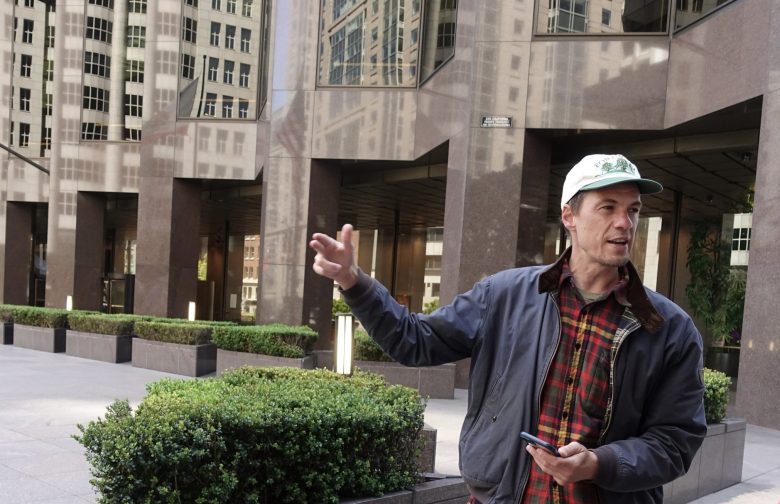

Over the last hour and a half, Ted Barrow led a local family from Chinatown through the Financial District, discussing almost two centuries of urban development — and some of the most important rails, ledges and obstacles in skateboarding history.
The tour closes at the three-stair ledge that borders the Embarcadero Plaza. Behind Barrow on the plaza stand two massive cubes, carpeted with astroturf and surrounded with high plexiglass walls.
These are temporary installations where, for a minimum entry fee of $30, visitors can play padel, a racquet-based sport that touts itself as “easy to pick up like pickleball, dynamic like squash, and athletic like tennis.”
Barrow ends the tour on an urgent, if solemn note: now that plans are well underway to redevelop this plaza, San Francisco risks losing a part of its history.
The city has partnered with BXP (formerly Boston Properties, whose portfolio includes Embarcadero Center and Salesforce Tower) to redevelop Embarcadero Plaza and the adjacent Sue Bierman park.
The only thing left unchanged will be a children’s playground far from the plaza itself. Vallaincourt Fountain, the plaza’s iconic red bricks, and what’s left of the granite ledges that defined different sections of the plaza, are likely to be removed.
Barrow hopes to spare at least some of these features — both to commemorate the plaza’s historic significance and to ensure that street skating continues there.
San Francisco isn’t the only city where skateboarding flourished in the 1980s and 90s, Barrow added on a recent weekday at a Mission District cafe. But it was a highly visible scene, extensively documented in skateboarding videos and photography, as tricks evolved and matured.
“It’s like our Athens,” Barrow said. “This is where classical culture came from. That culture spreads to other scenes and other cities and other ecosystems, but its germ started here.”
When Barrow was getting a Ph.D in 19th-century American painting at CUNY, he began leading architecture tours with Big Onion, a walking-tour company based in New York City.
When he moved to San Francisco in 2020, Barrow, a long-time skateboarder, began researching the city’s architectural history through the prism of skateboarding culture.
Barrow wants to preserve some of that history in the face of change. So far, that looks like mobilizing skateboarders and preservationists to attend public meetings, and getting the attention of city officials. Barrow has heard that city officials “want to do right by us.”
In March, he started a petition and now leads ongoing efforts to preserve elements of Embarcadero Plaza in the face of a proposed $35 million redesign. Most people know the plaza as the gateway to the Ferry Building or home to the much-maligned, perhaps misunderstood, Vaillancourt Fountain.
But, Barrow says, it is where skateboarding first took shape as a technical sport and culturally urban phenomenon.
“We’re talking about a world-class plaza where street skating was basically born,” he said.
The Embarcadero scene of the late 1980s and early 1990s represents a pivotal point in the history of skateboarding — the era where ollies, grinds and flip tricks were codified, and skateboarding transformed from a suburban pastime that initially took its cues from surfing into a sport all its own.
Barrow grew up splitting his time between the Bay Area and Austin, Texas. Spots like the Embarcadero Plaza made San Francisco “the archetype for the city,” and laid the groundwork, he said, for his exploration of skate spots elsewhere. If San Francisco is Athens, Embarcadero is the Acropolis.
Barrow, an incoming adjunct professor of 19th-century painting at Cañada College, has researched modernist architecture and plazas from the turn of the century through the 1980s, and holds a vast well of skateboarding knowledge from its birth to today.
In 2023, he contributed to the redesign of U.N. Plaza, working with the city to transform the troubled spot into an outdoor skate park.
“We just used a European model,” Barrow said of the redesign. “They do that in Paris. They slightly adjust a preexisting hardscape plaza, add a couple things that make it a little more amenable and fun to skate.”
City officials deem U.N. Plaza a success. Public safety experts have told Mission Local that other troubled spots, like 16th and Mission streets, could benefit from the kind of permanent “activation” that skateboarders provided to a place like the Civic Center.
Barrow knows that to be true. A place like U.N. Plaza or the Embarcadero can become a “sort of interstitial, ambiguous zone where many different things can happen in addition to skateboarding.”
As San Francisco plans for 81,000 more housing units by 2031, “these places are more and more rare. So in advocating for skateboarding, part of what I’m doing is advocating for these undefined spaces that everyone can use,” he said.
Cities and cultures, as skateboarders well know, change. Barrow knows that, too.
“A big part of skateboarding is exploration, and it’s about finding new spots and accepting impermanence,” he said.
With passing reference to Frank Lloyd Wright’s description of New York as “The Disappearing City,” he said that many of the urban features where he honed his skills around over the decades are no longer, having been razed or redeveloped.
Nonetheless, Barrow said, Embarcadero is special. “There are only a few places like this in the world, and this one’s here. We don’t have to do much to it to preserve it.”

Burn that thing to the ground. Feel free to skate at kids school. I’d rather have my 3rd grader dodging a skater everyday than ever having to look at that eyesore ever again. The sacrifices we make as parents….
If you want a monument to skateboarding culture, you can build a beautiful stone bench for the public to enjoy. Then, beat the hell out of it until it’s an ugly eyesore. Finally, add a bunch of metal rods so that it’s uncomfortable to sit on.
They’re much more likely to add spikes and stuff to deter homeless than skaters these days. Skaters are hip and trendy, being stuck in poverty isn’t.
i totally back this man 100% in what hes doing!!!! emb must live !!!