

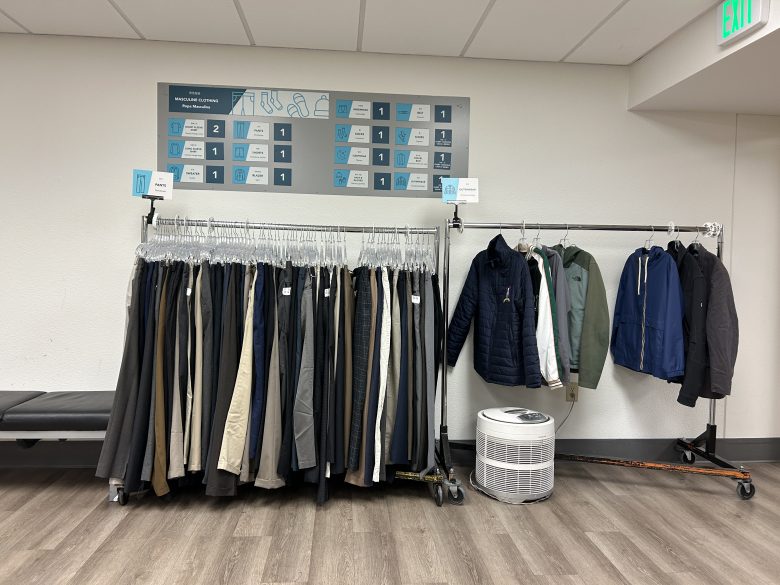

During San Francisco’s chilliest summer in four decades, organizations that distribute free or low-priced clothing are reporting shortages of men’s clothing and coats, leaving their patrons out in the cold.
At St. Anthony’s, which hosts San Francisco’s largest free clothing program and primarily serves men — many of them unhoused — coat racks are bare, and shoe racks are empty by the time the first few customers of the day go through the organization’s Golden Gate Avenue boutique.
Donations to the program, which primarily come through individuals and donation drives, have never recovered to their pre-pandemic levels, but this season seems especially bad, according to staff members.
“We hate to see guests leaving without what they need when it’s cold out,” said Ian Sicurella, the assistant manager of St. Anthony’s free clothing program. “I just don’t have enough to give them.”
The summer months are usually slower for donations than the winter, when donation drives are plentiful, said Sicurella. While he’s not exactly sure what’s causing this drought, he suspects that fears of tariffs and a rocky economy might be prompting would-be donors to hang on to clothing for longer.
But Jackie Mocha, the store’s manager for Community Thrift in the Mission, had another explanation.
“Men tend to wear their stuff until it’s no longer something that someone else would want to wear,” said Mocha, who added that it is typical for the store to have much less men’s clothing available than women’s clothing. Larger-sized clothing for men is particularly scarce.
St. Anthony’s customers line up at the door beginning at 6 a.m. each day to pick out a designated amount of free clothing. Individuals and families are allowed to visit the store once a month. But they’re only allowed to pick out coats every four months, if any are available when they make their visit.
Salvation Army stores across the western U.S. have also witnessed a decline in men’s clothing donations over the past six months, limiting what they can carry in their stores, according to Craig Stone, a regional sales manager.
On a recent visit to the Salvation Army’s Mission Street store, there were about 10 times as many racks for women’s clothing as there are for men’s clothing. A section of one rack was empty; there were no coats heavier than a sweatshirt available for purchase.
Joanne Annuzzi, the store’s assistant manager, said that the stock of men’s coats is “very low all the time.” It’s not unusual for her to have to turn away customers looking for warm clothes for men, though it still worries her.
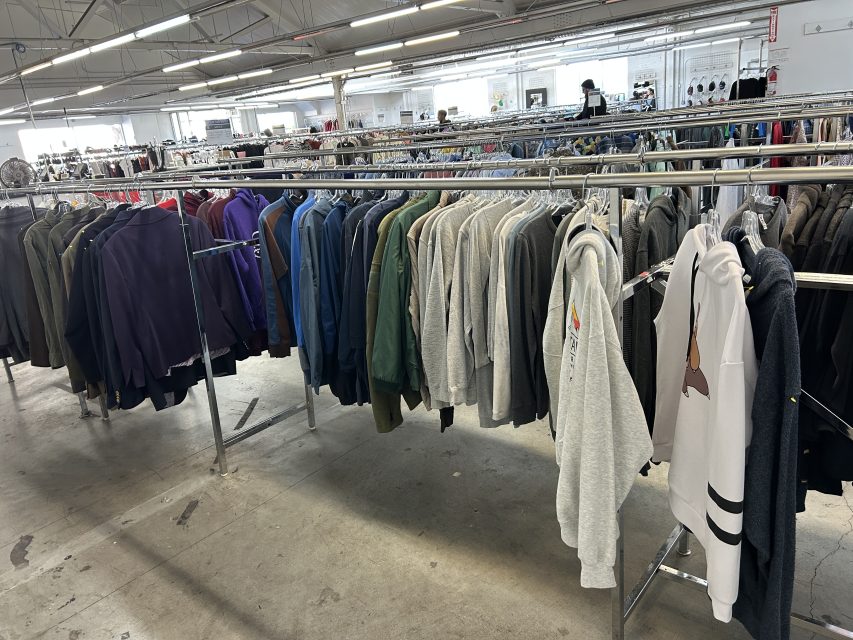
Clothing donations to St. Anthony’s dropped 35 percent during the pandemic, when the store temporarily decreased the hours that it accepted donations. Sicurella said that they have not yet recovered to pre-2020 levels.
Online resale also boomed in 2024, aided by digital thrifting platforms like ThredUp and Poshmark, which encourage users to list their unwanted items for sale. The items that aren’t of high enough quality to sell — often torn or stained — might get donated, but St. Anthony’s does not give these clothes out to their customers.
“We want to make sure everyone has a dignified experience when they come in,” Sicurella said.
St. Anthony’s accepts clothing donations 11 a.m. to 4 p.m. Monday to Friday at 121 Golden Gate Ave. Community Thrift accepts donations from 10 a.m. to 5 p.m. every day. Find a Salvation Army donation center here.
This is a huge missed opportunity. Stained or torn coats can be repaired to be as good as new. Dedicated volunteers with sewing skills could be put to good use. If the emphasis is on warmth and water-proofing, a lot of people could be helped in this way. I’ve washed and repaired many coats and sweaters to give away to my neighbors downtown. I repair and hand out used shoes as well to people that I see walking without any. Just as I repair my own second-hand vintage finds to wear for years on end. Especially if we are trying to save the planet by reusing, reducing and recycling, we need to find more effective and resourceful ways to help our brothers and sisters out in the cold without warm clothing. If the charities really want to help, rather than simply taking advantage of the homeless industrial complex, they will find a way to think outside their “can’t- do” attitude boxes. Step up!