


The picture is striking: On one side stands expansive concrete, fleets of trucks and skeletal transmission towers — the remains of a now-demolished power plant that closed in 2006 after a barrage of complaints linked it to high asthma rates in the surrounding areas.
On the other side, a network of paths weave between native grasses, leading parkgoers onto a narrow spit of land, one of many that connect Bayview to the San Francisco Bay. The sound of gulls fills the air as shorebirds stalk wetland pools.

This is Heron’s Head Park, situated just north of Bayview’s infamous Superfund cleanup site. It’s the site of an environmental restoration project, a pilot project of sorts to answer the question: Instead of a massive and costly seawall, can investing in natural systems that have protected shorelines long before human industrialization combat rising sea levels?
The Bayview community has long faced environmental hazards and a government slow to take responsibility for its damage. San Francisco seawall plans excluded the Bayview neighborhood in 2018. Since then, residents have wondered what will protect them from sea-level rise.
Enter the Shoreline Resilience Project, a hodgepodge of dreams including wetland restoration, shoreline stabilization and the installation of an oyster reef in 2022. The full environmental benefits of the Shoreline Resilience Project, which is a San Francisco Bay Restoration Authority project, will not be realized for decades.
In the meantime, it aims to benefit young people in Bayview in a more direct way: with jobs.

When Nina Omomo graduated from San Francisco State University in 2020, she had no idea what she wanted to do with her life. Amidst the uncertainty of the early days of the pandemic, Omomo thought, “Oh my gosh, I’m not going to be able to get a job.”
Five years ago, Omomo took a chance, applying to be an eco-apprentice for Literacy for Environmental Justice, a workforce development program embedded in the broader shoreline resilience project. Now, Omomo is the program’s community stewardship manager.
While working through college, Omomo’s bachelor’s degree in environmental studies took six years at San Francisco State, but “I truly felt like I had learned more in my first year at [Literacy for Environmental Justice] than I had in my six years of going to college,” Omomo said. Suddenly, she understood how the environment related directly to the communities she was serving.
Mariana Rodriguez Reboyoso just completed her eco-apprenticeship in April. The San Francisco native grew up in the Excelsior and, after graduating from the University of California, Davis with a bachelor’s in psychology and sociology, was looking for jobs in the nonprofit sector. She heard about the eco-apprenticeship from a friend.
Now, she’s a few weeks into a fellowship with the city of San Francisco called DreamSF. Reboyoso said that her time as an eco-apprentice “one thousand percent” prepared her for this fellowship. The time they set aside for professional development allowed her to apply in the first place. “The application was, like, 40 pages long, and I remember being, like, ‘I don’t know if I could do this,’” she said.
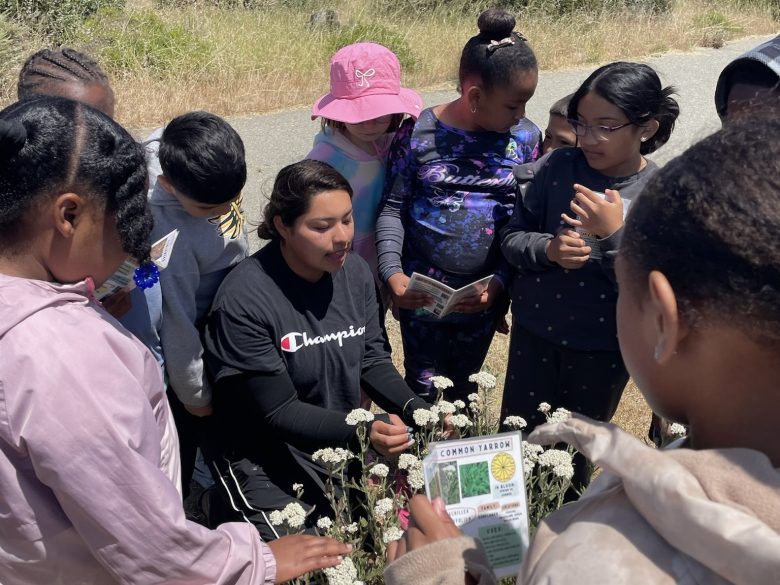
The most recent cohort had four students, half of whom were from Bayview. The actual work of an eco-apprentice changes day by day. About half of the time, they’re teaching Bayview youth about the environment by packing the lessons into fun nature walks and kayak trips.
Teachers who want to expose their students to environmental education book time. Everyone wants a kayak trip, Omomo said, but Bayview schools get the first pick of their activities calendar.

“My favorite part was when those high school kids would come kayak,” said Reboyoso. The students, once “too cool for school,” would finally “let their guard down a little bit, and they enjoyed themselves a little more,” she said.
The younger kids, on the other hand, were full of limitless enthusiasm.
“They were asking me a million questions when we would go on the eco-botany walks,” she said. They loved to get their hands dirty, took to weeding with surprising vigor and eagerly lapped up nature facts.
Reboyoso loved seeing them make connections, realizing the native plant the eco-apprentices told them about grows behind their house, or they see it on their way to school.
When they learned about a plant that wards off mosquitoes when boiled in water, they resolved to remember that for the next time they go camping. They grew so enamored with an edible plant called sour grass, they clamored to take bunches of it home to share with their family.
“Damn, if I had this when I was their age, I’d have been a different person,” said Reboyoso.
Her other main responsibility was helping out in the plant nursery, something Reboyoso had no experience with until joining the program. The seeds for the nursery are collected from their restoration sites, Candlestick Park and Heron’s Head Park. The nursery is a cradle for native plants until they’re ready to be planted in Bayview parks.
Reboyoso said watering can take two hours, and even longer if you don’t have help. It’s a more meticulous process than one might expect. To ensure proper saturation, she would have to lift each plant to see the underside of the pot and check that the soil has all been dampened. Reboyoso found the process meditative.
“Honestly, it was amazing. I feel like it helped me with my mental health,” she said.
Omomo and the eco-apprentices are essential to the upkeep of Candlestick Park and Heron’s Head Park, where they meticulously remove invasive plants, bring in native ones, sometimes even do the mowing. “We do anything it takes, we’re pretty much the land stewards of these public parks,” Omomo said.
Already, parkgoers are noticing the effects of the shoreline resilience project.
“Sometimes [people] would walk by, ask us what we’re doing. Some of them were bird watchers,” said Melani Ramirez Ozuna, a recent eco-apprentice. These days, bird watchers report spotting more birds, which Ozuna hopes is a sign that biodiversity is coming back to the area.
To Ozuna, the long days she spent ripping invasive species out of the ground and piling them in bags to cart away were made worthwhile by the clear difference she was making — and the people she got to meet.
Ozuna and Reboyoso are now “besties,” are both DreamSF fellows and still in touch with others they met through the program. Ozuna’s favorite memory from her time as an eco-apprentice was when they were working in the rain, covered in mud and blasting music.
“I felt like rather than doing work, I was hanging out with friends.”
A new cohort of eco-apprentices will be formed in December with applications released in the fall.
According to Omomo, “We intake contact info year-around for interested folks and contact them once the application process is open.”
I love this and love Heron Head’s Park and all the new parks they have added along the water in this part of the city. And across from the park are two plant nurseries one focusing on native plants. And they have chickens running around too.
The Bayview community has long faced environmental hazards and a government slow to take responsibility for its damage. San Francisco seawall plans excluded the Bayview neighborhood in 2018. Since then, residents have wondered what will protect them from sea-level rise.
This is a joke right?. Slow to take responsibility…How about cutting the pretentious nonsense and calling it like it is…They don’t care, never did care . It’s all just theater.
Can we just call this what it is, another non profit organization paid for with tax payers money? Can someone please give me a count? It has to be in the tens of thousands. Might as well be the New Deal under Roosevelt. It’s a heartwarming story but we’re broke. How much more can the city withstand?
The Shoreline Resilience Project is an effort of the San Francisco Bay Restoration Authority, an organization funded by 2016 ballot measure AA, which created a $12 parcel tax specifically for the purpose of bay restoration. It passed 2/3 majority across the 9 counties. A strong majority of Bay Area voters specifically agreed to raise this money for this purpose, there is no tradeoff where this money can be used for anything else.
https://en.wikipedia.org/wiki/San_Francisco_Bay_Restoration_Authority