
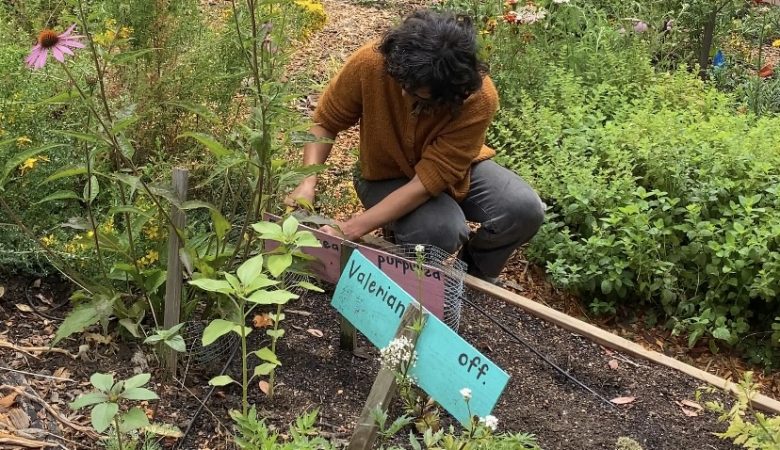

Tucked into the southern slope of Bernal Hill and shadowed by the traffic of I-280, Alemany Farm is home to the largest urban agricultural site in San Francisco — and medicinal herb garden.
“It’s a public medicine chest,” said clinical herbalist Bonnie Rose Weaver, who founded the garden in partnership with Friends of Alemany Farm. “And it’s open 365 days a year.”
The Medicine Garden holds more than 60 species of medicinal plants, culinary herbs and edible flowers, many of them uncommon outside specialty stores. Calendula blooms alongside collards. Plants like boneset, skullcap, yerba mansa, and bee balm thrive not in neat rows, but in a natural, cooperative sprawl.
Founded in early 2020, the garden’s formal launch was almost immediately disrupted by the pandemic. The garden’s first cohort of interns came to an abrupt halt just two months after planting began.
In the years since, the garden has grown in both size and purpose. Harvesting the plants is free to the public during daylight hours, with a simple understanding: Take only what you need, and leave the rest for others. This shared respect helps the garden thrive as a communal resource.
From the beginning, Weaver and her collaborators asked: What do people need? What’s familiar? What might draw someone in?
The answer, often, was food.
This spring, volunteers reestablished a culinary garden at the site’s entrance, planted with herbs like rosemary, thyme, epazote, parsley, and shiso. A flower garden is blooming with nasturtiums, sunflowers and three types of marigold, and a bog garden is being expanded to support moisture-loving medicinal plants.
After years of studying herbalism through books and dried specimens, Ann Lawson, a dedicated herbalism student and longtime volunteer at the medicine garden, now finds joy in working with living plants and the community that nurtures them.
“There’s so much overlap between food and medicine,” said Lawson. “Take parsley; it’s both flavor and remedy. The more time I spend here, the more I learn.”
Jennifer Lynch, a personal chef who’s volunteered at the garden since 2021, has helped shape its culinary focus. “This is what’s possible with just a little space and a little money,” Lynch said. “The medicine garden, the dye garden, the grapes — it all nourishes people in so many ways.”
Yet the garden’s growth coincides with broader financial uncertainty in the area. While The Medicine Garden is fully volunteer-run and operates without a budget, its neighbor and former partner, The Friends of Alemany Farm, a nonprofit, recently scaled back staff and paused its paid apprenticeship program due to city funding cuts.
A grassroots campaign to raise $200,000 is still underway. “We shouldn’t have to depend on city funding alone, Lynch said.
Like other sections of Alemany Farm, the Medicine Garden operates independently and relies entirely on volunteer labor. Community support continues to show up — in hours worked, seeds donated, and other partnerships.
Lawson credits the city’s Parks Department and the Friends of Alemany Farm for helping keep the garden going. “They’re our family here,” she said.
For Tessa Kappe, who joined the team in spring 2024, to help lead an internship in community herbalism, the garden offers something increasingly rare in urban life.
“It’s different hearing the name of a plant versus meeting it,” she said. “This space is immersive. It’s a refuge.”
The Medicine Garden now hosts occasional public workshops, including two upcoming sessions on harvesting and preparing medicinal herbs. For Weaver, this educational focus is part of the larger purpose..
“All of our ancestors practiced herbal medicine,” she said. “This is a chance to remember that, to return to it. That’s what the Medicine Garden is here for.”